BOOK REVIEW: Classic Haiku ed. by Yuzuru Miura

Classic Haiku: A Master's SelectionClassic Haiku: A Master’s Selection by Yuzuru Miura

My rating: 5 of 5 stars

Classic Haiku is a collection of 106 poems by masters such as Matsuo Bashō, Kobayashi Issa, and Yosa Buson. It’s logically arranged into five sections: Spring, Summer, Autumn, Winter, and New Year’s Day. While haiku has come to be thought of as any poem in a 5-7-5 syllable arrangement, those familiar with traditional haiku know that there are other requirements that are at least as fundamental as the syllabic arrangement. One of these is that the poem be pure observation devoid of exposition. Another criteria is that it be rooted in nature. A final criteria, historically, has been that the poem indicate the season, if not giving an explicit seasonal word or phrase. This makes the season an optimal organizational unit for the book.

One nice feature of this book is that it includes the English translation, the Japanese romaji version (i.e. the way it would be spoken in Japanese but using roman alphabet characters), and the version using the Japanese system of writing. Granted, for those who aren’t fluent in Japanese, these features might not seem to add much. However, sound can be evocative itself in poetry, and so it can be interesting to read the Japanese for that reason. Furthermore, there are those who argue that 5-7-5 syllables is not the closest facsimile to Japanese haiku for haiku written in English. Because of the average length of syllables, some say that a 2-3-2 accented syllable pattern for English haiku is closer to the original Japanese form. Reading the Japanese, gives one an idea of the sound characteristics of Japanese haiku.

[Furthermore, if one loves a haiku enough to want to get it tattooed in Japanese on one’s body, one can double-check the characters before one gets it done at a Chinatown tattoo parlor only to find that what one really has tattooed on one’s butt is, “Syphilitic nightmare – Ketchup bottle mayhem day – Rides the goat to school”]

Here’s a sampling my favorites:


the raftsman’s straw cape
brocaded with
the storm-strewn cherry blossoms
– Yosa Buson

calm and serene
the sound of cicada
penetrates the rock
– Matsuo Bashō

in summer grasses
are now buried
glorious dreams of ancient warriors
– Matsuo Bashō

oh, cricket
act as grave keeper
after I’m gone
– Kobayashi Issa

View all my reviews

TODAY’S RANT: The War on Rhyming Verse

A fine Hungarian poet who Wrote with and without rhyme

A fine Hungarian poet who Wrote with and without rhyme

it’s my cross, my curse
this rhyme in my verse
rhymers aren’t taken seriously
and are berated furiously

“Oh, your poem is so cutsie,
like little baby bootsies.”
call it banal or call it niche
but “cutsie?”, please!, step off bitch

just because my verse ain’t free
don’t act like I’m a perp to slavery
I spare my words the sting of the rod
they’ve never tasted a cattle prod

I’ve never waterboarded my “ands” or “buts”
or kicked a pronoun square in the nuts
I don’t whip my adjectives to get ’em in line
I stand waiting patiently holding a sign

Why steer my words like some stern brigadier?
because it scratches an itch somewhere in my ear
I know my rhymes sometimes lack cachet
because they’re little too Ogden Nash-ay
but from the hilltops I sing
like that guy Rodney King
hear the words of my song
“Can’t the poets all just get along!”

Who Am I?

“I” am a collection of cells.
some  expressly invited by “my” genes
others are interlopers,  “my” guts their cross-town bus
but these interlopers defend “me”  daily
fending off worse marauders
thankfully
so “I” let them stay inside “me”
“my” greatest shame? “I” am a slave owner.
the  mitochondria in “my” cells  are trapped and  forced to serve “me”
all this begs one fundamental question,
am “I” really just a “me?”
or  a  whole society?

If “my” parts
needn’t be fully integrated
where do “I” end and “you” begin?
can “I” say that “I” have been everywhere?
well, everywhere on this tiny, spherical-ish speck of galactic dust?

The Sound of One Nub Clapping

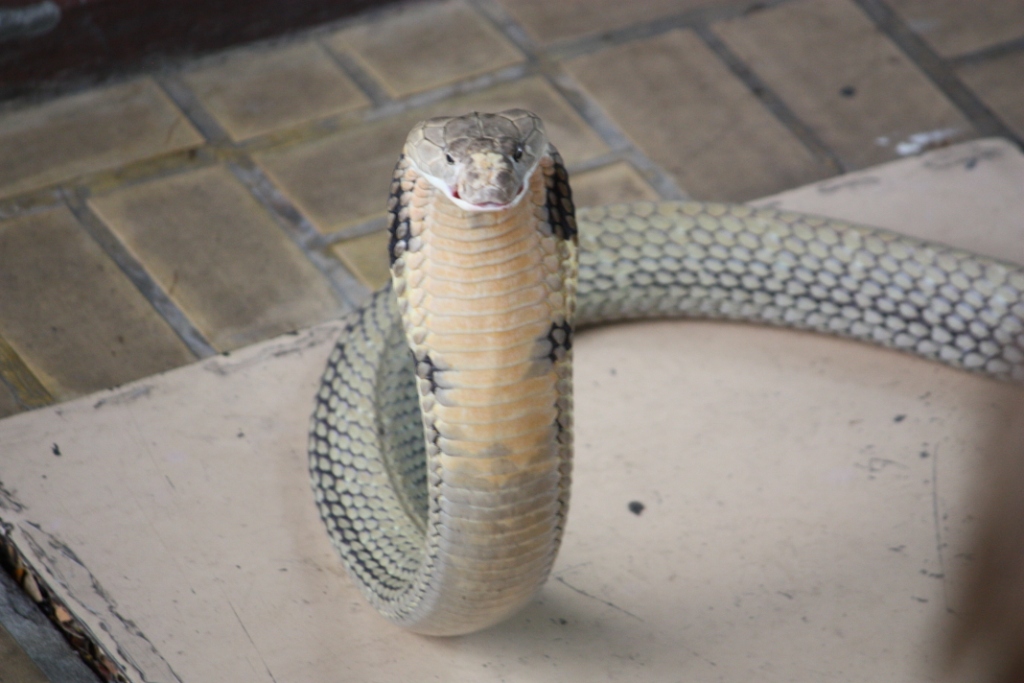
Taken at the Red Cross Snake Farm, Bangkok

Taken at the Red Cross Snake Farm, Bangkok

Once upon a day in February
ruminating about creatures scary
staring at a flaring cobra hood
I thought, maybe this serpent ‘s just misunderstood
I know its bad rap (wrap?) is Biblically-inspired,
but perhaps it’s time that rap be retired
if you stepped on me, I’d bite you too
well, perhaps not bite, but in the harshest tone bid you adieu

The crocodile has a snappy smile
and is always dressed in dapper style
if you evict him from his birthday suit
to suit your needs for some snazzy boots
I think we’ll all understand, if he claims as his your right hand
don’t think it’s  some vast assault on man
think of it as a reptilian guru teaching one Zen koan
and, to you, the sound of one hand clapping will be known
hint: it sounds like a bloodcurdling scream
and requires a readied surgical team

Taken at Budapest Zoo

Taken at Budapest Zoo

Your bigger tiger can be a grumpy cat
when unwise souls encroach its habitat
just don’t pitch a tent like you own the place
if you value the features on your face
think of yourself as that visiting kin
for whom “just passing through” looks like “moving in”
you don’t feel nice calling Uncle Bob a pest
think how the tiger feels ripping your heart from your chest

Taken at a "bear park" in Veresegyház, Hungary

Taken at a “bear park” in Veresegyház, Hungary

Grizzly bears’ hairiness inspires scariness
but under that fur is the motive for wariness
it may look like rolly-polly flab
but bears have muscular six-pack abs
you think you’ve got him in your trap
but wonder how your spine just snapped
a minor miscalculation on the tranq front
and your life is liquids through a shunt
can you blame him, the trap ‘s a rusty, toothy maw
that you just caused to kill his paw

TODAY’S RANT: Pronunciation Police

Pronunciation is tricky.

Pronunciation is tricky.

If you’ve ever had someone tell you that any water can be put in a pot (for pronouncing drinking water pot-table rather that po-table), then you may be with me here. If you frequently exercise your perogative, rather than your prerogative, you may agree. Have you had sherbert, or only sherbet? Do both your eggs and oxen have yokes?

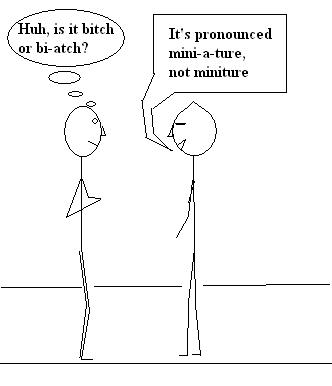
If you’re not with me, you –my friend– might be the person on the right in my little stick cartoon.

I’m as anal about language as the next writer, but let’s try to dial down the pretentiousness. The big question I have for pronunciation police is this: What in your experience with the English language has led you to believe it is a phonetic language?

For those who think English is phonetic because they learned it via “Phonics,” let me expose you to a poem that says it more eloquently than I ever could. (I would attribute the poem, but it is to my knowledge owed to that most prolific “Anonymous” chap.)

Hints on Pronunciation for Foreigners

I take it you already know
of tough and bough and cough and dough.
Others may stumble, but not you,
On hiccough, thorough, laugh and through.
Well done! And now you wish, perhaps,
To learn of less familiar traps.

Beware of heard, a dreadful word
That looks like beard and sounds like bird.
And dead-it’s said like bed, not bead.
For goodness sake, don’t call it deed!
Watch out for meat and great and threat.
They rhyme with suite and straight and debt.

A moth is not a moth in mother,
Nor both in bother, broth in brother,
And here is not a match for there,
Nor dear and fear for pear and bear.
And then there’s dose and rose and lose
Just look them up–and goose and choose.
And cork and work and card and ward.
And font and front and word and sword.
And do and go, then thwart and cart.
Come, come I’ve hardly made a start.

A dreadful language? Man alive,
I’d mastered it when I was five!

If you still don’t believe that the language can handle multiple pronunciations, check out what the experts say.

DAILY PHOTO: Guy Fawkes at DragonCon

Guy Fawkes in Georgia

Guy Fawkes in Georgia

This photograph was taken on Labor Day weekend a couple of years ago after the DragonCon parade.

It reminded me of the poem “The Fifth of November.” I don’t believe its author is known, it’s usually cited as a “traditional English folk verse.”

 The Fifth of November

Remember, remember!
The fifth of November,
The Gunpowder treason and plot;
I know of no reason
Why the Gunpowder treason
Should ever be forgot!
Guy Fawkes and his companions
Did the scheme contrive,
To blow the King and Parliament
All up alive.
Threescore barrels, laid below,
To prove old England’s overthrow.
But, by God’s providence, him they catch,
With a dark lantern, lighting a match!
A stick and a stake
For King James’s sake!
If you won’t give me one,
I’ll take two,
The better for me,
And the worse for you.
A rope, a rope, to hang the Pope,
A penn’orth of cheese to choke him,
A pint of beer to wash it down,
And a jolly good fire to burn him.
Holloa, boys! holloa, boys! make the bells ring!
Holloa, boys! holloa boys! God save the King!
Hip, hip, hooor-r-r-ray!

NASA Finds Poetry by Paula Nancy Millstone Jennings.

The poetry of Paula Nancy Millstone Jennings of Greenbridge, Essex, England was thought to have been completely lost when the Earth was demolished to make way for an interstellar expressway. However, a scrap was found adrift in space. Scientists believe the sheer awfulness of the poem may have made it impervious to incineration, which is to say that the rays of the Vogon demolition beams refused to land upon the piece.  


Your Love

Your love, it warms me
like a midsummer’s flatulence.
I reel like a sorority girl in her
first instance of crapulence

I’m cocooned in an embrace
that reeks of tepid tapioca.
Tapioca, all lumps and fangs
fangs so very, very… very pointy.

[INTERPRETIVE INTERLUDE:  Herein the reader is encouraged to recreate their own impression of the first two stanzas through a capella interpretive dance…

Well, that should be quite enough, shouldn’t it? You got a bit carried away, I should say.]

Your squarish face squishes in my Winnebago memories
I’m a steel town girl on a Wednesday night that is so dim, dimmish, darkid.
Fluffernutter is like butter but jaundiced by mallowy goodness
Spreading it on pickled herring makes a treat that smells like feet

–          a quart of milk

–          lima beans

–          three frozen pizzas

–          hemorrhoid crème (not the mint kind this time)

And brings out the wicked amour of one who is without more, sans  more.
But I need more; I must have… something, something [you get the drift.]

In summary, you are the wind above my wings.

[Dear estate of Douglas Adams, Please do not sue me. I am so very, very… very poor. That goes for the estates of Bette Midler and Hall and Oates as well…  (Oh, you say those people are alive? Really?)]