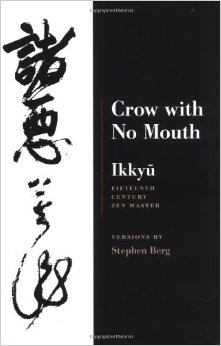
I finished four books this week. That makes it sound like a big reading week, but two of the books were tiny and I was well into the other two at the start of the week. I will present them in the order in which I enjoyed them because they hit the great, the middling, and the awful. The best was Ikkyu: Crow With No Mouth, which is a poetry collection by an irreverent 15th century Zen monk. Given that this is a collection of Japanese short form poetry, you may have guessed that it’s one of the short books (as opposed to one that was half read.) [Full disclosure: some will find a few of the poems vulgar, and it’s probably not a collection you want your kids reading until they are of suitable age for graphic sexual description.] Among my favorite verses are:
you can’t make cherry blossoms by tearing off petals
to plant only spring does that
and
it’s logical: if you’re not going anywhere
any road is the right one
and
I live in a shack on the edge of whorehouse row
me autumn a single candle
or
the edges of the sword are life and death
no one knows which is which
(Yes, I’m on a bit of a haiku kick lately. With my RCYT training in progress, I haven’t had a lot of time for more extensive reading or writing lately.) Unlike the previous book, this book on Haiku isn’t a poetry collection–though it does assemble a lot of great haiku, tanka, renga, and haibun as examples. However, this book is–as its subtitle suggests–about writing, sharing, and teaching haiku and related poetic forms. The book teaches one that five-seven-five syllable organization isn’t an essential element haiku, but rather it should be considered the most readily abandoned and superficial aspect of this form. However, beyond teaching one what one really needs to know to construct haiku, the book offers a lesson plan for teaching haiku to school children and tells us how this Japanese poetry form went global.
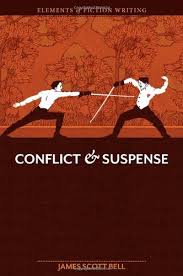
Elements of Fiction Writing: Conflict & Suspense is my second read by Bell on writing. The first one was on plotting and structure. That first book must have been useful enough to get me to read a second. This book is divided in two parts, the first one on conflict and the second on suspense. (The first is much longer.) In both cases, the chapters examine how the various elements of fiction (i.e. setting, plot, character, dialogue, etc.) can contribute to creating the much-needed characteristics of conflict and suspense. Bell uses a lot of example text to illustrate his points (mostly–but not exclusively–from commercial fiction), and this is a valuable feature of his guides.
This book was a stinker, and I can’t recommend it for anyone–though its saving grace is that it’s slim and thus only wastes a tiny bit of one’s time. What the author apparently did was to watch a Star Wars movie marathon and pull every Yoda line out and collect them together. This is a sad effort in two ways. First, while Yoda isn’t a lead in the movies (and, therefore, has a limited number of lines), there’s a vast canon of Star Wars books, and it doesn’t look like the author trolled any of them for quotes. Second, some of the lines are neither witty nor wise. Occasionally, Yoda has a line equivalent to, “take a left at the second light,” and the author includes such banal quotes. Furthermore, some of the quotes appear a second time in either reduced or extended form. Beyond all these complaints, the author doesn’t even take the time to put together meaningful front matter to tell the reader something interesting that they don’t already know, and thus doesn’t establish his worth in producing such a book. (Also, he doesn’t seem to know accepted protocol for writing quotes inside quotes–i.e. use of single quotes. Which I guess means he probably didn’t just cut and paste all the quotes because then they would have been grammatically correct.) He also could have at least provided told us which movie each quote was from. It’s a lazy effort. It succeeds spectacularly in being lazy. If you’ve seen the movies (or have basic cable so that you can readily do so by way of one of the frequent Star Wars marathons) you’ll gain nothing from this book.
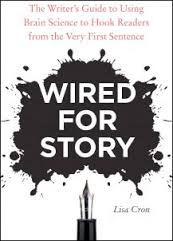
I bought three books during this week, but one of them was the aforementioned Yoda crapfest. On the other hand, one of these books I have high hopes for being both fascinated and educated by, and that’s Wired for Story. This book is about how our brains are evolutionarily optimized to the narrative form, and how one can use this fact to one’s advantage as a constructor of stories.
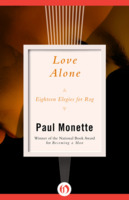
The second book was a poetry collection that is on sale on Amazon entitled Love Alone. I must admit that I picked this book to meet one of my remaining requirements in the 2015 Book Riot Read Harder Challenge–nevertheless I have high hopes for this work.
There are a number of editions of this collection of poems, as Whitman apparently continued to revise it right up until his death. The 1855 edition is popular but there is a “Deathbed Edition” which–as the name implies–is the closest thing to a final draft that exists.
Back in the day (the late 19th century), this was considered racy and controversial stuff, and the collection got Whitman fired from is civil service job as well as a great many vitriol-filled reviews. Like the works of Emerson and Thoreau, with whom Whitman shared some beliefs, it was also controversial in that the poem put man at the fore and religion was shunted out of the picture. (Trust in yourself and don’t blindly follow anyone was still a heretical notion among many at the time.) This isn’t to say that Whitman eliminated spirituality from his work (any more than Emerson did), references to the soul are commonplace—but it’s a mystic spirituality. There were features outside the “prurient” and religious that angered many, such as Whitman’s shining of light on the barbaric institution of slavery. However, today Leaves of Grass is considered one of America’s greatest and most beloved works of poetry, and for good reason. It beautifully reflects an America that was changing, an America subject to a new era of ideas both from science and from distant lands.
It should be noted that this is a life’s work. If you are expecting a typically thin poetry collection, you will be in for a surprise. Leaves of Grass is of a page count normally reserved for histories and epic novels. The collection consists of 35 “Books” that are quasi-themed sub-collections of poems. Individual poems vary greatly with some being only a few lines and some running for pages. Most of the poems are free verse, though there are sections that display a meter (specifically iambic pentameter.) Free verse is poetry without meter or rhyme. If you didn’t know there was such poetry, you may want to work through your Doctor Seuss before you crack open a tome like this one.
There are a few themes that are repeatedly revisited. One idea that made the collection so controversial is that it exalted in the human form and the physicality of humanity. In recent years, a lot of discussion of this work revolves around whether Whitman was or wasn’t homosexual or bisexual. Not that it matters, but the fact is there is a dearth of information about what form of sexuality Whitman practiced—if any, but one can imagine why people wondered. Whitman writes descriptively about both the male and female forms, and was not shy about verse that suggested lying with this gender in one poem and the other in the next. The poem “I Sing the Body Electric” is probably the most famous example of Whitman’s discussion of the body.
However, perhaps the most striking theme is a celebration of America, both in its natural state and as it was shaped by the people who settled there. In multiple poems one sees long strings of description and exposition about the various states of the United States. Whitman paints pictures of the nation as a collage showing the variations among its constituent parts. To a lesser extent, he does the same for the world (e.g. see Book VI.)
I enjoyed this collection, although I will admit I read it a bit here and a bit there over a long time period. I, therefore, probably missed some of the depth of meaning coming from how the poems were arranged. Maybe someday I’ll have time to go back and read it once more. However, the beauty of this collection is that it’s so many different things. It meanders like a river, and peers overland with an eagle-eyed view. It offers scenes that are like a hard-boiled work of film noir and ones that are like Ansel Adams pictures. It’s not anti-god, but rather about the god within, or the god within the blade of grass. Leaves of Grass offers brilliant turns of phrase, bold descriptions, and always interspersed with the author’s personal philosophy.
It’s for good reason that this is considered one of the greatest poems of the 20th century. Eliot’s vivid verse paints a bleak landscape in language of beauty not seen in the poem’s imagery. It will come as no surprise that this work was penned during a dark time in the poet’s life, but it wasn’t just Eliot’s personal dark hour; for many, the wounds of World War I hadn’t yet scarred over.
This poem is divided into five sections, each with an artful title. The five sections of The Waste Land are: “The Burial of the Dead”, “A Game of Chess”, “The Fire Sermon”, “Death by Water”, and “What the Thunder Said.” Some consider The Waste Land to be a collection of five poems, but there is both language and theme that connects the various parts. For example, the following verse is contained in both the first and third chapter:
Unreal City, Under the brown fog…
The poem contains many complex references to Arthurian legends and to a broad swath of literary canon. You can learn about that from individuals more erudite than I. I will suggest a simpler theme, and that is death—not just death, but death as an eraser of legacies and influence. Eliot refers to bone almost as much as he does death, and by the time one’s body is reduced to bones one’s influence on the land of the living is minimal—even for giants among men. When he’s not speaking of bones, he’s speaking of death of masses, also a form of anonymous death.
I will pick a few lines from each of the five sections to illustrate my point.
From “The Burial of the Dead”: Unreal City, Under the brown fog of a winter dawn A crowd flowed over the London Bridge, so many, I had not thought death had undone so many
From “A Game of Chess”: I think we are in rat’s alley Where the dead men lost their bones
From “The Fire Sermon”: White bodies naked on the low damp ground And bones cast in a little low dry garret Rattled by the rat’s foot only, year to year.
From “Death by Water”: A current under sea Picked his bones in whispers
From “What the Thunder Said”: After the agony in stony places The shouting and the crying Prison and palace and reverberation Of thunder of spring over distant mountains He who was living is long dead We who were living are now dying With little patience
I’m not saying that Eliot’s views on death and dying are great from a philosophical or psychological perspective—on the contrary, but as a work of poetry these words should be read by all.
Neither the version linked to in GoodReads nor on Amazon is the version I read. As far as I could tell by way of a hasty search, the Kindle edition I read no longer exists.
The 20th Century in Poetry is an anthology of over 400 poems written in the 20th century that take (often tenuously or symbolically) historical events as their prevailing theme. The poets included in this collection range from household names to those who’ll be well-known only to poetry lovers to a few obscure choices. Among the more famous poets included are: Rudyard Kipling, A.E. Housman, James Joyce, W.B. Yeats, D.H. Lawrence, Ezra Pound, Robert Frost, Carl Sandburg, T.S. Eliot, Langston Hughes, William Carlos Williams, A.A. Milne, Countee Cullen, Edna St. Vincent Millay, W.H. Auden, e.e. cummings, Dylan Thomas, Allen Ginsberg, Bob Dylan, Sylvia Plath, John Updike, Chinua Achele, Robert Penn Warren, and Seamus Heaney.
Read the title carefully, this isn’t a collection of the best or most popular poems of the 20th century. Many of the works included aren’t even among the best known works of poet authoring them—though there are a few exceptions (e.g. William Carlos Williams’ Red Wheel Borrow and Dylan Thomas’ Do not go gentle into that good night.) Having “clarified” this point, one should note that many of the poems aren’t written about 20th century events. In other words, they’re all written in the 20th century, and they’re mostly about (or around) historical happenings, but sometimes those happenings are from a much earlier time period. However, the editors could well argue that the decision to reflect back on ancient events at that particular time speaks to perceived corollaries in the contemporary era.
I remember reading the reviews on Amazon for this book when I was considering whether to purchase it. The few reviews were overwhelmingly positive, but there was one negative review. Now usually when there’s one negative review and several positive ones, one can dismiss the negative review as that of a curmudgeon—the same person who returns his or her steak three times because the cook can’t get it within one minute and half-a-degree of what that person has determined is the ideal state of cookedness. However, I gave this negative review the benefit of the doubt and read it. What I found was a well-reasoned and uncurmudgeonly explanation of why that person didn’t like the anthology. Still, I dismissed the review and bought it. While I’m glad I did, I can see that reviewer’s point.
What was said critique? It was that the entire anthology was bleak and depressing. At the time of purchase, I shrugged that off. It’s poetry. Of course, it leans to the dark and morose. Poets aren’t generally known for their cheery dispositions (Augden Nash, Dr. Seuss, and Shel Silverstein notwithstanding—and, of course, none of those individuals’ works is in this book.) There are times when the doom and gloom obviously strikes the right tone (e.g. poems about the Depression, the World Wars, and various genocidal atrocities.) However, the 20th century was not all war and holocaust; it was also a time of great advancements in science, technology, and quality of life. But even the best times of the 20th century are painted depressingly in this collection. To give an example, there are three poems about the moon landing and they all come across as works of petty douchebags. (I suppose the underlying sentiment was, “Why are we spending millions going to the moon when there are poets who can’t make a decent living moping about and painting word pictures of the world as seen through shit-colored glasses.)
As this book is proclaimed as an attempt to capture the history of an entire century through poetry, it’s worth pointing out that this is clearly an English language centric view of history. To be fair, the editors do go to lengths to include poems from both Indian (i.e. South Asian Indian) and African poets whose works were published in English.
The poems are arranged in 7 chronological parts: 1900-1914, 1915-1922, 1923-1939, 1940-1945, 1946-1968, 1969-1988, and 1989-2000. Anybody remotely familiar with the history of the 20th century should be able to tell what world events drove this particular delineation of timeframes. For readers who aren’t history buffs, one nice feature is that each part begins with a prose discussion of world events during said era.
I would recommend this book to individuals interested in poetry as long as they don’t currently suffer from depressive disorders.
Amazon recently put out a list of 100 Books to Read in a Lifetime. I appreciate the mega-bookseller taking a less doctrinaire approach than, say, The Guardian’s 1000 Novels Everyone Must Read. Also, props to Amazon for including a number of contemporary works—though I guess that is self-serving of them (i.e. $10 versus $0 sales price)—so never mind.
Whenever I see one of these lists—and there are so many of them—I always feel a bit inadequate. I suspect I’m not alone, given a recent generic list posted by The Millions, entitled 28 Books You Should Read If You Want To. That author’s approach is laudable. She doesn’t hand out exact titles as if we all need the same books, but rather suggests the kind of books one should consider reading (but only if you want to.)
I read like a fiend. While I usually don’t read rapidly (I can; I learned how in grad school, but I prefer savoring to injecting words), I’m constantly reading. So it’s a little disappointing to see how I stack up in the grand scheme of list-makers.
So this brings me to the point of this post, which is to boost my self-esteem by building a list of books, all of which, I’ve read. As I considered the books I’ve read that I would be so bold as to recommend “everyone” read, I saw trends. First, I read a lot of thin books, or, perhaps, they stick with me more. Don’t get me wrong, I’ve read some monsters Moby Dick (on everybody’s list—I don’t know why), Atlas Shrugged (on the Libertarian Book-of-the-Month Club list, and not much else), and 1Q84 (given a few years, it’ll be on all the lists.) However, it’s the thin books that have stuck with me, and they often get kicked aside by the [other] pretentious list makers. Also, shorter forms (e.g. essays, short stories, poems, and novellas) often don’t get properly recognized because everyone wants to talk about novels and tomes.
Second, while I like to consider myself an international reader (e.g. I’ve read a fair number of translated Japanese and Chinese classics), the fact of the matter is that I’ve had a skewed reading history. I’m an American, and have disproportionately read books that are either by Americans or that speak to the American worldview / mindset (my list will be both.) This isn’t so much an issue for most of the list makers as they simply propose that every Nigerian, Thai, and Peruvian should read a canon devoid of any Nigerian, Thai, and Peruvian authors (but instead that is 50% British, 30% American, and 20% all others.) While the list may be targeted toward U.S. audience, these books are good for everybody, and everybody should read outside the familiar.
Without further ado, my list, 30 Thin Books That Every [Attention-Challenged] American Should Read:
Because poetry is good for the soul. Yes, this anthology is skewed toward dead poets, but it’s not only thin, it’s cheap. It’s got Whitman, Dickinson, Frost, Sandburg, and Hughes.
Because, screw totalitarianism, that’s why. This is like 1984, but without the villainy clubbing one over the skull. Therefore, you can introduce the kids to commie-hating early and without giving them nightmares—well not bad ones. Plus, it’s thinner than 1984.
Because virtue is good for the soul. This is Plato’s account of Socrates’ defense at his own trial and his subsequent explanation of why he was going to drink the hemlock. Yes, it’s technically three books, but they are often bundled together as one book. Even with all three, it’s pretty thin.
Because Orwellian dystopia isn’t the only dystopia. In Huxley’s book, tyranny wasn’t a matter of force, but manipulation. This book shows how dystopia can be disguised as utopia by keeping the population adequately drugged and well-sexed.
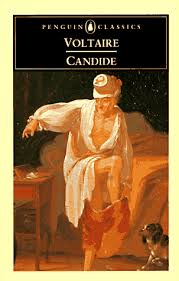
Because satire is good for the soul. No sacred cows escape roasting in this thin volume. A naïve young man travels out into the world to find that evil is ubiquitous.
Because how often does a book coin a common phrase. (FYI- “A Clockwork Orange” was a phrase Burgess borrowed for the book that was common in some parts, but Heller invented the term “Catch-22.”) The story revolves around the notion that one can’t get out of the war by reason of insanity, because if one is trying to get out of the war one is sane by definition, and if you are insane, you don’t try to get out.
Because if you’re going to break the law, you should know how to do it do it virtuously and not like a dirtbag. (Hint: It’s more painful than you think.) This essay tells of Thoreau’s imprisonment because he refused to pay taxes that would fund the war with Mexico. It’s usually bundled with other essays.
Because books are good. The title comes from the temperature at which books burn, and it’s set in a dystopian future in which the protagonist, “Fireman” Guy Montag, goes around collecting and burning books.
Because you should know how to turn someone down (e.g. I would not eat them on a boat, I would not eat them with a goat.) Or, because learning to be playful with words may serve one well. Or, because you should try new things. In the story, an unnamed narrator is subjected endlessly to green eggs and ham, which he steadfastly, refuses until the end.
Because you think you’ve got a weird family. Hamlet exacts revenge when he finds out that his uncle killed his father to marry his mother and usurp the throne.
Because you don’t want to underestimate Mother Nature when you strike out to build your indomitable American spirit. This is the true story of a college graduate who gives away his bank account, burns his pocket-money, cuts ties with his upper-middle class family, and sets off to become self-made. Ultimately, he ends up in Alaska, and it does not end well.
Because, stop being such a gloomy-Gus. Admittedly, this is an unconventional choice– both because it’s not particularly skillfully written and a few of its conclusions may not be as true as they once were. However, it does inject a dose of reality for those who view the world through shit-colored glasses. As the title suggests, the authors argue that life in America is getting better year after year. We are getting healthier and richer. Being economists, they present much of their findings as graphic representations of statistical data.
Because sometimes the world actually looks better through shit-colored glasses, Seriously, because you need to know how to get on with it when life is at its toughest. Viktor Frankl was a psychiatrist and Holocaust survivor who writes about what kept people going at places like Auschwitz.
Because, just get on with it. This was actually a kind of “Notes to Self,” written by the Roman Emperor to remind himself to be virtuous, to live, and to not fear death.
Because you don’t get enough of the word “rickety” these days. But seriously, you get to “see” a lot of America through Kerouac’s poetic language. It follows the road trips of a beat generation protagonist through America.
Because Faulkner’s language rocks, and this is a gripping and gritty tale. It’s the story of an upper class co-ed who’s dragged down into the underworld and some desperate times by a couple bad decisions, not the least of which was going for a ride with a stupid drunk.
Because you need a pep talk to think for yourself. Emerson proposed that one stand as an individual and stop letting political parties, religions, or other organizations decide what one believes. Emerson and Twain both saw a sad trend brewing in which people were starting define their beliefs by identifying with a party and then letting that party’s opinion leaders tell them what to think. Sadly, this trend only grew since there day to the point that many people have extremely strong beliefs that they can’t begin explain in a logically and factually consistent way.
Because one day China is going to collect on our debts, and well need some grasp of their culture. Seriously, you should read outside your culture. In the process, you’ll find that the Taoist stream of thought isn’t all that far off our own—“f#@k authority and pretentiousness and all the bureaucratic formalities.”
Because, screw Melville, this is the great American novel. Yes, I realize that it’s not particularly thin, but compared to Moby Dick it is—and it reads more quickly because there aren’t long drawn out sections on the minutiae of whale pineal glands and what not. This book follows the adventures of that rapscallion, Huck, as he flees a drunk father and a lady who wants to make him civilized, and takes to rafting on the Mississippi with an escaped slave. Yes, it has the n-word like a billion times, but if you read all the words (and not just that one) you’ll see there’s a positive message about the development of mutual friendship and respect between Huck and Jim.
Because you need to get outside more. It’s the story of a dog who is taken from the good life as a pet in California to the wilds of Alaska, and what said dog must do to survive.
Because you need to be concise AND coherent. In the age of Twitter, people are mastering the former while losing the latter. This is a thin books that tells you most of what you need to know to write intelligibly in English.
Because America has a dark side, and nobody writes it better than Poe. Any of the many collections of Poe’s short stories (some including poems and/or long-form works) will do. One definitely wants “The Pit and the Pendulum,” “Tell-tale Heart,” “The Murders in the Rue Morgue,” “A Descent into the Maelstrom,” and, of course, the title poem.
Because we need an injection of Stoicism to counteract the prevailing trend toward whining and moaning. Epictetus was a slave who became one of the most famous Greek sages. His sayings are mostly about not crying over spilt milk, but to be careful not to be the one who spills the milk. In other words, don’t whine about what the world gives you, devote your energies to being virtuous and conscientious.
Because you should understand your place in the ecosystem, and Lewis Thomas describes it artfully and concisely. This is a series of essays that covers a lot of ground with respect to the subjects of biology and physiology.
Because you may just want to take over the word someday. This is advice about how to rule. It may not make one popular as a middle manager, but there are bits of wisdom throughout.
Because someday it’s all going to come to an end, and it will probably end badly. This is the story of a father and son wandering through a post-apocalyptic wasteland. I realize I’ve put a lot of dystopianism on this short list, but I’m going to say that’s part of the American condition. America has had it good for long enough to realize that all things come to an end.
Because we should not give the short story short shrift, and Hemingway—like Poe—did them well. Besides the title story, this collection includes “The Killers”, “The Gambler, The Nun, and the Radio”, and “A Clean, Well-lighted Place.”
Because you need to get out of the country and experience some of the rest of the world. This is about the travels from Paris to Pamplona of a group of men who’ve all fallen for the same woman with that woman—of course—along for the ride.
Because you need to get out of the house, away from your cubicle, and out into nature. This is an essay extolling the virtues of putting one foot in front of the other like you mean it.
This is the story of a little boy’s dreamtime journey to a world inhabited by “monsters” and his interaction with them. Like Green Eggs and Ham, you should have read this as a kid. If you didn’t, I’m sorry about your defective parents, but get over it. Since you probably don’t want to read this as an adult on the Metro going to work, you can get Christopher Walken to read it for you on YouTube.
So that is it. That is my list of 30 Thin Books that Every [Attention-Challenged] American Should Read.


 Elements of Fiction Writing: Conflict & Suspense is my second read by Bell on writing. The first one was on plotting and structure. That first book must have been useful enough to get me to read a second. This book is divided in two parts, the first one on conflict and the second on suspense. (The first is much longer.) In both cases, the chapters examine how the various elements of fiction (i.e. setting, plot, character, dialogue, etc.) can contribute to creating the much-needed characteristics of conflict and suspense. Bell uses a lot of example text to illustrate his points (mostly–but not exclusively–from commercial fiction), and this is a valuable feature of his guides.