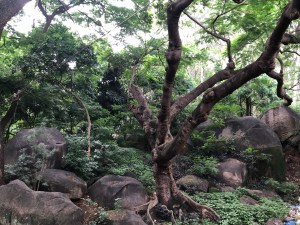
Rock Agama [Tanka]

a Rock Agama
peeks over a rock, stops,
and tries to be
inconspicuously
bright orange

Discovery Distance [Free Verse]

Mountains are best viewed at a distance,
despite humanity's "closer is better" bias.

Up close, one is invariably in a cloud,
looking at an undifferentiated mass
of gray-white:
ice -- granite -- snow -- fog.

One may climb a mountain 
to see other mountains in the distance,
but standing eye-to-rock with a mountain
offers little spectacle & grandeur.

Massive things can be too close to see.

I wonder whether I'm also
 better viewed from a distance.

Not everything is.

Consider the opposite mistake:
People say things such as, 
"My Great White Whale is out there."

But Great White Whales are  
always found looking inward --
not out in the distance.

Nocturnal [Kyōka]

owl sticks its head out,
staring in silent rebuke
as if to say:
"Hey! I'm nocturnal.
What's with all the ruckus?"

BOOK REVIEW: An Essay on Criticism by Alexander Pope

An Essay On CriticismAn Essay On Criticism by Alexander Pope
My rating: 5 of 5 stars

Amazon.in Page

View free at The Poetry Foundation

This essay is a poem, i.e. heroic couplets in iambic pentameter, to be precise. It advises both poets and critics of some of the mistakes made in their respective pursuits (though at the outset he warns that bad criticism is a bigger sin than bad poetry.) To critics, Pope advises against nit-picking, as well as failure to recognize the tradeoffs inherent in poetry – i.e. sometimes the better sounding line is grammatically strained, or the wittier line may be less musical. To poets, he lays out a range of insights from stylistic to psychological, and it is an essay both about improving the product of writing as well as improving the relations between writers and critics.

Those unfamiliar with the essay will still be aware of a few of its lines, these include: “A little learning is a dang’rous thing;” “To err is human, to forgive, divine.” “For fools rush in where angels fear to tread” and anyone who’s learned to write iambic pentameter (and the sins, thereof) will remember: “And ten low words oft creep in one dull line.”

But those everyday aphorisms are by no means the full extent of this essay’s wise words and its clever phrasing. My favorite couplets of the poem include:

“Some neither can for wits nor critics pass, // As heavy mules are neither horse nor ass.”

“Trust not yourself, but your defects to know, // Make use of ev’ry friend – and ev’ry foe.”

“For works may have more wit than does ‘em good, // As bodies perish through excess of blood.”

“Words are like leaves; and where they most abound, // Much fruit of sense beneath is rarely found.”

“True ease in writing comes from art, not chance, // As those move easiest who have learn’d to dance.”

“Some praise at morning what they blame at night; // But always think the last opinion right.”

“Unhappy wit, like most mistaken things, // Atones not for that envy which it brings.”

“All seems infected that th’ infected spy, // As all looks yellow to the jaundic’d eye.”

“’Tis best sometimes your censure to restrain; // And charitably let the dull be vain:”

I delighted in this poem. It’s full of food-for-thought, and reads remarkably well for a piece from the year 1711.


View all my reviews

Quotations Stumbled Upon [Recently]

To survive in this world you have to be many times a coward but at least once a hero.

Adam Johnson, The Orphan Master’s son

The metaphysical assumptions upon which you want to build your life cannot be an inherited duty.

Patrick levy, Sadhus

It is true that if there were no phenomena which were independent of all but a manageably small set of conditions, Physics would be impossible.

Eugene wigner, the unreasonable effectiveness of mathematics in the natural sciences

I feel about literature what Grant did about war. He hated it. I hate literature. I’m not a literary West Pointer; I do not love a literary man as a literary man, as a minister of the pulpit loves other ministers because they are ministers: it is a means to an end, that is all there is to it.

Walt whitman, as quoted in Yone Noguchi’s the spirit of japanese poetry

Know that all the sects in existence are a way to Hell.

Nichiren, as quoted by yone Noguchi in the spirit of japanese poetry

It is so easy to convert others. It is so difficult to convert oneself.

oscar wilde, the critic as artist

If you meet at a dinner a man who has spent his life in educating himself — a rare type in our time, I admit, but still one occasionally to be met with — you rise from the table richer, and conscious that a high ideal has for a moment touched and sanctified your days. But Oh! my dear Ernest, to sit next to a man who has spent his life trying to educate others! What a dreadful experience it is!

Oscar wilde, tHE CRITIC AS ARTIST

Pause Bloat [Free Verse]

A pause hangs in the air
like poison gas.

It threatens to devour
more moments:
good moments,
sacred moments,
moments that could've been something.

It envelops all,
encasing minds in psychic concrete,
entombing thoughts so hushly
that not even the thinker can hear them.

Through the ear-ringing hours,
nothing is said
&
nothing is heard --
not a word or a scream
or unsolicited fashion advice --
nothing but the high tone
that slits through silence.

Necropolis [Haiku]

the necropolis
sprawls across the desert --
desolate... to us 

Tributary [Free Verse]

Your river is a tributary.
My river is a tributary,
merging
&
flowing to a sea.

I feel your molecules,
floating past my own,
intermingling
& 
in some way tingling:
a jangled excitation.

And, 
[at the sea]
we will be, together
&
[at the sea]
we will be together.

I no longer worry
that I'm a river with no name --
an anonymous tributary -- 
because every sea 
has many names.

The Naked Dream [Free Verse]

There is a dream
in which one is naked.

But no one is looking at you,...
yet

And that is so much worse;
the anticipation of being gawked at 
is more disconcerting 
than being gawked at.

And, yet, one can't bring oneself 
to shout,
attracting onlookers, 
so as to end the misery of anticipation.

One can only sit with one's naked
expectations --
wading in anxiety.

Bardo Mind [Free Verse]

lost in a disembodied
Bardo state

fantastical happenings
mainlined into consciousness

with a side of swirling 
phantasm

and all the angry demons

and all the faceless gods

churn around the periphery