BOOK REVIEW: Embrace the Suck by Stephen Madden

Embrace the Suck: A Crossfit MemoirEmbrace the Suck: A Crossfit Memoir by Stephen Madden
My rating: 3 of 5 stars

Amazon page

Embrace the Suck is one man’s account of his experience with Cross-fit and other high intensity fitness regimens, including SEALFIT 20X. While Madden comes across as a regular Joe, i.e. not one of those crazed individuals who wreck their bodies through lack of rest, failure to heed the body’s warnings, or by way of starvation diets pursued to get that perfect cut, he’s a cheerleader for Cross-fit. If one is looking for an unbiased account of the strengths and weaknesses of Cross-fit, there are probably more objective accounts of the system’s pros and cons. This book is for someone who’s trying to psych themselves up for high intensity interval training. In that regard, the book does a good job because Madden always portrays himself as a human with the unique set of strengths, weaknesses, and limitations that condition entails. He succeeds because he guts it out in the company of the people around him who are portrayed as being more fit (at least in some dimensions) and driven than he.

Still, Madden’s account does give one a taste of the ugly side of the notoriously cult-like fitness system. For example, there is the trainer who refers to orange juice as poison–because it’s a high glycemic index carbohydrate. Even more disturbing is the wife who chastises him upon seeing a photo of him smiling as he crossed the finish line in a marathon–because it showed he hadn’t pushed hard enough. [Come on, it’s not as if, even if he’d died upon crossing the finish line from exhausting all bodily resources, that some Kenyan wouldn’t have been hours ahead of him.] Madden does include a chapter about pain and injuries, but it just suggests one should know what is run-of-the-mill fatigue and what is an actual injury. He mentions an example of a shoulder injury from his own body that he “should probably get checked out.” Furthermore, the final chapter seems to be a cautionary tale about packing too much training into too few days.

The book lays out the Cross-fit approach to exercise, and explains why it is so successful without getting deeply into the research. For those unfamiliar with high intensity interval training (HIIT), the general principle is that one constantly varies one’s workout, and that said workouts are done at maximum intensity with short and regimented rest breaks (though the core workout—i.e. the so-called WOD, workout of the day, is often quite short, i.e. 15 -20 minutes.) The track record for increasing fitness for this approach is good. Studies have indicated that one can get about the same level of cardiovascular benefit as one does from traditional cardiovascular exercise while building muscle (endurance activities like running pursued in isolation tend to result in muscle wastage) and reducing risk of repetitive stress injuries (because one is always changing one’s workout / movement.)

It sounds like there’s no down-side. The workouts are short (granted you may puke, but you’re out the door in an hour or less.) The benefits are high, and it doesn’t seem to be deficient in cardio—the one area in which one might think it would be. The jury is still out on the injury risk. Cross-fit puts out guidelines (which Madden explains) on how frequently one should take a rest day and on the need for perfect form. Those who follow the guidelines may not have any higher risk than other exercisers (the science remains insufficient.) However, the problem may be that it’s hard to maintain the aforementioned perfect form when a trainer is shouting, “faster, faster, faster” in one’s face. Furthermore, moderation and following rest suggestions has apparently not proven the strong suit for many Cross-fitters, some of whom come down with rhabdomyolysis (a deterioration of skeletal muscle from over-exertion / insufficient rest.)

Diet is, of course, an essential topic for any book on fitness, and Madden touches on the two diets that are popular with Cross-fitters. One of the diets, The Zone, is quickly dismissed as being of little use to him because it requires weighing out one’s food portions, and that level of anal retentiveness is beyond his capabilities. The other diet popular in Cross-fit is the one that Madden practices and addresses in the chapter on diet. It’s the so-called Paleo diet—in which one is supposed to eat like one’s pre-agrarian ancestors–except if it involves a high glycemic index food that our ancestors ate, in which case, no. Madden stresses the 80% rule that other Cross-fitter put him on to. That is, follow the diet in a strict way 80% of the time, but allow for a cheat here and there of no more than 20%. Madden’s approach to diet, like his workout drive, seems more moderate and approachable than that of other individuals one sees in the book.

The most fascinating chapter was his description of completing the SEALFIT 20X challenge. This is a one [long] day program in which one trains like a Navy SEAL. It’s part of a fitness and mental toughness conglomeration headed by former-SEAL Mark Divine. This training is a bit different from the Cross-fit workouts in that endurance is a major challenge, and the mind is challenged as much as the body. I don’t just mean that will is important, but the SEALFIT program tests one’s ability to use one’s brain under the pressure of intense physical training.

I’d recommend this book for those interested in learning about the Cross-fit and SEALFIT 20X experience. If one is trying to get an unvarnished view of Cross-fit, you may want to start with another book before getting to this one. It’s readable and thought-provoking.

View all my reviews

BOOK REVIEW: Sleights of Mind by Stephen Macknik and Susana Martinez-Conde

Sleights of Mind: What the Neuroscience of Magic Reveals about Our Everyday DeceptionsSleights of Mind: What the Neuroscience of Magic Reveals about Our Everyday Deceptions by Stephen L. Macknik
My rating: 4 of 5 stars

Amazon page

Sleights of Mind explains magic tricks by telling one about the shortcuts, limits, and programming of brain (and attendant sensory systems) that facilitate such tricks. The reader needn’t be concerned that the book will spoil all the illusionists’ secrets for one. The authors carefully demarcate the beginnings and endings of spoiler sections that explicitly explain tricks. This allows a reader to skip over such sections if one doesn’t want to know the trick. I suspect few readers do skip the spoiler sections because that’s where the rubber meets the road in terms of the neuroscientific concepts being discussed. The spoiler sections are an attempt to comply with the magician’s code (the neuroscientist authors became magicians themselves) and to maintain a good relationships with the many magicians (some, like Teller or the Amaz!ng Randi, quite famous) who cooperated in the writing of the book.

Over 12 chapters, the authors explain the neuroscience of how various classes of illusion work. Most of the chapters address a specific class or subclass of illusion. The first few chapters deal with visual illusions. We look at the world in what seems like crystal clarity (at least with glasses on or contacts in), but there are many limitations and gaps in our visual processing system. While it seems like we are directly seeing the world around us, in point of fact, our visual experience is a product of the brain reconstructing information that the eyes take in—and it doesn’t do it as perfectly as our brain tricks us into believing. As the authors state it, “The spooky truth is that your brain constructs reality, visual and otherwise.” Chapter 3, deals with illusion in art, which is little outside the theme of the book, but it offers an opportunity to explain some intriguing facts about how the brain and eyes work in concert.

The next couple chapters (Ch. 4 and 5) deal with cognitive illusions. Just like our visual system, our conscious minds save energy by engaging in short-cuts that disguise the mind’s limits while offering the possibility of manipulation. The brain also works hard to reconcile what appear to be inconsistencies, and often this reconciliation leads us astray. Misdirection is discussed in detail. Our minds are primed to let certain actions and sensory inputs draw its attention, and humans are awful at paying attention to more than one input stream at a time. Teller explains that, “Action is motion with a purpose.” So, if one can give one’s movement a purpose (even scratching one’s chin) it will be ignored while movements seemingly without purpose are anomalous and draw attention. The authors introduce the reader to mirror neurons—the part of our brains that take observations of another’s actions and makes forecasts about that person’s intent. This system is highly hackable by magicians.

Chapter 5 informs us that we aren’t as good at multitasking as we think—which is to say we completely stink at it but tend to think we are awesome multi-taskers. The gorilla experiment is offered as a prime example of this situation. In the gorilla experiment, about half-a-dozen people, moving around randomly, pass a ball / balls among themselves. The subject is asked to count the number of passes. In the middle of this activity a man in a gorilla suit walks through the middle of the rapidly moving passers. When asked whether they saw the gorilla, most people say they didn’t (and those who do see the gorilla invariably offer a count of passes that is vastly off the mark.) [If this is either unclear or unbelievable, you can YouTube it.]

Chapter 6 examines multi-sensory illusions. The quintessential example is how our brains lead us believe that the sound of a ventriloquist’s voice is coming from the moving lips of a dummy. (Also, it seems like voices are coming from the lips of actors on-screen in the movies, even though the speakers are probably off to the side in the walls or ceiling.) Synesthesia (cross-wiring between senses and brain such that some people may always see the number 5 in red or hear a C-sharp in green) is introduced to the reader.

Chapter 7 explores the illusions of memory. Just as with our vision and attention, our memories aren’t as indelible as they seem to be. We think we’re calling up a transcription of the events of our lives, but really we’re remembering the last remembrance of said event. This can lead to a migration / distortion of events in the same manner as the kid’s experiment whereby one whispers a phrase into the ear of the kid in the next chair and it traverses the classroom. The original sentence “The cat is on the windowsill” invariably becomes something like “Lenny Kravitz steals puppies from the till.” (Have you ever experienced a situation in which a person remembers the details of an event substantially differently from yourself even if the broad brushstrokes are the same?) Some entertainers use pneumonic tricks to convince audiences that they have supernatural mental abilities when—in fact—they have merely turned understanding of memory to their advantage.

Chapter 8 considers how in-built expectations and assumptions are exploited by magicians and mentalists. Again, these methods work because our brains employ all sorts of energy-saving shortcuts. For example, our brains often do the same thing as Google’s search engine—filling in the blanks by taking advantage of one’s experience to avoid the need for costly cognitive processing.

Chapter 9 explains that our “free choices” are often not so “free” as we think. One of the most disconcerting, yet intriguing, facts to come from the onslaught of brain imaging studies since the 1990’s is that our decisions are made on a subconscious level before our conscious minds are even aware the decision has been made. Prior to this, we’d always been under the misapprehension that we are consciously making all these decisions–big and small–because the conscious mind is just a big credit stealer (to be fair, the conscious mind doesn’t recognize that it’s so out of the loop in decision-making.) So many of our decisions are made in predictable ways by emotional / automated responses, and mentalists use that fact to their advantage.

Chapter 10 is a catchall for topics that didn’t fit into earlier chapters, including hypnosis, superstitions, and the gambler’s fallacy (i.e. the idea that a roulette number that hasn’t come up in a while [or slot machine that hasn’t paid off recently] is bound to pay soon—regardless of the probability distribution that actually rules the outcome.)

The remainder of the book tells the story of the author’s try-out for a magic society and discusses the question of whether knowing the neurological and psychological roots of magic tricks will kill magic as a source of entertainment. I found the latter to be the more interesting discussion. The authors are optimistic about magic’s survival, and offer good reasons. After all, almost nobody believes that magicians are conducting supernatural activities [not even people who take some wildly unsubstantiated beliefs as givens.] Even knowing how the tricks work doesn’t create the ability to see through the tricks because so many of the factors that magicians exploit operate on a subconsciously programmed level, and such proclivities would have to be trained away. People who want to enjoy the spectacle of magic aren’t likely to go to the trouble of training themselves in that way.

I enjoyed this book even though I’m not particularly a fan of magic—though I did find myself watching quite a few YouTube clips of the magicians mentioned in the book. If you’re interested in how one’s mind and sensory systems work, and the limitations of those systems, you’ll find this book worthwhile. If you’re into magic, you’ll like it all the more so.

View all my reviews

BOOK REVIEW: Buddha’s Brain by Rick Hanson

Buddha's Brain: The Practical Neuroscience of Happiness, Love, and WisdomBuddha’s Brain: The Practical Neuroscience of Happiness, Love, and Wisdom by Rick Hanson
My rating: 4 of 5 stars

Amazon page

This is one of those books whose title leaves one unclear as to the book’s nature. The title has religious connotations, but its subtitle, The Practical Neuroscience of Happiness, Love, and Wisdom suggests a secular and rationalist work. The subtitle might clear things up if it weren’t for the fact that there are so many New Agey, spiritualist types who like to glom onto scientific terminology—presumably in an attempt to lend credibility to ideas that are “out there.” Thus, one may reasonably wonder whether this is just another Biomechanics of Chakra Fluffing style book—actually, I made that one up, but if you can see why such a title would be oxymoronic you know where I’m coming from. Without further ado, let me state that this book is rooted in the science of the brain, and, while it uses its fair share of concepts from Eastern religion as pedagogic devices, it doesn’t presuppose need to believe in anything [or anybody] for which there is no evidence. [What remains less clear is whether this book is properly considered self-help or pop science?] This issue with the title may be why Hanson came out with the more secularly-titled Hardwiring Happiness book a few years later that seems to cover similar territory (though, I’ve not yet read the latter.)

The central premise of Buddha’s Brain is that the brain’s neuroplasticity allows one to change the way one experiences life by changing the way one perceives and responds to life’s little trials and tribulations. Over time, one can become happier, more loving, and wiser—i.e. one can have a brain more like the Buddha’s. “Spiritual” matters are always at the periphery of what Hanson is discussing because this type of practice has historically been in the bailiwick of religious traditions—specifically Eastern (and other mystic) traditions that focus on looking inward to be a more virtuous person. However, where said traditions have often relied on assumptions unsupported by current science—such as the existence of a unitary (i.e. universally interconnected) consciousness, Hanson considers the issue from the perspective of our current understanding of the brain. In particular, he focuses on the fact that we are capable of training our brain to respond more positively to events.

Evolution, beautiful and elegant as it may be, has made us pessimistic and prone to disproportionately focus on the negative. This is because survival depended on being ready for worst case scenarios. So we imagine what that worst case is, and endlessly replay scenarios to prepare ourselves for how to deal with said worst cases. While this approach may have enhanced our ancestor’s survival probability, it can easily get out of hand and for far too many people it has. In the book, Hanson proposes three evolutionary strategies (i.e. creating separations [us / them, I / you, etc.], maintaining stability, and threat avoidance / opportunity seizure) that often end up tainting our worldview, raising our stress levels, and causing declining health and well-being. The book does get into the mechanics of stress reduction as well as how to change the way one experiences the world so as to be exposed to less stress.

Rick Hanson is a psychologist who holds a Senior Fellowship at a center at the University of California at Berkeley. He also founded his own center called The Wellspring Institute for Neuroscience and Contemplative Wisdom.

The book is organized into 13 chapters arranged in four parts. The four parts are: I.) The Causes of Suffering, II.) Happiness, III.) Love, and IV.) Wisdom. These parts are preceded by front matter which includes the first chapter which lays out the basics of the brain in layman’s terms as well as discussing the evolutionary survival strategies that sometimes fail to serve us well in modern living. More detailed discussion of the brain is introduced throughout the book at is relevant to the discussion at hand, but the level of this discussion should be approachable to all readers. Each chapter is divided into many subsections to make the reading easily digestible. One of the nice features of this book is that each chapter has a bullet point summary at the end. Actually, the author uses bullet points prominently throughout the book. There is one appendix which explores questions of nutrition for brain health. There is an extensive reference section containing largely scholarly references, as one would expect of a science book.

I mentioned earlier that I wasn’t certain whether to classify this as a self-help or popular science book. In many ways it’s both. It does give a great deal of practical advice about what one can do to change one’s life. On the other hand, it offers more background into the science than your average self-help book—though always at a layman’s level.

I’d recommend this book if you are interested in self-improvement, the science of the mind, or both.

View all my reviews

7 Stress Fighting Tips with Relevant Monty Python Song Interludes and Book Recommendations

In writing this post, I realized that Monty Python provides the I-Ching of life wisdom. If they don’t say it, it may not need being said. So I’ve let them expound upon my points wherever possible.


1.) Always  Usually look on the bright side: Our brains are programmed to constantly be on the look for potential problems and ruminate over solutions. This isn’t without its advantages. However, as your brain takes flight with this problem anticipation mode, it can begin to taint how one sees the world.

My high school psychology teacher told us a story of what he called the “gestalt of expectations.” The story goes like this: One is driving across southwestern America and there’s a gas station coming up, but one still has half a tank. Being from the East, one doesn’t realize how rare service stations can be in the desert, so one passes it by. Of course one runs out of gas (it wouldn’t be much of a story otherwise.) As one is walking back toward the service station, one begins to obsess over how the service station attendant is going to screw one over. After all, the unknown individual knows one is in a desperate situation. The more one walks under a burning sun, the more one inflates the gas station attendant’s ill-intentions, and one suitably escalates one’s mentally rehearsed response. Finally, disheveled and weary, one reaches the service station. A concerned-looking attendant bursts out of the station to meet one, saying, “Geez, you look beat, what can I do for you?” And that’s when one punches him right in the nose.

BuddhaBrainThe good news is that one can gradually train one’s brain to take a more positive perspective. A neuroscientist, Rick Hanson, has written a few books on how one can go about this cognitive rewiring. Buddha’s Brain is probably the most well-known of these books. The book lays out the science behind the brain and negative thinking in particular, and then goes on to present suggestions as to how one can change this cycle and yield the benefits of a more positive outlook. While the title of this book makes it seems like a religious tract, it’s really secular and scientific. If you’re still concerned, you might check out the more secularly titled Hardwiring Happiness.


2.) Make rest part of the process–and an essential one at that: Duh?  Yeah, it sounds self-evident, but  too many people think of rest as the slacking off that one does between doing “useful stuff.” What isn’t valued is given short shrift. Don’t think of rest as a necessary evil. Equating rest with goofing off results in two problems. First, the obvious one, people don’t get as much rest as they should. Second, while one thinks he or she is resting, one may be under chronic stress (the bad kind) as one’s minds churns over what they should be doing and the adverse impacts of not doing it. Just as one should have rests built into one’s workout for maximal effect, one should have rest times built into the day, week, and year.


3.) Find your bliss, and just do “it”: You probably think that by “it” I’m referring to sex. Actually, sex isn’t a bad “it,”  as its go, but it’s not the only it. Exercise, work the heavy bag, do a vinyasa (yoga flow sequence), go to work solving the problem at hand, or practice your Silly Walk. This also sounds like a “duh!” kind of statement, but far too many people wallow when they feel overwhelmed. What do they wallow in? Negative feelings. They worry that they can’t possibly hit the deadline or find the perfect solution. They worry that they’ll let someone down. They get angry at other people, the world, or a god or gods for putting them in their present predicament. They bristle at the unfairness of the universe. All of this snowballs into a stress monster–to mix my metaphors up nicely. If one can’t meditate or keep one’s mind on one’s breath, one may find relaxation in exhaustion. It’s all about inertia. It’s hard to get moving when one thinks one’s world has gone to shit, but that movement will make one feel much better–even if it doesn’t seem it can solve the problem at hand. One might need to change one’s life’s course altogether and become a lumberjack.


4.) Don’t create false monsters:  Remember what Michel de Montaigne said, “My life has been full of terrible misfortunes most of which never happened.” As this is really just expanding on a point in item #1, instead of elaborating, I will offer you this Monty Python skit to consider.


5.) Exhale: Each exhalation trips the “rest & digest” circuit (i.e. the Parasympathetic Nervous System [PNS])  just a little. Granted, this subtle relaxation effect is easily overwhelmed by the countervailing forces of stressors and even the antagonistic effect of inhalation with its–also minute–fight or flight mode (of the Sympathetic Nervous System [SNS.]) Still, if you don’t know what to do, controlling your breath while elongating each exhalation is a good start. This will help in two regards. First, it helps the PNS gain a little ground. Second, it’ll break your conscious mind’s obsession with the problem (or potential problem) at hand. One’s mind will wander and one will lose track of the breath, but the more one practices quietly returning one’s attention to the breath the better off one will be. Becoming frustrated with these diversions only strengthens the stress monster–so don’t do it.

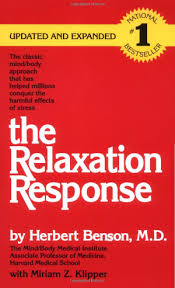
Relaxation ResponseThe bible of the rest and digest mode is Herbert Benson’s Relaxation ResponseThis book was first written over a quarter of a century ago, but it remains readily available. It’s telling that Walter B. Cannon’s work on “fight or flight” mode predates Benson’s work by such a long time. In other words, the medical and scientific community were researching the body under stress for decades before it ever occurred to anyone to think in terms of rest mode as a state that could be studied and advanced–as opposed to just being the normal state of affairs. This should give one an insight into how the human mind goes about considering problems.


6.) Recognize that stress is like cholesterol–there’s a good kind as well as the bad: Acute stress can serve one well during instances of danger. We have this response for good reason. The problem is chronic stress. When one’s body is in a stressed state, it’s not taking care of general maintenance tasks like healing itself. That’s fine in a short term, but problems compound over time. Chronic stress brings a high likelihood of illness because the body isn’t dealing with its run of the mill chores as it should be.

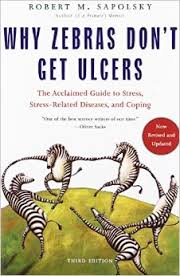
ZebrasUlcers_SapolskyThere are a number of books that expand upon this issue and which offer advice for keeping one’s stress of a healthy type. Robert Sapolsky’s Why Zebras Don’t Get Ulcers is among the best. It’s a long book and goes into great detail, but Sapolsky’s sense of humor helps to continue reading when the scientific minutiae might seem overwhelming. Another book on this topic that I found to be quite informative was Lissa Rankin’s Mind Over Medicine.  Rankin is a medical doctor, and so she offers a little different perspective from that of Sapolsky. (The latter is a biologist / neurologist.)


7.) Realize that you are a speck in a vast universe and, so, how big or long-lasting can your problem be?: Yeah, it’s a double-edged sword because it’s–in a way–a demoralizing thought as well as a comforting one. Therefore, one should first watch this bit of Monty Python wisdom:


But then one can keep things in perspective through the realization that one is not yet dead.

BOOK REVIEW: Extreme Fear by Jeff Wise

Extreme Fear: The Science of Your Mind in DangerExtreme Fear: The Science of Your Mind in Danger by Jeff Wise
My rating: 4 of 5 stars

Amazon page

Extreme Fear examines the science behind fear—particularly the fear of life and death situations. In doing so, the author presents findings from scientific research as well as cases that demonstrate the concepts behind those findings. People are often so close to their fears that they take them for granted, and feel that there’s nothing to be done about them. However, there’s a great deal to be learned about how fear operates and how one can improve one’s performance in fearful situations. By replacing the lens of shame with one of science, one can see what fear is objectively, and make the emotion more of a help and less of a hindrance.

A central idea in the book is that fear evolved to maximize one’s chance of survival against the age-old threats facing mankind. These pre-historic threats were relatively straightforward: saber-tooth tiger attacks, clubbing by members of warring tribes, fire, famine, flood, etc. Ancient threats often called for hauling ass, freezing in place, or getting stabby. The problem is that our present-day threats often call less for gross motor skills (run, kick, or throw) and more for creative or nuanced solutions to technological problems (i.e. sliding cars, falling planes, or malfunctioning assault rifles.)

Motor learning is one means by which this mismatch between what our brain tells our body to do in a stressful situation and what is called for in our modern world. Take the case of the infantryman with the jammed rifle. Without training, he might pick up the rifle like a club, intending to use it to unleash blunt force trauma. That is, if he’s still alive then the enemy gets into cudgeling range. Alternatively, the soldier may drop the rifle and run for his life. However, because he had a drill sergeant who made him practice clearing his weapon over and over, his body can go to that behavior while his conscious mind is blinking out.

Still, motor learning only takes us so far. Sometimes creativity is called for, and that’s a tall order in the face of where our body / brain want to put limited resources. In fact, Wise begins the book with the story of a pilot who was flying an old plane when the wing support broke and the wing flipped up, threatening to rip off. Somehow the pilot figured out—based on a vague memory and lots of experience—that he could flip the plane over and fly it upside-down and the wing would snap back into place. Then he had to figure out how to land: a.) upside-down crash, or b.) try to flip the plane over at the last second. The brain systems that this pilot smoothly accessed are among those that one doesn’t expect to be operating in life or death situations—e.g. those involved with long-term conscious memory and abstract problem solving.

The question of how some people can keep their wits about them, as the above pilot did, while others crash and die is the one that Wise really wants to answer. It turns out that it’s not such and easy question. During World War II, the military conducted studies to try to determine which soldiers could be counted on under life and death stress. The answer didn’t readily present itself. Among the problems in finding an answer is that courage and fearfulness aren’t as unitary or straightforward characteristics as one might think. Wise presents the case of Audie Murphy as a prime example. Murphy was at once one of the most decorated American soldiers in World War II—a man who’d taken on a company of Germans single-handedly—and a man of great social anxiety.

The book’s 13 chapters are divided into three parts. The first part presents fear and its effects. The middle section deals with various forms, aspects, and facets of fear, including: social v. life-and-death fear, choking behavior in sports, and fear of fear v. fear of an outcome. In the last part of the book, Wise suggests how one might achieve better performance in the face of fear.

I found this book to be informative and interesting. Wise did a good job of picking cases to illustrate the concepts discussed in the scientific literature. I’d recommend this book for individuals who are interested in the science of the brain and the ways to achieve ultimate human performance.

View all my reviews

BOOK REVIEW: What If? by Randall Munroe

What If?: Serious Scientific Answers to Absurd Hypothetical QuestionsWhat If?: Serious Scientific Answers to Absurd Hypothetical Questions by Randall Munroe

My rating: 5 of 5 stars

Amazon page

If you like the tv show Mythbusters and snarky and / or silly humor, you’ll love Randall Munroe’s What If?: Serious Scientific Answers to Absurd Hypothetical Questions. Munroe gained internet fame (still not the same as real fame) drawing the popular webcomic xkcd. The book’s subtitle says it all. Munroe solicited questions from his web-legion (not the same as a real legion) of fans, selected a collection that he found intriguing, and answers them with a mix of science and humor. Munroe’s bona fides to answer questions of a technical nature include a degree in physics from Christopher Newport University and a brief career as a roboticist for NASA—though he’s fond of pointing out that he’s just a web-cartoonist whenever his answers might be wrong.

Each chapter presents a detailed answer to one of the absurd hypothetical questions. Most of the chapters are just a few pages long and feature the same variety of stick-figure cartoon that grace the xkcd website. He covers 60-ish questions in the book. Scattered throughout the book are sections called “Weird (and Worrying) Questions” which usually don’t receive answers but merely cartoons that mock the demented mind that came up with said question. (If that seems harsh, keep in mind that many of the questions he does answer are pretty warped (e.g. setting off a nuke in a hurricane or whether steady rising would result in death by freezing or suffocation).)

Like the Mythbusters, Munroe does an excellent job of selecting questions that have unexpected answers. For example, the author addresses the question of what would happen if one went swimming in a spent fuel pool (nuclear fuel rods are stored underwater for a long time after they come out of the reactor before they can go to dry storage.) The answer: Nothing if one swam near the surface, but if you swam down and touched the casks, you’d die in minutes. Munroe also takes liberty to find the more interesting unintended consequences embedded in some of the questions. For example, he dismissively answers the old question about whether every human on the planet standing as close together as possible and jumping so as to land simultaneously would have any effect on the planet. Instead, he takes on the questions of the logistics of getting everyone to one place, how much space humanity would take up, and how / whether people could get out of this state of shoulder-to-shoulder proximity alive.

Some of the questions are impossible to answer with certainty but Munroe takes them on when he can offer reasonable, scientifically-based speculation. For example, what will the area that is currently New York City look like in a million years? His answer is more or less: Who cares? Humans will be long gone and veins of plastic in past landfills will be the only evidence that we ever existed. Another such question is how much power can Yoda achieve through application of the Force?

Besides the many physics question (e.g. What’s the fastest speed at which one can hit a speed bump and live?), there are others that involve mathematics, chemistry, and biology. Mathematics questions include calculations of the likelihood that one would find his or her soulmate if each person really only had one soul mate. (My Indian friends might be pleased to know that we’d all be screwed if that were the case.) There are actually many questions that hinge on mathematical calculations.

One of my favorite chapters is in the domain of chemistry, and it answers what would happen if one tried to make a wall by collecting together blocks of all of the elements in the periodic table in the relative position in which they exist on the table? Answer: Nothing good. There are a few biologically centered questions as well. Munroe takes on the question of how much computing power human brains collectively have—and the more interesting unasked question of how human “computing” is different from that of machines.

I’d highly recommend this book for science lovers. In fact, even people who don’t care for science may find this book palatable because of its humor and the fascinating questions it addresses.

View all my reviews

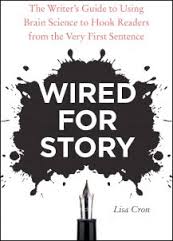
BOOK REVIEW: Wired for Story by Lisa Cron

Wired for Story: The Writer's Guide to Using Brain Science to Hook Readers from the Very First SentenceWired for Story: The Writer’s Guide to Using Brain Science to Hook Readers from the Very First Sentence by Lisa Cron

My rating: 5 of 5 stars

Amazon page

There are countless books offering advice to writers. Some are good. Some are not. Good, bad, or ugly, few of these books offer anything new beyond particularly artful (e.g. humorous or poetic) explanations or superior examples. In other words, if you’ve read five writer’s guides you’ve read five thousand. Cron’s book is the rare guide worth a read even if you’ve read a hundred other such books. It’s not that Wired for Story offers radical or novel advice on story building (its writer’s tips are orthodox.) It’s the way this book couches the arguments for what can admittedly be hackneyed advice. As the title suggests, Cron’s book is about how our brains are wired to love stories–as long as said stories contain certain attributes that the brain finds appealing. (Conversely, there’s a reason why books that go wildly off the reservation with “experimentalism” are doomed.)

While I’ve read many a book on writing, I picked up Wired for Story more out of an interest in the subject of the neuroscience of story. The book doesn’t delve deeply into the science, but it does cite leading thinkers in the field as well as providing a good layman’s overview of the neuroscientific principles that inform the book’s tips. Cron’s background is in publishing and her bona fides to write this book are as someone who came from a career reading and rejecting / accepting manuscripts. However, I believe she did a good job of laying out science.

The central idea is that humans love stories because the narrative structure allows people to simulate a nasty chain of problems without suffering the real world consequences. The brain loathes uncertainty and randomness, and loves whenever it can learn about how to face a problem or make sense of the world. This is why we love conflict, tension, and an unrelenting unfolding of worst case scenarios in our stories even though we tend to hate those characteristics in our own lives. This results in both the tried advice to keep putting the protagonist through the wringer, and the qualifications that a writer should do so in a way that is believable (our brain’s BS-detector is ever on) and which will eventually force the protagonist to change. Cron offers a definition of story that has the usual elements: “A story is how what happens affects someone who is trying to achieve what turns out to be a difficult goal, and how he or she changes as a result.” As with many guides, the definitions of plot, the protagonist’s issue / goal, theme, and tone are elaborated at length—as well as being differentiated because these topics tend to be confused by neophytes—often resulting in a failure to clarify one or more of them.

Stories also give us an opportunity to anticipate what others will do, and forecasting the behavior of others gives one a nice little dopamine dump. The ability to foresee what others will do has always been a powerful evolutionary advantage, and those who did it better passed on their genes more than their oblivious counterparts. Owing to this idea, there is a great deal of advice about what should be in the book (only what is relevant), and how it should be revealed (in a way that eschews attempts to play “gotcha” with your readers.)

One may wonder why I’m so pleased with a writer’s guide that gives common advice about writing–just because it explains said tips in terms of evolutionary biology. The answer is that it’s far easier to keep these lessons in mind when they’re held together by a logic rooted in what all readers have in common (e.g. conscious and unconscious minds, emotions, instinctual drives, etc.) For example, knowing why readers hate an overly simple resolution for a problem that’s presented as insoluble (i.e. robbing them of dopamine reward for figuring it out) helps one better recognize this pitfall in all its forms and to avoid it. Such an approach allows for a deductive approach and is far more useful than having memorized “avoid deus ex machina” as a disparate tip that’s attached to a specific example. In short, it’s both easier to remember and broadly implement these ideas when one understands the rationale from the ground up.

Beyond the reason in the last paragraph, I enjoyed this book for reasons that have little to do with its advice to writers. While I now know that there are other books on the evolutionary biology of story that deal with the subject more from a scientific perspective (while I haven’t read it yet, you might try this book), this was the first book that I stumbled across on that topic. And, it’s a topic that’s well worth understanding whether you’re a writer or not. No matter what one does, understanding the universal appeal of a story can be beneficial, whether it’s in the context of teaching, parenting, or business.

I’d recommend this book for writers—particularly those who think about the world in scientific terms. Beyond writers, if you have cause to construct or use stories in your life—or suspect you should—you can benefit from this book.

View all my reviews

BOOK REVIEW: Becoming Batman by E. Paul Zehr

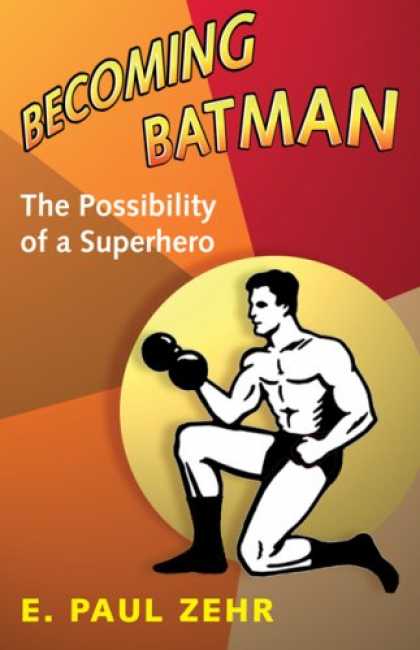
Becoming Batman: The Possibility of a SuperheroBecoming Batman: The Possibility of a Superhero by E. Paul Zehr

My rating: 5 of 5 stars

Amazon page

[Note: This book is about sport and exercise science, particularly as they pertain to the martial arts. If you’re a martial artist or are interested in fitness and movement arts at the extremes of human capacity, you’re in the right place. If you’re interested in the comics and an overview of topics including how many billions Bruce Wayne needs and what technologies Batman must master, those aren’t questions addressed in this book. Such readers may find the book delving into depths they aren’t interested in on biological science. There are articles on the web that deal with topics like the “Cost of being Batman.”]

Next summer an eagerly awaited movie entitled Batman v Superman: Dawn of Justice hits theaters. Who knows how much screen time will involve the fight between the titular characters, but the same battle has played out a number of times in the comics, and its appeal is clear. What are the limits of human capability given training, technology, and sufficient smarts? Can a man really defeat an alien that’s faster than a bullet and more powerful than a locomotive? A popular fanboy mantra is, “I like Batman, because I could be Batman. Batman has no superpowers.” So, yes, if you were a billionaire, genius, with the physique of a Greek god, and knew 127 martial arts, you too could be Batman. Or could you? That question is at the heart of Zehr’s book.

Becoming Batman is arranged into sixteen chapters divided among five parts. It begins logically with the question of whether Bruce Wayne needs to begin at any particular point to achieve success in transforming himself into Batman? (At the extreme, one probably can’t imagine Bruce Wayne becoming Batman if he was born with one leg a foot longer than the other and with a Quasimodo hump, but given a Bruce who is starting out “average,” what are his limitations.) In other words, how much does genetics come into play. In the first part, Zehr introduces a character, Bob Wayne, who doesn’t appear in the comics. Bob is Bruce’s twin, and is used throughout the book for comparison purposes, i.e. to convey what Bruce Wayne would look like if he didn’t train fanatically to be Batman. The question of how much of Batman is innate and how much is painstaking built by exercise and training is critical to determining how many of those fanboys really could be Batman.

There a series of chapters explaining the mechanism by which stressors result in a stronger, faster, more powerful, and more resilient Batman. The idea is that Mother Nature doesn’t over-engineer. The only way one gets stronger muscles is by overloading them, which triggers a process of rebuilding them bigger and better than before. Wolff’s Law defines the same concept for bones, i.e. bone density increases in response to increased loading. (Incidentally, the same is true of the mind. A more agile mind is achieved only by working it, and zoning out in front of the television results in a dumbening.)

The next section shifts from generic exercise science to questions of Batman’s martial arts training. What kind of martial arts (or arts) would Batman practice? There is an often quoted statement in the comics to the effect that Batman had mastered 127 martial arts. (This is ridiculous, but it does spur the intriguing question of how many systems does Batman need to learn to have a well-rounded skill-base without being a dabbler? Many will say one art—the right one–is enough, others will say that–given the varied cast of villains he must defeat–Batman needs a broader skill-set than any existing art provides.) More to the point, how many hours does one need to practice a technique to ingrain the movements into one (e.g. neurologically it takes repetition to optimize efficiency.) This is among the questions discussed in this book.

The fourth section deals with the ravages of being Batman, and how much any human could be expected to endure. In this section, one will learn about the cumulative toll of concussions, the likelihood of Batman avoiding broken bones and other injuries that would necessarily sideline his crime fighting, and the effect that working the night shift would have. (The latter might seem trivial in comparison to the former two topics, but—in fact—it’s not. It’s well established that night workers have higher incidence of some cancers and other ailments. Furthermore, as Bruce Wayne has to keep appearances up, it means not only fighting circadian rhythm issues, but also frequent sleep deprivation—the hazards of which are even clearer and occur in short order.)

There are a number of interesting topic that aren’t don’t pertain to the core question per se, but which are interesting for fans of the Batman canon and the character’s mythos. Famously, Batman doesn’t use guns or lethal force. This raises the question of how realistic it is to regularly fight hardened knaves and miscreants without killing them. One can only knock out so many of Gotham’s baddies before one doesn’t get up.

There’s a chapter about what a fight between Batman and Batgirl would be like. While strength would definitely be to Batman’s advantage, there are advantages that an equally skilled female fighter might bring to the fight? How would Batgirl (or Catwoman) need to fight to put those advantages to use? Finally, for those of us who are no longer spring chicks, there are chapters about how Batman could expect to age, and how long he could keep performing at a level at which he could defeat his enemies.

I enjoyed this book and found it both educational and interesting. It should be clear that Batman is just a teaching tool used to explore the limitations of the human body and its ability to endure a life of fighting. That said, references to the Batman comic books and movies makes for a readable text. Perhaps what I like most about this book is that most of the books that address these subjects are textbooks that are sold on the textbook pricing model (i.e. we have a limited but captive audience so let’s make them pay top dollar.) This is one of the few books that takes on these topics at the readability and pricing model of a popular science book.

I recommend it for those interested in the science of performance, martial arts, and injury.

View all my reviews

READING REPORT: May 1, 2015

Becomingbatman

Most of my reading time this week was divided between two books, one of which was also a new purchase. The newly purchased book that I spent a lot of time with is E. Paul Zehr’s Becoming Batman. This book isn’t at all what one might expect from the title or the cover. If one were to notice that it’s put out by Johns Hopkins University Press, one might realize that it’s not a fanboy fantasy work. What it is is a book about the science of exercise and conditioning for athletes that uses “Batman” as a pedagogic tool to make more digestible scientific information like how our muscles grow or how we make our movement more efficient through practice. It’s a fascinating book if you are interested in science and martial arts (or movement arts more generally.)


Wired for StoryThe other book I’ve been tearing through is Wired for Story, which I wrote about last week. It’s a book that explains how human brains are wired to be intrigued by story, and how writers can put this information to good use.


Meeting the Dog Girls

The one book that I finished this week is Gay Terry’s Meeting the Dog Girls. This is a collection of short stories (some of which might be classified as flash fiction) that could be called tales of the weird or supernatural fiction. Most of the stories have a quirky sense of humor.


ZebrasUlcers_Sapolsky

I bought two other books this week, both of which have been on my reading list for a while. The first is Why Zebras Don’t Get Ulcers, by Robert Sapolsky.  As the title suggests, this book is about why humans are unique within the animal kingdom with respect to stress-induced illnesses. Stress reduction and mitigation have been an important question of inquiry for me as of late.


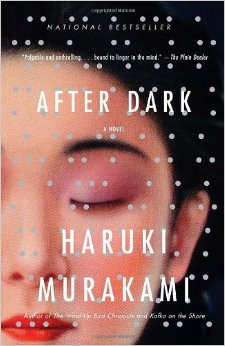
afterdark_murakami

The other book is Haruki Murakami’s After Dark. This will be the third or fourth book by Murakami I’ve read, and I enjoy his style. Ironically, this was the first book by Murakami that I noticed in the bookstore, but I never got around to reading it.

BOOK REVIEW: Free Will by Sam Harris

Free WillFree Will by Sam Harris

My rating: 2 of 5 stars

Amazon page

I had high hopes for Sam Harris’s book Free Will, but they didn’t pan out. It’s a very short book (less than 100 pages) on the subject of free will–or the lack thereof. While I’m normally a huge fan of brevity and conciseness, Harris could have put some more pages to good use. My two principal complaints regard the lack of information: a. substantiating the notion that free will is always and everywhere an illusion as Harris asserts; b. suggesting what logic is at the root of decision if our conscious thoughts are irrelevant. (If they were random synaptic firings our behavior wouldn’t be nearly so consistent. Self-preservation of genes? The hand of god? You won’t know from this book.)

Harris might claim that that’s not the purpose of this book, that one should familiarize oneself with the vast literature on the topic before getting to this book. In that case, my complaints remain two-fold. First, he shouldn’t take on such a bold and presumptuous title as Free Will (no subtitle) if he’s not going to educate us from the ground up on the titular topic. Second, if the reader has done all the scholarly reading on the subject, why should we care about Harris’s opinions?

I will say that if you liked Matrix Revolutions, the third Matrix movie, you will love this book. SPOILER: In that movie, we find out that Neo is the central element of an elaborate plan to fool people into thinking they have some control over their own lives. In Harris’s book, Neo is replaced by the conscious mind.

There’s a scientific literature supporting the notion that free will is an illusion–though Harris only touches on it. This conclusion has been reached by observing that subconscious parts of the brain involved with decision-making light up well in advance of the conscious parts of the brain. [On a note unrelated to the book: we also know that individuals with damage to the emotional centers in the brain become unable to make decisions because all options hold the same weight.] The most illuminating example offered is an experiment in which participants were asked to press a button to select a letter or number of their choosing from among a string of changing letters / numbers. Some subjects felt the scientists had mastered precognition (a class III impossibility according to physicists–i.e. impossible according to the laws of physics as we know them.) What was really happening was an exploitation of the lag between when the individual’s subconscious decided and when their consciousness became aware of their decision.

Harris briefly mentions a couple of these neuroscience experiments, but then expects that the reader will treat the free will illusion as law. That is, we are to accept that always and everywhere people’s subconscious minds decide some measure before their conscious minds. Maybe there has been a broad enough scientific investigation of the topic to safely conclude that free will is always and everywhere an illusion–but Harris does make this point.

Harris tells us about couple of studies in which, a.) there’s no cost differential between the different options; (i.e. is it possible that the mind treats decisions about picking a spouse or a house differently than picking a letter or number for which there is no objectively better or worse option?) b.) those studied are a random sample of individuals who have no particular expertise with their minds—probably mostly college undergrads. (If I drew a random sample of people and asked each to lift 300 lbs over his or her head. If no one could do it, would I be safe in concluding that lifting 300 lbs was something forever beyond the capacity of every member of the human race? In other words, what if exercising conscious control over decision-making requires training and expertise with the mind.)

There are a couple of red-flags for me about Harris’s approach to the subject. First, Harris scoffs at the suggestion that it might be that the conscious can overrule the subconscious, and seems to deem this as unworthy of study because it would just be the subconscious making a second decision instead of the conscious truly vetoing. Anytime a scholar is dismissive of another scholar’s attempts to further probe into a question signals that a pet theory has become a sacred cow.

Second, Harris suggests that anyone who truly studied his own mind in action couldn’t help but realize the fallacy of free will. People who can’t imagine that others see the world differently than them are also a point of concern when it comes to getting sound information. Could it possibly surprise Mr. Harris to learn that there are people who’ve spent far more time alone with their minds than he, who’ve concluded quite the opposite?

Alright, I may have overstated Harris’s position when I suggested the conscious mind is relegated to a Matrix Revolutions-style (and Rube Goldberg-esque) machine for tricking us into thinking we have choice and control over the direction of our lives. I suspect Harris would agree that evolution doesn’t over-engineer, and a conscious mind that is just part of a trick would be the vastest act of over-engineering in the history of the universe. (Unless the universe is a hologram, as some physicists are now suggesting–presumably based on the notion that their math works out in 2-D.)

I just don’t have a good idea of what purpose Harris thinks the conscious mind serves. His central point seems to be that we still need to keep putting rapists and murders in jail so they can be kept off the streets. We just shouldn’t bear any ill-will toward them because they had no control over their decisions. However, if we set a tone with our conscious thought stream, then whether the individual’s decision to act was conscious or not they would have culpability by virtue of stage-setting. If we don’t have any control over our conscious thought stream then there would be no benefit to courses of study that help one improve one’s state of mind, but there’s also a scientific literature showing that people who begin meditative practices, yoga, and the like do see tangible positive changes. (Not to mention that Harris should give all the money back for the books he has sold about meditation, i.e. Waking Up.) If we have conscious control of our thought stream, but that thought stream is irrelevant, then we should be walking around in a constantly perplexed state.

To add to the confusion, Harris uses the term “choices” to refer to his “decisions,” but according to his paper he doesn’t make any choices. He—like all of us—are slaves to some unknown–or at least unexplained–process. Black boxes aren’t persuasive.

I can’t say I’d recommend this book, unless you’ve read extensively on the topic and are rounding out your reading experience. This book isn’t the ideal starting point for engaging this subject—as it seems when you are reading the blurb–because you’re as likely to come away more confused than when you began reading.

View all my reviews