POEM: Thought Bubbles

Source: Spiff via Wikipedia


Silence the jittery critter.
Ride the dullness down
to where images bubble.

In that blurry dimness
one feels their logic,
but shine the mind’s light
and all sense shatters —
scattering,
dissolving into shadows
without a trace.

Leaving only the dull ache of betrayal
that, as in a dream,
something so absurd and fragile
could feel so wise.

BOOK REVIEW: Sure Ways to Self-Realization by Swami Saraswati

Sure Ways to Self RealizationSure Ways to Self Realization by Satyananda Saraswati
My rating: 5 of 5 stars

Amazon page


This book is one-stop shopping for the yogic meditator. The first half of the book explores many of the most common yogic practices of dharana (concentration) and dhyana (meditation) in step-by-step detail. The second half of the book situates yogic meditation in a global context of meditation by introducing various techniques of meditation and mind science seen around the world. This allows the reader to compare and contrast the yogic approach to that of other systems — be they closely related systems such as Buddhism or Jainism or more remote ones such as hypnosis or moving meditations like dance or the martial arts.

I found this book to be incredibly useful. While there are mountains of books on yoga, there are relatively few that shine a light on the practices of the mind, and among those that do only very few are nonsectarian. Many books look at meditation solely as a spiritual practice and a few others present it exclusively as a secular scientifically grounded practice. This book skillfully bridges between, and does its level best to get the accounts of different systems right. That doesn’t mean that there aren’t a few oversimplifications or minor misunderstandings here and there, but the good overshadows them by far. It should be noted that even within the domain of yoga, many authors warp concepts such as jnana yoga and tantric yoga to fit their worldview or sect instead of reporting on how practitioners of those systems would see them. This book seemed to me to be much fairer than many in this regard.

The book consists of an Introduction and seven chapters. Chapters 1 and 2 discuss tools and aids used in meditation. The primary difference between the two chapters is that the first looks at traditional aids such as mantra, mandalas, and symbology, and the second discusses more modern scientific aids such as biofeedback, drugs, and sensory deprivation tanks.

Chapter 3 is one of the largest (more than a quarter of the book) and it explores the many yogic meditation techniques, including: antar mouna, japa, ajapa japa, chidakasha dharana, yoga nidra, prana vidya, trataka, nada meditation, jnana yogi meditations, kriya yoga techniques, and tantric techniques. While the later discussion of non-yogic approaches generally includes instructions for basic exercises, the descriptions in this section are much more detailed, and some include variations on the primary practice.

Chapter 4 is about the same length as chapter 3, and it investigates many of the other systems of meditation from around the world. These include religious systems such as those in: Hinduism, Jainism, Taoism, various sects of Buddhism, Zoroastrianism, the mystical branches of Christianity and Islam (Sufi,) and Native American animist traditions. It also includes secular systems such as hypnosis and autogenic therapy.

Chapter 5 delves into how movement of the body is used as an anchor point in meditation in yoga, on pilgrimage, in Tibetan Buddhism, in Zen Buddhism, in the martial arts, in dance, and in sports. This is where I saw those few of the aforementioned minor oversimplifications and misunderstandings (e.g. referring to all martial arts under the rubric “karate.”) However, I greatly appreciated that the authors included discussion of this important topic, and so I can’t say that there was anything that detracted from my enjoyment of coverage of the topic.

The penultimate chapter is a catch-all for miscellany not covered earlier in the book. It includes meditations for kids (who require a very special approach, I can attest.) It also has a section on meditation on death, which I believe to be an immensely important topic for helping people shed their fear so they can get the most out of their lives. The other two sections are on nature and sensory meditations, respectively. The last chapter is short and discusses samadhi as the goal of meditative practice.

There are only a few graphics in the book, mostly symbology, but there is a glossary and a bibliography.

I would highly recommend this book for yoga practitioners and those who have a broad interest in meditative and mind science practices.

View all my reviews

BOOK REVIEW: The Healer Within by Roger Jahnke

The Healer Within: Using Traditional Chinese Techniques To Release Your Body's Own Medicine *Movement *Massage *Meditation *BreathingThe Healer Within: Using Traditional Chinese Techniques To Release Your Body’s Own Medicine *Movement *Massage *Meditation *Breathing by Roger Jahnke
My rating: 4 of 5 stars

Amazon page


This book examines how four techniques – movement, massage [specifically, self-applied], breathing exercises, and meditation — can be used to facilitate a robust immune system and to stimulate the body’s innate healing capacities. Jahnke, as a Doctor of Oriental Medicine, specializes in Traditional Chinese Medicine (TCM,) but he acknowledges that these activities aren’t the exclusive domain of that system. The book is designed to be one-stop shopping for an individual seeking to build their own self-healing practice either as preventive medicine or as a part of one’s treatment regimen for an ailment or infirmity.

The thirteen chapters of the book are divided into five parts. The first two chapters form the book’s first part, and they discuss the body’s innate healing capacity and the literature on the roles of mind and self-applied activities on health outcomes.

Part II forms the heart of the book, and it consists of chapters three through seven. Chapter three offers insight into the process of building a personal practice from the four key activities including guidelines for how to organize disparate parts into a whole and how to fit it into one’s life overall. The other four chapters provide examples and techniques for each of the four components of the system: gentle movement (e.g. qiqong), self-applied massage, breathing exercises, and meditation and deep relaxation techniques.

Part III expands on the issues touched upon in Chapter 3. That is, it explores in greater detail the nature of building and deepening a personal practice.

Part IV, entitled “The Way of Nature,” provides a philosophical context for a global self-healing movement and describes how a community can be built around this endeavor. There are three chapters in this section. The last part consists of only one chapter and it describes a potential future self-healing regime. Throughout the book there is a recognized that, while modern medicine is invaluable, it’s also developed a dysfunction by undervaluing the role of the body’s innate healing factor, while not only removing the patient from of the driver’s seat but also stuffing them in the trunk as a sort of cargo in the health and healing process.

The book has line drawings to help clarify the techniques. There are several pieces of back matter (an appendix, a bibliography, and a resources section) to help make the book more useful. [The appendix is a little strange and unfocused for an Appendix. It’s almost more of a Reader’s Digest Condensed Version for someone who wants to get to brass tacks, but it does offer some interesting insight into how a community built around these ideas has formed.]

I found this book to be informative and believe it offers a great deal of valuable insight into how to not only develop one’s own preventive medicine activities, but also how to situate those activities within a community of like-minded individuals. I thought the author did a good job of presenting scientific evidence for building a self-healing practice while not becoming too bogged down technical detail and offering a way of thinking about it for those who look at such activities in more metaphysical or spiritual terms. I’d recommend this book for anyone who is considered engaging in health enhancing activities.

View all my reviews

5 Reasons to Practice Yang Style 24 Form

With slight variations, this taijiquan (tai chi chuan) sequence is alternatively called: Yang Style 24 Form, the Yang Style Short Form, Beijing Standard Form (occasionally Peking Standard Form), or Simplified 24 Form. Here are some reasons to give it a try.


5.) Widespread: It’s the single most popular taiji form in the world. This means, if you’re the gregarious type, you can join groups in parks all over the world.

4.) Balance: It’s good for your balance and you don’t want to fall and break a hip.

3.) Moving Meditation: It’s a great way for fidgety individuals to work up to meditation. All the meditation without having to stay perfectly still.

2.) Scalability: It’s scalable to fitness level. Because taiji is popular with older people, many modifications have been developed for those who aren’t ready for the classical expression of the form.

1.) Gentleness: There’s virtually nothing to go wrong — as long as you “know thyself.” i.e. There are no contraindications, at least for the simplified form.

BOOK REVIEW: Taoist Yoga & Chi Kung by Eric Yudelove

Taoist Yoga and Chi Kung- For good health,better sex,and longer life.Taoist Yoga and Chi Kung- For good health,better sex,and longer life. by Eric Yudelove
My rating: 4 of 5 stars

Amazon page


This book was originally released under the title: “100 Days to Better Health, Good Sex & Long Life.” It offers a 14 week qi gong practice that proposes to improve health, sex life, and longevity. It’s presented as a step-by-step explanation of the practice aimed at those who intend to carry out the practice—as opposed to those who are looking for a more general explanation or overview.

The book offers a systematic presentation of the 14 week / 100 day practice. It’s divided into two parts. The first is a short explanation of Taoist concepts as they pertain to health building practices, and particular emphasis is given to the concepts of chi (energy / breath), jing (body), and shen (mind.) That emphasis is valuable as each of the chapters (i.e. the description of each week’s practice) is outlined according to these three concepts. So, each week there is a new breath practice, new bodily practices, and a new meditation or visualization practice. That said, these practices build on each other—i.e. starting with very basic activities and either adding to them or shifting to more complex variations.

The sections on breath and mind are fairly straight forward and mostly involve one practice each per week. Those practices become quite complex over the course of the book, but it’s one practice per week. This is in contrast to the middle section that has three or four subsections of activities per week. The middle section on Jing, or body, includes subsections on making sounds, self-massage, “sexual kung fu” (exercises intended to tone the reproductive system and prevent chi “leakage”), and the movement exercises that one might most closely associate with qi gong (chi kung.)

The book has many graphics in the form of line drawings used to clarify anatomy or how one is to visualize the practices. There is a glossary to help explain both Chinese terms and terminology in English that is specific to qi gong. There is also a two page bibliography that includes many works by one of Yudelove’s teachers, Mantak Chia, but also including works by individuals from other lineages and systems.

I have practiced through week eight. One may find the parts of the practice vary in their usefulness, but there doesn’t seem to be any harmful practices and there are many from which one will benefit. I’d recommend the book if one is looking for practices—as opposed to background. The explanations are systematic and the overall practice is well-organized. It’s not the kind of book that is much of a pleasure to read for reading’s sake. Much of the book is lists and bullet points of step-by-step explanation.

View all my reviews

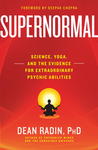
BOOK REVIEW: Supernormal by Dean Radin

Supernormal: Science, Yoga and the Evidence for Extraordinary Psychic AbilitiesSupernormal: Science, Yoga and the Evidence for Extraordinary Psychic Abilities by Dean Radin
My rating: 4 of 5 stars

Amazon page


With this controversial book, Dean Radin presents the scientific evidence for an array of psychic powers, but he frames the discussion in terms of yogic siddhis. “Siddhi” is a Sanskrit term for an ability that isn’t seen among the general population–at least not reliably so– and for the most part these “accomplishments” correspond to the categories discussed in parapsychology (i.e. telepathy, precognition, psychokinesis, and clairvoyance.) [Note: As mentioned, this is a controversial book. I will attempt to provide as unbiased a review as possible. I am generally skeptical, but don’t believe in poo-pooing the study of subjects because they offend my skeptical sensibilities. Furthermore, I try to keep an open mind because: 1.) there is no scientific consensus about what consciousness is or how it works, 2.) quantum biology is a subject in its infancy and we may yet learn there is more quantum “spookiness” going on in the brain than we think. 3.) for all I know we are in an simulation and then it’s all a matter of programming.]

The yogic emphasis doesn’t change the book much from the pop psych literature review of parapsychology studies it would otherwise be, except to necessitate background information on yoga and siddhis. However, this emphasis may or may not have opened up a huge additional readership. Outside of a fringe, siddhis aren’t much in vogue among yoga practitioners these days. Among modern day yogis and yoginis, there are some who believe in them and some who think they’re throwbacks to an era of superstition, malnutrition, and wishful thinking. However, even among the former, siddhis are generally considered a distraction. The advice of most of the great yogis has been to not get lost in the pursuit of such powers because chasing siddhis can derail one from one’s ultimate objective (e.g. liberation.) Still, if even a small fraction of yoga practitioners take an interest, that’s a fairly large readership.

So what exactly is the controversy? Obviously, there are many divergent demographics with differing views on the topic. For hardcore skeptics, parapsychology is right up there with alien abduction, bigfoot /yeti sightings, and the anatomy of the Loch Ness monster with respect to being a legitimate topic for scientific study. On the other hand, there are believers who are offended by the mere notion of studying such phenomena with science, and who say such investigations are an assault on their beliefs.

But that’s not a very interesting controversy—i.e. there are some people who won’t believe in such abilities no matter what the evidence, and others who will believe in them no matter what science has to say. So let’s chop off the hardcore skeptics and hardcore believers and ask what the controversy is as it pertains to those of us who consider evidence when drawing conclusions.

The root of the controversy can be stated rather quickly and clearly. Here it is: the effect size is small but statistically significant. What does that mean? Say this study asks a subject to determine which of five randomly selected shapes has been chosen using nothing but his / her mind. Using pure guessing, one would expect to be right 20% (i.e. 1/5th) of the time. If a person happened to get 32% right in a given trial, that means nothing because small samples don’t give one a convergence towards a mean value. (i.e. Intuitively, you know that if you flip a coin 10 times and get 7 heads, it doesn’t necessarily mean anything. If you repeat that 10-flip set 10,000 times, and still get 70% heads, then you probably have a trick coin or something else odd is going on.) So the issue is that even when experimenters repeat the experiment over and over again such that the average value should converge on 20%, it doesn’t. It stays at, say, 30% (exact effects vary but it’s on this order.)

At this point the reader might be thinking of all the factors that could result in this effect (i.e. cheating [insider or outsider], subconscious observation of facial expressions, random selection that is biased, etc.) Well, so have the scientists. In any study, one wants to account for alternative explanations to the utmost. Over the years, researchers like Radin have put all manner of protections in place from quantum random number generators to booths with extreme sound-proofing and Faraday cages (prevents radio signals from transiting.) Still they get this small positive effect that can’t be explained by alternative explanations.

There is also the issue of the filing drawer problem, which Radin devotes considerable space to discussing. It’s the idea that when drawing conclusions from many similar studies, one must accept that there may be many unpublished studies that sit in file drawers because they didn’t produced negative results. These filed / unpublished studies could negate the outcome of the body of studies of that nature. While this remains an open criticism, there is mathematics for determining how many negative studies would have to be turned up to make the results insignificant. Radin argues that the numbers calculated strain credulity.

So this “small but statistically significant effect” is generally agreed upon by all, excepting conspiracy theorists. Now we get to the controversy, which is how to explain this effect. Skeptics run the gamut from hot-blooded haters who claim that it’s all just a scam perpetrated by hoaxers with tenure, to more diplomatic challengers who provide thoughtful, plausible, and non-nefarious explanations for what they believe are false results. Said objections include file drawer problems, statistical “crud factor” (an observed effect in which large sample size studies can show a significant correlations between any two random variables—i.e. everything is correlated with everything else to some degree), and outlier effects.

The latter is a particularly revealing controversy. Say your study results in this 30% instead of 20% effect, and there’s one subject in the study who (over many trials) got the shape right 80% of the time. If you’re a skeptic, you call that an outlier and you want to cut it out of the study because it may be causing part, most, or all of the effect you see. Your assumption is that that this outlier could be anything from a data entry error to an outright cheater, but it’s obviously not a gifted psychic. If you’re a believer, not only do you want to keep that result, you want to find that person and study them to find out if the result was a one-time fluke, or if you have some rare, gifted person.

The book is arranged into three parts. The first part offers background on yoga and siddhis. The second part is the heart of the book and it presents an overview of results from studies of precognition, telepathy, psychokinesis (both of animate and inanimate objects), clairvoyance, and the effect of meditation on these abilities (which also shows a small positive effect, i.e. the general population outdoes probability by a little bit and experienced meditators outperform the general population by a little bit.) The last section is just a couple chapters about the future of parapsychology.

I found this book to be interesting and thought-provoking. Radin comes across as a reasonable investigator who is willing to accept that there is a lot of duplicity going on out in the world, but yet when one uses the methods of science one obtains results that would be generally accepted as successful across the social sciences. At times he does go on anti-skeptic rants. On the other hand, one can imagine his frustration in dealing with individuals unwilling to pin down how much higher the bar must be for parapsychology results over results in more mainstream topics. I think Radin’s greatest mistake was in discussing levitation. Besides at a quantum level, the effects of gravity are well-understood and non-negotiable. While our lack of understanding of consciousness leaves wiggle room to at least consider some unusual happenings, levitation seems a non-starter. Fortunately, as it hasn’t been studied, Radin just presents a couple historical anecdotes and moves on (while—to be fair–acknowledging the fundamental risk in relying on anecdotes.)

I’d recommend this book. I can’t say it swayed my belief on the topic, which tends skeptical, but it did inform my confusion. (It should be pointed out that not all these abilities are equally reviled by science. Precognition is the most fundamentally opposed because it seems to violate the fundamental cause and effect nature of the universe at our scale and larger [as opposed to the quantum level were all sorts of weird happenings transpire.]) I do agree with Radin that there shouldn’t be taboos in science in which scientists are afraid to study a subject of interest because the prevailing notion is that it probably doesn’t have merit. If there weren’t scientists with the cojones to study “crazy stuff” we’d no doubt be far behind our current understanding of the world.

View all my reviews

BOOK REVIEW: Sitting Still Like a Frog by Eline Snel

Sitting Still Like a Frog: Mindfulness Exercises for Kids (and Their Parents)Sitting Still Like a Frog: Mindfulness Exercises for Kids by Eline Snel
My rating: 4 of 5 stars

Amazon page


Anyone who’s ever taught children mindfulness, concentration, or relaxation knows that one can’t use the same tried and tired approach one does with adults. One must recognize the strengths and weaknesses that children’s level of cognitive development brings. [That said, I’ve found myself in front of a room full of kids who sat with the unflinching stillness of bronze Buddha statues, but that’s because regular practice was part of their school experience.] This is the twin premise of Snel’s book: that one needs to tailor one’s approach to teaching children to be mindful, and that their practice needs to be integrated into their life on the whole.

It should be pointed out that the book isn’t just a collection of exercise for children. It’s also a book for parents to help them align their approach to parenting to the mindfulness that the child is developing. It’s also a book of application. That is, it’s not about practicing mindfulness meditation in the abstract; it’s about using the understanding that arises from that practice to improve behavior and emotional coping.

Chapter 1 introduces the topic of mindfulness and sets up the book’s approach as well as explaining the use of the audio exercise that go along with the book. The second chapter explains a mindful approach to parenting by which parents can adopt a calmer and less emotionally charged approach to interacting with their child. Chapter 3 explains how and why breath is used as the basic anchor point to life in the here and now. Chapter 4 suggests how attention can be improved, and mindful eating is used as a tool to advance this objective. The next chapter explores how mindfulness can be practiced using the body as a means to anchor one’s awareness while simultaneously being more aware of what’s going on with one physically. There is discussion of mindful walking, but most of the chapter is about teaching children to be more cognizant of what they feel as a precursor to being more emotionally aware.

The next several chapters cover emotional awareness and how to improve response to emotional situations (both for the child and for the parent.) Chapter 6 uses the analogy of a weather report as a means for children to evaluate their emotional state. Chapter 7 expands on the topic by considering how one can manage one’s response to emotions. The crucial topic of witnessing the changing nature of emotional states is the subject of Chapter 8.

The last two chapters examine how to cultivated desirable character traits in children. The penultimate chapter describes how kindness can be fostered as a skill in children. The last chapter is entitled “Patience, Trust, and Letting Go” and that probably adequately describes the gist of the topics covered. The concept of an “inner movie theater” is discussed as a tool to facilitate building the desired characteristics.

There’s a single page bibliography and a table of audio exercises at the end. As far as graphics are concerned, they are mostly whimsical drawings of frogs.

I found this book to be concise, informative, and designed to appeal to the child’s need for concrete–as opposed to abstract—conceptualization of this, otherwise cerebral, topic.

I’d recommend this book for parents, teachers, and others who interact with children.

View all my reviews

5 Minds You Meet in Meditation


No matter what style of meditation you practice, you’ve probably heard the following refrain: “And if you find your mind wandering, non-judgmentally make a note of where your mind went, and let that thought drift away as you return your awareness to __________.”


I’ve certainly heard many takes on that teaching, and had plenty of opportunity to implement that advice. In the process, I’ve noted that the places my mind wanders can be classified into several categories.


5.) The Planner: Our conscious mind is first and foremost about answering the question, “What’s the worst that can happen, and how can I make that worst case less bad?” The mind wants to anticipate undesirable events and either make an end run around them or figure out a way to make them less troubling. The Planner wants to rehearse everything from making dinner to being interviewed for a job to having a dreaded conversation.


4.) The Entertainer: This is the mind that sticks songs in your head and replays clips of movies.


3.) The Walter Mitty / The Bolsterer: This is the daydream mind which cooks up scenarios in which you are the hero.


2.) The Subconscious Image Generator: In a relaxed state in which the conscious mind is quieted, one may find oneself seeing images that probably don’t make a lick of sense. The pictures may come and go in a way that make them hard to maintain even a glimpse of. This is the same kind of imagery that one experiences in the hypnagogic state–as one is drifting towards sleep.


1.) The Critic: Saving the most despicable for last; this is your inner critic. The one who thinks that you won’t succeed at any given task.

5 Tools to Hulk Your Way Out of Your Comfort Zone


5.) Take a class / Join a group: While I’m partial to yoga and the martial arts, the class could be in any area that presents a challenge.  However, there are a couple of advantages to the aforementioned two (to which I would add dance.)


First, these disciplines train one to be expressive with one’s body and to move more freely. This can do wonders for confidence. People store tension in their bodies without even realizing it. Many have postural problems that effect confidence and self-perception.  A 2014 New Zealand study found that posture can have a strong effect on emotional state.


Second, no matter who one is, one will be challenged by new approaches to movement.  The average person has great difficulty learning to use their body in new ways. One needs to drill in movements conscientiously to achieve competency. Our conscious mind, frequently gets in the way. Even the most athletic and coordinated people will need to work it, failing repeatedly until they succeed.


Why is the challenge so important? Many people go through life afraid to fail, but far too few fear never failing. Sounds idiotic. Nobody wants to fail. I have some hard news. If you’ve never failed, it’s not because you are unmitigatedly awesome in all things. It’s because you’re living in a box and cherry-picking life experiences that feel unthreatening.


If, like me, you’re an introvert, this approach offers the additional benefit of social interaction that is of a predictable / schedulable nature. One needs the interaction, but the problem comes when one has social interactions and / or sensory stimulation that go on too long and in an unpredictable fashion. Therefore, being able to schedule such time is a good way to go about being a more productive introvert.


4.) Writing  / Visualization:  These two approaches to mentally rehearsing allow one to keep one’s inner critic in check. The problem with simply day-dreaming it is that critic can chirp in without being that cognizant of it.

In visualization, one quiets the mind and can then non-judgmentally acknowledge and dismiss the negative thoughts. In writing–be it as a journal entry, poem, or a story–we may not notice the nagging voice of the inner critic on the first draft, but you can take note of it and undo it in rewrites.


3.) Travel / Living abroad: I should point out that not just any old travel will have the desired effect. Many people plan their travel with the objective of being comfortable at the fore.  They eat at places that serve the same kind of food as at home. They stay in hotels with virtually all of the comforts of home, and sometimes many more. This is understandable because the traveler might just be seeking rest.  However, if one is seeking the epiphany or enlightenment experiences talked of by backpackers and ashram-dwellers, that’s not something that comes from staying in resorts or eating at American fast food joint. Those kinds of brain changing experiences come when one is stripped from the familiar and has to surrender one’s attachments to the way one thinks the world should be. One’s perception of culture and worldview changes radically when immersed in a foreign environment.


2.) Game it / Roleplay: There’s a big movement to gamify all manner of everyday activities.  In her book, “Reality is Broken,” scholar of game design Jane McGonigal describes a game called “Chore Wars” that incentivizes the doing of mundane household chores.


What is it about games that help one move beyond one’s limits? First of all, it incentivizes actions. And if you’ve ever noticed people playing games on their phone or FB for hours on end, you’ll note that it doesn’t take much reward to keep people plugging away—as long as the game is structured well.


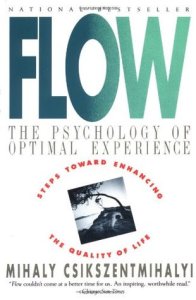
Second, good games provide a built-in process of “leveling up.” This means that the challenge keeps being intensified as our skill level advances. Those familiar with Csikszentmihalyi’s conception of “Flow” will recognize that matching skill level to challenge level is one of the most crucial elements in facilitating flow-state.


Roleplaying is a bit like the previously mentioned tools of visualization and gaming in that it’s a way to have a low-cost rehearsal. If one has someone with whom one can engage in such a roleplay, than one also has someone to help make you aware of your inner critic and its deleterious effects. And that brings us to the final tool:


1.) Have a spouse, partner, and or confidant: In “Why Zebras Don’t Get Ulcers” Robert Sapolsky tells a story of being interviewed by a magazine. He was asked what the number one thing that they could tell their readers about reducing stress.  To which he replied that the most well-established factor in stress reduction is to have a spouse / life partner with whom to share one’s challenges.  Unfortunately, this was a magazine for women business leaders, a significant portion of whom had given up on permanent relationships and families. They, therefore, asked him what else he had.  Still it’s hard to overlook the anxiety-fighting effects of having someone around with whom to share one’s dread.

POEM: River to Sea

The river twists through a barren landscape.

Filling with flotsam, detritus, and silt,

dragging death downstream,

it will pour into a bright, blue sea.

You should savor that scene,

but your view is from above,

and so you see a shit-colored plume

splaying into the clear, calm waters.

And you fear the shit stain

will spread across the sea.

But it doesn’t.

It seems to settle.

You never knew the clear and calm could

subdue those murky, mucky waters.