How to Choose a Muay Thai Gym in Thailand

Tiger MT Beginner's Area. (The mats are up for cleaning to prevent Staph outbreaks.)

Tiger MT Beginner’s Area. (The mats are up for cleaning to prevent Staph outbreaks.)

So you’re going to Thailand and you want to learn a bit of Thai Boxing. Where do you go to train? This is the question under consideration in this post.

I just got back from two weeks of training at Tiger Muay Thai & Mixed Martial Arts on Phuket. This was my second experience training Muay Thai (MT) in Thailand. In October of 2012, I spent 6 days at the Muay Thai Institute (MTI) in Rangsit (a suburb of Bangkok.) The training at both places was awesome, but quite different. This got me thinking about what type of student would find each of these two places ideal. Both of these schools has a niche of students who would find it better suits their needs than the other.

First let me point out a factor that one might think is crucial that really isn’t so much, and that’s price. While I’ve only attended the two schools, I did quite a bit of web research and found that prices don’t range that widely. Particularly in Phuket, where there is a saturation of the market, everybody seems to charge around 3,000 Baht ($91USD) per week—give or take 500Baht. While 2,500 to 3,500 Baht ($76 to $106 USD) might seem like a big gap, there could be very reasonable explanations for why a gym is at the high or low end. Low cost gyms may be more remote, and thus have fewer customers. One should take into account that if one has to rent a scooter or take taxis or pay exorbitant rates for food, one might not be so happy with tuition savings. A gym at the high-end might offer more training opportunities beyond MT, may have more facilities, or may have more prestigious trainers (or just more trainers–period.) [Note: For what you pay you can probably get 24 to 28 hours of classes in per week.]

Now I suspect there are some who will say, “Hey, stop relying on the internet. Find out where locals train. There are gyms that produce winning fighters, but that just aren’t as fancy/web-savvy but are much cheaper.” This may be true, and– if one speaks Thai–that may be the way to go. However, the places that have glitzy English-language websites, usually also have trainers and staff that speak English and that can be a big advantage if one doesn’t know more than Su-was-dee-krap and Kob-Kun-krap.

Note: What I’m saying about price doesn’t necessarily apply to lodging and food. Some gyms offer accommodations and meal plans that may not be competitive with what one can do at local guesthouses and restaurants. Web research should tell you whether you are getting a decent deal staying at the gym. If you don’t mind Spartan accommodations (and I don’t) the baseline gym rooms often offer great savings. I stayed at the gym at both MTI and Tiger, and found it was a good deal (but, again, I don’t need TV, AC, or other luxuries–a bed, a fan, and my Kindle pretty much have me covered.)

Tiger had a meal plan, but I didn’t use it. However, I can’t say that I even looked at its price. I like to try as many different places as I can, and I ate at most of the restaurants and cafes on that strip. I will say there are a lot of cheap, tasty, and nutritious places to eat within walking distance of Tiger. My experiences with the restaurants on the strip were overwhelmingly positive.

So this brings us to what does matter. Some questions you should ask are:
-What is the typical student/trainer ratio?
-What styles are taught at the gym? (i.e. Only Muay Thai or other disciplines as well?)
-Are classes mixed abilities or are there skill level divisions?
-What does the typical class consist of for the level at which you will be training?
-What are the trainers like and how does that jibe with what you need?
-Where is the gym located, and how close is it to the services you’ll need?

Of course, the central question that undergirds five out of six of the questions above is, “What do you want to get out of the training?”

The MTI Gym from my room.

The MTI Gym from my room.

Student/Trainer ratio: How important this is varies radically depending upon what one wants from training. If one is going to class primarily for fitness, having a low student/trainer ratio may not be important. However, if you are looking to improve your technique, it matters greatly because you need attention to the minutest details.

I attended Tiger in peak season and MTI just before peak travel season. That said, I think I can safely say MTI probably always offers lower student/ trainer ratio. (I don’t think MTI’s student attendance is as tourism-cyclic as it has more Thai and expat students and relatively few foreign visitors at a given time. Tiger MT is probably very tourism-centric at the beginner level.) In Rangsit, there was often one trainer to every one or two students. The beginner’s class at Tiger had many students per trainer. However, Tiger offers four separate classes of Muay Thai (Beginner, Intermediate, Advanced, and Fighter), and as one moves up there are fewer students per trainer. So if you “test out” of the beginner’s class your ratio gets better.

One should note that at the extremes one may find a low student/trainer to be more a curse than a blessing. First, one will not have many different people to train with, and diversity of training partners is important to growth. Second, having eyes on you every second may become overbearing, particular if the trainer is fixing every tiny error. In such situations, one may never get into the grove.

What do they teach? The two schools I’ve attended were at opposite ends of the spectrum on this issue. MTI taught Muay Thai–that’s it and that’s all. If you just want to improve your Muay Thai, MTI is a great place for it. There’s not the distraction of tons of people coming through doing other things.

Tiger MT, on the other hand, taught about everything there is to teach. If you want to get into Mixed Martial Arts (MMA), they’ve got you covered with classes on MMA tactics, Brazilian Jujutsu (BJJ), and Boxing in addition to Muay Thai. On the other hand, if you’re a martial arts wonk, who likes to get into the evolution of the arts or understand the combat aspects, they also teach Muay Boran and Krabi Krabong. Muay Boran is the unarmed ancestor to Muay Thai, and Krabi Krabong is a weapons system.

Mixed abilities v. Tiered classes: If you are a rank amateur, an advanced practitioner, or a competitive fighter, you may be pleased with multiple tiers of classes. A beginner may be intimidated or uncomfortable training with advanced students. Advanced student may have a lackluster training experience when working with a lot of people who are well below their skill level. On the other hand, if one has a bit of confidence and fitness, one may find a mixed abilities class enjoyable because one gets an opportunity to pit oneself against more skilled or experienced training partners.

In reality there was not much difference between Tiger and MTI here, though it might look like there was. As mentioned, Tiger MT had four different classes for MT and these were held in distinct areas, but all the other courses (e.g. MMA and BJJ) were mixed abilities. At MTI, everybody was taught in one big gym. However, because there was a low student/trainer ratio, there were usually at least three or four distinct groups (sometimes groups of one or two) training concurrently and the gym was big enough for these small groups to not be in each other’s way.

Class schedule: There’s a widespread standard approach to Muay Thai teaching that goes: running laps, other warm-up exercises, drills / shadowboxing, rounds of bag work, rounds of focus mitt drills, rounds of sparring, and cool down exercises. However, the emphasis can vary tremendously from one gym to another. In particular, some schools will make great efforts to drill the basics before putting a student into sparring or teaching more complex tactics. Other schools have their beginners hit the ground running to a greater degree. Each of these approaches will appeal to a certain type of student. Some want to get into the meat of training by sparring as soon as possible even if their fundamentals are a bit shaky. Others are concerned about having solid foundations before building upward.

Of course, this is all a matter of degree. At every gym, beginning students are going to spend more time drilling than sparring—and that’s as it should be. One needs to learn the techniques well before one can have any hope of applying them in a quasi-competitive / competitive environment effectively. Usually the emphasis for beginners will be on getting the basic mechanics down, and intermediate students will spend more time pumping up the power and working on application.

Of the two places I trained, MTI took a like more time and attention with the nitty-gritty details of form and technique, and Tiger gave one a pretty broad experience from the get go, i.e. they got student into light free sparring right away.

What are the trainers like? I’m not just talking about their fight records or whether they were champions or not. Both of the places I trained at had trainers with very impressive fight careers. Also important is the trainer’s disposition. If you’re just trying to get fit and learn a move or two, an intense, scar-faced task-master who works you till you puke and kicks you till you collapse may not be for you. On the other hand, if you’re preparing for a fight or are just deadly serious about your training, the smiling old softy may leave you disheartened. Some students may want someone who is a stickler for detail, and others may want someone who will focus on getting them in better shape. Unfortunately, while you can probably get information about a trainer’s fight history online, you may only be able to get information about their disposition by visiting, trying the place out, or by talking to people who’ve trained there.

It should be noted that a common complaint about many MT gyms is that the trainers don’t seem to care. Students need to understand that they may have to be a little proactive to get the best relationship out of their trainer. Keep in mind that trainers are overwhelmingly extremely driven individuals. Often a trainer has had 200+ fights in their Thai-boxing career, and they still do their own training every single day even if they’re 40 or 50 years old. Plus, they have their own young fighters to train for competition. They will often have a very low interest in–or tolerance for–tourists who just want to half-ass the training as an alternative to jazzercise class. If you want to get their respect and prove worthy of their attention, you’ll need to gut it out day-after-day.

To put this more clearly, don’t whine about the trainer not giving a damn if any of the following apply to you.
-You join laps 20 minutes into class to avoid all the running.
-You leave early so you don’t have to do all those dreadful push-ups at the end of class.
-You take a water break right in the middle of a round of bag work.

Your trainer is someone who has probably:
a. trained until he puked
b. exercised until his muscles literally gave out
c. used the ropes to climb to his feet
If that was you, would you have a lot of enthusiasm for the half-assers?

Keep in mind, the most gregarious trainer may not be the one who’ll give you the best training experience. The guy who doesn’t say a word and seems mean as hell may take the greatest efforts to develop your skills. At MTI there was a trainer who smacked my arm every single time my guard was not perfect.

Location: I’m not just talking about whether it’s beach-adjacent or not. (Some may find nearby beaches or nightlife too tempting or distracting, while others may be into that.) There are a range of services you’ll want ready access to such as laundry, ATM, food of variety, taxi services / scooter rental, the occasional Thai Massage, and massive amounts of bottled water.

MTI was located in a Bangkok suburb. If you don’t mind a good walk, pretty much everything one might need or want was within walking distance via shopping malls, 7-Elevens, and even hardware stores. Tiger was in a less developed area, but it was on a stretch of road that was littered with MT gyms and fitness centers, and so all the essential businesses a foreign student would need were plentiful on that strip of road, and it was a short ride to Phuket Town for those things that long-term visitors might unexpectedly find that they needed.

If you are interested in martial arts, I’d highly recommend putting in some time at a MT gym while you’re visiting Thailand. It’s exhausting, but worth it. I hope this post will give you some food for thought about what to consider in picking a gym.

BOOK REVIEW: The Warrior’s Path James Sidney (ed.)

The Warrior's Path: Wisdom from Contemporary Martial Arts MastersThe Warrior’s Path: Wisdom from Contemporary Martial Arts Masters by James Sidney

My rating: 5 of 5 stars

Amazon page

My upfront apology: Having drafted this review, I noticed that the book comes off sounding like a bunch of old folks being curmudgeonly about the current generation. As I read this book, that wasn’t the feeling I got. Therefore, it may be a matter of the points that resonated with me, and be more reflective of myself than the martial arts sensei (teachers) who have chapters in the book. [That being said, young readers be forewarned that your generation does get blasted upon not only in this review, but by the sensei in question.]

Fifteen prominent martial arts teachers offer their insights in this book. The group is in many ways homogenous. All fifteen teachers are practitioners of Japanese gendai budō (the modern-day martial arts that developed after the Meiji Restoration [1868]; as contrasted with kobudō or koryū bujutsu, i.e. old school martial arts). All of these martial artists were born in the 1910’s and 20’s and began their study of martial arts in first half of the 20th century.

These teachers are a bridge between the founders of these arts and the arts as we know them today. In a few cases, they are also bridges between kobudō and modern martial arts. For example, Hiroshi Tada was a student of Morihei Ueshiba, the founder of aikido. While we think of O-sensei (Ueshiba) as a gendai budō practitioner because he founded a modern school, he was brought up on kobudō. Furthermore, students of Gichin Funakoshi (the Shotokan karate founder), Jigorō Kanō (the Kodokan judō founder), Hironori Ōtsuka (the Wadō-ryū karate founder), and Dōshin Sō (the founder of Shōrinji Kempō) are represented.

This book is particularly important in that several of the teachers in it have passed away since the book was published. Time is receding for this generation’s thoughts to be saved for posterity. A cursory google search revealed that at least four of these teachers have passed away: Hidetaka Nishiyama (2008), Tatsuo Suzuki (2011), Keiko Fukuda (2013), and Ron Nobuto Omoto (2013.) However, some were more well-known internationally than others, so there may be a few others that passed on without attracting the attention of English-language websites. However, the youngest of them is 84 (the oldest believed living is 97), and so it’s safe to say there may not be many more chances to hear these people’s wisdom.

I’ve pointed out the homogeneity of this group, but there’s also a diversity about them. Practitioners of karate, judō, aikidō, shōrinji kempō, kendō, kyūdō, and Atarashii Naginata are represented. Despite the notoriously male-dominated nature of Japanese martial arts, at least there are two women’s voices in the mix. While all of the artists are of Japanese ancestry, they’re not all Japanese by citizenry. There are two Americans and two Canadians among the bunch, and one individual who was born in China. There are also individuals who were born in Japan but moved abroad to places like France and Brazil to spread their art.

There are a few themes common across multiple of the commentaries. It might be tempting to dismiss some of these points as the “back-in-my-day” sentimentality of the aged, but their experiences are sometimes too similar to lack veracity.

First, several of the teachers said there was much less doggedness in recent generations than in their era. People come into the dōjō (a martial arts school), dabble a little, and–if they’re not constantly entertained by new and fancy techniques–they quit. As a result, there are many practitioners who possess a vast repertoire of technique, but they aren’t skilled in any of it—and even more who get nowhere. The theme was that there is no fast-track to success in budō, one has to work at it day in and day out. It should be noted that all of these individuals were born before 1930, and yet were still teaching / training in 2003 when the book was published.
Second, this generation devoted considerable effort to developing the mind as well as the body. With the availability of better nutrition, training equipment, and sport science, young martial artists may be physically fitter than ever on average (I’m talking about competitors not those using martial arts as a fat camp), but they are also mentally weaker than ever—with limited attention spans and emotional control. Present-day martial arts students often give little credence to the value of training the mind or carrying a martial arts mindset outside the dōjō. Several of the teachers in this book mentioned practicing Zen or some other form of mental exercise, and some emphasized the importance of carrying the clarity and intention of the dōjō about everyday life.

The problem with this is that the martial arts become a young man’s game, and there becomes a lack of experience. A student does a martial art for a few years and then abandons it because his or her physical athleticism isn’t going to increase. This decreasing physical capacity translates into becoming a weaker martial artist. The only way to grow in the long-run is to become mentally stronger, more self-confident, and having better emotional control.

The problem is that this mental strength and confidence often becomes confused with arrogance or cockiness. But as Nobuyuki Kamogawa (kyūdō) points out, the problem with arrogance is that one can’t see one’s weaknesses—and, thus, can’t grow. While Japanese arts may seem overly-formal (and there can be truth to that), it shouldn’t be forgotten that part of what this formality does is (potentially) build mental discipline and humility.

I think Toshiro Daigo best summed up the problem of not living the art. He said, “But to young Japanese people, judō becomes judō when you put on your judō costume. So without the costume, judō doesn’t exist.”

Third, judō, karate, and kendō teachers bemoaned a shift away from the pursuit of victory by decisive technique (e.g. the the ippon.) Over time, there has been an increased reliance on building up a win by minor points. In judō this may mean trips instead of throws; in kendō it means going for the forearm rather than the head. In other words, competitors have become more risk-averse and less bold. Concern about this is two-fold. For one thing, there’s a worry about the dilution of these arts, but there’s also concern about the sport becoming less interesting to watch and thus losing its following.

Related to the previous two criticisms is a concern about training to build champions, while forgetting to forge good students. This was emphasized not only by some of the sport-oriented art teachers, but also by Hiroshi Tada. Tada, as an aikidō practitioner, is in the unique position being the only one of the teachers to practice a non-sport martial arts system.

Fourth, several sensei suggested the importance of learning for oneself. One of the teachers, Rod Nobuto Omoto, was an uchi deshi (live-in student), and he—as in the old days—spent a lot of time doing chores while getting little to no training. The point is not so much to criticize the younger generation, but to inform them that they must take the reins of their martial arts practice. This may come to a surprise because the educational experiences they are most used to is having information handed to them in as learnable a form as possible.

Fifth, there was a general disdain for the idea of thinking of one’s art as being inherently superior to all others. Masao Takahashi (judō) and Mitsusuke Harada (karate) both made this point. Harada proposed that abject faith in the superiority of one’s art encourages the development of martial artists who cannot defend themselves. If you think your system is inherently best, you may begin to rely on that illusion of superiority rather than on the advancement of your own skill.

Sixth, the importance of mutual benefit was emphasized throughout. Of course, for the judo practitioners, the idea of jita kyoei (self-perfection, mutual benefit) is one of the two Kodokan budōkun (martial arts maxims.) [The other being seiryoku zenyo, or maximum efficiency.] Shigeru Uchiyama said that the belief in Shōrinji Kempō (whose practitioners are also Kongo Zen pupils) is that of “…living half of your life for yourself and half for others.”

A couple of other points that caught my attention were brought up by individual teachers.
Keiko Fukuda expressed concern about women being trained in the same manner as men, and, thus, using too much strength. The 9th dan was concerned about injuries resulting from this over-reliance on strength. This is an interesting point which I hadn’t given much thought. No doubt it’s a controversial point as well. It’s hard for me to comment about whether Fukuda is just old-fashioned and a product of her time and culture (which is, I’m afraid, highly misogynistic) or whether her point is valid. However, I’d be willing to give her the benefit of the doubt as she was an extremely impressive woman.

Lest one think that these are all just traditionalists trying to keep the traditions alive, consider a quote by Yoshimitsu Takeyasu that speaks otherwise. “Not all traditions are good but we have to identify the ones that should be kept.” Rod Nobuto Omoto said simply, “Tradition is not important.” However, I think Omoto’s point is more nuanced than it seems (and perhaps more Taoist) in that what he seems to be saying is that if you make the tradition important it becomes about the tradition and not the what lies beneath the tradition (e.g. values, etc.)

Omoto also offered a great deal of thought-provoking insight into death. It was clearly a topic that he’d reflected on not only as someone coming to the end of his life, but also as one who practices budō.

I think this is an important book for martial artists of all stripes. However, I think that even non-martial artists might learn a thing or two from the insights of these old masters.

View all my reviews

Why I Study Thai Yoga Bodywork

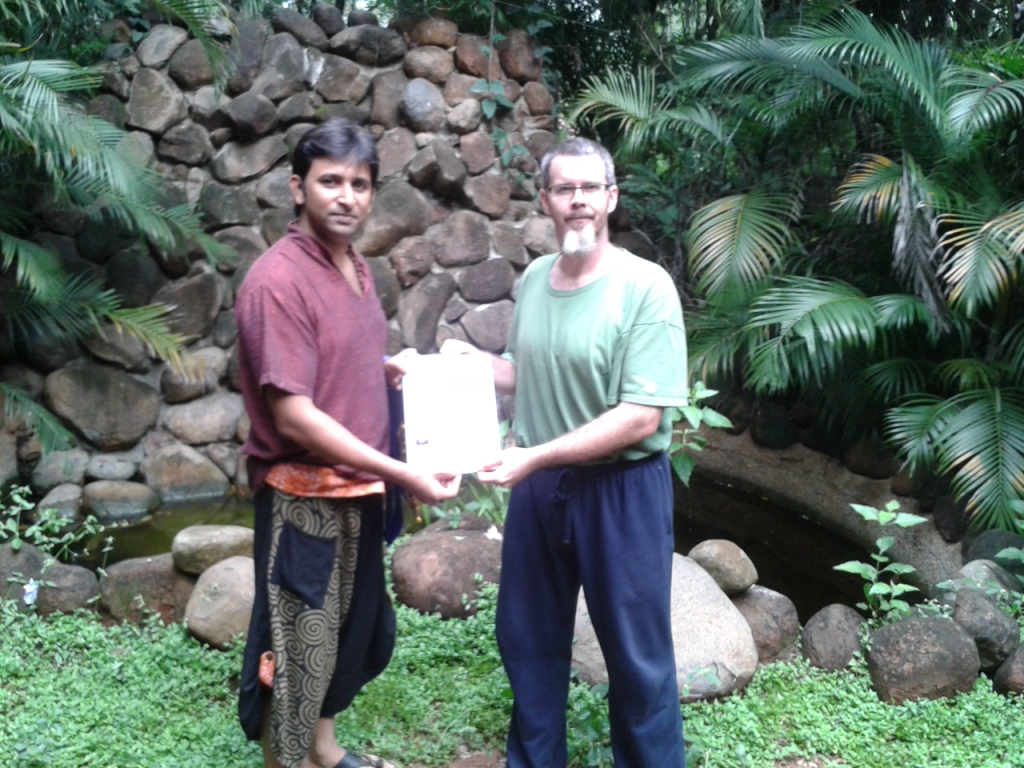
Receiving my 60 hour course certificate from the teacher.

Receiving my 60 hour course certificate from the teacher

Thai Yoga Bodywork (TYB), also called Nuad Boran (ancient bodywork) or Thai Massage, is a system that integrates assisted yoga-style stretching, reflexology, acupressure massage, and elements of Ayurvedic healing to stretch and massage the body. Its history is believed to date back 2,500 years to Northern India, where its roots lay with Jivaka Kumar Bhaccha–a physician in Buddha’s community. However, the art reached its perfection in Thailand, the nation with which it remains most closely associated.

I recently completed an introductory course in this system in Bangalore through the Inner Mountain School of Healing Arts.

Before I moved to India, I thought a lot about what I would like to learn while I was on the other side of the planet. There’s a great deal of expertise on subjects sparsely taught in the US, and it can often be had at a bargain in comparison to American prices.

Some of the skills I wanted to foster were to be expected. I wanted to learn more about meditation and the ways of living in the moment and with a quieter mind. I’ve played with such practice for a long time, and I came to believe that becoming a better martial artist  and person depended upon cultivating fudōshin— an immovable spirit. I’ve seen no route to that state that circumvents quieting the mind, and that requires observing and training the mind. One can only become more physically capable for a time, then growth depends upon the mind, on shedding petty impulses, on being incapable of manipulation, and on being unswayed my the vagaries of emotion. I’ve begun working on this objective through visits to meditation centers and by making my own practice more regular.

I also want to learn about other martial arts, besides the one I’ve been learning my entire adult life. It makes sense to learn something about the indigenous martial arts of the places I visit. I want to experience the similarities and differences of these arts, and to learn about the cultural elements that shape those differences and elements of uniqueness.

However, one of the biggest surprises has been my new-found interest in studying Thai Yoga Bodywork (TYB.) When I visited Thailand last fall I studied Muay Thai (Thai kickboxing) for a week and Thai cooking for a day, but it didn’t occur to me to take one of the many Thai Massage short courses until I was back home. My interest in TYB is reflective of a broader desire to learn more about the indigenous healing methods of Asia, and that goes back a few years.  I developed a vague feeling that I wanted to study such things a couple of years back when I realized my body was deteriorating too fast for comfort, and Western medical treatment consisted of advising me to stop doing a number of the activities that I love.  Still, I must admit that I didn’t really give  a lot of thought to this interest until I started this course.

Having now thought about it, my interest in studying TYB is closely linked to my interest in martial arts. This notion might seem hard to reconcile.  TYB is a healing art, and martial arts, while they should be grounded in a sound moral philosophy, are essentially about inflicting damage on a body. The  two disciplines seem to be at odds. Still, they have a great deal in common. In each, mindfulness is key. Control of the breath is a common element of both. In Japanese martial arts there is a word, taijutsu, which means body skills, but which implies efficient use of the body. This means favoring bigger muscle groups over smaller ones where possible and taking advantage of the body’s natural alignment (e.g. straight spine) and body weight. These concepts that I had long practiced in budō were also ubiquitous in TYB. Furthermore, a number of the points that I had learned to attack, were now targeted to heal.

Still, some of these same points could be said to be common to any system of movement done properly, be it dance or exercise. So why I was drawn to TYB in particular? The most direct reason is to learn how to fix the failings of my body, and those that I’ve witnessed in others. I experienced these methods as a recipient in Thailand, and could see their value at once.

There’s also a benefit from increased understanding of anatomy and bodily awareness. One learns about how the musculature works to move the body in a way that isn’t easily picked up from textbooks. One begins to read bodies like others read books. One gains insight into the bodily deficiencies that one has taken on without even being cognizant of them. A martial artist may, on average, be a hundred times more bodily aware than the average person, but that doesn’t mean there isn’t great room for growth. (It speaks to how sadly lacking in bodily awareness most people are as much as anything.)

Still, this isn’t the full story of why I wanted to learn this art. Another reason came to mind in the introductory session, before we even began learning the technique. The teacher was talking about how TYB teaches humility, and how one has to learn to touch a stranger’s feet with compassion and devotion to that person’s well-being–an act that doesn’t come naturally to most of us.  Admittedly, this isn’t a level of humility and compassion that I have developed in life to date. Though I am the son of a mother who–as a nurse as well as a mother–was probably more at ease with putting the well-being others above her own comfort than anyone else I’ve ever met, for me this is a struggle outside my comfort zone. The martial arts teach a kind of humility (a lesson that all too many practitioners find a way to make an end run around), but if one’s practice is separate from one’s career field it’s easy for the notion of service to be so abstract as to lose meaning.

This, of course, returns back to my earlier mention of the mind. One’s ego is the biggest barrier to personal growth. Ego makes one easily manipulated. Ego makes one subject to petty impulses. Ego makes one give into fear and anger.

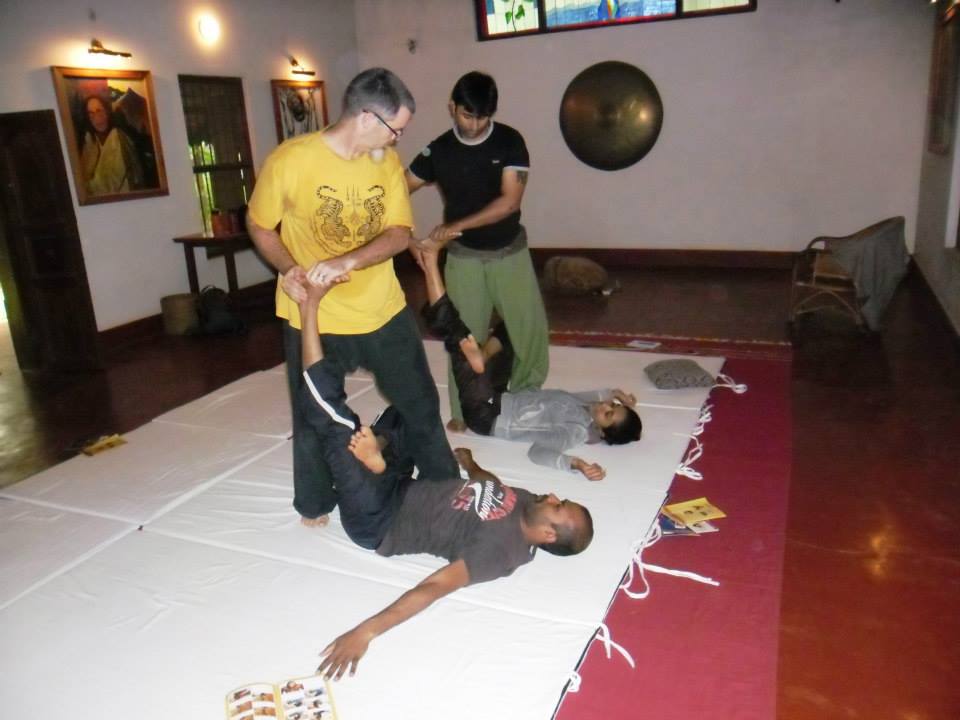
Learning a stretch

Learning a stretching technique

BOOK REVIEW: Ip-Man Portrait of a Kung Fu Master by Ip Ching, et. al.

IP Man: Portrait of a Kung Fu MasterIP Man: Portrait of a Kung Fu Master by Ip Ching

My rating: 3 of 5 stars

Amazon page

Ip Man led an interesting life. The master of Wing Chun Kung Fu lived through tumultuous times that included the Boxer Rebellion, the Sino-Japanese War, and China’s Communist revolution. After the Japanese occupation he served for a time as a police chief. Coming from a wealthy family, he experienced a riches to rags fall when the Communists took over. He had to move from his home in Foshan to Hong Kong. His use of kung fu was not restricted to the training hall, but, rather, included a few real world altercations. A couple of films have been made(loosely) about his life.

All that being said, this book doesn’t do a great job of capturing the life of this intriguing man. To be fair, the book isn’t really a biography proper–though the title might lead one to believe it was. However, it’s not entirely clear what the book is. Its fifteen chapters are each built around a principle and use vignettes from Ip Man’s life to illustrate how the Grandmaster lived virtuously. This makes the book seem more like treatise on martial arts philosophy and/or strategy. However, some chapters do a better job of making clear what the actual principle is and how the events of Ip Man’s life exemplify them than do others. In some parts it does a great job but in others it’s only lackluster.

There are some fascinating stories about the man’s life in the book, but they are generally told in a lifeless manner. In part this may be done on purpose as we are told that Ip Man eschewed embellishment and favored humility, but it makes the reading experience less than gripping. It’s also probably that some of the details were lost when Ip Man died in 1972. This lack of detail leaves one at times wondering. Throughout most of the book we get a picture of Ip Man as a virtuous warrior. However, there is one vignette in which we read about the Grandmaster picking a fight with a man by taunting him with humiliating insults about the man’s appearance. Ip Man does this to teach his student a lesson in courage. His lesson notwithstanding, this behavior paints Ip Man as anything but virtuous–rather than a humble martial arts master he becomes a pathetic bully. The author, Ip Man’s son Ip Ching, suggests that this might have been a setup for the student’s benefit, but with the prior assent of the bullied man. At any rate, there was no fight because the bullied man backed down–whether because it was staged or out of genuine fear remains unknown.

For some readers the most surprising omission will involve a lack of any mention of the man who was far and away Ip Man’s most famous student, namely Bruce Lee. There may be a number of reasons for this omission, including a desire to prevent the teacher’s story from being overshadowed by his student’s fame. However, most readers would probably like some inkling of how the ill-fated superstar came to train with Ip Man and what he learned from him. In fact, the only reference to the entertainment aspect of kung fu is a picture caption that shows Shek Kin, the villain “Mr. Han” from Enter the Dragon, at Ip Man’s funeral.

I would recommend this book only for those that have a particular interest in martial arts. It does offer tidbits of interesting events from Ip Man’s life as well as a few great life lessons. It benefits from being a concise book, and thus is not a major time investment to read. However, I don’t know that–short as it is–it would hold the interest of the general reader. Hopefully, someone will take on a more extensive English-language biography of this fascinating man’s life while there are some key people still alive to be interviewed about his life story.

View all my reviews

Transmigration of Blog

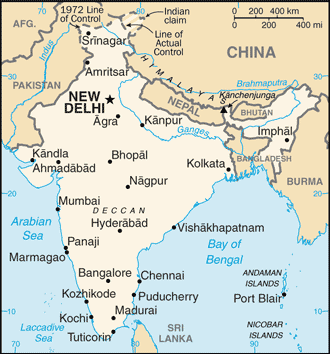
india_sm_2012We’re down to about a month until our move to India.

The house is largely in order with only a few odds and ends remaining.

Most of our worldly possessions are in storage, and I haven’t really missed any of it. (A lot of “moss” collects when your stone stops rolling for a few years.) The house now echoes. Movers will be coming to get the small amount of stuff we’ll ship to India in the next couple weeks. Then we’ll really be living minimalist.

We’ve got all our shots with the exception of the final doses for Hepatitis. We’ll get those in country. With respect to shots, when moving to India, one has to get… well,  all of them.

Visas are in the works though we’ve had some delay on that front. However, fortuitously, the local Indian Consulate is beginning to take applications, and so I won’t have to send my application off to another city and can eliminate the time and risk of postal transit.

My list of things to do consists of fewer large, all-consuming tasks and more quick and easy jobs.

All of this means that I’m getting back to writing.  This is a bit like getting a corroded junk-yard jalopy running again. It’s remarkable how much the creative juices curdle when one spends a few months focusing on home repairs, monitoring contractors, getting shots, and other mundane tasks of international relocation. I worked almost exclusively on drafting two novels for a period of a little over a year, and now–as I resume writing and revisions–I’m having to re-read just to figure out what they’re about. On the bright side, I sometime surprise myself with what I wrote. For me, there’s definitely economy of scale in long writing  projects. Writing eight hours a day yields a lot more than eight times writing for one hour a day. I lose voices, character idiosyncrasies, and plot detail so easily unless I’m immersed in them.

As for this blog, I think a rebirth is in order. Since I’m moving to India, I’ve invoked the concept of transmigration of soul. In Hinduism, some sects of Buddhism, as well as a few lesser known religions, there’s a belief in reincarnation in which the soul may be reborn into an altogether different type of container. For example, if you were good in your last life, you might come back as a lama or a lap cat. If you were bad in your last life, you might come back as a slug or a Congressman. So the question of the moment is what this blog will be reborn as when  it sputters up from out of the ashes.

I would like the site to remain (or, perhaps, become)  humorous, but I’d like the humor to be less curmudgeonly. This presents a challenge because I’m not sure that I know how to be funny without being a curmudgeon. In point of fact, I’m not sure I know how to not be a curmudgeon–funny or otherwise.

I want this site to be reflective of my new life. I’ll continue posting photos, though after the move they will be disproportionately from Bangalore, India, and a few adjacent countries to which I will be traveling. So it’ll remain part travel site. I’m sure I’ll have plenty of lessons learned about travel in India to share.

When I’m not writing or sleeping, I’ll be engaged in a quest of self-improvement. The development of mind and body have been raised to high art in India, and I hope to  find some of those individuals with that knowledge.

Expanding my abilities and understanding of martial arts is one of my goals for this period. It’ll be a challenge to keep from becoming rusty in the jissen kobudō (Japanese old school martial arts that emphasize pragmatic skills) that I have been studying my entire adult life. However, in addition to working on what I know, there are other activities that I think will help expand my understanding while keeping me suitable limber and conditioned. I would like to learn  a little about indigenous Indian martial arts such as kalaripayattu, silambam, and–if time permits–gatka. Furthermore, I would like find a place to train in Bangalore where I can do some training in what I’d call general jissen (practical fighting) skills.

However, my attempts to improve myself will not be limited to martial arts alone. India might be cursed with plagues of poverty, pollution, and–well–plague, but they have no shortage of gurus–whether I can find one that’s reputable and willing is another matter. The older I’ve gotten, the more I’ve realized that I don’t have a firm grasp of my mind. My mind runs and I don’t pay enough attention to what it is telling me; I don’t put enough effort into fixing what is broken. I read a quote recently about people who put great effort into studying the external world, but who remain ignorant of themselves.  This struck close to home, but it’s not just me–it’s widespread. People study psychology in school and learn about cognitive biases, but they don’t put the information to use in becoming more virtuous people. For example, a person might learn about the “self-serving bias” –whereby people claim responsibility for successes but place blame for failures on external factors–and say, “yeah, it’s funny that other people totally do that.”

Part of practicing martial arts is keeping one’s self healthy, against all odds. While I’ve never practiced yoga, I appreciate the belief that mind and body are inseparable. I would like to work on building a body that is less likely to be crippled by the practice of martial arts as I age. I intend to study Thai yoga massage, which incorporates stretching and pressure point massage. There’s an interesting connection between India and Thailand with respect to this form of bodywork. While it’s most closely associated with Thailand, some claim that its roots are in Northern India with a master called Guru Jivaka. While visiting Thailand, I developed an appreciation for the health benefits of this type of massage–particularly for one prone to have things out of whack. However, I didn’t have the time to study it during that visit. There is also the more distinctly indigenous holistic healing system of India, Ayurveda, and I would like to learn more about it as well.

In short, I intend to have a pretty full agenda while living in India, and I hope readers will find my posts about these experiences interesting and worthwhile.

The Good and Ugly of Olden Times

This was posted in my martial arts blog, Jissen Budoka, as well.

I’ve been doing a lot of reading about Japan’s past recently. In my spare time, I’m working on rewrites for a novel in which 14th century Japan features prominently. Being my first foray into historical fiction, I’m finding the need to go back and do a lot of research about the time because the quick and dirty draft I wrote needs a lot of gussying up. I just finished reading Charles Dunn’s Everyday Life in Imperial Japan,  which is about a later period but one which would have shared much in common when it comes to everyday life. Presently, I’m reading The Taiheiki–which is about the 14th century, but which blends fact and fiction.

Doing such research encourages one to consider what it meant to live during that time. We all build constructs of the world to adjust for our limitations in knowledge. Some of these constructs hold up better than others, but they’re all simplifications. When one reflects upon a time before one’s experience–and particularly regarding a place with which one has limited familiarity–there are two major forms of fallacious reasoning that can take hold:

1.) The Golden Age Fallacy: This is the thought that everything was better back in the day–back before humanity started slouching toward craptasticness.

2.) The Outhouse Fallacy: This is the idea that any society that couldn’t manage indoor plumbing couldn’t possibly be worthy of emulation.

Of course, these simplifications are both true and false in some regard, and–as absolute statements–are absolutely false. The truth is something more like what Ralph Waldo Emerson suggested in Self-Reliance. Emerson described society as a wave, receding on one side as quickly as it advanced on the other. In other words, changes maybe seen as progress, but they also bring about the destruction of valuable knowledge. In martial arts terms, the spear becomes obsolete and the art of spear-fighting dies.

LastSamuraiThe movie entitled The Last Samurai revolves around this premise. Of course, in Hollywood fashion the forces of modernity are made entirely villanous and our heroes, the samurai, are entirely virtuous. In a way the movie is perverse in that it suggests we root for the medieval approach over our own.

When considering feudal Japan, Golden Agers point to it as a time during which virtue was paramount, craftsmanship was exquisite, and much culture flourished. They are right; but don’t set your time machine just yet because Outhouse Agers are also correct when they say that it was a time during which most of the population had no rights, wars ravaged the country, and in which farmers were not allowed to partake of many of the products they produced–but rather had to feed and cloth their families with inferior substitutes.

One should be careful to neither romanticize nor vilify the samurai. We should keep what is of value of the old ways without being a slave to the worst ways of our predecessors’ nature. One shouldn’t abandon everything old on the assumption that by definition everything abandoned to the past is refuse.

DAILY PHOTO: Preparing for Battle

Taken October 2012 at Rangsit Boxing Stadium

Taken October 2012 at Rangsit Boxing Stadium

Teachable and Unteachable Lessons

[Note: This is posted in my Jissen Budōka blog as well.]

Source: Wikipedia; Status:  Public Domain

Source: Wikipedia; Status: Public Domain

Miyamoto Musashi, who was undefeated in over 60 duels, claimed that he never had a teacher. Some historians refute this claim. Whether one accepts it or not, the statement astonishes.

Musashi wasn’t talking only about martial arts, but about the many areas in which he was accomplished. Not being a painter or a sculptor, I can’t say how important a teacher is in such domains. But it’s easy enough for me to imagine a successful writer who never took a formal class in writing; someone who read profusely and practiced his (or her) craft relentlessly could do it. (Certainly, one can easily imagine successful writers whose formal education was in some area other than writing because there are so many of them–probably at least as many as those whose education was in writing. Examples include: Vonnegut [Chemistry], Crichton [Medicine], Zane Grey [Dentistry], Ursala LeGuin [Anthropology], and J.K. Rowling [French]. That’s not even to start on the many literary legends who dropped out all together– e.g. Dickens, Faulkner, Twain, H.G. Wells, and Jack London.) This isn’t to say that writing teachers don’t make writing better, but just that there is a path to this skill that doesn’t involve being fed lessons.

However, I struggle to imagine a martial artist achieving so much without a teacher. Boiled down to its most workaday definition, a martial art is a collections of lessons about what works in a combative situation. This is what separates the importance of a teacher in martial arts from that of a discipline like writing. In writing, one has the leisure to make one’s mistakes, learn from them, and self-apply course corrections. Musashi was in life or death duels; he couldn’t learn lessons at such a leisurely pace and in such an iterative fashion.

A martial arts teacher has a number of roles, such as preventing inertia (slacking) from taking hold in the training hall. However, the most fundamental purpose is to pass along the collection of lessons so that a student doesn’t have to learn them all by way of personal experience. Most of us aren’t Miyamoto Musashi; we can’t survive the process of learning all our own lessons.

Needless to say, I am a firm believer in the value of a good teacher. I’ve had several over the years, and I received valuable lessons from all of them–all with different, but no less valid, points of emphasis and flavor.

Having said all that proceeds, there’s much that cannot be taught. Such lessons may be described or discussed, but they cannot be learned except through the initiative of the student. I said that most of us can’t survive the process of learning all one’s own lessons, but I’ve increasingly come to believe that one can’t survive learning none of them either. In the beginning, one must be fed the lessons from a teacher in order grow. However, as the decades pass, one increasingly needs the space to learn one’s own lessons. If one lacks said space, one will stagnate and eventually the wheels will roll off one’s training altogether.

So what are the unteachable lessons? Knowledge can be conveyed, but not everything that a martial artist must learn is knowledge. Confidence cannot be taught. A teacher may explain–or even show–how he or she became confident, but that won’t translate one iota into the student being more confident.  This is like a Buddhist monk telling one that “desire is the root of suffering.” One may understand that statement. One may believe the statement. However, one’s suffering won’t decrease because one has the knowledge.  One’s suffering will only decrease if one conscientiously does the hard work of reducing one’s desires.

Another area of unteachable lessons are the lessons that the teacher has never learned. Loyalty is a great virtue, and so there may be a tendency to restrict one’s learning to the lessons of one teacher. However, even if one has an outstanding teacher and are practicing a great lineage, blind spots happen. The only way to learn whether there is anything of value obscured in those blind spots is to throw off one’s blinders and have a look for oneself.

What blinders? An excellent and tricky  question.  It’s like when someone says, “it’s not what you said, but the way you said it.” We all understand that there is some intangible character in language that is commonly understood but not easily seen or defined. In any culture (and a dōjō contains a culture, believe me) there’s always a collection of norms, rules of thumb, ideas, beliefs, mores, credos, etc. that come to be taken so much for granted that they become an invisible filter through which one sees the world. This isn’t an inherently bad thing, and it’s probably necessary to produce sufficient order in a chaotic world in which to learn and grow. Having said that, some of the ideas and beliefs in our cultural filter may be arbitrary, or at least not universal, but yet we don’t necessarily see the potential for error because we are seeing the world through the cultural filter. We take for granted that grass is green, but what if we see it through a yellow filter? Then it’s blue. Right?

Blatant Blog Post Theft by Martial Arts Outfitters

In all my years of blogging, I haven’t caught any incidents of blatant plagiarism of my posts… until now.  I was looking  through the martial arts posts and saw this post on the MartialArtsOutfitters.com blog posted Thursday.  It immediately seemed to me that it looked just like a post that I had posted a year and a half ago. (See: Yoroi Kumiuchi.) Then I realized that they were the same word-for-word.

This is blatant plagiarism. I mean they copied everything including the photo (granted that was public domain and not mine) and title, and then published them on the same platform (i.e. WordPress.) This wasn’t reblogged, which is a function that I allow because it comes with attribution and a hit to one’s site. The fact that reblogging would have been easier for them to do means that this company was outright trying to steal content.

What’s particularly sad to me is that the thief is an organization that is involved with martial arts. The martial arts should be about advancing virtue not practicing vice. I guess they are targeting those scheezy pedophile “teachers” one hears about in the news, and not high-caliber martial artists.

What is doubly disappointing is that this is a business, and, thus, one would expect that they would be in favor of people paying for what they take in principle.

If you are a WordPress blogger and write martial arts posts, you might want to look at the feed of http://www.martialartsoutfitters.com to make sure they aren’t ripping you off.

If you are a supplier of http://www.martialartsoutfitters.com, be warned they don’t feel obliged to pay for what they take.

DAILY PHOTO: Capoeira Demonstration

Taken in 2011 at the Decatur Book Festival in Decatur, Georgia

Taken in 2011 at the Decatur Book Festival in Decatur, Georgia

Capoeira is a Brazilian system of movement that mixes elements of dance with elements of martial arts.