PROMPT: Cultural Heritage

What aspects of your cultural heritage are you most proud of or interested in?

I’m not sure whether this prompt is directed toward the culture of my ancestors (Irish) or the culture in which I was raised (American.) If it is the former, then the answer is certainly the great literary and poetic talent that was born of the culture (i.e. Yeats, Wilde, Shaw, Heaney, Beckett, Joyce, etc.) But if it is the latter, then it is certainly the great literary and poetic talent that was born of the culture (i.e. Whitman, Poe, Hemingway, Hughes, Twain, Dickinson, Faulkner, etc.)

“Song” by James Joyce [w/ Audio]

My love is in a light attire
Among the apple trees,
Where the gay winds do most desire
To run in companies.

There, where the gay winds stay to woo
The young leaves as they pass,
My love goes slowly, bending to
Her shadow on the grass.

And where the sky’s a pale blue cup
Over the laughing land,
My love goes lightly, holding up
Her dress with dainty hand.

“The Fish” by William Butler Yeats [w/ Audio]

Although you hide in the ebb and flow
Of the pale tide when the moon has set,
The people of coming days will know
About the casting out of my net,
And how you have leaped times out of mind
Over the little silver cords,
And think that you were hard and unkind,
And blame you with many bitter words.

“Death” by William Butler Yeats [w/ Audio]

Nor dread nor hope attend
A dying animal;
A man awaits his end
Dreading and hoping all;
Many times he died,
Many times rose again.
A great man in his pride
Confronting murderous men
Casts derision upon
Supersession of breath;
He knows death to the bone -
Man has created death.

“Down By the Salley Gardens” by William Butler Yeats [w/ Audio]

Down by the salley gardens
my love and I did meet;
She passed the salley gardens
with little snow-white feet.
She bid me take love easy,
as the leaves grow on the tree;
But I, being young and foolish,
with her would not agree.

In a field by the river
my love and I did stand,
And on my leaning shoulder
she laid her snow-white hand.
She bid me take life easy,
as the grass grows on the weirs;
But I was young and foolish,
and now am full of tears.

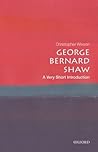
BOOKS: “George Bernard Shaw: A Very Short Introduction” by Christopher Wixson

George Bernard Shaw: A Very Short Introduction (Very Short Introductions)George Bernard Shaw: A Very Short Introduction by Christopher Wixson
My rating: 4 of 5 stars

Publisher Site – OUP

This concise guide to George Bernard Shaw is an exploration of the works of the prolific playwright and how his philosophy and life experiences influenced the stories he created. The book is arranged by periods of Shaw’s own determining, including: Unpleasant, Pleasant, Puritan, Political, Extravagant, and Farfetched. The book does mention Shaw’s novels, literary criticism, and some of his major non-literary activities, but largely in the context of the comedies, tragedies, and histories he wrote for the stage.

If you are interested the works of George Bernard Shaw and how they came to be, I’d recommend this book. It’s a quick read and offers some fascinating insights.

View all my reviews

“Crazy Jane Talks with the Bishop” by William Butler Yeats [w/ Audio]

I met the Bishop on the road
And much said he and I.
'Those breasts are flat and fallen now
Those veins must soon be dry;
Live in a heavenly mansion,
Not in some foul sty.'

'Fair and foul are near of kin,
And fair needs foul,' I cried.
'My friends are gone, but that's a truth
Nor grave nor bed denied,
Learned in bodily lowliness
And in the heart's pride.

'A woman can be proud and stiff
When on love intent;
But Love has pitched his mansion in
The place of excrement;
For nothing can be sole or whole
That has not been rent.'

BOOKS: “Pygmalion” by George Bernard Shaw

PygmalionPygmalion by George Bernard Shaw
My rating: 5 of 5 stars

Available on Project Gutenberg

Pygmalion is a play about class and human connection, and is probably the best-known work of George Bernard Shaw, having been adapted into a popular movie entitled My Fair Lady.

Henry Higgins, an expert on accents and dialects, bets his friend, Col. Pickering, that he can train a poor Cockney flower girl (Eliza Doolittle) to pass as a duchess at a soiree with genteel elites. Higgins is educated and of upper-crust upbringing but is neither refined nor does he have much in the way of people skills. Pickering is a personable and mannerly gentleman. Eliza is on a journey of transformation and her interaction with the two men offers insight into how those of different classes view dignity. (Besides examining class differences, some insight into how men and women differently view human interactions is generated.)

Beginning the last act (Act V,) it felt like the earlier acts hadn’t done the work required of them to motivate the last act behavior / discussions, but — I must admit — that feeling went away by the time the dialogue was complete. (Also, I give benefit of the doubt to the fact that good acting may have conveyed inklings to an audience that couldn’t be garnered from reading dialogue and stage directions.)

There was an Afterword that sketched out what happens in the lives of the characters after the events of the play. I didn’t care for it. There is a certain level of ambiguity in the ending, and I was good with that. I understand that many readers / viewers are not, however. (If you watched Christopher Nolan’s Inception and the spinning top ending drove you batty, you’d probably appreciate this Afterword. I believe the movie (My Fair Lady) tweaks the ending to make it more definitive.)

At any rate, this is a witty and evocative play and is well worth reading (or seeing.)

View all my reviews

“The Dawn” by William Butler Yeats [w/ Audio]

I WOULD be as ignorant as the dawn,
That has looked down
On that old queen measuring a town
With the pin of a brooch,
Or on the withered men that saw
From their pedantic Babylon
The careless planets in their courses,
The stars fade out where the moon comes,
And took their tablets and made sums--
Yet did but look, rocking the glittering coach
Above the cloudy shoulders of the horses.
I would be -- for no knowledge is worth a straw --
Ignorant and wanton as the dawn.

“A Needle’s Eye” by William Butler Yeats [w/ Audio]

All the stream that's roaring by
Came out of a needle's eye;
Things unborn, things that are gone,
From needle's eye still goad it on.