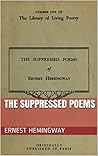
BOOKS: “The Suppressed Poems of Ernest Hemingway”

The suppressed poemsThe suppressed poems by Ernest Hemingway
My rating: 4 of 5 stars

Available online – Public Domain

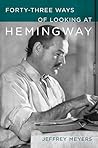
I read this book because my curiosity was piqued by a reference to poems Hemingway published in Der Querschnitt, a reference that was made in a biography of Hemingway I’ve been reading recently (Forty-Three Ways of Looking at Hemingway by Jeffrey Meyers.) Five of the seventeen poems in the book are from Der Querschnitt. (Ten of the poems were published in a book entitled Three Stories and Ten Poems and a couple are odds and ends.)

The Der Quershnitt pieces are bawdy by 1920’s standards, though not particularly for today. The other poems can be a bit intense, dealing in subjects like death in war (Champs D’Honneur,) suicide (Montparnasse, and a curse upon literary critics (Valentine,) but tend to be a bit more refined (excepting Valentine. which may be the least elevated of the collected poems.)

The poems include a mix of lyric, free verse, and prose poem, though all are fairly short (the longest, The Soul of Spain, fits in three pages.)

My favorite was a short lyric poem entitled The Age Demanded, which considers the paradox of the 1920’s as a progressive age, restrained. I also found T. Roosevelt to be fascinating because in the act of critiquing Teddy Roosevelt, Hemingway (wittingly or not) gives us a bit of autobiography. (i.e.“And all the legends that he started in his life // Live on and prosper, // Unhampered now by his existence.”)

I give Hemingway more credit for saying interesting things by virtue of being bold than for saying anything in a particularly interesting way, but it’s enough to make these poems worth reading.

View all my reviews

BOOK: “Islands in the Stream” by Ernest Hemingway

Islands in the StreamIslands in the Stream by Ernest Hemingway
My rating: 5 of 5 stars

Publisher Site – Simon & Schuster

This novel was actually published almost a decade after Hemingway’s death. It was found among his papers, a complete — but rough — draft.

The book’s protagonist is Thomas Hudson, a divorced painter living alone in the Caribbean. The story is told in three parts. In the first, Hudson’s solitary existence is brightened by a visit from his three sons (one from one ex- and the other two from a second.) The second part is the story of a prolonged bender in Cuba. The final section follows Hudson and his crew as they track the survivors of a sunken German U-boat as said Germans try to island-hop their way to safety. The three sections are each quite different in tone. The last part reads like genre fiction (i.e. commercial fiction,) while the former two are character driven literary fiction (but of quite different tones.)

The book is mostly about loss and grief and the varied ways with which it is dealt, and the process through which the griever proceeds.

I enjoyed this book. While, like a life, it may be a bit messy, I found it compelling. I’d recommend it for those who enjoy Hemingway.

View all my reviews

PLAY: “A Streetcar Named Desire” by Tennessee Williams

A Streetcar Named DesireA Streetcar Named Desire by Tennessee Williams
My rating: 5 of 5 stars

Available online – Internet Archive

I’ve never seen the play, nor the movie. Of course, this is one of those works that has so scrawled itself across pop-culture that it’s impossible to go in without some reference from it kicking around in one’s brain, be it the pained shout of “STELLA!” or character names like “Blanche DuBois” or “Stanley Kowalski.” Even the name of the plantation on which the fallen socialite sisters grew up, Belle Reve, has been lent to a prison for supernatural villains in the world of DC Comics.

At the play’s heart are two sisters raised in a wealthy Southern family. One, Stella, has adapted well to the family’s fall from grace. Stella has married a fellow who is rough around the edges (to say the least,) Stanley, but Stella is satisfied that Stanley is a dependable provider — even if he does rough her up a bit now and again. The other sister, Blanche, hasn’t coped nearly so well. Blanche lies perpetually to try to shield herself from reality — and to present a more appealing reality to others. It is when Blanche, having nowhere else to go, moves into the small New Orleans apartment of Stanley and Stella that the tension is set to form the play’s story.

I enjoyed reading this play. It’s well-paced and effectively mixes comedy and drama. It’s in character building where the play shines. The main characters are well-defined and behave quite believably within the context of each one’s neuroses and vices. The constant conflict between Blanche and Stanley drives the story.

I’d highly recommend this for readers of plays and / or of American Literature.

View all my reviews

BOOKS: “John Brown” by W.E.B. Du Bois

John BrownJohn Brown by W.E.B. Du Bois
My rating: 5 of 5 stars

Available free online at Project Gutenberg

“John Brown’s Raid on Harpers Ferry” is one of those historic events like the “Teapot Dome Scandal” that American kids have to memorize a rote fact about to regurgitate on an American History test a couple times during their scholastic lives, never to be thought of much again, forever a familiar name lacking all depth of understanding. (At least that’s how it was in my day.) Unlike the Teapot Dome Scandal, which I suspect is not learned about in detail because it was somewhat complex and boring, I think the minimalist coverage of John Brown might reflect a bit of national embarrassment. For Brown’s tale is not complicated, and it’s certainly not boring. Brown thought slavery was an abomination, and he devoted his life to freeing slaves by whatever means he could, which culminated in a raid on an arsenal at Harper’s Ferry, West Virgina, at the convergence of the Potomac and Shenandoah Rivers, a raid intended to liberate weapons to the cause of arming freed slaves and other abolitionist fighters.

It’s a shame that more is not learned about John Brown because he was such a fascinating and principled individual, and in a sense his story isn’t just an embarrassing tale of a sparse few virtuous people against a mainstream that was — at best — indifferent to slavery. But there is a potential for pride in the fact that Brown and those who fought with him were able to see slavery for what it was and to stand strong against that mainstream, to make the fight of the oppressed their fight and — in the case of Brown and others — to pay the ultimate price in the conduct of that fight.

W.E.B. Du Bois’ biography of John Brown came out in 1909 and may not be written in the novel-esque style that a writer today would write it, but it is well-written and readable. Du Bois’ book is a full biography of Brown, if focused on his abolitionist aspect. Du Bois tells a little of Brown’s backstory and of his work life and then explores his experiences fighting in Kansas. However, this book does really shine in its account of the Harpers Ferry Raid and its aftermath.

Readers interested in American History or the biographies of virtuous individuals are urged to read this account of the life of John Brown.

View all my reviews

PROMPT: Cultural Heritage

What aspects of your cultural heritage are you most proud of or interested in?

I’m not sure whether this prompt is directed toward the culture of my ancestors (Irish) or the culture in which I was raised (American.) If it is the former, then the answer is certainly the great literary and poetic talent that was born of the culture (i.e. Yeats, Wilde, Shaw, Heaney, Beckett, Joyce, etc.) But if it is the latter, then it is certainly the great literary and poetic talent that was born of the culture (i.e. Whitman, Poe, Hemingway, Hughes, Twain, Dickinson, Faulkner, etc.)

“Upon the Road of My Life” by Stephen Crane [w/ Audio]

Upon the road of my life,
Passed me many fair creatures,
Clothed all in white, and radiant.
To one, finally, I made speech:
“Who art thou?”
But she, like the others,
Kept cowled her face,
And answered in haste, anxiously,
“I am good deed, forsooth;
You have often seen me.”
“Not uncowled,” I made reply.
And with rash and strong hand,
Though she resisted,
I drew away the veil
And gazed at the features of vanity.
She, shamefaced, went on;
And after I had mused a time,
I said of myself,
“Fool!”

“Changed” by Henry Wadsworth Longfellow [w/ Audio]

From the outskirts of the town
Where of old the mile-stone stood,
Now a stranger, looking down
I behold the shadowy crown
Of the dark and haunted wood.

Is it changed, or am I changed?
Ah! the oaks are fresh and green,
But the friends with whom I ranged
Through their thickets are estranged
By the years that intervene.

Bright as ever flows the sea,
Bright as ever shines the sun,
But alas! they seem to me
Not the sun that used to be,
Not the tides that used to run.

“A Decade” by Amy Lowell [w/ Audio]

When you came, you were like red wine and honey,
And the taste of you burnt my mouth with its sweetness.
Now you are like morning bread,
Smooth and pleasant.
I hardly taste you at all for I know your savour,
But I am completely nourished.

“So set its Sun in Thee” (808) by Emily Dickinson [w/ Audio]

So set its Sun in Thee
What Day be dark to me —
What Distance — far —
So I the Ships may see
That touch — how seldomly —
Thy Shore?

“King Trisanku” by Henry Wadsworth Longfellow [w/ Audio]

Viswamitra the Magician,
By his spells and incantations,
Up to Indra's realms elysian
Raised Trisanku, king of nations.

Indra and the gods offended
Hurled him downward, and descending
In the air he hung suspended,
With these equal powers contending.

Thus by aspirations lifted,
By misgivings downward driven,
Human hearts are tossed and drifted
Midway between earth and heaven.