Line of Lost Souls [Rondeau Triolet]

I'm queued into a file of lost psyches.
It winds through time but lacks a hint of space,
and something heads the line that's unappeased
I'm queued into a file of lost psyches.
A greedy devourer remains displeased
despite the endless line and racing pace.
I'm queued into a file of lost psyches,
it winds through time but lacks a hint of space.

Hectic [Verse]

They were called to heaven,
as if it did exist,
but they could not accept
a perfect state of bliss.

They're wrapped in the struggle -
attached to their own strife,
seeking out some jarring
rush in a leaden life. 

BOOK REVIEW: Nature is Never Silent by Madlen Ziege

Nature Is Never Silent: how animals and plants communicate with each otherNature Is Never Silent: how animals and plants communicate with each other by Madlen Ziege
My rating: 4 of 5 stars

Amazon.in Page

Out: Hardcover out February 8, 2021 [e-book is out now]

The central premise of this book is that humans miss the tremendous amount of communication that is going on among and between other species. We miss it because we think of communication in an extremely limited way that revolves around visual and auditory expressions of human style languages. It doesn’t occur to us that different senses (e.g. smell) or other activities (e.g. stinging or passing gases,) could be used to convey messages as overt as, “Don’t touch me!” to as complex as, “There are good flowers to the southeast, roughly four-hundred meters along this line” or “Watch out! Some beetles have started chewing on my bark.”

While one might still dismiss all this communication as extremely simple compared to the infinitely complicated endeavor humans have made communicating, it’s not all just warning signaling. Many species engage in a form of communication that most people would probably attribute to humanity alone, specifically, deception. There are female fireflies who cannot only send a mating signal to males of her species to engage in reproduction, but can send counterfeit signals of other species to attract a male of another species of which she can make a snack.

It’s also important to note that it’s not just the species most similar to us who communicate. There are chapters devoted to both unicellular creatures and plants, species that one might be surprised to learn are quite active communicators.

I found this to be a highly thought-provoking book for the nature-lover, and I’d recommend it for anyone who wants to expand his or her horizons with respect to what is being transmitted in the natural world on those cold and quiet days when it seems like not a creature is stirring, and yet there’s always something.

View all my reviews

BOOK REVIEW: A Simpler Life by The School of Life

A Simpler LifeA Simpler Life by The School of Life
My rating: 3 of 5 stars

Amazon.in Page

Out: January 6, 2022 (May be later in your market)

This book is hard to rate because for the person who is entirely new to the subject, it will offer some interesting food for thought and point one in the direction of useful resources. However, if you’ve been giving the topic some thought and have read works like Kamo no Chōmei’s “The Ten Foot Square Hut,” you’re likely to find it a disappointing regurgitation of the thoughts of others mixed with banal truisms. So, I wouldn’t recommend it for someone who’s begun simplifying their lives, but for someone who needs an entry point that isn’t as intimidating as hardcore works such as that of Chōmei it might be of use.

My biggest problem with this book was that it seemed to suggest that because simplifying means more simplicity that all readers would be converging toward the same life. In other words, that there isn’t space for a diversity of approaches to simplicity. In one of the great ironies of the book, it advocates for reading less and having at most a dozen books on one’s shelf. The irony isn’t the suggestion of fewer books, but that in a world in which no one had more than a dozen books on their shelves, this book would not exist on any of them. And the kinds of books this book suggests are essentially self-help titles. [To be fair, I almost never read self-help books because they mostly (and certainly in this case) leave me feeling like I would having come from a fortuneteller – i.e. feeling lighter in the wallet, but no wiser in the mind.]

This isn’t a bad book, but I think most readers can do better.


View all my reviews

Biodestiny [Free Verse]

linked machine to machine
we're bio-destined to oblivion

we can take our fidget romps,
but we're still turds migrating
through a litterbox called life

among us are sentient volcanoes,
self-aware, but not aware

BOOK REVIEW: Three Japanese Buddhist Monks by Saigyō, Chōmei, and Kenkō

Three Japanese Buddhist MonksThree Japanese Buddhist Monks by Saigyō
My rating: 5 of 5 stars

Amazon.in Page

This book collects three essays composed between the twelfth and fourteenth centuries. They are in chronological order, but also in order of increasing length, i.e. Saigyō’s piece is a short excerpt, while Kenkō’s essay makes up the bulk of the book.


An excerpt from Saigyō’s Senjūshō tells the story of the monk’s meeting with a wise reclusive meditator on Mt. Utsu. Saigyō tries to talk his way into living / meditating with the hermit, but the sage convinces him that that wouldn’t be good for either of them. The monk goes away, planning on visiting the hermit on his return, but he wistfully tells us that he took another route.


“The Ten-Foot Hut” is about the benefits of a simple, minimalist existence. It discusses Impermanence, and takes the view that having more just means one has more to lose. A quote that offers insight into the monk’s thoughts is, “If you live in a cramped city area, you cannot escape disaster when a fire springs up nearby. If you live in some remote place, commuting to and fro is filled with problems, and you are in constant danger from thieves.” The author’s solution? Build a tiny cabin in the woods and – in the unlikely event it burns or gets robbed while one is away – what has one really lost?


The Kenkō essay makes up about eighty percent of the book. Its rambling discussion of life’s impermanence delves into morality, aesthetics, and Buddhist psychology. There are many profound bits of wisdom in this piece. Though it’s also a bit of a mixed bag in that some of the advice feels relevant and insightful, while some of it hasn’t aged / traveled well.


I enjoyed this book and found it thought-provoking. Some may be disappointed by finding how little of Saigyō’s writing is included (he being the author of greatest renown,) but I found each author had something valuable to offer.


View all my reviews

POEM: One Life at a Time

The man on a metaphorical soapbox said, “Aren’t you concerned about the afterlife?”

I replied, “My hands are full with the duringlife.”

Of course, nobody thinks about the beforelife,

because that requires acknowledging your parents made a bi-backed beast.

[Not you. You’re a single-backed beast in this story.]


POEM: The Sum of All Ignorance

Oh, take me on a learning spree.

Explain the nature of reality.

Am I living in a simulation?

Perhaps, dumb luck is the world’s foundation.

Does life have meaning, or must I make one?

Should I live for love, or live for fun?

Should I consecrate or desecrate?

Do I live by chance or live by fate?

The answers, they grow no nearer.

Am I the heard or the hearer?

&

If I received such a knowledge bearer,

would I awake in bliss or in terror?

5 Bits of Wisdom from The Matrix Movies

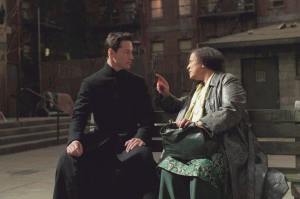
5.) Wisdom: Choice is not as it seems.

Quote: No, you’ve already made the choice. Now you have to understand it.
Said by the Oracle to Neo in “The Matrix Reloaded” as they discuss a dream in which he sees Trinity falling.

Interpretation: Studies in neuroscience have repeatedly validated the notion that by the time we think we’re making a decision at a conscious level, we’ve already made it on a subconscious level. While many suggest this means that the verdict is in and free will is completely illusory, another way of looking at it is that one must understand one’s decisions in order to begin to regain the rudder on one’s life.
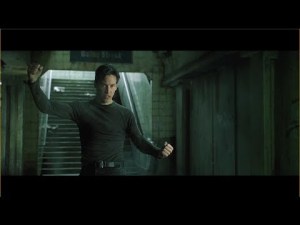


4.) Wisdom: Courage elevates: or, if you don’t run, he won’t chase you.

Quote: He’s beginning to believe.
Said by Morpheus to Trinity in explanation of why Neo isn’t running from Agent Smith in the subway.

Interpretation: My mother used to say, “If you don’t run, he won’t chase you” with respect to being chased by my older brother. It seemed like insane advice at the time; the alternative to being chased being beaten down. However, now I can see that even taking a butt-whooping elevates one’s spirit over engaging in prey behavior.



3.) Wisdom: Rationality is a thin veneer.

Quotes: Beneath our poised appearance we are completely out of control. & It is remarkable how similar the pattern of love is to the pattern of insanity.
Said by the Merovingian to Morpheus, Trinity, and Neo.

Interpretation: While one might like to dismiss the Merovingian’s comments as the cynicism of a hedonist, the undeniable fact is that we have animal biology and it influences us more than we pretend.
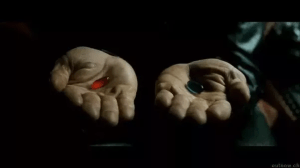


2.) Wisdom: The world contains more Cyphers than not.

Quote: Ignorance is bliss.
Said by Cypher to Agent Smith as he plots his subversion in order to be put back into the Matrix.

Interpretation: Most people are happy with their illusions, rely on them as coping mechanisms, and will respond unfavorably to attempts to strip them way. The illusion in question may not be so much that the world is completely fake as much as biases such as the self-serving bias (i.e. people attribute successes to their inherent awesomeness but blame failures on external sources.)
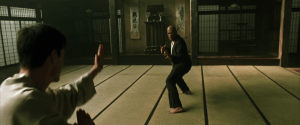


1.) Wisdom: There are limits to being cerebral.

Quotes: Don’t think you are, know you are. & There’s a difference between knowing the path and walking the path.
Both are said by Morpheus to Neo. The former quote is delivered in the sparring program when Neo isn’t performing up to his potential. The latter is said after Neo & Trinity rescue Morpheus and Neo tries to tell Morpheus what the Oracle revealed, but Morpheus quiets him with said words.

Interpretation: I hope I haven’t muddled this bit of wisdom by choosing quotes in which Morpheus uses the word “know” in two different ways. In the first quote, Morpheus contrasts knowing with thinking, and he means that Neo must not treat it as an intellectual exercise, but rather feel its inherent truth deep down. In the second quote, he contrasts knowing with doing, and in this case “knowing” is the cerebral / thinking activity in comparison to doing (i.e. “walking the path.”) However, the gist is the same, you must approach some things–to use the Oracle’s words–balls to bones.

POEM: Stone

someday someone will stumble on the stone

a stone outlasting skin and bone

a stone surface pocked and mossy

though once it shone polished glossy

brushing off letters worn shallow

on a stone face bleak and sallow

rendered so by nature and time

twins spoiling all not in its prime

they’ll read a name with bookend dates

and be shown they hold a common fate

should one become legend and myth

you’ll still not outlive your monolith