The Horn As A Navigational Tool

When I was learning to drive, one piece of advice I still remember was:

Never blow your horn because whatever damn fool thing the other driver is doing to get you in an accident is predictable. They will continue to do the same damn fool thing. Therefore, focus on avoiding the collision, and not venting your anger. Honking the horn can only cause the other driver’s panicked reaction to be unpredictable, thus making the situation more dire. The horn can cause inopportune slamming of the brakes, gunning the accelerator, or swerving sharply (invariably in the direction one was hoping to avoid them.)

This isn’t advice practiced in India. Rather the horn seems to be used to say, “One of us should be paying attention right now, and I kind of need a break.”

I suspect one reason why Indians don’t follow the above advice  is because there is no erratic response to horn blowing here–there is no response whatsoever. The locals don’t even hear the horns anymore. I’ve only been here three days and I’m already becoming desensitized to them. (Although I took an early morning walk this morning and everything was perfect in the world because the horn blowers had not yet awoken.) No doubt, many literally cannot hear the horns after a lifetime subjected to the blare,

I wonder whether the blowing of the horn isn’t just an attempt to assert one’s existence among the whirring throngs of motorists.

Bangalore suffers from regular, albeit ephemeral, power outages. Sometimes the sewer drains don’t work as intended. Sometimes, cars come to a gliding halt; hoods popping up. But one thing works with the certainty of death and taxes. and that’s the horn on every single motorized vehicle in the country. One would think the horns would wear out, that they would choke and sputter, but there seems no sign of that.

1 in 3 drivers are looking at the road at any given moment

Only 1 in 3 drivers are looking at the road at any given moment (but the one not looking slams on his horn to alert others to keep an eye on him.) 

The Mythical High Performance Sock

All my socks do is sit and plot their escape.

All my socks do is sit and plot their escape.

The day before I flew to India, a guy in the hotel’s guest laundry room told me that he’d almost gotten in a fight once when a pair of socks turned up missing. We all know that socks are the great self-emancipators of the garment world; they go Steve McQueen from the dryer all the time. Begging the question, why would anyone get so upset over the disappearance of them.

He must have seen the incredulity in my face, as he went on to tell me these were “high performance” socks.

I don’t know if got my second level incredulity as I thought, High… Performance… Socks? The things you wear on your feet to mop up sweat?

A sock is essentially a foot-shaped bag for your feet. As near as I can tell, the acts it “performs” are: 1.) warming the foot a little, 2.) drying the foot a little (theoretically)–though it can also keep the foot wet longer than it otherwise would be, and 3.) producing stink.

In the military we were instructed to wear two pairs of socks. The sock closest to the skin was a cotton sock, and the outer sock was wool. This rationale for this foot sauna was that the cotton sock would wick moisture away from one’s skin, and the wool sock would keep one’s foot warm even when wet. Incidentally, this works great if you are in a cold environment–unfortunately, we haven’t fought a war in a cold environment since 1953.

So when I thought about the “performance” at which these socks excelled, I assumed they must keep one’s feet toasty. Wrong! The material seems extra thin. So, they must keep the foot extra dry, perhaps they are embedded with talc or something like that. Wrong again.

Surely these socks aren’t better than average at producing foot stench?  No. That’s not it.

Then I realized there was an other factor on which a sock might be judged: its ability to get people to hand over money in exchange for it. An average pair of socks can garner $3 or $4, but high performance socks can get people to shell over $17 or more. That’s some high performance.

Now, I know someone out there will be wanting to tell me about the orthopedic benefits of said sock in supporting one’s arch. This sounds like sock oil salesmen shtick. Is there any fabric known to man that can support your body weight so as overcome in adequate arch support in your shoes? Unless you are Tinkerbell, I doubt it. Perhaps, these socks do have physics-defying properties; maybe we should use them to mend bridges.

Enough with the Indian Food Warnings, Already

Bengali Authentic Full Meal; Source Nandinissaha (via Wikipedia)

Bengali Full Meal; Source Nandinissaha (via Wikipedia)

When I tell people that I’m moving to India, a common–but strange–response is for them to issue warnings about the food and water. I find this odd for two reasons.

First, said warnings are often issued without much firsthand experience of developing world dining (not including high-brow resorts), and without knowledge of my dining history.

Here are few facts that might help one to better understand my approach. I’ve dined on cold seafood salad in a Phnom Penh cafe. I’ve noshed on snake-on-a-stick in China. I once supped at a home/restaurant in the Peruvian Andes whose latrine consisted entirely of a squat-hole cantilevered out over a  cliff side. A couple of days in Bangkok, I consumed nothing but street-food. I was raised on a farm with non-pasteurized milk, and had a father who wasn’t above cooking up a nice-looking piece of road kill. Not a bloated opossum mind you– but I’ve gnawed clean the drumstick of a pheasant that died not by birdshot, but on the grill of a Peterbuilt. (Funny story, spellcheck wanted to change “pheasant” in the preceding sentence to “peasant.” That would have really freaked you out.) So while my home life has been first world, I’ve got a little third world in my gut.

Now you’re probably thinking, “This idiot is infinitely lucky to be alive, and given his behavior he will probably die soon.” Au contraire mon frère. It’s not that I randomly engage in high-risk behavior. Even locals get Delhi Belly if they don’t choose wisely–despite the full panoply of aggressive gut organisms working on their behalf. I’m quite aware of the hazards, and take calculated risks backed up with sensible precautions.

It’s funny that people live in terror of street food–not that there aren’t some carts that one should run from screaming. However, do you really know what the pimply-faced teenager is touching or scratching during the act of assembling your burger at Chili’s? I know exactly what the hands of the old lady grilling my moo ping on Sukhumvit Road looked like. I got a good look because there was always a line that I had to wait in– and gladly so. (FYI – sanitary wipes or hand sanitizer are one thing you should take with you wherever you go in this world.)

I’m not saying that I’ve never gotten an upset stomach, but I’ve done some remote third world travel and never experienced anything worse than resulted from any given trip to Taco Bell.

I’m quite fond of Indian food, and am sure I will cope well with having it for the majority of my meals for the next couple years. Yes, I’ll have to severely reduce my intake of ice-cold beverages and raw foods. (Ice and wash water are the hidden killers that probably cause more food-borne ailments than anything else.) However, ice-cold beverages –while refreshing and pleasant– are not really that healthy for a body in high temperatures anyway. (Flash heating or cooling of things at the other end of the temperature spectrum is bound to cause problems–one’s organs aren’t that different.) While I like raw vegetables, the human body is more efficient at extracting nutrients from cooked food, so there’s a side advantage there as well.

I think people freak themselves out and miss out on some excellent food. One individual who traveled widely once told me that she never ate the local food for fear of getting sick. I felt bad for her. She traveled to the source of some of the world’s best food, and then dined on American fast food–that’s a squandering of no small part of the travel experience. Of course, some people have very weak systems, and that may have been the case for her. (American fast food may be bad for you, but it is uniformly bad throughout the world.)

The second thing that I find strange is that when I was moving to England 25 years ago, no one warned me that I would be going to one of the most gastronomically unappealing places on the planet. Let’s face it, the reason Britain took over India in the first place was so that they could get something decent to eat. Curry is also the reason they didn’t let go easily.

Is there some bias whereby people tend to respond with negativity when one says that one is moving to the developing world, versus positive responses to moving within the developed world?  One probably shouldn’t respond with negativity to news someone is moving anywhere, but–if you must– you should tailor it to the individual concerned.  For example, if one said to me, “That shrill flute in their music is going to get on your last nerve.”  Well, sorry, but that’s probably a correct statement. (No offense, I’m sure it sounds lovely if you were brought up with it, but it will be–at best– an acquired taste for me.)

Outsourced as a Guide to Indian Corporate Culture?

As my wife and I prepare for our move to Bangalore, we are doing research to help us avoid inadvertent insult and blasphemy . We’ve learned such useful facts as: a.) don’t tug on a Sikh man’s beard, and b.) don’t buy a statue of the goddess Durga to use as a hat rack.

Source: Dipankan001 (via Wikipedia)

Durga Source: Dipankan001 (via Wikipedia)

These are just the kind of faux pas a well-meaning but uninformed American couple might make. (Oh, you say, not really?)

Every culture has its little proclivities that seem insane from the outside, but which are so deeply ingrained as to be invisible from the inside. (In fact, I had trouble thinking up such American cultural proclivities, but I believe they exist. Our norms are just so ingrained as to be hard to see. Of course, we are also a  diverse society, a young nation, and tend toward the irreverent in the social domain– all of which may make our cultural idiosyncrasies look a bit different from those of more traditional societies.)

We’ve been reading books like Culture Shock! India, which is one of a series of books that explain the various cultural idiosyncrasies of different countries. (I was first introduced to the series through Culture Shock! Cambodia, though I have read other such books about China and Japan.)  Such guides are extremely useful for explaining do’s and don’ts. However, they don’t necessarily prepare one for the corporate culture of India, which is a mix of Indian, Western, and   multinational business cultures. For insight into the corporate culture we turned to:

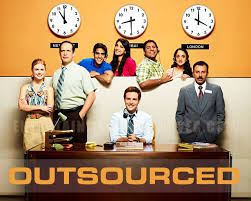
OutsourcedFor those of you unfamiliar, Outsourced was a sitcom that ran for one season (2010-2011) on NBC. The premise of the show was that the manager of a novelty company call center is moved from the US to Mumbai. He becomes acquainted with Indian culture as he must teach his staff enough about American culture  so that they can communicate with the customers they are on the phone with all day. Some of the humor comes from the exposure of a very conservative workforce to products that include dildos and slutty Halloween costumes, but much of it is just cultural tension more broadly. The show was popular with critics and Americans familiar with India. Unfortunately, that was not enough to keep it on the air, particularly when Americans who buy tacky crap and couldn’t find India on a map were the butt of the joke at least as much as were Indians. (Americans who buy tacky crap and are geographically illiterate are a large demographic within the television viewing public.) At any rate, the show was clever and well-acted.

One may scoff at the use of a sitcom as reference material, but the show seemed to be well-researched. For example, I know that its discussion of the famous Indian head bobble matched the description in the cultural guide quite well. The bobble is a non answer that can mean virtually anything. The video below gives a more detailed explanation, but the visual is not so good. From what I’ve seen, most people tend to do this action more with the top of the head staying relatively stationary while the jawline swings side-to-side.

This left us wondering whether other elements of the show will ring true. The show introduced me to a new term, “holiduping.” This is when one’s employees convince a manager that a day is a holiday, when in reality it isn’t. To get the joke, you must know that Indians have enough work holidays to make US Federal employees say, “Damn, that’s a lot of holidays!” Furthermore, not all the holidays are national. There may be days taken off in Karnataka that are not in Gujarat, and vice versa. This can make it a challenge for new comers to keep track.

I’m curious as to the views of people in-the-know about how accurate Outsourced was. Most of the cast were Americans of Indian origin, but it doesn’t look like the same was true of the lead writers.

BOOK REVIEW: Mostly Harmless by Douglas Adams

Mostly Harmless (Hitchhiker's Guide, #5)Mostly Harmless by Douglas Adams

My rating: 3 of 5 stars

Amazon page

[NOTE: If you would like to read my reviews of the first four books, you can do so by following the hyperlinked title: 1.) The Hitchhiker’s Guide to the Galaxy 2.) The Restaurant at the End of the Universe  3.) Life, the Universe, and Everything 4.) So Long, and Thanks for All the Fish]

This is the fifth and final installment in The Hitchhiker’s Guide to the Galaxy series (not including Eoin Colfer’s And Another Thing, which I don’t.) Fans of the series will recognize “Mostly Harmless” as the sum total of the Earth’s entry in The Hitchhiker’s Guide to the Galaxy.

The story focuses on a trio of characters from the original book’s cast: Arthur Dent (of course), Tricia McMillan (a.k.a. Trillian), and Ford Prefect–with the Random addition a new fourth feature character. As the series had already begun trending, this story is more human-centric than the earliest installments. The central story could be divorced from the sci-fi genre with relatively minor modifications. However, as Restaurant at the End of the Universe uses time travel as a sci-fi plot device, this book uses the concept of a parallel universe.

The story begins with our main characters separated from one another. Arthur Dent is making sandwiches of Perfectly Normal Beast (an Orwellian turn-of-phrase as one might expect) on the planet where he crash landed. Trillian, or one of them, is reduced to doing an interview with an astrologer. Ford Prefect is breaking into his place of employment to avoid the accountants in his usual manner of hijinks.

Adams throws each of these characters a monkey wrench. Dent finds out he has a daughter, Random Dent, and that her mother–Trillian–is dropping her on his doorstep. Ford discovers that the Guide is under new and nefarious management, and that they have created an edition with dire ramifications. Trillian, or one of them, gets her big break being picked up by a Grebulon ship only to discover they want her to advise them on astrology.

The notion that no one escapes the feeling of being without a home is a central theme in the book.

This isn’t Adams’ best work. The story has grown stale. It lacks the creative brilliance derived from plot devices like the Infinite Improbability Drive, and–while there may be something to be said for a story with more humanity– it leaves one missing idiosyncratic characters like Zaphod and Marvin. That being said, even at his worst Adams is amusing and thought-provoking. If you enjoyed his earlier books, you could certainly do worse than to finish the series. In the unlikely event that Adams isn’t your cup of tea, this final installment probably won’t revise your assessment.

View all my reviews

Drunk, Narcissist, or Buddha: What Kind of Writer Are You?

IMG_0173I read a story in The Guardian the other day entitled “What drives writers to drink?”  It was actually an edited excerpt from a book by Olivia Laing entitled The Trip to Echo Spring: Why Writers Drink.

I found this piece fascinating despite the fact that the title question seemed readily answered with another question, “In what other occupation must one regularly, repeatedly, and thoroughly get punched in the soul in order to succeed?” Writing is a personal act, and no piece of writing that is read escapes the assault of criticism, invited and uninvited, which ranges from sagacious to ridiculous.

One somehow has to find the courage to wade through what feels a lot like attacks on one’s intellectual self in order to discover what is useful and what is not. If one summarily rejects all criticism and advice, one will neither grow nor is one likely to be published. If one accepts all criticism as having merit, one may find a psychiatric ward in one’s future–and one is likely to remain unpublished. So the trick is to be able to answer the question, “What within this writing is genuinely bad?”

The problem is that it feels like the question is, “What about me is flawed?” It’s like holding a mirror up to the core of one’s being and noticing that you have some rot.

How do writers do this? There are probably innumerable approaches, but three common ones come to mind. The first is the one thoroughly addressed in Laing’s book; that is, some writers self-medicate. The article references a quote by Tennessee Williams, “…you felt as if a new kind of blood had been transfused into your arteries, a blood that swept away all anxiety and all tension for a while, and for a while is the stuff that dreams are made of.”

A second unhealthy approach is to reject any assertion that contradicts one’s perfection. In other words, be a narcissist. These are the writers who meet each and every piece of criticism with statements like, “you just don’t understand what I was trying to do there, my misspelling was actually a clever commentary on the zeitgeist of 20th century Armenia.”

The narcissists have the advantage not becoming clinically depressed by the constant rejection and criticism that is a life of writing. The downside is that they have to live in a world in which everyone else on the planet is ignorant and incapable of recognizing brilliance when it’s shining in their faces, and that is depressing in its own way. Only a few in this group manage to get published, and they do so through a combination of being truly great and, at least early on, being willing to tarnish their awesomeness by accepting some editorial suggestions.

The third approach is the one that we should all aspire to, but it’s a bitch getting there. In the title I used “Buddha” as a code word for the enlightened approach. What is the enlightened approach to dealing with rejection and criticism? First, one must realize that equating one’s writing and one’s self is illusory, and that criticism of one’s work isn’t criticism of self. Before any writer gets to the point of submitting works to agents, editors, or publishers someone along the line has told one that one’s writing is good. This fatal compliment causes one’s self-worth to become entangled in one’s writing.

Second, one must develop a confidence that isn’t rooted in external validation. In less pretentious words, one mustn’t feel it necessary to be loved by everyone with whom one comes into contact. This is hell if one’s entire life is writing. The value of published writing is inseparable from how it’s received. My only suggestion on this point is to find something else in one’s life that allows one to build self-confidence. For me, this has been martial arts. Sure there are usually rank tests, which are about validation from one’s teacher. However, what it really comes down is whether one experiences success in training and sparring. If one sees some success, the rank starts to be irrelevant to one’s confidence. I think outdoorsmanship is another such skill– for those less scared of bears than being beaten ugly with a stick. There are few activities in which other’s evaluation of one is ultimately irrelevant, but those are the activities with which one should seek to balance one’s writing.

If anyone needs me I’ll be guzzling Bourbon and contemplating how the publishing industry is run by poop-weasels.

Sharknado: or, the Rock Band or Cheesy Movie Game

Somebody on Facebook made an offhand reference to Sharknado the other day.  I had no idea what a “Sharknado” could be, except the mind-numbingly stupid idea suggested by the phonetics of the “word.” It turns out that is exactly what it was. Despite the fact that sharks exist in places like Florida and tornadoes exist in places like Oklahoma (not a lot of overlap there), the movie is about tornadoes that pick up sharks and throw them through the air at unsuspecting people. (The sharks are, of course, still alive and hungry contrary to everything we know about biological entities that get picked up in twisters.)

I once wondered why the “Sci-fi” channel changed its name to the “Syfy channel.” I now know that it must have been the threat of false advertising lawsuits that spurred this change. (Of course, this doesn’t explain why the “History channel” isn’t the Sasquatch Alien channel.) Sci-fi is short for science fiction. Let’s break that down. First, the reference to “science” means one would expect some speculative universe which is constrained by scientific laws–either the laws of physics as we know them or some reasonable set of scientific principles by which a universe could be held together. It is not a magic universe, as required by Sharknado. The target demo for science-fiction is geeks and nerds (said in the most complimentary sense of those words)–in other words, people who overthink (or, at least, think.) The target demo for Sharknado seems to be pubescent boys failing science and in need of an opportunity to masturbate to Tara Reid.

Second, fiction is a creatively-engineered story, and I’m not even sure Sharknado qualifies on this front either. The creative component seems to be limited to cramming two things that terrify people together into one word or phrase. This may work in some cases, such as with the term “divorce lawyer.” However, the two concepts that one smashes together have to have some credulity as a unified threat. The fact that motherf#$%ing Samuel L. Jackson couldn’t save Snakes on a Plane, should have made this apparent to all.

As a thought exercise, let’s try some examples:

1.) Which of the following terror-inspiring dualities are devices around which a movie plot could be built, and which are just awesome rock band names?

a.) Clown-Pirates

b.) Hobo-Scorpions

c.) Black Mamba-Teen Driver

d.) Bear-Proctologist

e.) Spiders in a Tuk-tuk

f.) Karaoke-Mugger

g.) Robo-gynecologist

h.) Newborn-Arsonist

i.) Mother-in-Law / Attorney-at-Law

j.) Anthrax-blizzard

By the way, if the Syfy channel comes out with any of the above movies or series, please shoot me an email so I can claim my Executive Producer credit. It’s more likely this will be the starting line up for Lollapalooza 2025.

Bear with bubbles

RANT ROOM: Robots Calling

698px-Alt_TelefonThe phone rings. I pick it up. A robot starts talking in my ear. Well, not a robot, but an electronically recorded voice. I hang up. This happens about seven times a day.

I’m on a no-call list, but there’re so many loopholes so as to make its value questionable. First of all,  the politicians exempt themselves–of course. Only a politician could be so megalomaniacal as to think that a person who expressly requests not to be bothered by anyone by phone is secretly awaiting his robo-call.  Second, charities are exempt, whether it’s the March of Dimes or the Irritable Bowel Syndrome Defense Fund.  There seem to be more charities calling than ever. Or, perhaps, they’re like Phnom Penh urchins– if you give one of them money it induces a swarm. (Or, more likely, they make all the big money by selling contact lists to other charities.) Finally, any business that you’ve ever done business with is exempt  (even monopoly phone companies and utilities, for which you had no choice but a third world existence), as well as the parent companies that bought a company that you did business with once 20 years ago.

People who know me will tell you that I don’t even like to talk on the phone with human beings that I like, what hope would a machine have? Answer: “None.”

Now, let it be known that I’m not anti-machine. In 200 years, when they unfreeze my brain after the Terminator Wars, I’m not going to be one of the douche-bags standing on a picket like to prevent little T8-Y0 from going to school with the human kids and super-intelligent dolphins. I just resent someone calling me, intent on taking up my time, without even having the common courtesy to be intelligent–artificially or otherwise.

Some will say, “But, Bernie, you’ve called me and said not a word that was remotely intelligent.”

To that I say, “Nuh-uh, stop being a jerk-head.”

I almost always meet the technical definition of “intelligent” (self-aware? I’m self-obsessed!) when I call someone on the phone, and that’s all I expect of others.  I would pass a Turing test because the evaluator would say, “Any machine would maintain a train of thought better than this guy. He’s all over the place. He must be human. Plus, he can’t do math for shit.” [If you want to weed the androids out of your life, ask them to divide 49  by 18. If they answer automatically and correctly to two decimal points, stake them through the oil pump. If they are one of those “Human Calculators,” they deserve it for betraying their kind–but I’m not speciesist.]

Still, this brings one question to mind, how lonely do you have to be to listen to a machine blather on? Obviously the companies using robo-calls have sufficient success to keep paying their phone bills. That means that some people have to hear the robot voice and say, “What the heck? Let me hear what R2-D2 has to say.”

Who does this? I’ve heard that some people have guilt issues with hanging up on people because they were “raised right.” I can’t claim to understand this. It’s not an affliction that burdens me. I will hang up on anyone who assumes they can make demands on my time without compensation in about two microseconds. Yes, I said it, Mom. (Just kidding, I’m really talking to cable companies, natural gas providers, credit card companies, etc.)

Still, even if one feels guilty about hurting the feelings of a person, why would the same guilt apply to machines–which do not have feelings to hurt.

I mean, does this person think the caller might be a T-101 calling from the future to warn him that a mean T-1000 is on its way to poke him to death with a memory metal finger? I guess that sounds reasonable… no, no it doesn’t.

Alternatively, do people sit around thinking, I wish someone would call me up and tell me what I want, because I have no idea.

Maybe I just don’t understand this mindset. No person has ever convinced me to make an impulse buy by yapping. I’ve never said, “Gee-whiz, you’re right, I definitely need this product or plan that I didn’t know existed five minutes ago.”

It has occurred to me that I might be taking the wrong tack by hanging up on these calls instantaneously. By doing that, I am helping them weed out an unlikely sale in as inexpensive a manner as possible. The next time a robot calls me, I think I’ll put the phone down next to the radio–playing easy listening, of course–and then walk off. I encourage you all to do the same.

10-LIST: Bangkok Tips

10 helpful tips for visiting Bangkok.

1.) When seeking a massage and not a “massage” [insert wink], the older and uglier the masseuse, the better the massage. Alternatively, if your masseuse is gorgeous and/or wearing a miniskirt, you are in a brothel… and your masseuse may be a dude.

2.) Just because the religion’s core message is one of peace and tolerance doesn’t mean a Buddhist nun won’t put you in a hammerlock if you fail to make a donation at each and every Buddha you see. BTW, there are about 70 bizzillion of them.

3.) Tuk-tuk fares have no connection whatsoever to distance traveled. One day you may have a driver take you all over town for $1.70, and the next you can’t get one to take you three miles to Hualamphong station for less than $5. To be fair, it takes three days to travel three miles to Hualamphong–unless you’re on foot, then it takes about 20 minutes.

4.) You can’t get out of town without being taken to a silk suit “wholesaler” and a “state-sanctioned” tourist travel office; just get it over with. When you meet a local who is friendly, helpful, and seems to have no ulterior motive whatsoever, that’s when the hook is set. The entire country is in on it. The Thai Pledge of Allegiance even has a line to the effect of, “…and will faithfully divert tourists to silk shops and tourist offices whenever possible, so help me Buddha.”

5.) Trains always leave on time, but a train has never arrived less than three hours late in the history of Thailand. This begs the question of whether the time-space continuum is the same as in the rest of the world.

6.) The Grand Palace is open every day–even though you will be told twenty times a day that the palace is “closed today only”–often within earshot of a blaring loudspeaker announcement on a loop  that says, “The Palace is open everyday from 8:30am to 3:30pm, do not believe anyone who attempts to divert you!” Don’t bother pointing out the announcement, they’ll just tell you that some dimwit forgot to turn it off and that the Queen is having a Parcheesi festival with heads of state today. [They are very creative in their detail.]

IMG_1976

7.) The penalty for peeing on a wall is… nothing. The penalty for peeing on a wall under a photo of either the king or the queen is death administered summarily. This means you have a fifty-fifty shot of getting away with it alive.

8.) If you are prudish, avoid Chinatown as porn is sold from kiosks in the street. Alternatively, if you are looking for cheap porn, tasty dim sum, or cheap plastic items emblazoned with “Hello Kitty” clipart make sure to allow a day in Chinatown. You might be wondering who would flip through vast troves of skanky and, in some cases, freakish porn in the middle of a thronged pedestrian thoroughfare presumably traveled by friends and family, the answer is, “more than you’d think.”

IMG_3837

9.) Be friendly, but–remember– if you tousle a child’s hair you will be asked to leave the country immediately.

10.)  Contrary to what you have heard, Bangkok is not one big red-light district. Its 429 separate, reasonably-sized  red-light districts are spread evenly throughout the city for your convenience.

Despite my sarcasm, Bangkok is a fun and fascinating city that should be visited by all. You’ll learn a lot from those discussions with locals, even if they do wind up with you buying a necktie just to get out of a silk shop.

10 Tips for Averting Tiger Attacks

As with mean drunks, never interrupt a drinking tiger

As with mean drunks, never interrupt a drinking tiger

I was working on a short story that involved a tiger attack, and–knowing almost nothing about the subject–I did a little research. I found some fascinating factoids. Here are some important tips to keep in mind in tiger country:

1.) Avoid squatting postures as it’s thought that many tiger attack victims are cases of mistaken identity. That is, sometimes an individual crouching to do his business or whatnot is mistaken for a tastier species. Apparently, tigers don’t realize that humans are the only creatures that wear clothing. Despite attempts by missionaries to educate tigers on biblical stories such as that of Adam and Eve, tigers continue to see themselves as god’s favorites.

2.) Avoid wearing leather, it makes you smell and taste like cow. While cows are sacred in India, tigers have denied receiving that memo. Or perhaps tigers are like members of PETA and are attacking those wearing animal hides to make a bold statement… but I doubt it.

3.) Avoid carrying meat in your pockets. Enough said.

4.) If one is attacked, don’t immediately counter-attack. Some tigers are just trying to express their passionate feelings on the subject of breakfast cereal, and one would not like a needless fight to ensue. One should only partake in needless fights when one has a good shot at winning– no offense to any one who has ever fought Manny Pacquiao.

5.) Don’t leave your dead out and about. Apparently, human is an acquired taste that tigers will find a fun exotic treat once they get used to it. We are the Rocky Mountain Oysters of the tiger world.

6.)  Be aware of your surroundings, and–as with Zombies–CARDIO-CARDIO-CARDIO. Tigers can run at speeds of up to 35 miles per hour (56km/hr.) for short bursts, but have the stamina of a pack-a-day smoker. If you can keep them from getting close to you, they’ll lose interest.

7.) Stay in the city. Tigers almost never go into the city because they tend to attract unwanted attention. The average tiger weighs about 400 pounds (180 kg.) and the orange and black stripe pattern that camouflages surprisingly well in wild sticks out everywhere except Paul Brown Stadium or the lingerie section of an inner-city K-Mart.

8.) If you are attacked, the tiger will leap up and put its fore paws on one’s shoulders to push one over onto one’s back so that the cat can leisurely crush one’s neck in his or her mouth. When the tiger rears up on its hind-legs you may either try a kick to the crotch or to engage the predator in a foxtrot. The former offers a 1 in 10,000,000 chance of success. The latter has never been tried before, and so no one can rightly speak to its likelihood of success, though it’s suggested that one not try to lead (You must recognize that–at that point– you are the tiger’s bitch.)

9.)  Because humans aren’t ideal tiger food but we are slow, weak, and are skilled in disciplines like “managerial analysis” rather than hunting or survival in the wild, man-eating tigers tend to be the old and infirm cats that find gazelle and antelope both too fast and jungle savvy. Because only the oldest of cats tend to attack, a sure strategy is to get your attacker talking about how things were back in his day and how the current generation of tigers are all misfits and hooligans.

10.)  If you’re attacked, make loud noises and violent “shooing” gestures with your arms. You’ll still be eaten, but you will appear quite brave on the video in comparison to those who go fetal and poo themselves.

Best wishes and be safe out there.