
Taken October 23, 2015 at Varanasi
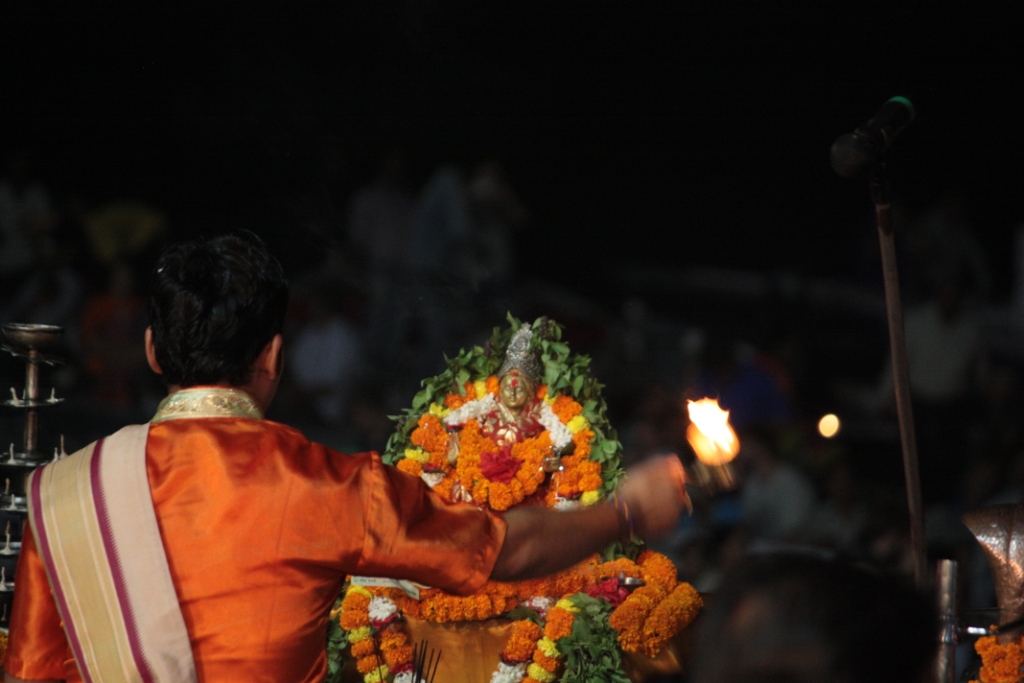


Taken on August 8, 2015 at Nrityagram
I’m a neophyte with respect to Hindu iconography–plus I read no Indian languages, so I may be wrong about this being a Shiva. Shiva is usually depicted clean-shaven, but I’ve seen bearded images. I mostly based my conclusion on the tiger skin (or stylized representation thereof) that he’s sitting on, which is often associated with Shiva.
Shiva is part of the Hindu trinity, which also includes Brahma (the creator) and Vishnu (the sustainer.) This leaves Shiva, the destroyer.
If you’re someone who actually knows about such things, and know I’m wrong, please drop me a comment to let me know.
 Last fall I attended a panel talk hosted by the New Acropolis in Bangalore. I’d never heard of the New Acropolis before, and only heard of said event because the head teacher from my yoga teacher training course was among the panelists. I found the environment at the New Acropolis to be friendly and intriguing. The talk took place amid a small library (not necessarily small for an institution of its size) and books always put me in my happy place.
There were brochures out for an upcoming 16-week Explorations Course. “Explorations” is the name for the introductory course that’s taken by non-members to dip their toes into the New Acropolis curriculum, and see if they’d like to continue as members of this school of “philosophy.” (You may be asking, “Hey–wait a minute–why’d he put quote marks around the word philosophy. I’ll get to that in due time.) At any rate, perusing the brochure, I decided to enroll.
The course consists of 13 lectures given over a 16-week timeline. The reason there are more weeks than lectures is that there are two sessions in which one meets briefly with the instructor one-on-one, and one session that consists of exercises that one does with one’s classmates. (The latter is one of the highlights of the course.) The course is organized into three parts. The first and longest section deals with the idea of “know thyself.” That is, it presents several approaches to developing oneself as an individual. The second section expands the scope, looking at society and the role of individuals in it. The third section is about the “philosophy of history,” (there go those telltale quote marks again) or what they refer to as “evolution,” (really?) which shouldn’t be confused with Darwinian Evolution (which–as near as I can tell–has no status in their system of teachings.)
In my opinion, the transitions from one part to the next represent downshifts in the value of the course. (i.e. The course is at its most beneficial in the first section. That’s also the portion in which it’s presenting ideas that are fairly mainstream among the various philosophical / religious systems it studies.) As the course moves into the second section, one begins to see a few ideas that are either archaic or that depart from rationalism (e.g. the word “magic” gently enters the discussion.) By the time the third section rolls around, ideas that have no relationship to observable reality are being presented as if they were a given.
I was reading Nassim Nicholas Taleb’s book entitled Antifragile the other day and he used the term “neomania.” Neomania–a term that Taleb coined for all I know–means an exuberance for the new for its own sake (as opposed to any objective improvement it represents.) Taking this cue, I will cobble together the term “paleomania”(an exuberance for old ideas for their own sake) to describe one of the main underlying features of the New Acropolis syllabus. One might easily believe that nothing of value has been learned in the past 2000 years and that modern thinkers (not to mention modern science) have nothing worthwhile to lend to the discussion.
This can be seen in the ideas presented from ancient Greece. Let me first say that I’m a big fan of Plato. His words “Be kind, for everyone you meet is fighting a hard battle” is one of my favorite philosophical quotes. However, while I like Plato, the New Acropolis pretty much deifies him. I’m sure they wouldn’t agree with that statement. However, even Plato’s ideas on those subjects about which he was least in a position to write intelligently or authoritatively are presented as if irrefutable. A couple of his most ill-informed ideas are at the forefront of two of the lessons–notably the Platonic hierarchy of forms of government and the ideas he accepted [I don’t know that these are properly attributed to him, but he seems to have believed them] about astrology. (Note: New Acropolis’s teachings about forms of government seems to be one of the biggest causes of ill will toward the organization in Europe. Plato was an elitist on the subject. He distrusted democracy–to be fair they killed his teacher under [a form of] democracy–but believed that if you could just give a philosopher unlimited power he’d do the right thing for everybody–and not just himself. Plato wasn’t a believer of Baron Acton’s “…absolute power corrupts absolutely…” an idea that came later by those with a greater body of exposure to varying forms of government.)
The first couple of lectures I attended didn’t seem in any way untoward or unusual. The first lecture was about knowing oneself, and presented two ancient approaches to this question–i.e. Greek and Indian Vedic. The Greek three-pronged model of soma/psyche/nous, which is translated various ways–but commonly as body, soul, and reason. The Indian approach was a seven-layered variant that also started with the physical body and moved toward more conceptual elements of being.
Now, it might have occurred to me that both of these approaches take the supernatural as a given, but as they were true representations of the systems in question, I didn’t find it bothersome. This raises a point that I think bears saying, I don’t think that the New Acropolis distorts the teachings that they include in the syllabus, but they do use selectivity to frame the subject. This framing gives the student a limited view philosophy and the various approaches to leading an examined life (as opposed to the unexamined life that Socrates told us was not worth living.)
The second lecture I attended was actually the third lecture–because I was out-of-town for a class on the Bhagavad-Gita–and it dealt with Buddhism. This session was the most orthodox and arguably the least controversial of the lectures. The four noble truths and the eight-fold path were the core of the lesson, and one doesn’t get any more fundamentally Buddhist than that.
However, the fourth lecture, which was ostensibly about Tibetan Buddhism, started me wondering where the course was going. One would expect a lecture on Tibetan Buddhism to refer heavily to the words of lamas, but most of the ideas presented in this lecture were attributed to a woman who I don’t think I’d ever heard of before. Her name was Helena Petrovna Blavatsky. (If you’re saying, “Hey, that name doesn’t sound Tibetan, you are correct.”) It’s not that I don’t think that a 19th century Russian woman is capable of giving informed insight into Tibetan Buddhism. However, one becomes curious when there’s not a single Lama, Rinpoche, monk or nun in the picture. While I’m admittedly a bit of a neophyte on the subject, I’ve been to hear Tibetan monks and nuns before and have visited the local Tibetan meditation center on occasion, so I’m not completely ignorant of that system’s teachings–enough to have an idea what the most fundamental ideas would be.
So, after the Tibetan Buddhism class, my Googling fingers got to work. I just wanted to be sure I wouldn’t be asked to drink any Kool-Aid made Jim Jones style. There wasn’t a lot on the organization besides their various websites, but there were a few negative comments and would-be controversies to be found. I wasn’t too concerned by these comments for a number of reasons. First, the claims were isolated and unverifiable. To elaborate, if a person is either far to the right or far to the left, then the middle seems an extreme way off. Therefore, when a leftist organization calls an organization a “fascist cult” one has to consider the bias of the source of the claim. (Note: the same could be said from the other end of the spectrum, but I stated it that way because that’s essentially what I read in one post.) Nothing I’d seen at New Acropolis would lead me to think they were fascist, or even particularly politically conservative (if anything, I’d guess that individual members would be more likely to be left of center, but it wasn’t really an issue that came up.) Second, most of the negative comments were directed at a couple of the European centers, specifically.
I will say that, despite the fact that I didn’t believe the extreme claims, I can’t say that they weren’t cause for concern. I’ve had a little experience with organizations prone to being embroiled in drama. Even if the organization has many worthwhile attributes and individuals, that inclination to attract drama will inevitably bite a member in the ass. In my experience, one can’t just sit on the sidelines and pretend the drama won’t affect you. If you do, you’ll just be all the more surprised when you feel your ass being bitten.
My web searches confirmed that the New Acropolis was an offshoot of the Theosophical Society. This wasn’t kept a secret. In fact, I believe it was mentioned in the Tibetan Buddhism lesson, and I know it was intimated at various junctures in the course. I was aware of the Theosophical Society, and–in particular–the falling out that Jiddu Krishnmurti had had with them. (A parting of ways that was apparently amicable on Krishnamurti’s side as well as on the side of some from the Theosophical Society’s side–though some Theosophists apparently went dark.) Krishnamurti is among my favorite thinkers, and it was a concern that New Acropolis was an offshoot of an organization whose beliefs were so at odds with his own. I don’t want to deify Krishnamurti (that would be ironic as he was explicit that he didn’t want followers and believed followers were missing the point), but many of his ideas resonated with my own–particularly those on organizations to advance personal or spiritual development (of which he [& I] are quite skeptical.)
Krishnamurti opposed the idea of religions, sects, and paths as means to betterment. The New Acropolis would likely agree with Krishnamurti’s stance on religion as they’re explicit in their antipathy for the ritualism of religion. However, Krishnamurti went further to oppose entities that proposed that they had a path to guide one to some enlightened state. This is where the New Acropolis would presumably part ways. They seem to believe they have such a path. The aforementioned framing that they do seems to designed to carve out the waypoints so that future courses can work on building the path.
There’s a common saying that a good education teaches one HOW to think and not WHAT to think. By that definition, I wouldn’t classify the New Acropolis’s approach as a good education, generally speaking. The course is set up for a one way flow of learning. There’s no time for discussion or refutation of the concepts presented in the course. The teacher presents concepts in a lecture format, and there are designated times in which students can ask questions (in many cases outside the class time when peers might have ideas to add or questions to build off.) Despite the nominal homage to ancient Greece, the New Acropolis pedagogic approach is at odds with the Socratic method by which students are asked questions rather than being presented with answers.
What’s my beef with their use of the term “philosophy?” Depending upon how it’s used, I don’t have a problem with it. When they’re explicitly talking about their particular philosophy, (i.e. New Acropolis’s philosophy) it’s perfectly acceptable. It’s only when one uses the term in a general sense, e.g. as in “school of philosophy,” that students might expect that they’ll learn rational approaches to consider life’s big questions for themselves, rather than learning a specific ideology’s answers to said big questions.
The term “theosophy” would be much more honest and apropos, though I understand their reticence to use that term–given their strained relationship with the Theosophical Society–which has a corner on the market of that term. The fact that the New Acropolis takes the divine or supernatural as a given is hard for me to reconcile with philosophy, which implies an open discussion and refutation of ideas–particularly of those notions for which there is little or no evidence. I’m not saying that philosophy can’t and shouldn’t consider the question of whether there is a god (or spirits or divinity or whatever term you prefer.) I’m just saying that taking the existence of such ethereal entities as a given flies in the face of rationality, because the existence of such ethereal entities isn’t rooted in observation or application of logic but in emotion. Faith is the domain of theology (or theosophy, if you prefer), rationality is the domain of philosophy. A lot of the teachings in this course were couched in terms of feelings or the beauty of ideas rather than in rational investigation.
It might seem that I was quite negative about the experience, and that I wouldn’t recommend it for others. That’s not exactly true. There are some individuals that I wouldn’t recommend it for, but others that I might. I did learn a lot during the course, and brought away a number of ideas that I think will be of service to me. For example, we did a throwing stick concentration exercise that was eye-opening (no pun intended), and there were many ideas and stories presented in the course that provided good food for thought. There was only one class /idea that I found not only completely baseless but also potentially dangerous.
(FYI-If you’re wondering what idea that was, it was in the penultimate lecture on astrological cycles (yeah, I know, right?) The lecture presented both Indian Maha Yugas and Greek zodiac cycles. Guess what? According to both mythical sets of cycles we’re currently in the crappiest of times. [FYI- If there’s anything my education and experience as a social scientist taught me, it’s that notions of determinism applied to the sphere of human behavior are inevitably wrong. The physical world may be clockwork, but the minds of men are a clockwork orange.] Why do I think these conceptions of cycles may be dangerous? Because a lot of damage is done by people who go through life thinking the world is feeding them a steady diet of shit-sandwiches. This is, of course, all perception. Nature–unlike gods and other supernatural mythical creatures–doesn’t draw targets on the backs of individuals, nor weigh them good or evil. However, now you’re going to tell people who already see the world through dung-colored glasses that your [pseudo-]science shows they were born in the worst of times. That–my friends–is not helping make a better world.)
I think those interested in the course should be aware of three things: 1.) a god, gods, the divine, the supernatural, or whatever you wish to call it is taken as a given by the course (you’re not going to see a Nietzschean counterpoint in this school of philosophy); 2.) you aren’t going to get a broad-based exposure to philosophy in that a.) the ideas are all from ancient traditions and b.) the concepts presented are cherry-picked to be consistent with the New Acropolis agenda (which isn’t to imply the agenda is onerous by the standards of sects or religions, but there’s an agenda) ; 3.) you should banish any expectations of engaging in rousing class discussions or dialogues with the teacher because it’s very much a one way street. If you’re good with those three factors, you may want to give it a try. You might find it’s the right approach for you.

Taken on November 23, 2014 at Somaiya College in Mumbai
 The Bhagavad Gita by Anonymous
My rating: 4 of 5 stars
The Bhagavad-Gita is a philosophical poem, the title of which is translated as “Song of the Lord.” It’s often read as a stand-alone work, but it’s included in the sixth book of longest known epic poem, entitled the Mahabharata.
In The Bhagavad-Gita, Krishna teaches the warrior-prince Arjuna about sacred duty (dharma.) The setting is the battlefield at Kurukshetra as a war is about to get underway. Arjuna asks his charioteer, Krishna, to halt the vehicle between the opposing armies. Arjuna is struck with a crisis of conscience. He doesn’t want to fight and kill the men on the opposing side–some of whom are related to him by blood and others of whom are well-respected elders. Arjuna can see no virtue in the war.
Krishna, after briefly mocking what he describes as Arjuna’s newly developed cowardice, goes on to offer his explanation of why it is that Arjuna should fight. The first argument is that nobody really dies because consciousness is reborn. This makes sense if you believe in reincarnation… otherwise, not so much. A concise restatement of this argument is presented in the 11th teaching: “I am time grown old, creating world destruction, set in motion to annihilate worlds; even without you, all these warriors arrayed in hostile ranks will cease to exist. Therefore, arise and win glory! Conquer your foes and fulfill your kingship! They are already killed by me. Be just my instrument, the archer at my side!”
Another of Krishna’s argument is that if Arjuna fails to fulfill his duty he will be thought less of by others. This is an odd argument to make as Krishna makes a more compelling case for ridding oneself of ego, whereas this seems to be saying that one should put what others think of one above doing what one believes is right. That sounds a lot like succumbing to ego rather than eliminating. In the 12th teaching, in fact, Krishna tells us that the best of men are “Neutral to blame or praise…” This suggests that perhaps one shouldn’t be moved by what others will think of one.
At the core of Krishna’s argument is that one cannot escape the Karmic cycle by engaging any acts but those that are selfless. Like the reincarnation argument. One may find this logic compelling or not depending upon whether one believes in Karmic theory. Karma is the idea of cause and effect. If you do good, you’ll receive good effects and if you do bad you’ll experience bad effects. Ultimately, however, the goal is to break free of the Karmic cycle and, in theory, the only way to do that is to engage in acts that are selfless—hence doing your sacred duty. If your driver isn’t God, it’s not entirely clear how you know what your sacred duty is, at least not by way of this work. (Presumably, God talks to kings and princes, and kings and princes tell the unwashed masses what they are supposed to do. If you happened to have already done away with such a system—as most of the planet has—you may have trouble with this logic.) However, if one takes the lesson to be that one should not be consumed with personal gain when one acts, one has an argument of more general appeal.
Another argument is that devotion to God is all important, not a man’s actions in any absolutist sense. From the 9th teaching, “If he is devoted to me, even a violent criminal must be deemed a man of virtue, for his resolve is right.”
It should be noted that Krishna delivers a number of lessons beyond the need to comply with one’s dharma, and, in my opinion, many of these ancillary lessons are more compelling than Krishna’s explanation of why Arjuna must fight.
One such lesson is to concern oneself with the journey and not the destination. Krishna states it as such, “Be intent on action; not the fruits of action…” Furthermore, there are a great many teachings that will be familiar to Buddhists, such as the need for non-attachment and moderation.
The poem contains lessons of Samkhya (e.g. discussion of the three gunas) and Yoga. It describes concepts from the three original forms of yoga (predating yoga as a fitness activity by centuries): those being of action yoga (karma yoga), knowledge yoga (jnana yoga), and devotional yoga (bhakti yoga.) While The Bhagavad-Gita predates the formulation of eight limbs of yoga as described by Patanjali, it does address certain among them in varying detail. Early on, it speaks about pratyahara—withdrawal from the senses—in considerable detail. There are also references to pranayama (breath/energy control exercises) and most of the yama and niyama are listed among the virtues in the latter part of the teachings. Of course, samadhi (liberation / yoga’s 8th limb) is a central concept in this work.
While The Bhagavad-Gita remains widely cited and relied upon for guidance to this day, it’s not without its controversial elements. In the fourth teaching, Krishna explains how he created the caste system. Of course, Krishna might not have intended it to be the stain it became.
The Miller translation that I read has a few nice ancillary features. There is an introduction that offers background and context for those who have little knowledge of Indian history or mythology. There’s also a glossary that goes into detail about terms that are frequently used in the work. It’s not that there are Sanskrit words mixed into to the text. The glossary explains what the English words should be taken to mean in the context of the Hindu worldview.
What is most intriguing, however, is the afterword which is entitled, “Why Did Henry David Thoreau Take the Bhagavad-Gita to Walden Pond?” Of all the thinkers that have cited The Bhagavad-Gita, the use of Thoreau and Emerson as examples raises intriguing questions. The Thoreau of Civil Disobedience and the Emerson of Self-Reliance would seem to be as far from the message of The Bhagavad-Gita as possible. Krishna is telling Arjuna to ignore his conscience, and just do what God tells him to do—be a selfless instrument of destruction. Thoreau and Emerson both preached that one’s conscience should always be one’s ultimate guide. Thoreau went to jail because he refused to pay taxes that would support the war with Mexico. I suspect Krishna would say to Thoreau, “Hey, I’m throwing this war, and you’d damn well better do your part.” However, there are ideas in The Bhagavad-Gita that work with the American Transcendentalist philosophers. The idea of removing self-interest and egotism as a way to eliminate delusion before one makes one’s own decision is a consistent suggestion.
I have mixed feelings about The Bhagavad-Gita. Like many (most?) sources of religious doctrine, I think the central message of The Bhagavad-Gita is just another means by which to keep the masses under the control of an elite—and, specifically, fighting the wars of the royalty. However, I–like Thoreau and Emerson—also see a great deal of insight into how to be a better person in this poem.
I think The Bhagavad-Gita is worth a read, regardless of how you may ultimately feel about its message. It offers a concise summary of key ideas in Indian philosophy and psychology. It will give one a better understanding of the Indian worldview, and may teach you something about how to live in the process.

Taken in October of 2012 in Phnom Penh.
An estimated 95% of Cambodians are Buddhist, and Buddhism has been the dominant religion since the time of Jayavarman VII (i.e. the late 12th century.) This begs the question, why might one see a statue of a Hindu deity in a public space in Cambodia’s capital city?
If you’ve visited Angkor, you know that Hindu imagery abounds. This is because before Jayavarman, the Khmeris were Hindu. In a great early act of recycling, Vishnu sculptures became Buddha sculptures by decree. (In what is–as far as I know–a coincidence, many Hindus believe that Buddha [Siddhartha Gautama Buddha] was an avatar, or incarnation, of Vishnu.)
This still doesn’t explain why a relatively new sculpture of Ganesha would reside in present-day Phnom Penh (Phnom Penh is not as old as Angkor, and by the time it was founded Buddhism was dominant.) Just as contemporary taxi and auto-rickshaw (tuk-tuk) drivers in India display Ganesha in appeal to this “remover of obstacles,” 10th century maritime traders did the same. This desire to court the favor of the remover of obstacles has continued on into the modern-day.
It’s an interesting commentary on how cultures never interact without getting some of their chocolate into the other culture’s peanut butter and vice versa (for those who have no idea what I’m talking about, that’s a reference to an old Reese’s commercial and not some dark coded message.)
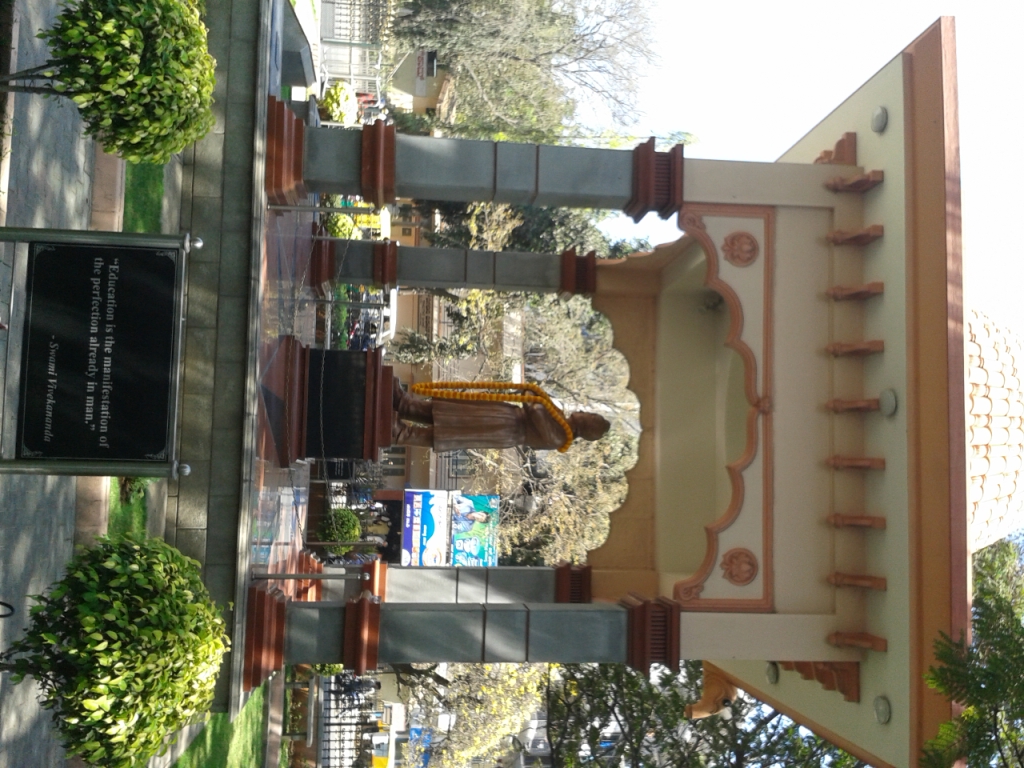
Taken February 25, 2014 in Bangalore
This little park devoted to Swami Vivekananda is located on Bull Temple Road in Bangalore. Swami Vivekananda was a 19th century yogi and Hindu holy man. He was the chief disciple of Swami Ramakrishna, and is often credited with introducing yoga to the West. This statue is located across the street from the Ramakrishna Math near Gandhi Bazaar (there is another Ramakrishna Math closer to Ulsoor Lake.)
The park has a series of quotes from the Swami in English and Kannada. The one above says, “Education is the manifestation of the perfection already in man.”
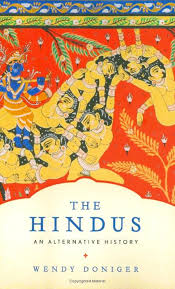
If anything sells a book more effectively than sex, it’s being banned. One knows that a book contains powerful ideas when someone goes to the effort to try to have it banned. Granted, the powerful ideas may or may not be good ideas–or true ideas, but thinking minds will demand to see for themselves. (I for one will be stopping by my local bookstore to see if they have a copy they’ll sell me for less than 1,000 rupee [$16USD], because I’ve got to know what has the thought Nazis up in arms.)
But does a self-imposed ban have the same effect? Penguin India settled a suit by agreeing to stop printing the book The Hindus: An Alternative History, and to burn outstanding copies. This, after a protracted legal battle against a Hindu nationalist group called Shiksha Bachao Andolan. However, there may be more to it than simply trying to build sales on the four+ year old book (that likely would have been long forgotten in an environment of free speech.) Indian law makes it a criminal offense to offend Hindu sensibilities, and thus puts the publishers in physical as well as fiscal jeopardy. Of course, it’s already come and gone as a best-seller in India, so it couldn’t hurt to restoke global interest.
It should be noted that there isn’t overwhelming support for banning the book in India. There has been outrage against Penguin’s fold by Indians who read, who believe in freedom of speech, and who are terrified of the idea of a crime of hurting someone’s feelings by discussing their religion’s history. (The latter being a direct route to tyranny if ever there was one. )
As I said, sex sells and bans sell double; the book in question has both. One might be inclined to think that it’s some sort of porn novel churned out on pulp. Actually, the author is a Professor of Religious History at the University of Chicago, Wendy Doniger. The book does apparently focuses heavily on the role of sexuality in Hindu mythology. What some readers might not know–and might be surprised to learn–is that hardcore Hindu nationalists are two steps to the right of Jerry Faldwell on issues of sex.
Here’s are accounts by the LA Times and Galleycat.
One of the most extensive discussions of the forces who succeeded in getting the book banned is in the NY Times.

Taken on October 12, 2013 in Agra.
This photo was taken during Dussehra (Vijayadashami) celebrations in Agra. There were many street parades that day.
Dussehra is a Hindu festival that celebrates the victory of Lord Suraj over Ravana and also marks the victory of the Goddess Durga over the Mahishasur demons.

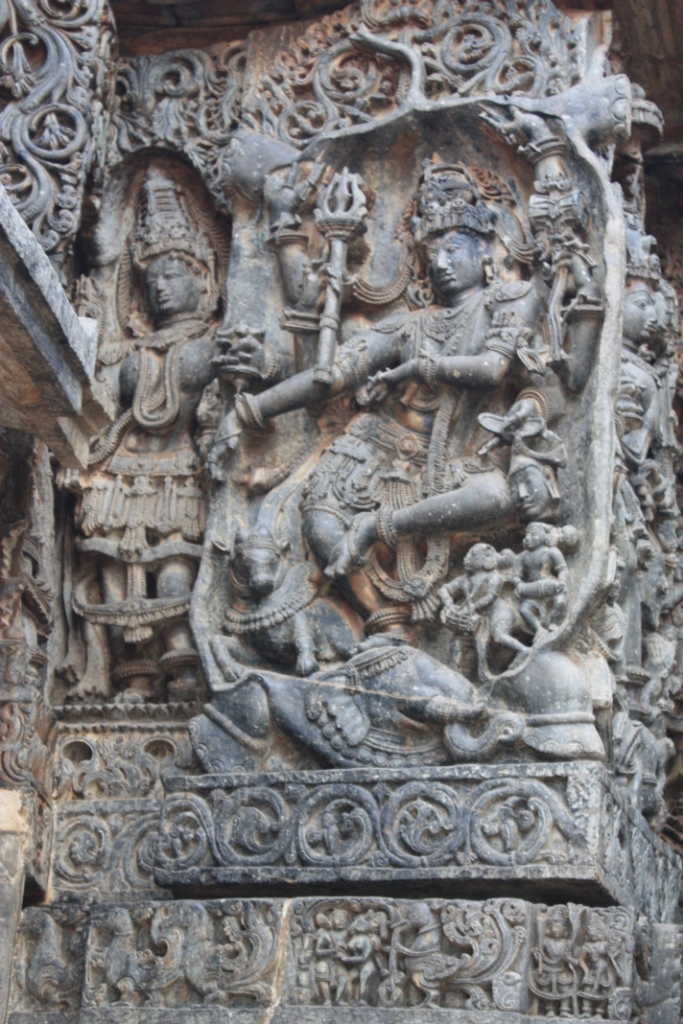
Taken November 23, 2013 at Halebidu.
This frieze is located at Hoysaleshwara temple in Halebidu. Hoysaleshwara is dedicated to Shiva, and was finished in 1121AD–though many believe it was not actually finished. It’s one of the largest temples to Shiva in southern India and is actually a double temple–the inside being split between the king’s temple and the queen’s temple.
This is a depiction of Shiva dancing inside a vanquished elephant. It may seem mean to kill an elephant and dance inside it, but this particular elephant was a demon or possessed by a demon. Of course, the question remains as to why one would dance inside a slain enemy. I guess it’s a little like dancing on your enemy’s grave, but a lot stinkier and messier. It’s just weird no matter how you slice it.


 Tiger Riding for Beginners