
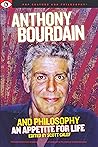
BOOKS: “Anthony Bourdain and Philosophy” ed. by Scott Calef

Anthony Bourdain and PhilosophyAnthony Bourdain and Philosophy by Calef Scott
My rating: 5 of 5 stars

Amazon.in Page

Release Date: December 26, 2023

These pop philosophy books that examine philosophical ideas through the lens of a particular pop culture personality or entity have become, well, popular. It’s not hard to see why; it’s an easy way to take your medicine, your medicine being to learn philosophical concepts. And, let’s face it, scholarly philosophical books are often nigh unreadable, being laden with jargon and having a tendency to get so lost in the minutiae of razor fine points that they display no relevance to the human experience. I am not immune to the appeal of such books, though when I see a book like “Miranda Sings and Philosophy” I figure I can take a hard pass. But this one caught my eye because Anthony Bourdain did live a life shaped by his own particular philosophy, and an intriguing one at that.

Like most of these books, this is a collection of essays written by different authors. As such, the quality and relevance of the included chapters does vary somewhat.

The book is divided into four parts. The first part looks at the subject of the work for which Bourdain was best known — i.e. at the intersection of food and travel. In these four chapters, authors explore the aesthetics of food and questions like: Do “expert” views on food matter? What is disgusting? And what role does culture play in the culinary experience?

The second part is entitled, “life,” and these five chapters look at Bourdain, the man. That is, they shift away from his work, and look at Bourdain as a martial arts student, a storyteller, and -generally – as a person. These chapters also offer insight into his epistemological perspective — i.e. how he viewed (and engaged in) the pursuit of truth, as well as touching upon his philosophical views more broadly.

The third part takes another turn to examine Bourdain’s addiction and his death by suicide. The chapters present broader philosophical frameworks on suicide and freedom, as a means to put Bourdain’s experience in perspective.

The final part is really kind of a grab-bag of subjects that don’t fit neatly into the other sections. Probably not coincidentally, this is where most of the book’s rough spots are located. It sometimes seems that Bourdain’s philosophy is not so much the subject anymore, and some authors convey their ideas more clearly and effectively than others. This is not, by any means, to say that any of the chapters are completely stinkers, nor to say that all of the chapters are defective. Chapter 13 [which, BTW, I think could have found a spot in Part II] does an interesting job in clarifying Bourdain’s approach to ethics, no easy task as it can seem like an odd mix of spiteful nihilistic impulses and compassionate humility (and it certainly evolved over time.) But even Chapters 14 and 15, which are not only the least flattering discussions of Bourdain but also the most didactic, have something to offer. The first lays out the scandal involving Bourdain’s girlfriend who was a MeToo leader but who also paid off a young actor who accused her of statutory rape, a pay-off made by Bourdain and which seems to be a factor in his suicide. Chapter 15 offers examples of what the author believed Bourdain did right and wrong in discussing the historical context of the places he visited that had been colonized. Ch. 16 was a discussion of the ethics of engaging in luxuriant fine dining in a world with starving people. I thought this chapter would stay the course set by the previous two, but it did shift back into academic objectivity by producing a more complete discussion of competing viewpoints. The penultimate chapter goes more niche than the others, but is a fascinating look at the ethics of AI generated voicework for the “Roadrunner” documentary — i.e. using AI to make it sound like Bourdain said things that he wrote in emails or books but never said [at least not into a recording device.] The last chapter involves climate change and episodes Bourdain did in Madagascar and Bhutan. This was both one of the longer chapters and definitely the most muddled. It remains unclear to me exactly what the author was trying to say, exactly. It’s perfectly readable, and yet unclear.

All in all, I enjoyed this book (as much as one can “enjoy” a book that is about a deceased beloved figure,) and thought it offered some excellent food for thought.

View all my reviews

BOOKS: The Mind of Adi Shankaracharya by Y. Keshava Menon

The Mind of Adi ShankaracharyaThe Mind of Adi Shankaracharya by Y. Keshava Menon
My rating: 4 of 5 stars

Amazon.in Page

This book does a good job of that at which the title hints, offering the reader insight into the philosophy of Adi Shankaracharya. Along the way, Menon presents clear descriptions of Indian philosophical concepts such as Maya, Avidya, Antahkarana, etc., and also compares and contrasts Shankaracharya’s philosophy with those of other philosophers (from both the East and West) as a means to clarify ideas that can be subtle and complex.

That said, what the book isn’t is an unbiased and objective look at Shankaracharya’s ideas. While Menon doesn’t go as far as to support the supernatural myths of Shankaracharya’s life (which are only discussed in the Appendix,) and he skirts that 800-pound gorilla of Hindu philosophic controversy, caste, he does present the philosophy as an advocate for Shankaracharya rather than as an indifferent scholar who merely wishes to deliver arguments and ideas while inviting thought among his readers.

While the book deals with epistemology, ethics, and various aspects of metaphysics, the biggest single subject is Self. I found the explanation of this topic to be fascinating. I had previously understood that among the major differences between Shankaracharya and Buddha was on this question. While I still find the Buddhist approach to Self (or, more properly, lack of Self — i.e. Anatta) to be the more compelling and parsimonious explanation, I feel that I was provided with about as clear an explanation of the Hindu (generally) and Shankaracharyan (specifically) views on Self as one could wish for.

I’d recommend this book. If you’ve come away from reading about subjects like “Maya” (Is it illusion? Is it NOT illusion?) this book can definitely help offer clarification, and (as books on philosophy go) it’s readable and not too jargon-laden. That said, if one is looking for a book that is not advocating a philosophy but, rather, objectively providing ideas and contrasting explanations, this book may bias your views.

View all my reviews

PROMPT: Quote

Do you have a quote you live your life by or think of often?

Four, actually:

Be kind, for everyone you meet is fighting a hard battle.

Plato (attributions vary)

There is nothing either good or bad, but thinking makes it so.

William Shakespeare (in HamLet)

Contentment comes not so much from great wealth as from few wants.

Epictetus

If you reject the food, ignore the customs, fear the religion, and avoid the people, you might better stay home.

James a. Michener

The Good, the Bad, and the Bat-Shit Crazy of The Republic by Plato

INTRODUCTION: The Republic is the most read and discussed of the Socratic dialogues written by Plato, and for good reason. It offers some intriguing ideas that have influenced philosophy, politics, religion, and even science fiction to this day. That said, the book isn’t without its stinkers, and many people have reasonably asked whether a state or nation employing all of Plato’s guidance wouldn’t be more dystopian than utopian. To avoid the error committed by many religious people regarding scriptures (and probably by a few scholars regarding Plato’s work,) we shouldn’t ignore the parts that are — let’s say…, complete lunacy, and also shouldn’t contort language and reason to make the questionable ideas palatable. With that in mind, we’ll start with a couple of The Republic‘s banana ideas before examining a few that have stood the test of time.

PLATO’S WAR AGAINST POETRY & THE ARTS: In The Republic, Plato goes on a tirade against the arts on the basis that they aren’t truthful and that they encourage readers and viewers to behave from the lesser elements of their “soul” – the emotional and desirous bits. Plato’s condemnation of art is informed by two of his major teachings. First, the “tripartite soul” in which reason is king and emotion and desire are lesser elements of humanity that should be checked by reason. Ergo, he doesn’t like that reading Homer makes people weepy or riled up. Second, in Plato’s conception of forms, for any given thing under the sun there’s an ideal form that was made once by god, then there are actual items made by craftspeople, and then there are the imitations made by artists. In Plato’s mind, this leads to a warped situation in which the craftsmen stray from the ideal by copying what artists presented, rather than seeking the divine ideal, and Plato is all about the pursuit of the ideal.  

Plato would grant artists the opportunity to prove that their works are of service to the state, but barring their demonstration that the art advances reason and is truthful it would be outlawed. To me, it sounds a lot like the Soviet Union where art was mostly jingoistic pieces that encouraged a Stakhanovite effort. At any rate, I’ve got to give this one to Aristotle who saw the cathartic value of art and poetry. There is value in the existence of a wide variety of modes of expression and ways of thinking about the world. It allows us to break new ground. I was just reading a book by Yeats in which he wrote: “Everything exists, everything is true, and the earth is only a little dust under our feet.” This may not seem like sound thinking in our rational age, but I like that such a counterweight exists.

THE SHARING OF WIVES & CHILDREN BY THE RULING CLASS: Plato’s Republic would be ruled by a philosopher-king, and it requires the ruling class to be specially educated and controlled to avoid pursuit of wealth and comfort. One such control is that the aristocrats can only have kids (unaborted ones, at least) under certain conditions, but the children wouldn’t know who their biological parents were.

Plato is no fan of democracy. In fact, democracy is the stage right before tyranny in Plato’s model of political devolution. [It starts with Plato’s ideal, Aristocracy, which devolves into Timocracy with the declining character of leaders (because they’re not well-trained philosophers.) Timocracy devolves into Oligarchy as the lesser quality ruling class becomes obsessed with wealth. This leads to Democracy because people get fed up with the oligarchs having all the money and they revolt. But since anyone can become leader, a tyrannical type will eventually rise to the top and use an iron-hand to maintain power.]

There’s a reason why, to my knowledge, this approach has never been tried, despite the immense popularity of Plato and The Republic. It relates to a previously mentioned point as it pertains to Plato’s ineptitude with regards to human psychology. Plato [like several other philosophers of the ancient world] believes one can kill emotion and desire through the power of pure reason. Reason maybe our smartest mental activity, but it’s neither fastest nor particularly capable of steering the ship. At any rate, this joint parentage scheme makes me think of the Harry Harlow experiments in which baby monkeys were put either with a wire mesh or cloth-covered “mother surrogate.” We’ve learned a lot about how psychopaths are made since the days of Plato. I think Plato’s guardian class would be chock-full of lunatics.

THE SUPREME IMPORTANCE OF GEOMETRY: I love a triangle as much as the next fellow, but I think Plato may have gone a little overboard with his views about the transcendent value of geometry.

WHAT PLATO GOT RIGHT: There are definitely ideas in The Republic that continue to contribute to humanity’s understanding of itself and the world. Here are a few good reasons to read The Republic — despite all that junk mentioned above.

THE ALLEGORY OF THE CAVE: Because of sci-fi works such as The Matrix, this is probably the most widely cited bit of The Republic. However, it’s not just a fictional or hypothetical idea anymore. One will also see references to Plato’s cave in nonfiction works of neuroscience and physics that deal with how our perceived world doesn’t equate to the objectively real world. Plato offers a very clear thought experiment in Book VII.

PLATO’S GENDER PROGRESSIVISM: In The Republic, Plato argues that women can be guardians of the state as well as men, and that women must receive the same education in order to do so. Lest the feminist jump all-in on Plato, it should be noted that he maintained some pretty misogynist / patriarchal views (e.g. women being like children,) as well as some bizarre ones (e.g. the wandering womb hypothesis.) However, in at least that one regard, Plato was ahead of his time.

KNOWLEDGE ACQUIRED UNDER COMPULSION OBTAINS NO HOLD: Given that Plato’s Republic would feature some harsh limitations of individual freedom, from lack of artistic expression to inability to know one’s own mom, it’s nice to see that he held some freedom-loving views, as well.

COURAGE IS STAYING SPIRITED IN ONE’S DECISIONS IN THE FACE OF PLEASURE OR PAIN: Much of The Republic is an attempt to define and distinguish the cardinal virtue of justice. In fact, in many Socratic dialogues, the primary objective is to understand virtues, and they’re often discussed at length, not always resulting in a firm conclusion. I like the definition of courage provided in The Republic. One makes a decision based on the virtuous path, and sticks with it even when pleasure or pain might divert one.

THE TENDENCY TOWARD DIMINISHING EFFECTIVENESS IN POLITICS: While I share neither Plato’s enthusiasm for aristocracy nor his pessimism about democracy (there’s a reason the world has abandoned the former in preference for the latter,) I do think there’s a potential grain of truth in his model of political devolution that’s mentioned in Books VIII & IX. I think there can be a proclivity towards weaker and less effective leaders over time under certain systems of governance. One can see this in the Soviet Union, and arguably in North Korea. It seems possible that there are systemic causes for devolution of political effectiveness, at least under certain approaches to governance. (I’d argue this is one of the reasons that democracy is best, because it can fully overturn the apple cart of governance rather than struggling with whatever continuity issues contribute to declining effectiveness.)

READ THE REPUBLIC, both for its great and for its dystopian ideas, because even when it’s bad, it’s stimulating.

BOOK REVIEW: Humanism: A Very Short Introduction by Stephen Law

Humanism: A Very Short IntroductionHumanism: A Very Short Introduction by Stephen Law
My rating: 4 of 5 stars

Amazon.in Page

In this guide, Law lays out the basic principles of humanism, discusses the arguments for and against belief in a deity, and examines the humanist conceptions of morality and meaning of life (two constructs that religious people often claim can only exist in a deist world.) Humanism is an ill-understood system, in large part because it isn’t so much a set of ideas ascribed to as a way of approaching ideas in a questioning and secular way. Therefore, defining humanism isn’t as straightforward as listing a set of common beliefs because humanism can cover a wide variety of different worldviews. That makes this a particularly useful book as it clears up a number of false equivalences. Many think that humanism is the same as atheism or agnosticism, and while humanists generally follow one of those two approaches to the question of whether there is a god, humanism isn’t identical to either.

This book does a good job of organizing the debate and laying out arguments and counterarguments. I learned a lot by reading the book and by deliberating over the points of contention. There were points where I think more could have been said. For example, in the chapter on the meaning of life, after systematically dismantling the religious argument that a meaningful life is the sole domain of religion, Law doesn’t offer any guidance as to the humanist approach to pursuing a meaningful life (stating merely that most humanists agree with the religious about what is a meaningful life, even if they disagree about why it is.) I realize this is a brief guide, and the author might have wanted to avoid stepping on the toes of other guides in the series that investigate the question, but it stands as a deficiency. True, there wouldn’t be a list of what makes a meaningful life so much as an outline of how to approach it, but, still, even an overly simplified statement would have been useful.

I learned a lot from this book and would recommend it for anyone wanting to gain insight into the debates around humanism.


View all my reviews

BOOK REVIEW: Buddhist Ethics: A Very Short Introduction by Damien Keown

Buddhist Ethics: A Very Short IntroductionBuddhist Ethics: A Very Short Introduction by Damien Keown
My rating: 5 of 5 stars

Amazon.in Page

Most people, if they know anything about Buddhist ethics, have heard of the Eightfold Path (right + view, intention, speech, action, livelihood, effort, mindfulness, and concentration.) However, just knowing that can lead to the impression that Buddhist ethics are blurry and that it’s all a matter of doing as one pleases within one’s personal interpretation of rightness. This concise guide offers an overview of the Buddhist ethics and morality, focusing on issues of global and modern interest (as opposed to those issues only of interest in places where Buddhism is practiced or at the time in which Buddha was teaching – i.e. issues like abortion, vegetarianism, war, suicide, and cloning and not subjects like caste, traditional family roles, etc.)

The first two chapters present a broad overview, and the rest focus on particular ethical issues. I found the second chapter beneficial; it asks how Buddhist ethics fit in the categorization scheme employed by Western Philosophy. I considered it useful even though the answer was that Buddhist ethics aren’t neatly contained by this way of thinking, but rather can be seen as a mix of multiple approaches. (e.g. Buddhism has sets of precepts – ala deontology, has a karmic doctrine that is arguably consequentialist, and, also, has elements similar to the virtue ethics of ancient Greece.)

Chapters three through eight investigate specific issues: animal rights and environmental ethics (ch. 3,) sexuality and gender (ch. 4,) war and violence (ch. 5,) abortion (ch. 6,) suicide / euthanasia (ch. 7,) and upcoming technologies that will change what it means to be alive and conscious (i.e. cloning, artificial intelligence, cryogenics, and CRISPR.) As with chapter two, there’s often no tidy answer. For one thing, the author tries to contend with what is common across various sects, and this is often reflected in the laws of countries, laws which are only partially informed by Buddhist philosophy. Also, it’s not like the Buddha had anything to say on many of these issues, which either weren’t issues (e.g. cloning) or were considered radically differently (e.g. gender.) Still, one does get an idea of how these questions relate to ideas such as karma and dharma, and how contemporary Buddhist thinkers might begin to consider them.

One will note that there are ethical territories that aren’t addressed (e.g. justice / punishment, ethics of governance, business ethics, etc.,) but a brief guide needs filters, and this one chose to focus heavily on modern, individual ethical questions of broad international interest.

If you’re looking to better understand Buddhist ethics, this book is worth reading.


View all my reviews

BOOK REVIEW: Humour: A Very Short Introduction by Noël Carroll

Humour: A Very Short IntroductionHumour: A Very Short Introduction by Noël Carroll
My rating: 4 of 5 stars

Amazon.in Page

As both Mark Twain and E.B. White made abundantly clear, humor is like a frog; dissection kills it and few are interested in watching that happen. Which isn’t to say that dissection isn’t useful. But it does mean that readers who are looking for a book that’s a laugh-riot are looking in the wrong place. Most of the example jokes were ancient when the book was first published eight years ago. (They’re good jokes. Bad jokes don’t become old jokes, they die ignominiously.) All that aside, this book provides an intriguing look into such questions as: 1.) why do we find things humorous in the first place? (We take humor for granted, but – think about it – there’s no rationale for things being funny that automatically springs to mind;) 2.) how, if at all, does humor relate to our broader emotional experience; and 3.) when, if ever, is humor unethical?

This concise guide has three parts. In the first part, we learn the various theories of humor, and learn that the author favors Incongruity Theory (i.e. humor is – first and foremost – a recognition of and response to incongruities.) In the second, the author discusses the debate over whether humor is an emotional experience, or something else. Finally, we learn about the value of humor and, in particular, the ethics of humor. There’s a continuum from those who believe that humor – in and of itself – is always ethical to those who think that it’s virtually always unethical (unless one can find a joke without a butt,) with many nuanced variations, in between.

I found this to be an intriguing guide to the philosophy and psychology of humor, and – if that’s what you’re in search of – you should check it out.


View all my reviews

BOOK REVIEW: Ancient Philosophy: A Very Short Introduction by Julia Annas

Ancient Philosophy: A Very Short IntroductionAncient Philosophy: A Very Short Introduction by Julia Annas
My rating: 4 of 5 stars

Amazon.in Page

Annas’s task of creating a concise guide for such a broad topic is a daunting one. For perspective, I’ve read books in this series [AVSI] on Stoicism, Epicureanism, and Socrates – each of which is a slim subset of the material called “Ancient Philosophy.” Furthermore, it’s not as though there was great homogeneity of ideas among the ancients. And, adding to the challenge, the author attempts to address the full scope of ancient philosophy: i.e. ethics, epistemology, logic, and metaphysics.

The book is forced to both restrict itself to an inch deep (because the subject is a mile wide,) but also to make choices about what schools, philosophers, and sub-topics it will address. History did part of the work – e.g. for many ancients, only fragmentary or secondhand evidence of their positions survived. So, we see a lot about Plato and Aristotle because their words remain. The book also devotes a disproportionate emphasis to what some call “philosophy of life,” i.e. ethics and how / whether to pursue a happy and meaningful life – i.e. how to live. This emphasis is both because that’s what many ancients focused upon, but also because it’s what people find relevant when looking back to them. [As opposed to ancient metaphysics, which science has largely made obsolete, ancient ethics and thoughts on happiness aren’t necessarily outmoded.] The first chapter sets up this focus on philosophy of life in an interesting way by discussing humanity’s mixed motivational system — reason v. emotion.

One question that the book robustly considers is the degree to which ancient philosophy is still relevant. This is taken up most directly in chapter two, but the final chapter (on what constitutes ancient philosophy) also has germane things to say on the subject.

I found in this book a quick guide to comparing schools of the ancient world across the breadth of philosophy, and would recommend the volume – particularly as a starting point prior to delving deeper into sub-topics.


View all my reviews

BOOK REVIEW: Stoicism: A Very Short Introduction by Brad Inwood

Stoicism: A Very Short IntroductionStoicism: A Very Short Introduction by Brad Inwood
My rating: 4 of 5 stars

Amazon.in Page

Inwood provides an overview Stoic philosophy as it’s discussed in a scholarly context. To distinguish Stoicism as scholars see it from how it’s viewed by those who practice it as a lifestyle, the author differentiates “large Stoicism” from “minimal stoicism.” The vast majority of books today deal only with minimal stoicism – in other words; they exclusively explore how to lead a good and virtuous life, i.e. ethics-centric Stoicism. Scholars, however, are also interested in the physics (/ metaphysics) and the logic of Stoicism.


There are several reasons for this difference in scope. First, Stoic ethics has aged much better than its other philosophical branches. Much of Stoic logic has been improved upon or superseded, and Stoic physics is [arguably] obsolete. This means that scholars studying Stoic physics and logic are more interested in those subjects as a stage of development or a piece of philosophical history than they are as contenders for understanding those subjects. Second, prominent Stoic philosophers with surviving writings (i.e. Epictetus, Marcus Aurelius, and Seneca) have inspired many people by discussing Stoicism as a way of life – not so much as a navel-gazing endeavor.


After discussing the origins of Stoicism, the major Stoic authors, and how Stoicism relates to other philosophical schools of the ancient world, the book presents a chapter each on physics, ethics, and logic. The last chapter investigates how Stoicism is viewed today and how it might maintain relevance despite challenges to some of its metaphysical and logical underpinnings.


Having read a number of books on Stoicism, I didn’t know whether this concise book would be of much benefit. However, by describing Stoicism’s broader context and how the deterioration of much of that context influences the philosophy’s relevance, the book offered plenty of food-for-thought. If you’re interested in this broader context, you may want to give this book a look.


View all my reviews

BOOK REVIEW: Anecdotes of the Cynics by Various

Anecdotes of the CynicsAnecdotes of the Cynics by Robert F. Dobbin
My rating: 5 of 5 stars

Amazon.in Page

This is a collection of brief stories and sayings from famous Cynic philosophers – notably, Diogenes of Sinope, Crates of Thebes, Hipparchia, and Bion. It opens with the longest piece, a dialogue [allegedly] by Lucian the Cynic advocating the Cynic’s minimalist approach to life. [Cynics were ascetics who shunned customs and cultural conventions and thus often ran afoul of the conservative societal base / rubbed people the wrong way.] The dialogue uses Socratic method, but also contains prolonged exposition. [Not like the Platonic dialogues in which Socrates tends to ask brief questions and attempts to demand brief answers – granted not always successfully.] However, most of the pieces are just a paragraph or two brief excerpts.

Most of the entries report on what various Cynics said or did, though there are a few that are biased commentaries of non-Cynics about these “dog philosophers” – e.g. there is a Catholic tract denouncing the Cynics while talking up Paul. [It reads as though the early Christian church (which was teaching Jesus’s ideas, including: in part, the virtues of poverty, of simplicity, and of a lack of deference to the world of men) might have been concerned about being outcompeted.]

There’s not a tremendous amount that remains of direct Cynic teachings, and so a book like this is a way to get a taste of the highlights. Just as Buddha found that extreme forms of ascetism didn’t yield the optimal result, Cynicism lost ground to the upstart school Stoicism, which borrowed some Cynic ideas while jettisoning the most extreme aspects of the philosophy.

One can find these stories in old public domain sources such as Diogenes Laertius’ (no relation) “Lives of the Eminent Philosophers,” but this is a good way to get the condensed version without too much extraneous information.

View all my reviews