Can India Compete With China?

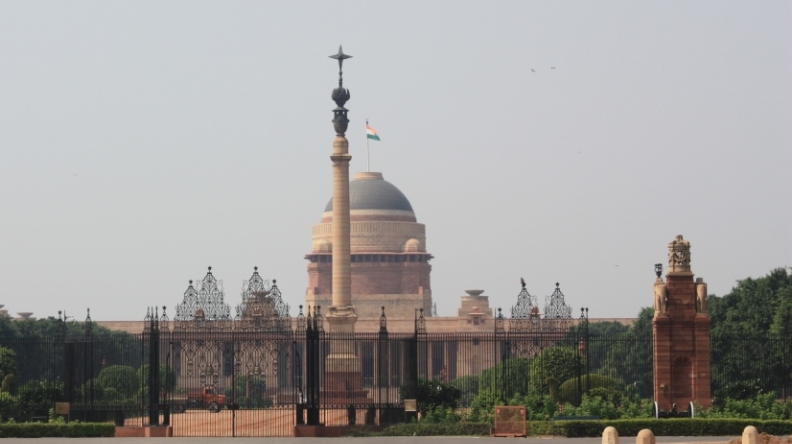
IMG_0131There’s perennial hope in the West that India will succeed. Having won the Cold War, advocates of democracy and rule of law aren’t eager to replay it and have a Communist country win–not even one that yields to market forces in large part.  Citizens of democratic nations want reaffirmation that democratic rule and rule by law, not men, is the superior paradigm. We acknowledge that such a system is rarely easy, but live with the words of Winston Churchill ringing in our ears:  

Democracy is the worst form of government, except for all those other forms that have been tried from time to time.

When I found out that I was moving to India, I read all that I could find on India in magazines I subscribed to, such as Foreign Affairs, National Geographic, and Wilson Quarterly. Needless to say, there was a lot to read. Besides India’s nuclear programs, both energy and weapons, I hadn’t followed its role in the world. These articles took me on a roller coaster ride. If one went back many years, no one expected much of India. Then, a few years back, massive enthusiasm blossomed that India was going to rocket off and leave India in its dust. Then I got to the most recent articles, which did yet another turnabout–saying that India’s growth had been ephemeral and no one should expect much from the country in the near future.

India has a number of advantages. Almost everyone who is capable of publishing is fluent in the de facto international language of business and academic publication–namely English. India has as abundant a supply of cheap labor as anywhere. Indians have a culture that values education. They are building a first-class university system by, in part, having sent students to the very best of academic institutions globally. Their universities are attracting foreign students. This, in combination with such a big population, has given them the potential to build impressive student bodies.

So, why isn’t India competitive? The first thing that should be stated is that things are never as simple as they appear in aggregate. In some domains, India is competing quite nicely–and not just with China. Here in Bangalore, it’s apparent that large IT companies see big advantages in doing business in India.

I made a recent trip to Hampi and was amazed to see how successful India was in building up wind power generation in central Karnataka. India is 5th in installed wind capacity overall. Many democracies have difficulty getting traction with wind because the public views the turbines as an eyesore.

Still, India has its problems. Political and Economic Risk Consultancy (PERC) surveyed business leaders about Asian bureaucracies and found India to be the worst bureaucracy in Asia.  On a 1 to 10 scale, where 10 is the worst possible, India rated a 9.21. This isn’t a surprise in the least. It seems to be common knowledge that business leaders who move to India do so in spite of India’s governance, not because of it.  India’s bureaucracy hasn’t embraced the IT-revolution. It’s interesting being in Bangalore, where IT-companies are state-of-the-art, and being asked for the same copies of documents a half-dozen times because the information is only stored on non-networked PC hard-drives–and paper files are collected but don’t seem to be organized in any way.

An ethos of corruption is ubiquitous in India. Police officers have been known to sit in parks and solicit “admissions fees” from tourists. I’m pretty sure I saw a shakedown in progress this past week when our car went through a toll booth on a toll road we had already paid for and two guys standing outside in front of the toll-taker insisted that our driver pay for the toll that he had already paid not ten minutes before. Being from a country where corruption is punished severely, I’m ignorant of the process of bribes. (I suspect this is why I’ve had so little success in getting anything done that involves the Indian bureaucracy.) For a less anecdotal experience, one can turn to the “Corruption Perceptions Index,” which places India in the bottom half among all nations.

One may wonder how a democracy retains a culture of corruption. Usually, citizens of a democracy get fed up and start voting their disapproval. At the Bangalore Literature Festival, I heard an interesting policy panel featuring a politician, a retired general, and a policy pundit. It was said that there is a high degree of apathy among the Indian middle class. Indian voter turnout rates are generally below 60%. There’s a belief that those most capable of affecting change are relatively happy and, thus, unwilling to rock the boat. I don’t know how true this is, but it seems that India is having trouble defeating some of the problems that wither on the vine in the face of a politically active public.

It also seems that there is a segment of the population who are completely cowed. This is a legacy not only of colonial repression but also of caste repression. While castes have been done away with, there remains a large segment of the population who are accustomed to doing just as they’re told without questioning and without making moves to get ahead.  Perhaps, because they believe they exist in a world in which there’s no getting ahead.

India’s abundance of cheap labor may be a curse as well as a blessing. While cheap labor has brought in foreign direct investment, it has also contributed to a business culture that doesn’t seem to value increased productivity. As an example, if one goes into a small shop in Chicago or Copenhagen or even Beijing, it’s likely that a single salesperson will show one merchandise, ring it up, and bag it. If it’s a big store, there may be a two person interaction–salesperson and cashier. In an Indian store, a salesperson will show one merchandise, a clerk will write up an invoice, one will take that invoice to a cashier, that cashier will take one’s money and hand one a carbon-copy of the “paid” stamped invoice and direct one to a pick up window, a bagger will bag your purchase, and  a “checker” will check your receipt and hand you the bag. I love specialization as much as the next economist, but this is a Rube Goldbergesque approach to retail operations.

If India wants to be a first-rate power, it needs to take on corruption, bring its bureaucracy into the 21st century, and its population needs to realize they can have a more satisfying life than waiting around for someone to need them for a momentary job. The citizenry needs to value good governance, and businesses need to figure out how to increase productivity.

Google Thinks They Know Me, We’ll See!

I sent an email to my wife asking if she wanted to have pizza tonight. Lo and behold, there was a Gmail ad for Dominos by the time I hit send. From here on out, I’m using the code “murder the butler” in place of “buy pizza.” I don’t want Google knowing that I’m carbo-loading.  I have shame. Find me an ad for that, bitches.

In related news:

“watch TV” now equals “watch gay porn”

“have a beer” now equals “fire up the crack pipe”

“masturbate” now equals “file a fraudulent insurance claim”


You think you know me, Google? We’ll see.


A Postal Solution & A Related Rant

I heard on the news yesterday that the US Postal Service was backtracking on its plan to stop Saturday mail service. It turns out that they need approval from Congress to make such a change. Of course, it’s hard to get Congress to agree on anything, but–adding to the challenge–Congress is not really familiar with the concept that one must have money in order to spend money. When the Postmaster General testified before the House that the Post Office could not keep operating as is because they weren’t taking in as much money as they were spending, the entire chamber was seen to simultaneously tilt their heads like the RCA dog. The House’s best and brightest was heard to inquire, “Why don’t you just use other people’s money?”

At any rate, I have a solution for the Postal Service. Instead of offering junk mailers a bulk rate discount, don’t. Here me out. I know what you’re thinking, if it wasn’t for junk mail there’d be no mail. Instead of charging Ida Mae Bludgeonsworth–an octogenarian from Beaver Springs, Montana who is the last remaining sender of private letters–half a dollar and charging Citibank ten cents, you flip it.  Yes,  it’s true that if one increases the cost to the credit card companies to spam us to, say, $3 then revenues won’t increase (remember discussion of Laffer Curves from Macroeconomics? I didn’t think so. The idea is that as you raise tax rates eventually you will reach a point where revenues decline because people will not feel an incentive to work anymore. There is great controversy about where we are on the Laffer curve at any moment, but that such a tipping point exists is undeniable–i.e. how many hours a week would you work if you paid zero income taxes? How many, if you paid 100% of income to taxes?) So revenues would likely decline (or your interest rate would shoot up), but if one cut out junk mail, the Post Office would only have to deliver to my house once a week–a substantial savings.

I know it’s always hard to see a career field go the way of the dodo. We have great sympathy for the typewriter repairmen and personal travel agents of this world, but it may be better to rip the bandage off swiftly.

You may wonder why I harbor ill-will towards the makers of junk mail? The person I particularly hate is the evil genius who decided to start putting plastic mock credit cards in each piece of credit card junk mail. Up until then, I didn’t even need to bother with opening envelopes, I could simply drop the junk mail into the shredder whole. Now I have to be bothered with either a.) opening the letter and extracting the shredder-killing  blockage, b.) purchasing an industrial strength chipper-shredder. I think I should be able to charge junk mailers for my time for making it such a pain to discard their “pre-approved” offer–which has to be shredded because it is half filled out with information they shouldn’t even have and is thus a case of fraud waiting to happen.

It’s All Fish Balls and Kipper Snacks From Here on Out

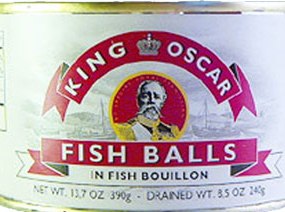
FishballsOwing to a freakish and inexplicable popularity of this blog with Norwegians, I recently received a quasi-lucrative endorsement offer from the King Oscar Canned Fish Corporation. In exchange for tweaking this blog’s content, I will receive all the canned fish products that I can eat– for life. Yeah, that’s right, I get all the minced mackerel, pickled herring, and fish balls that I can stomach. (FYI- Fish balls aren’t aquatic rocky mountain oysters, if you were wondering.)  This is almost as good an offer as was received by Flipper, and he had immense star power. The first truckload arrived this morning as promised, putting me on retainer. Therefore, from this moment onward, the content of this blog will be devoted to the delectable joys of such foods as herring fillets in monkfish sauce or Kipper snacks in oil.

Rest assured, I’ll continue to present the same type material I have in the past, but it will now all have a canned seafood theme running through it. For example, for those who have enjoyed my poetry, I have a doozy coming up entitled “Ode to the Happy Anchovie.”  I will continue to produce humorous postings. There is only one subject off the table… no, not pedophilia… I will never make fun of the delicious Norwegian canned fish snacks of the King Oscar Corporation. However, I have a scathing rant against people who don’t want anchovies on their half of the pizza that I think you’ll find particularly rib-tickling.

In conclusion, I’d like to wish you all a happy April Fool’s Day.

TODAY’S RANT: Puny Machines

When the machines rise up against humanity, I will be high on their list of Homo sapiens to put through the chipper-shredder.

You may be asking, “How can such an unimportant person make such a self-important statement?”

Here’s my confession: I have killed more than my fair share of consumer electronics. Let it be known for posterity that these were all cases of manslaughter–or, I guess, machineslaughter. I never once had malicious intent, nor did I ever engage in premeditation. Furthermore, in a way, I mourned the loss of these machines more intensely than I did the death of granny.

Let me say, in my defense, machines are weaklings. The good news is that I don’t worry about them taking over just yet because you can always take out a marauding terminator with a can of soda–and even make it look like an accident.

The rant part of this post has to do with the divergence between what is advertised, and what is true.

Below is a video that Lenovo has put on YouTube to show how robust their computers are.

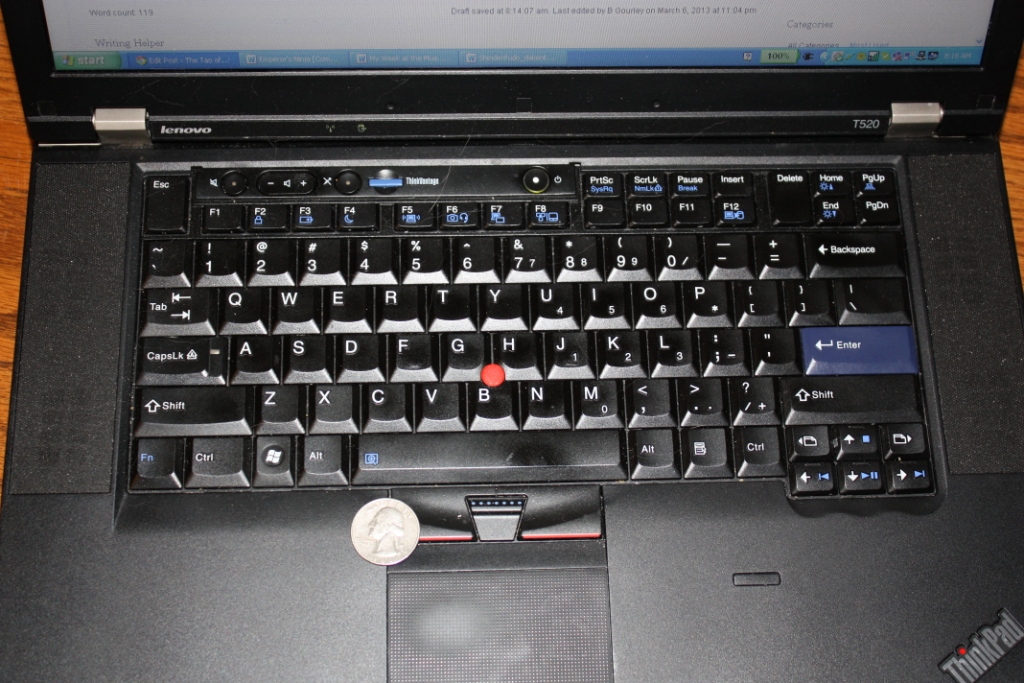
Here was my experience, avoiding the lunging paw of a hyper cat, I spilled a drop of milk the size of a quarter onto the upper mouse buttons. This killed my mouse instantaneously (I’m aware of the irony of me killing a mouse while my cat looked on in horror.) My entire laptop died a few weeks later from what I assumed to be related causes.

Your Experience May Vary

Your Experience May Vary

Since my last machineslaughter, I’ve  quelled my killing spree by implementing three simple rules.
1.) I don’t eat in the same room as my computer.
2.) I don’t drink within 12 feet of my computer.
3.) I must close the computer any time I leave the room, if a cat is present. (This is not so much to save the laptop as to prevent the cat from composing a witty coded email such as, “a;oreanrpwipfvchaqewutheiuancvpiwe. wpn2qeyt028hnfqv-,” and sending it out to my entire email list with his butt.)

Do I resent having to walk on eggshells around consumer electronics? A little. I’d like to be able to listen to my transistor radio while taking a bath. (Research notes: Do radios still have “transistors?” Do they still make radios?)

However, what I really resent is the manufacturer making it seem like its product is indestructible when, in fact, it’s really pretty puny.

That said, I like the fact that people are tougher than the forces of robopocalypse by virtue of the fact that we can get wet.  (Of course, by that logic, fish should be our gods.)

Until next time, keep your can of Coke at the ready (but don’t drink it, that stuff will kill you.)

BOOK REVIEW: It’s Getting Better All the Time by Moore & Simon

It's Getting Better All the Time: 101 Greatest Trends of the Last 100 YearsIt’s Getting Better All the Time: 100 Greatest Trends of the Last 100 Years by Stephen Moore

My rating: 3 of 5 stars

Amazon page

The title says it all. The authors, Stephen Moore and Julian Simon, discuss 100 trends in 20th century America that give one reason to be optimistic about the future. These trends are grouped into the following areas: health, nutrition, wealth, poverty, children’s issues, labor, leisure, housing, transportation & communications, innovation, information technology, education, safety, environmental protection, natural resources, socio-cultural indicators, sports, women’s issues, racial issues, and freedom & democracy.

One of the co-authors, Julian Simon, died before publication of this book, but is famous for a bet that he made with Paul Ehrlich. The bet was that any five commodities of Ehrlich’s choosing would decline in price over the subsequent decade. Ehrlich, author of The Population Bomb, was a doomsayer, and believed the five commodities and most others would become more expensive. In other words, Ehrlich was betting resources would become more scarce as they were used up, but Simon believed our technological advances in discovery and extraction would outstrip our consumption. Simon won the bet. All five commodities became cheaper, though some have pointed out that if they had gone double or nothing over another decade the tables would have turned.

The authors attribute the world’s 20th century success to three technologies: electricity, vaccines/medicines, and the microchip. In answer to the question of why the United States did particularly well, the authors point to freedom as the main driver. Neither of these hypotheses are systematically evaluated in this work; they’re just presented with anecdotal support. I say this not so much as harsh criticism, but so as to make the reader aware that it is not that kind of book. The bulk of the book is one page of text for each trend, plus a line or bar graph to visually depict the trend.

This book makes some excellent points. People have a tendency towards pessimism, hence all the dystopian, zombie, nuclear holocaust literature. There’s also a common fallacy that there was once a golden age of humanity in the past that is never to be surpassed. One may find it hard to believe that it’s getting better all the time, but one can’t argue with the numbers. Life expectancy is up. Infant mortality is down. Housing is less crowded. We have more symphonic orchestras. On a host of issues, the quality of life of Americans has risen.

The previous paragraph notwithstanding, there’s room for criticism. While one can’t argue with the numbers, in some cases one might find oneself asking whether they are the right numbers or whether they tell the whole story. For example, the section on disease shows a strong decline across a range of diseases. However, it doesn’t cover any of the many chronic disease that arose in the 20th century and disproportionately affect wealthy countries such as diabetes and crohn’s disease. It’s hard to know how much of the trends represented are a function of data availability (covering so much ground, they had to rely on second-hand data) and how much reflects selection bias intended to support their argument. As implied in the preceding paragraph, some of the measures are undeniably the right ones. However, the reader may find themselves wondering about others.

It would be interesting to see an update to the study. For example, GDP growth is shown to be higher on average among the freest nations. However, with countries like China and Vietnam rocketing upward in GDP in recent years, it would be interesting to see if this trend has held.

There’s a CSPAN Book TV program with Moore available here.

Even though this book is 13 years old, I’d still recommend it. Given all the doom and gloom as of late, it might be a particularly good time to pick it up.

View all my reviews

TODAY’S RANT: Punked by NPR

Sleeping CatsI’m driving along, my mind roving, the droning radio only faintly registering in my subconscious, and suddenly I’m ripped from my reverie by a shrieking siren. I punch the brakes, slowing from a present speed that, unbeknownst to me, is two miles an hour below the limit to an octogenarian crawl. I hear the screech, and look into my rear-view mirror to see the black behemoth, an  SUV, becoming ever bigger. The driver’s solitary finger pressed up against the window, not pointing  at me accusingly, but rather straight up in the air. The SUV slows just enough to not ram me. We travel onward in our respective soiled underwear, I not looking back, her boiling rage now just a flush face and a fading headache (or at least that’s what I expect from my vast experience in her shoes.)

I’ve been punked by a stranger, an audio tech who likes to put background noises into every news story or ad spot to gain the attention of an ADD -riddled populace. Yes, I should have been more in the moment; that’s how they get you.

I would be remiss if I didn’t act as a mouthpiece for another individual wronged by similar antics. I have a cat that only gets about 20.5 hours of sleep per day, and he’s inevitably robbed of precious slumber whenever he hears a “BING-BONG.”  This is another much beloved sound effect for the wicked curs in radio. This particular cat can comfortably ignore any other sound in the universe–including my high-volume rants about use of various personal possessions as a scratching post. I don’t know why our cat knows what a doorbell is. Does he get lots of visitors when we are not there? Who is he expecting? These are questions that I cannot answer.

TODAY’S RANT: TMI in Advertising

I was reading the label of a bottled tea this morning. It said something like:

To offer you the fullest flavor, our leaves are not washed prior to steeping. The first time they experience water is when boiling spring-water is poured over them for brewing. This is why it’s so important that we use organic farming methods. This ensures the product you get is only tea… and water… and trace amounts of poop.

Sometimes I think big advertising is out of control. Nowhere is this more readily apparent than on Sesame Street. Big money letters like “M” get all the play and “Q” ends up being the stumbling block letter in the road-trip “ABC” game. No one wants to make more words starting with “X” or “Z” any more. Sure there’s a grassroots counter-culture movement, such as Ernest Vincent Wright’s short novel called Gadsby. Wright’s book was written entirely without the letter “e.” To be sure, “e” is a big money letter; it’s made more money off of Wheel of Fortune than any other vowel. Vanna turns the “e”s and the whole puzzle becomes clear. I heard e’s manager wanted to make its purchase value higher than the other vowels, but Pat Sajak showed his ugly side and “e” backed down.

You probably thought this post was going to be about the Super Bowl ads. I didn’t get past the first Go Daddy ad, which creeped me out. I still don’t know who Go Daddy is and what he does. (His name sounds a little like a pimp.) Which, by the way, is just like the medicine commercials. They have these ads for medicine that leave me like, “I don’t know whether your product will give me a boner or loosen my bowels, why are you advertising to me– especially if you’re going to end by telling me that, ‘Side effects may include a bleeding rectum?'”

Here’s said Go Daddy ad. Bon appetit.

TODAY’S RANT: Preferred Customer Cards

Today at the grocery store, the cashier asked whether I had a preferred customer card.

To which I, of course, replied, “No. Do you have one of my preferred cashier cards?”

I thought that she would be devastated when she realized that she didn’t have my card, but she apparently thought I was joking — which saddened me a little.

I don’t sign up for such cards for a number of reasons, most of which have to do with being a dude.

1.) Wallet real estate premium: As a man, any extra card has to be wedged under one of my butt cheeks where it will sit all day trying to cause scoliosis. While your firm’s card may seem thin, they add up. Therefore, the card had better offer great perqs, such as an option to cut to the front of the line any time I so choose or the knowledge that –should there be a maniac on the loose in the store– lesser favored customers will be shoveled in front of me as human shields.

2.) Commitment limitations: One idea behind these cards is to build customer loyalty. I’m a man who has been happily married coming up on 19 years. Every ounce of my capacity for commitment is spoken for. I have no excess loyalty to spare on a brand of canned corn or on a particular store (you all sell the same stuff.) Sorry Keebler Elves, but I am not above a midnight rendezvous with some freaky Nabisco Oreos. Don’t make me perpetrate a lie.

3.) The Fudgesicle Dossier: When thinking about who to confess my moments of greatest weakness to (as reflected in buying a gallon of “Chunky Monkey” ice cream): a friend, a loved one, a priest; oddly enough Acxiom Incorporated does not spring to mind. Acxiom is one of the big companies that collects information about when you buy tampons or condoms or gas station sushi. Somewhere in a massive server farm sits an e-file, an indelible record of a lifetime of bad decisions as reflected in my consumer purchasing history. I’m not going to feed that monster.

Any way, getting back to my story. The cashier said that without the card my total would come to $21.70, but with one it would only be $12.95. She then proceeded to “blip” a card that she had stored next to the register. It saved me a bundle, so I felt obligated to give her one of my preferred cashier cards.