


Taken in Chicago in the summer of 2018.

[With doggerel the only way to be “good” is to be ironically bad.]
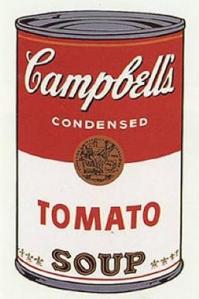 Being a true genius must be hard work.
Is there a less laborious path to the perks?
I’m so glad you asked:
Just convince the right person you’re a genius,
and you’ll be in like porn star penis.
Just stack some boxes of Brillo pads,
reprint some old burger joint ads,
slather color on portraits — Tammy Faye Bakker-style —
(just make sure to showcase the subject’s creepiest smile.)
Lest you think I’m just being snarky,
I say this without a trace of malarkey,
if you can buy mansions off a soup can label you didn’t design,
genius is too meek of a word, you stink of the divine.
[Like Odysseus being dropped in the lap of goddesses
who were ready & eager to pop open their bodices.]
Do you think the Campbell’s marketing artist has a mansion?
He probably retired with a meager pansion.
I say this without derision,
to be great artist you don’t need to show in galleries, Parisian
you simply need to showcase your vision
of some poor shmuck’s labors
to the person who can get you a better class of neighbors.

Taken in September of 2017 in Bangalore
 Poems to See by: A Comic Artist Interprets Great Poetry by Julian Peters
My rating: 5 of 5 stars
Available March 31, 2020
This anthology of twenty-four classic poems is set apart by the artwork used to convey the illustrator / anthologist’s view of each poem. The poets are all virtuosos, including: Dickinson, Angelou, Cummings, Langston Hughes, Auden, Seamus Heaney, Wordsworth, Shelley, Yeats, Poe, and Eliot. The poems are sometimes, but not always, among the most anthologized of the respective poet’s work. I would say that most poetry readers will probably find something that they haven’t read, but – even if not – it’s worth re-reading them as you enjoy the artwork.
The illustrator, Julian Peters, makes a bold decision to use the widest variety of artistic styles in an attempt to more aptly capture the tone of each poem. I recently reviewed a similar book, Chris Riddell’s “Poems to Live Your Life By,” and that book used a consistent style through out (which isn’t to say that tone and reality / surrealism didn’t change.) I’m not an artist, and don’t really have a vocabulary to describe the various artistic styles employed, but will attempt to give one some insight. There is the obvious shift between monochrome and color strips, but even within each of those categories there is great variation. Some monochrome strips were mostly gray, while others were exclusively black-and-white. Color works ranged from shocking dayglo to subdued pastels to dominant single color (e.g. blue) pics. Various poems were represented by a modern comic book style art, an old fashion comic strip approach, those which looked like paintings, those that were highly realistic, those that were surreal, those that were retro-chic, and even one [for Maya Angelou’s “Caged Bird”] that was in a quilt-like style.
I enjoyed this work tremendously. Most of the poems were short works, single pagers, and the fact that I’d read possibly all of them before wasn’t a problem because these are the kind of poems that should be revisited. Only the postscript poem, Eliot’s “The Love Song of J. Alfred Prufrock” was of substantial length.
I’d highly recommend this book for poetry readers, particularly those interested in are of imagery and how it’s conveyed and perceived.


