
Taken in August of 2016 between Leh and Khardung-la pass


Taken in August of 2016 between Leh and Khardung-la pass

5.) Veronika Decides to Die by Paulo Coelho
Premise: A young woman who attempted suicide is told that in the process her heart was damaged and she now has only five days to live. While it might seem that this would be all the same to a suicidal patient, it turns out to matter.

4.) Norwegian Wood by Haruki Murakami
Premise: The lead character, Toru, doesn’t suffer from mental illness, but his life is shaped by those who have. He must decide between two women. One of whom, Naoko, has been institutionalized since her boyfriend, Kizuki, committed suicide. Kizuki had been Toru’s high school best friend, and this weighs heavily in Toru’s feelings of obligation. Add into this Naoko’s roommate–a sage influence in Toru’s life, despite being institutionalized herself.
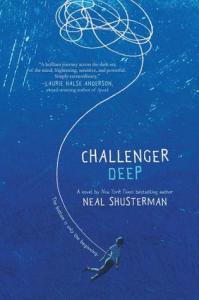
3.) Challenger Deep by Neal Shusterman
Premise: An adolescent boy, Caden Bosch, is transformed from a model student to a paranoid schizophrenic. The title refers to the deepest point on Earth, down in the Marianas Trench, and comes into play because the institutionalized Bosch believes he’s on a ship who’s Captain thinks all the treasure in the oceans got swept to the deepest point.

2.) Fight Club by Chuck Palahniuk
Premise: The unnamed narrator meets the eccentric Tyler Durden and soon Fight Club is born. It’s fueled by a feeling that men have been tamed to be turned into consumers. However, the underground fights are only the beginning, and our lead character is dismayed to discover that from the Club has sprung Project Mayhem with a nefarious terrorist plot.

1.) One Flew Over the Cuckoo’s Nest by Ken Kesey
Premise: Randle McMurphy has convinced authorities that he’s insane for the purpose of getting out of hard labor in prison and into a “cushy” insane asylum. The ward is run by the iron hand of Nurse Ratched. McMurphy on the other hand is rebellious and unruly. The clash is inevitable. McMurphy increasingly disrupts Ratched’s sedate and harmonious ward (re: heavily drugged and cowed into submission.) The story is told from the perspective of a patient named Chief Bromden who has the staff convinced that he’s deaf and mute. Like McMurphy, he’s not what he appears. The book is a scathing indictment of how mental health care was conducted in Kesey’s day.

Taken in April of 2017 in Botswana
 Yoga Nidra by Swami Prakashanand Saraswati
My rating: 4 of 5 stars
Yoga nidra literally means “yogic sleep,” and it’s a technique in which one systematically pursues a high degree of relaxation. Still, it’s a bit of a misnomer in that one doesn’t actually fall asleep. In theory, that is, most practitioners will have the experience of falling asleep at some point in practice. That’s because one is entering a hypnagogic state in which one is on the leading edge of falling asleep. It’s not always easy to stay on one side of that line (without being excessively mentally aroused.) The practice is typically done with a teacher who verbally instructs the students (live or via a recording)—because it’s quite hard to keep the sequence straight without an excessively high level of mental arousal—particularly for new practitioners.
This 8-stage practice has multiple purposes. One is simply to achieve a relaxed state. Note: it can be successfully used with individuals who suffer from insomnia, but with the notable risk that they may have trouble not falling asleep during the practice if they come to associate yoga nidra too strongly with sleeping. I know that I—who could never sleep in planes or on buses—found it useful for getting sleep when one’s mind tends toward an overly mentally aroused state. The technique is also used to tap into the subconscious. If you’ve ever noticed the strange imagery that pops up as one is going to sleep, you are witness to the subconscious at work.
The book is divided into three parts. The first part offers background on the topic. It describes both yogic and scientific explanations for the working of this practice and its sequential arrangement. The middle part describes variations on the practice, including scripts. While I mentioned that the basic approach consists of 8 stages that are sequentially arranged, there are many ways to vary the practice depending upon how much time one has and what one’s specific objective is. So the middle part describes several options including one optimized toward children (who have slightly different needs due to cognitive development.) [FYI: the eight stages are: 1.) Preparation for practice, 2.) Resolution (i.e. sankalpa), 3.) Rotation of awareness around the body systematically, 4.) Awareness of breath, 5.) Awareness of sensations /opposites, 6.) Visualization, 7.) Repeating one’s resolution, 8.) closing.] The final part delves deeper into scientific explanations of the state of yoga nidra and its health benefits.
There are four appendices that present research on yoga nidra with respect to: 1.) stress and heart disease, 2.) biofeedback, 3.) brain imaging, and 4.) altered states of consciousness. There is also a reference section arranged by topics. The book has many graphics from line drawn diagrams to color plates of brain scans (if one has a hard-copy or an e-format that supports them.)
I found this book to be extremely valuable. It’s definitely a guide book and its readability varies. It can be technical in places (but most laymen shouldn’t have a problem following it), and it can be repetitive in the middle where it’s mostly descriptions of variations on the practice. It does include stories in a few places, but is intended as a text rather than to entertain and so it’s not without some dry spots.
I’d highly recommend this book as a reference for those who teach yoga nidra. It will definitely expand upon (and help one keep straight) what one learned in teacher training and yoga nidra workshops.
 A Clockwork Orange by Anthony Burgess
My rating: 5 of 5 stars
While it’s a title that probably has had many readers scratching their heads, “A Clockwork Orange” is the perfect title for Burgess’s book. Our brains—while highly capable—are a stringy, wet mess of complexity, and to treat them like a clockwork machine is to invite trouble as well as to muddle what it means to be human.
This book is set in a dystopian future and features Alex, the head of a small band of teenage ne’er-do-wells who roam the streets engaging in random acts of violence. After Alex has a falling out with his band, they abandon him to be captured by the police. Institutionalized, he finds that he’s no longer a lion among sheep, but is a teenager among hardened criminal men. He’s eager to get out and after a violent precipitating event; he’s enrolled in a program that will use drugs and operant conditioning (i.e. the so-called Ludovico technique) to “cure” him of violent tendencies. Once he’s cured, they release him as he’s no longer a threat to society.
The technique works perfectly, but with the side-effect that the classical music that he used to love now makes him violently ill—because said music was used for dramatic effect in his conditioning. The days after his release are no picnic as he has run-ins with past enemies and has no ability to stand up for himself–any violence makes him ill to a physically debilitating level. He finds himself being used by anti-government dissenters who make him a poster-child for the level of authoritarianism the government has stooped to. The government ultimately caves to public opposition, and reverses the procedure. At first Alex immediately goes back to his ultra-violent ways with a newly formed crew, but he finds himself changing.
There are a couple of warnings of note. First, Alex and his friends speak in a dialect called Nadsat that is a kind of pidgin of Russian and English. It’s not hard to follow. Context usually makes the meaning clear, and only a handful of twists on Russian words are used and they are used repeatedly to the point their meaning becomes second nature. However, it should be noted that a considerable amount of the book is not in straightforward English. For example, “horrorshow” actually means “good” and it comes from the Russian хорошо (phonetically: “horosho”) which means “good.”
Second, if you’re buying a secondhand copy, make sure it has 21 chapters. In the US, an edition was released with the last chapter stripped out. (Note: some people do like it better without the last chapter, but you should probably experience it as the author intended and make up your own mind about which is best.) Needless to say, the tone of the ending is completely changed depending upon whether the last chapter is included or not.
The organization is straightforward, and consists of three parts with seven chapters each. The beginning is before Alex goes to prison, the middle is while he’s incarcerated and his experience of the Ludovico Technique, and the last part is from Alex’s release onward.
This book is a classic for good reason. It’s both an intense story and a thought-provoking morality tale. I’d highly recommend it.
 Submission by Marthe Blau
My rating: 4 of 5 stars
This book describes the life-cycle of one woman’s submissive relationship with a dominant man. Her relationship with the man isn’t sexual in the conventional sense–though she participates in lots of sex and he commands her to engage in various sexual activities. It’s a relatively tame and more modern variant of the tale told in the famous “The Story of O” written by another Frenchwoman, Pauline Réage (a.k.a. Anne Desclos.)
While “Submission” is like any number of stories of submissive individuals being dominated by a dominant and / or sadistic partner, it does carve out a unique space. The female lead is a highly regarded lawyer who is married with a family. She isn’t on the weak side of some power dynamic (i.e. it’s not a secretary / boss or employee / employer kind of tale.) That’s not that different from “Story of O” in which the lead is a successful photographer, but it does add complexity to the lead’s motivation.
It also makes the story’s main question a little bit more intriguing. That question being, how long can the relationship go on with the demands on her becoming progressively more intense (re: degrading) while the intimacy of the relationship isn’t increasing as she’d like? This tension builds to a climax at a point where the man momentarily shifts from the cool dominant to an angry abusive.
It goes without saying that the book contains graphic sexual scenes and won’t be the cup of tea of puritans or those with delicate sensibilities. Included among acts described are bisexuality, public nudity, wearing of sex toys in public settings, and mostly mild sadism.
“Submission” is interesting both as a work of erotica and as a psychological sketch. There seem to be many books out there that tell similar stories, so it’s hard to place this one. I wouldn’t call it exceptional in any way, and I found “The Story of O” to be more intriguing and intense. That said, while I haven’t read the “50 Shades…” books, from what I heard about them, this one likely surpasses them in terms of writing and the building of characters of verisimilitude. [That said, the “50 Shades…” books have obviously been immensely popular for a reason, and that reason—near as I can tell—is they tap into a fantasy in which a man who is extraordinary in every way (genius-billionaire-playboy-philanthropist-with-six-pack-abs) falls for a woman who is mediocre in every way because she submits to his will. “Submission” won’t scratch that itch.]
The book is short, clocking in at a less than 220 pages. It does have a discernible plot, though it’s more character-centric. A little more depth with the lead character and her dominant could be interesting. As it is the reader is left to draw many conclusions about the characters’ motivations—which, admittedly, has its advantages.
If you know what you are getting into, I’d recommend this book.

Stand atop the wall.
Feel the conch sound.
Watch the arrows sail.
Survey the killing ground.
Know you’ll someday die.
As will all, I suppose.
For those who die well,
it is no tale of woe.