Leaves scattered widely
Monsoon rains fall every night
You’d think it autumn
4 A.M. bird call
Ceaseless screeching through dreamland
Please, shut the fuck up
Banana leaf rains
Like an old tarp pulled tightly
But drips in my ear
Author Archives: B Gourley
DAILY PHOTO: Agra Fort Cupola
BOOK REVIEW: How We Feel by Giovanni Frazzetto
How We Feel by Giovanni Frazzetto
My rating: 4 of 5 stars
Frazzetto’s book tells us what neuroscience can and can’t tell us about seven core emotions: anger, guilt, anxiety, grief, empathy, joy, and love. Doing so puts the neuroscience of emotion into a broader context of art, philosophy, the humanities, and the legal / political domains. Most often this serves to make the book more interesting by offering stories beyond the case files of neurologists and neuroscience researchers, but it does result in occasional editorializing.
The book consists of seven chapters, each of which is linked to one of the emotions listed in the preceding paragraph. These chapters always tell us the rudiments of what science has learned about the brain’s role in said emotion, but they often offer insights from other disciplines as well as providing more general information about the brain that the author found particularly relevant to the topic at hand.
The first chapter delves into anger. Besides the neuroscience of rage, we learn a bit about the expression of emotion (e.g. through facial appearance; a theme revisited in other chapters), and the degree to which genetics plays a role in proclivity towards anger. This chapter serves to set up general concepts, and so we also learn about what an absence of emotion looks like (e.g. indecisiveness.) And in compliance with the law that every pop science book on neuroscience tell the story of Phineas Gage (the foreman who got rebar shot through his brain and lived to tell the story—though in an uncharacteristically hostile way), Frazzetto knocks it out early.
Chapter two explores the topic of guilt. It should be noted that some of these chapters discuss more than one related emotion, and here we learn how shame and regret are differentiated from guilt. There’s an interesting story about Caravaggio and how his own guilt-ridden story influenced one of his most famous paintings.
Chapter three is about anxiety, and also takes on fear. In addition to the neuroscience, we get a discussion of relevant philosophy, specifically that of Heidegger. Here, the author also describes brain plasticity.
The next chapter investigates grief. As I suggested above, there are multiple points where emotional expression is discussed, and this chapter has one of the most extensive of such discussions. In terms of general concepts, Frazzetto introduces the reader to neurotransmitters. One also learns how grief is related to physical pain.
Chapter five elucidates empathy. A lot of this chapter discusses acting, and the need for actors and actresses to be able to acquire empathy from the audience. The reader learns the story of Stanislavski, and how he went about creating his self-named acting system which remains widely used. This chapter also explains mirror neurons that allow one to recognize expression and to mimic others.
The penultimate chapter is about joy, and here we learn more about expression of emotions and, specifically, the seeming universality of smiles. There is a discussion of poetry as it pertains to the emotion at hand. Having introduced neurotransmitters earlier, the reader learns about dopamine, its role in happiness, and how a number of drugs have been created that increase our natural dopamine’s effect or mimic it.
The last chapter is about love. Of course, we learn about oxytocin and vasopressin, two neurochemicals famously associated with loving behavior. There is also a fascinating discussion of Capgras Syndrome. In this condition, the patient feels that his loved ones have been replaced by impostors. That may not seem relevant until one realizes that the proposed mechanism for this illness is damage to parts of the brain that control emotional connection. Without an emotional connection, the person feels that said individuals can’t be his / her dearest friends and family—though his senses register that they are exact duplicates in every way. The brain builds a rationalization that they must be impostors. Of course, no emotion evokes more resentment towards materialist explanations rooted entirely in biology than that of love.
The book is extensively annotated and also has a bibliography. There are many graphics throughout the book from line drawn diagrams of brains to photos of brain scans to the artwork “David with the Head of Goliath” mentioned relative to the discussion of Caravaggio’s guilt.
There are a number of books in this domain (i.e. the neuroscience of emotion) and if you were only going to read one, I don’t think I’d recommend this one as it. However, if you are into this topic, it is definitely worth a read. It’s interesting and insightful, and has a unique approach.
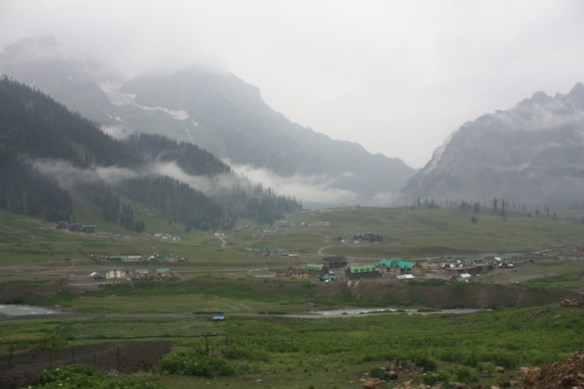
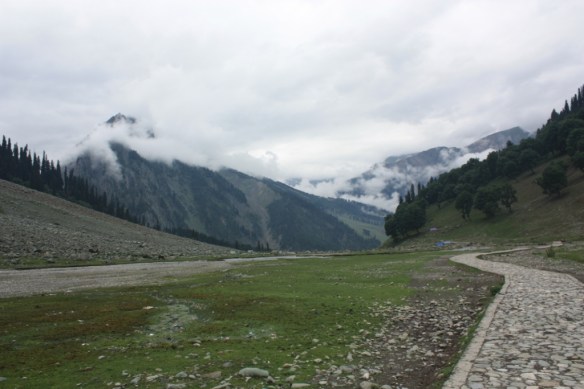
DAILY PHOTO: Kashmir Green, Dreary and Bright
BOOK REVIEW: Sitting Still Like a Frog by Eline Snel
Sitting Still Like a Frog: Mindfulness Exercises for Kids by Eline Snel
My rating: 4 of 5 stars
Anyone who’s ever taught children mindfulness, concentration, or relaxation knows that one can’t use the same tried and tired approach one does with adults. One must recognize the strengths and weaknesses that children’s level of cognitive development brings. [That said, I’ve found myself in front of a room full of kids who sat with the unflinching stillness of bronze Buddha statues, but that’s because regular practice was part of their school experience.] This is the twin premise of Snel’s book: that one needs to tailor one’s approach to teaching children to be mindful, and that their practice needs to be integrated into their life on the whole.
It should be pointed out that the book isn’t just a collection of exercise for children. It’s also a book for parents to help them align their approach to parenting to the mindfulness that the child is developing. It’s also a book of application. That is, it’s not about practicing mindfulness meditation in the abstract; it’s about using the understanding that arises from that practice to improve behavior and emotional coping.
Chapter 1 introduces the topic of mindfulness and sets up the book’s approach as well as explaining the use of the audio exercise that go along with the book. The second chapter explains a mindful approach to parenting by which parents can adopt a calmer and less emotionally charged approach to interacting with their child. Chapter 3 explains how and why breath is used as the basic anchor point to life in the here and now. Chapter 4 suggests how attention can be improved, and mindful eating is used as a tool to advance this objective. The next chapter explores how mindfulness can be practiced using the body as a means to anchor one’s awareness while simultaneously being more aware of what’s going on with one physically. There is discussion of mindful walking, but most of the chapter is about teaching children to be more cognizant of what they feel as a precursor to being more emotionally aware.
The next several chapters cover emotional awareness and how to improve response to emotional situations (both for the child and for the parent.) Chapter 6 uses the analogy of a weather report as a means for children to evaluate their emotional state. Chapter 7 expands on the topic by considering how one can manage one’s response to emotions. The crucial topic of witnessing the changing nature of emotional states is the subject of Chapter 8.
The last two chapters examine how to cultivated desirable character traits in children. The penultimate chapter describes how kindness can be fostered as a skill in children. The last chapter is entitled “Patience, Trust, and Letting Go” and that probably adequately describes the gist of the topics covered. The concept of an “inner movie theater” is discussed as a tool to facilitate building the desired characteristics.
There’s a single page bibliography and a table of audio exercises at the end. As far as graphics are concerned, they are mostly whimsical drawings of frogs.
I found this book to be concise, informative, and designed to appeal to the child’s need for concrete–as opposed to abstract—conceptualization of this, otherwise cerebral, topic.
I’d recommend this book for parents, teachers, and others who interact with children.
BOOK REVIEW: Better Balance by Salamon and Manor
Better Balance: Easy Exercises to Improve Stability and Prevent Falls by Suzanne E. Salamon
My rating: 4 of 5 stars
Balance is one of those qualities that one takes for granted until it fails. Actually, given our bipedal stance, it’s extraordinary that we aren’t falling down all the time. Achieving a stable upright posture takes a lot of complex anatomy and physiology operating flawlessly. I picked up this book because I believe a yoga teacher should be cognizant of the range of capacities for balance that might be seen while teaching. If one teaches students in their 20’s to their 40’s, the need for balance modifications and capacity building might not come up much. It’s when one deals with the very young as well as older students that one sees flawed balance in large measure. [And—let’s face it—the very young can fall down 30 times, pop right back up each time, and be all the stronger for it, and so mature students are the major concern.]
This isn’t the first book in this series of Harvard Medical School Guides that I’ve read and reviewed, and probably won’t be the last. (see: “Your Brain on Yoga,” “Guide to Tai Chi,” and “Low Back Pain.”) I’ve found the series to be beneficial because it presents scientifically sound information, but isn’t afraid to give alternative approaches—such as yoga and tai chi—their due when the studies show that said activities are of benefit. This book is no exception. At several points the authors mention tai chi as being beneficial, and the book includes a yoga balance workout as one of the six that it contains.
The book is organized into 13 sections (i.e. chapters.) The first chapter describes how our vestibular (inner ear), visual, and proprioceptive (the nervous system elements that track where one’s body parts are) systems interact to keep us upright.
Chapter 2 presents an overview of a range of conditions that affect balance. Some of these influence balance specifically and exclusively, but many are conditions that one might not associate with balance problems though they’ve been shown to increase the risk of imbalance. There are sections about which medications have side-effects adversely affecting balance as well as what your doctor may be able to do about balance problems.
Chapter 3 is a “Special Bonus Section” and is of particular importance to mature readers or those who care for said individuals. The topic is preventing falls, and this section describes common causes of falls and offers checklists of considerations for setting up the environments in which those with balance problems will be active.
Chapter 4 introduces various types of activities that improve balance, and chapter 5 is a brief guide to considerations relevant to beginning a balance workout such as whether to consult one’s doctor and what safety precautions should be considered.
In chapter 6, the authors propose how balance workouts can be merged into one’s overall fitness plan. A lot of this chapter is an introduction to exercise—e.g. how much is needed, and what the benefits are. Then there are some tips about how to smoothly merge balance with other exercises.
Chapter 7 presents more specific considerations for beginning balance workouts. Unlike chapter 5, this section provides information about equipment, warm-ups, and how to interpret the instructions for the workouts. The latter is beneficial because the workouts are in a one page per exercise format, and this section negates the need to be needlessly repetitive.
The next six sections (chapters 8 through 13) are various balance workouts that are organized in an easiest to hardest format. The first is a beginner’s workout, which is performed with a chair—used for sitting in some exercises and as a prop in others. The second is a standing balance workout that features simple static balance maneuvers. The level of challenge is similar to that of the first workout, except that one is without a chair prop. The third workout adds in movement to help maintain balance through steps and motion. The next workout is similar but utilizes another prop, a 360 step (a circular step of similar height to the more common Reebok rectangular step, but circular.) The penultimate workout uses a pseudo-balance beam. The author’s mention a product put out by Beamfit, but other manufacturers produce a similar product. It’s a low, dense foam beam that sits on the floor. The last workout utilizes classic Hatha Yoga poses, and features both expected poses like tree pose (vrksasana) and others such as down dog (adho mukha svanasana) that might come as a surprise.
There’s a resources section and glossary at the end. The book presents many graphics, most notably photos of each of the exercises in the six workouts.
I’d recommend this book for anyone who needs an overview of the problems of balance and what can be done about them. It’s short, readable, and user-friendly.
DAILY PHOTO: Orange
POEM: The Taoist’s Dilemma
Life, at the moment, was a dumpster fire.
But all roads lead up when stuck in the mire.
So one smiles with the rock-bottom delight,
lifting one up to the highest of heights.
But up top, amid those beauteous views.
You’re on the cusp of receiving dread news.
In the best times sits the seed of the worst.
In moments of elation, you’ll find yourself cursed.
DAILY PHOTO: Hunder Valley
POEM: Literarily Insane
Hemingway off’d himself–
curled up under his
own looming shadow.
What loomed beyond
that shadow was the
great unfathomable.
Peering into it might
have been a comfort,
or might have killed
him in pre-greatness days.
***
Kesey’s Chief wondered
how the Irishman could live
in his own grandiosity of being.
McMurphy’s sanity was surely
built upon a foundation of delusion–
sanity and delusion forged iron-clad.
Meanwhile, those free of such
delusions huddled in the fog,
unable to step out into life.
***
Heller’s Yossarian summed
up the whole damned mess:
claims of insanity are a
recognition of one’s sanity.
Who else seeks to turn down
the volume on reality?
Other than one who can
hear it well enough to know
when it peals thunderous?