 thunder yon
Zambezi rafting
greenhorns beware
cataract
water wind-misted
plume-zone green
terraced hill
rice paddy cascades
depth perfection
dry season
murmur to trickle to
fall-less falls
level rising
the overspill rolls
pulling drops


thunder yon
Zambezi rafting
greenhorns beware
cataract
water wind-misted
plume-zone green
terraced hill
rice paddy cascades
depth perfection
dry season
murmur to trickle to
fall-less falls
level rising
the overspill rolls
pulling drops

Taken at Toccoa Falls in the summer of 2011
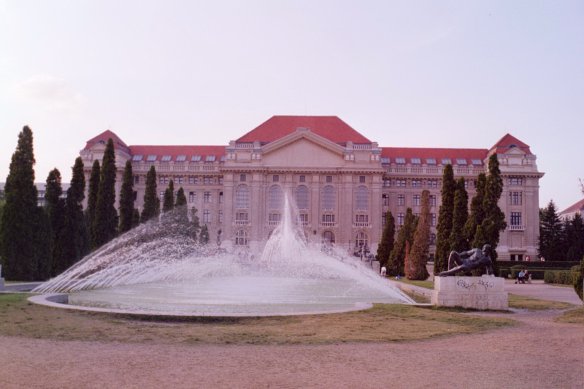
Taken in the Summer of 2002-ish in Debrecen
 For seven years,
Ulysses was hostage to Calypso.
He was like, “Wife is waiting, gotta go!”
“You know, by Neptune, you are still cursed?”
“Being stranded with you was fun at first…”
“Out there’s the ever-present threat of Death.”
“Worth it, to not wake to your morning breath.”
COVID-19, you are my Calypso!
[Anyone got Zeus’s number?]
 The Old Drift by Namwali Serpell
My rating: 5 of 5 stars
This novel follows three Zambian families through three generations from before there was a Zambia (when it was Northern Rhodesia) into the near future. The nine chapters each correspond to a member of one of the families for a given generation. Throughout the first two parts — i.e. “Grandmothers” and “Mothers” — we occasionally see the lives of members of the three families bump into each other, but in the third (“Children”) we see them become entwined. The families are ethnically diverse. The grandmothers include an Italian and a Brit who married a black Rhodesian. And there is a mixed-race marriage involving an Indian merchant. While the diversity of the novel’s cast makes for some interesting considerations of identity (e.g. how one views oneself versus how one is viewed by others,) it’s not so much central to the story as it is a flavoring of the story.
While we learn in a prologue that the title is a term used by the locals living near Mosi-o-Tunya (Victoria Falls) regarding the Zambezi River, it takes on another meaning as the book’s theme. The thematic meaning has more to do with impotence to fix the country’s problems. In other words, the momentum of Zambia’s “drift” simply can’t be overcome. A central idea in the book is squandered potential. Each of the three grandmothers shows a potential for greatness that is wasted not only because they are women in a patriarchal society. Sibilla is afflicted with a condition in which hair grows over her entire body at an incredibly rapid rate. Agnes is a skilled tennis player until she goes blind. Matha is smart as a whip, but she becomes caught in the orbit of men who are dim.
Each character is caught in this inexorable “drift” that is littered with detritus like poverty, AIDS, technological dependence, and weak governance. By the time it comes to the third generation, they are not only loaded with potential but (to a large extent) have access to resources but they still can’t manage to advance on solutions. In fact, they can’t seem to help but to contribute to the problems they are set against. In a crucial scene, a confluence of the work of the three (Joseph’s vaccination, Jacob’s drones, and an embedded communication device worked on by Naila) all come together in an action that is just what they are trying to create a revolution against. [Not having control or autonomy, but rather being colonized in an entirely new kind of way.] The problem is so amorphous and vast that a consensus of what it even is can’t be agreed upon.
I picked up this book as part of my project to read literature from every country I visit, and I’m glad I did. It’s hard to imagine a book that is more useful for that purpose because it covers so much ground in terms of the history of the country and the lives of a range of Zambians from prostitutes living in shacks to the wealthy elite — not to mention the various minorities.
The book is literary fiction, centered on the characters, but a story does unfold as well as a powerful thematic exploration. The book isn’t easily classified. There is even an element of science fiction in that “beads” [imagine a smart phone built into the human hand, using neuro-electrical energy for power] are an important plot device and are relevant in the resolution of the story. There is this technology being made available to Zambians, free or at low-cost, but they are guinea pigs and have no say in how it works, when it works, or how it’s used. (In a way, that is the story of us all and is not unique to Zambia, Africa, or even the developing world.) This technological dependence is presented as a kind of neo-colonialism, and – in that regard – it’s railed against, even as people are addicted to the tech in the same way people are to their phones today. While “Bead” and advanced drone technology are central to the story, one wouldn’t call this science fiction, per se, but it’s hard to ignore the salience of technology as an element of power (and how that plays into the story.)
I’d highly recommend this book for fiction readers. While it may be particularly intriguing if you have a special interest in African or Zambian literature, one need not have a particular interest for the book to be engaging and a worthwhile read.

Taken in March of 2020 in Amer, Rajasthan
 The Dolphins, the Whales and the Gudgeon by Aesop
My rating: 5 of 5 stars
This tiny book is part of a series put out by Penguin called Little Black Classics. This one collects about 55 of Aesop’s fables together. These are all short fables, few longer than a page and many of only a few lines.
The title is an interesting choice in that that fable isn’t among the most well-known of those assembled. However, some oft the most famous have rather banal titles like: “The Fox and the Goat” or “The Wolf and the Lamb.” [Though “The Frogs Who Demanded a King” is also among the most well-known of the included stories.]
I found the collected fables to be thought-provoking, as well as being a broad sample (not a lot of the same moral repeating.) My favorites, for their cleverness, were: “The Stag at the Spring and the Lion,” “The Field Mouse and the Town Mouse,” “The Woodcutter and Hermes,” and “The Ass Carrying Salt.” Your results may vary.
I like that they’ve embraced the short format with these books. It often used to be the case that they would pad out a 50- or 60-page book like this to 120 pages, using filler, forwards, needless illustrations, and useless epilogues. This book is just the fables. (Most, but not all the fables, include a single line summation of the fable’s moral. While I don’t think this is necessary for adult readers, it might be helpful in explaining the story to children.)
 A Choice of Comic and Curious Verse by J.M. Cohen
My rating: 5 of 5 stars
This poetry anthology consists of works selected and arranged by J.M. Cohen with the overarching theme of light-heartedness. Some of the poems are outright funny, others are more quirky, corny, or tongue-in-cheek. This edition was originally published in the 1970’s, though there was apparently a preceding edition that was largely the same that dates to the late-1950’s. The poems are almost all metered and rhymed, in part because that was still the dominant mode of poetry when these works were first published, and also because metered and rhymed verse conveys a jocular tone. Forms associated with comedic delivery, such as the limerick, are well-represented.
The 450-plus poems by about 180 authors (actually many more owing to the fact that the biggest contributor by far is Anonymous) are arranged into 22 thematic categories that are clearly meant to be more whimsical than categorical. The poets include those who are most well-known for playful verse such as Ogden Nash, Lewis Carroll, and Edward Lear, but also light works by poets known for seriously toned work (e.g. Alexander Pope, John Betjeman, and W.H. Auden.) There are also plenty by authors known for mixing light and serious work, such as G.K. Chesterton, Robert Graves, and Hilaire Belloc. There are also a large number of poets who you’re unlikely to have heard of unless you’re a literary historian. Included in the collection are some widely anthologized works such as Belloc’s “Matilda,” Carroll’s “Jabberwocky,” and Aldous Huxley’s “Second Philosopher’s Song,” but there are a great many more that will be unfamiliar to most (and a few that may be familiar as graffiti on a restroom wall.)
I enjoyed this book. It turned me onto some poets with whom I’d been unfamiliar. The works included, as one would expect of light verse, are quite readable (though there are some outdated references here and there.) If you stumble onto a decently-priced copy, pick it up.
 All’s Well That Ends Well by William Shakespeare
My rating: 5 of 5 stars
This play, like “Measure for Measure,” is one of Shakespeare’s “problem plays” – not consistently light-hearted enough to comfortably be called a comedy, but lacking the body count of a tragedy.
Helena loves Bertram, but he’s a Count and she’s the daughter of a deceased physician (a doctor who, while he was of great renown for his skill, wouldn’t be considered to be in a high-status career in those times.) Despite the fact that Helena is beloved by just about everyone – including Bertram’s mother, who became her guardian upon her father’s death – the relationship could never work… under ordinary circumstances. But those circumstances change when Helena saves the life of a dying King of France using her father’s proprietary medicines and methods. The grateful King removes [almost] all roadblocks to the marriage by allowing the wedding between a commoner and an aristocrat, providing Helena the wealth for a substantial dowry, and putting the squeeze on Bertram by telling the Count that if he loved his King he’d agree to allow the King to preserve his royal honor by rewarding Helena with all she truly wants.
The one roadblock the King can’t remove is Bertram’s feeling that he is too good for Helena because he’s a Count and she’s a nobody. The couple is married, but before the marriage can be consummated, Bertram slinks off to Italy under the pretext of fighting a war. He sends Helena back to his home where he thinks his mother will support him by making life hell for her new daughter in-law, but – joke is on him – his mother thinks that he’s being a jerk and she gives Helena a warm reception. Bertram forwards a note to Helena that unless she can get the ring off his finger and a baby is in her womb sprung from his loins, she shouldn’t really consider them married. Again the joke is on him, because Helena is the smartest person in the play and she develops a clever plot (that in part is similar to the “Measure for Measure” ploy) that is designed to meet the “impossible” requirements of Bertram, as well get the Count back to France where his failure to behave as a husband will be taken as a slap in the face to the King.
Of course “All’s Well That Ends Well” is worth reading. It’s Shakespeare. But I will say that I found “Measure for Measure” to be a better story. The major hurdle in this play is in accepting that Helena remains so stuck on Bertram, despite the fact that he’s portrayed as a jerk. Bertram does conduct himself admirably in war, but the “the heart wants what the heart wants” rationale is all we really get by way of explanation. It’s not clear whether Helena’s plot is playing out from the time she runs away from the Countess’s place, or whether she legitimately runs away to be a nun, but exploits a target of opportunity. Either way, there’s some deus ex machina to that part of the play. Also, her stock drops as we see the elaborate length she’ll go to in order to get her man.
I’d recommend this play, but if you can only do so much Shakespeare and haven’t read “Measure for Measure” yet, I’d recommend that one over this.

Taken in April of 2017 on the David Scott Trail


