Unknown's avatar

About B Gourley

Bernie Gourley is a writer living in Bangalore, India. His poetry collection, Poems of the Introverted Yogi is now available on Amazon. He teaches yoga, with a specialization in pranayama, and holds a RYT500 certification. For most of his adult life, he practiced martial arts, including: Kobudo, Muay Thai, Kalaripayattu, and Taiji. He is a world traveler, having visited more than 40 countries around the globe.

The Churn [Free Verse]

On the shore
of angry seas

I hear the crash
of foamy waves,

but miss the 
crisp sudsy sizzle
that one hears
on a sunny summer day.

That nuanced note
is lost to the Churn

DAILY PHOTO: Future Buddha

Taken in Ladakh in October 2016

BOOK REVIEW: Protagoras by Plato

Protagoras AnnotatedProtagoras Annotated by Aristocles Plato
My rating: 5 of 5 stars

Amazon.in Page

Hippocrates woke Socrates to announce that the famous sophist, Protagoras, is in town. Hippocrates hopes Socrates will make introductions and recommend him as a student to the sophist. The two head off to meet with Protagoras who is at the home of a wealthy Athenian, along with an assembly of wisdom-seekers. Along the way, Socrates questions Hippocrates as to whether the young man actually knows what a sophist is and what such a person teaches. (i.e. A painter would teach one to paint, but what does one get for one’s money paid to a Sophist?)

This is one of the more popular early Socratic dialogues of Plato, perhaps because it’s not so one-sided as many others — Protagoras holds his own more than most. In fact, when the discussion begins with the question of whether virtue is teachable, Socrates comes away convinced by Protagoras’ arguments that it is. (Though it’s also possible Socrates is just agreeable to fast-forward to the question that he’s interested in – i.e. the nature of virtue.) Protagoras offers a mythology-based explanation for the teachability of virtue and then preempts counterarguments such as good parents raising despicable children (and vice versa) via reasoning.

However, then Socrates takes the debate to his wheelhouse – the questions of what virtue is, is it one thing or many, and – if many – can one be both virtuous and non-virtuous through a mix of different traits? Protagoras says that there are distinct parts to virtue (e.g. courage, temperance, wisdom, etc.) Socrates then inquires about the nature of these parts. Are they parts like the various parts of the face (i.e. distinct of both form and function?) Or are they like a series of gold pieces (different in size and shape, but materially identical?) Protagoras claims they are more like the former (i.e. parts of the face / substantially different.) Socrates uses this to work Protagoras into a corner, seemingly advocating that each of the aspects of virtue is substantially distinct, but also that they can be so intermingled as to be indistinct.

For some reason, Protagoras doesn’t challenge the false dichotomization on which Socrates’ arguments are based. (Consider the distinction between the nose and the mouth. If the question is about getting food into the body, these are completely different. If the question is getting air in and out, they are veritable twins.) It’s possible that Protagoras doesn’t challenge these false dichotomies because he has an interest in maintaining them for his own purposes, but by that point it’s also possible that he is just seeing red. Protagoras gets miffed, and even more so when Socrates tries to insist that the sophist give up the mode of argument with which Protagoras is most persuasive (i.e. stories and extended / elaborate explanations.) Socrates wants to keep his sparring in the kind of fast-paced Q&A slug-fest at which Socrates excels. The dialogue ends with Protagoras questioning Socrates, an endeavor for which Socrates seems to score a point (though the abrupt cut leaves some ambiguity – like the spinning top at the end of “Inception”)

This is definitely a must-read among early Socratic dialogues.

View all my reviews

A Cheesy Cracker in Marmot Lands [Common Meter]

Along the road to Pangong Tso,
I spied an odd marmot.
'Twas rotund of both gut and jowl,
and had a beefy butt.
It seems Himalaya's boondocks
has quite a junk food glut.

The rodent snacked on a cracker
of the cheesiest kind.
I'd have guessed one could search near-n-far
and no Cheez-it would one find.

Not in this remote borderland
where few maintain a home.
The point is, for a cheesy-cracker
you'll have not far to roam. 

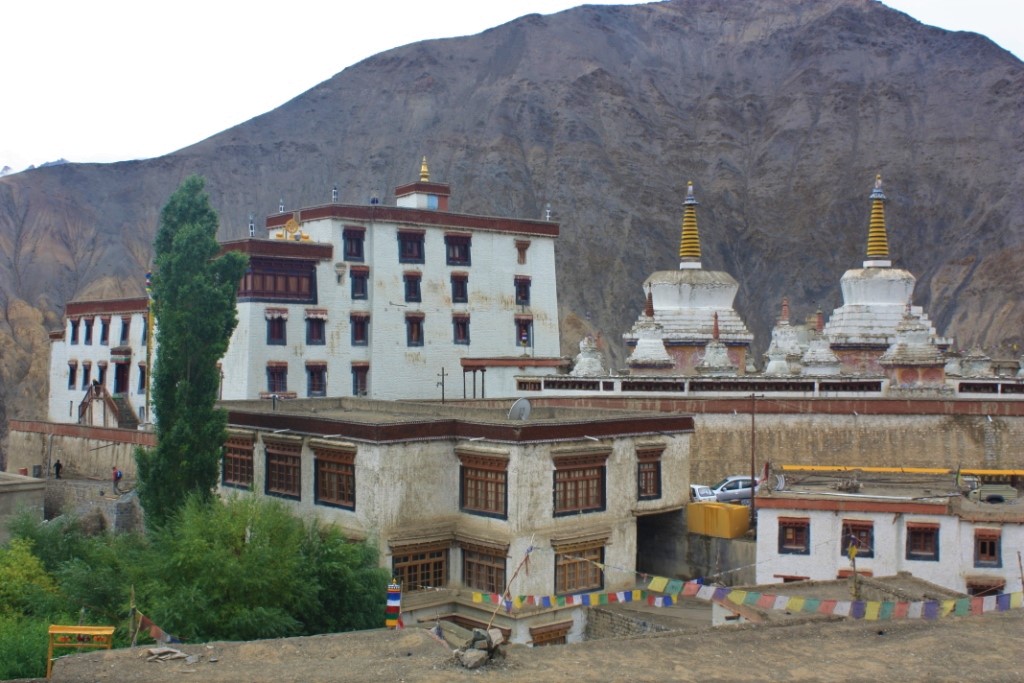
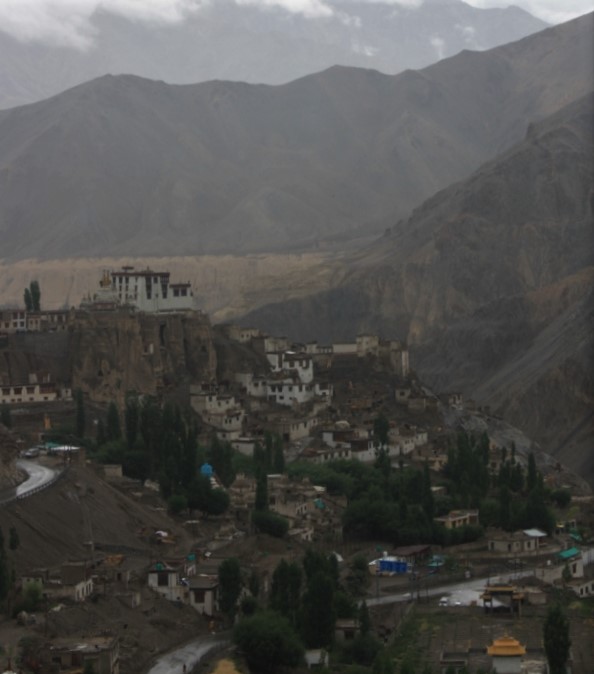
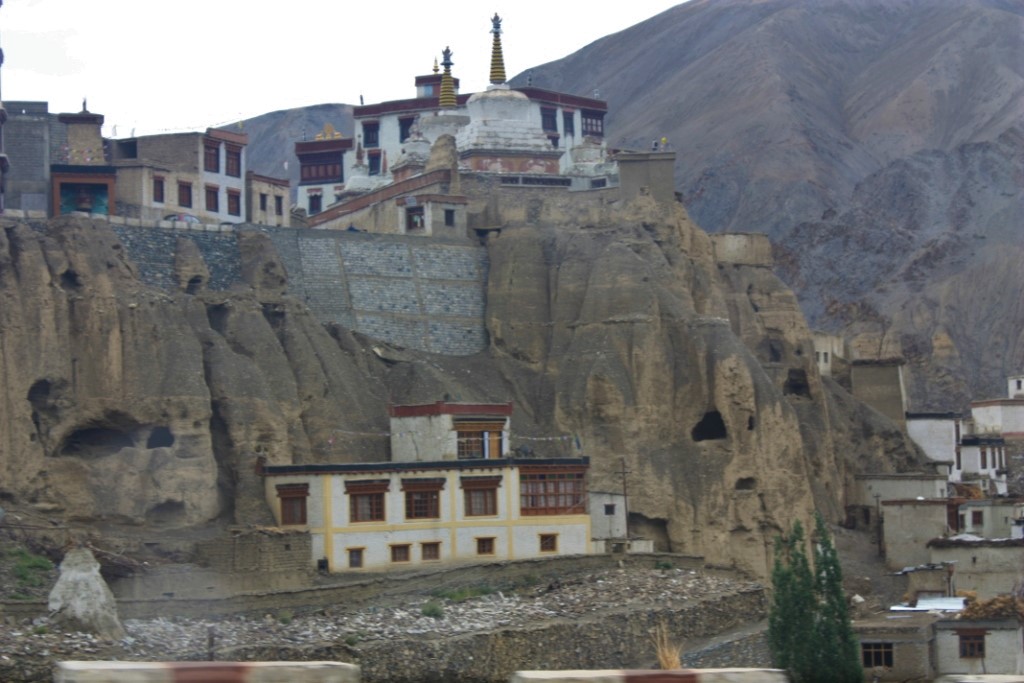
DAILY PHOTO: Lamayuru Monastery, Ladakh

Taken in Ladakh in August of 2016

BOOK REVIEW: Musashi’s Dokkodo ed. Lawrence Kane & Kris Wilder

Musashi's Dokkodo (The Way of Walking Alone): Half Crazy, Half Genius-Finding Modern Meaning in the Sword Saint's Last WordsMusashi’s Dokkodo (The Way of Walking Alone): Half Crazy, Half Genius-Finding Modern Meaning in the Sword Saint’s Last Words by Miyamoto Musashi
My rating: 3 of 5 stars

Amazon.in Page

“The Dokkōdō” consists of 21 precepts written by Miyamoto Musashi in his last days. Musashi was solitary, a minimalist, and single-mindedly resolute as a swordsman – all to extremes few of us can fathom. [Imagine a cross between Diogenes and Muhammad Ali.] These twenty-one sentences barely fill a page, let alone a book. However, as with sutras of yoga and Buddhism, a book’s worth of material comes from elaboration and analysis. This approach is taken in this book by way of five commenters from different walks of life, though all with martial arts experience.

However, normally the explanations would be made by: a.) someone who understands the language (particularly the archaic form the author wrote in – i.e. Musashi’s lifespan overlapped with Shakespeare’s, so consider the changes in the English language that transpired,) or b.) someone with a depth of understanding of the worldview of the author (in this case, that would be someone immersed in a mélange of Buddhism, Confucianism, Taoism, the Chinese classics, and the influence of life in the wake of centuries of feudalism and militancy on a person’s psychology.) This isn’t the approach taken in this book. While the five commenters are clearly well-read and intelligent individuals, they are also firmly ensconced in a worldview that is Western, Abrahamic, and materialistic. [I suspect this was the editors’ intention – to relate to the lives of the likely readership, but it does have stark implications for how the book is perceived.]

If one is looking for a book that will explore what – if anything – from the legendary swordsman’s deathbed lesson aligns with a Western / Abrahamic / American-suburban strip mall dojo lifestyle, this is your book — 5-stars – buy it immediately. However, if one approaches the book from the assumption that Musashi was an exceptional person who must have had valuable insight into how to be exceptional, then one is likely to find this book presumptuous and dismissive of Eastern values and philosophies.

Much of the book is the commenters dismissing Musashi’s ideas as wrong-headed. In some cases, this is because Musashi was such an extremist that few could hope to live a life like his. [It’s not “the way of going alone” for no reason. Though that’s arguably why we are still interested in what Musashi has to say 400 years after his death.] However, in many cases, the commenters seem to be talking past Musashi’s ideas because their assumptions are inconsistent with the swordsman’s cultural milieu.

This is most often seen with respect to a fundamental difference between Eastern and Western psychology. In Buddhism, there are purely mental constructs that have no reality except within the mind, and which can cause suffering with no material upside. For example, in precept #6 when Musashi argues against regret, some of the resulting commentary was as if the precept was “Don’t learn from your mistakes. Never change.” For a Buddhist, not holding onto regrets does not at all mean that one doesn’t learn or make corrections – mid-course or otherwise. It just means that there is this cancerous mental construct that can’t help one because the past is the past, and so it is jettisoned. Another example involves not having preferences, which – again – doesn’t mean that one won’t make a choice (if the situation allows one a choice.) It means not holding onto a mental attachment. [e.g. If I like coffee more than tea, and a choice presents itself, I order coffee. What I don’t do is let my mind obsess about not being offered a choice.]

There are some beautiful insights peppered throughout this book, some that appear to be in line with Musashi’s thinking and others that I suspect the swordsman wouldn’t recognize as related to his own words. However, there is also a lot of commentary that sounds like college students railing against how bad Shakespeare is, in part because they are missing much of the Bard’s nuance and in part because his works seem unrelatable to their experience.

My recommendation of this book would be contingent upon where you fall on dichotomy that I mention in paragraph three. You might love it, or you might loath it.

P.S. If you’d like to know what differences can result from translation, you can find a scholarly translation that is done by a Japanese linguist (Terou Machida) and published in the Bulletin of Nippon Sport Sci. Univ. right here. You’ll note that most of the precepts are (for-all-intents-and-purposes) the same, except the conversion from first to third person. However, you will notice that several precepts (10-12, 15, and 20) are substantially different, and one (#16) is arguably of the exact opposite meaning.

View all my reviews

BOOK REVIEW: Black Widow: Deadly Origin by Paul Cornell

Black Widow: Deadly OriginBlack Widow: Deadly Origin by Paul Cornell

My rating: 4 of 5 stars

Amazon.in Page

This flashback-laden volume revolves around Natasha Romanov’s relations with various men but especially Ivan, a man the Black Widow saw as a father figure. Ivan’s death is an impactful moment in the life of this femme fatale, and it seems like it might be just the start as all the men in her life begin to come under attack (mostly fellow Avengers and other superheroes from the Marvel pantheon.) The story unfolds as the Black Widow tries to unravel the mysterious plot to eliminate her prodigious corps of boyfriends while protecting said friends and (ex-)lovers.

This comic might seem like it would be the perfect entry point for a reader new to the Black Widow character. It offers flashes of insight into the character’s origin, but without the dated feel of old comics that were often marketed toward ten-year-old boys and that didn’t anticipate technological progress and cultural trends any better than most sci-fi does. However, I would argue that it’s a bit of a chaotic read for a newbie to the character (speaking as one.) It’s a four-issue volume and so the glimpses of backstory and the references to arcane Marvel characters and events come in rapid succession.

I found this book a fun and entertaining read, if a bit helter-skelter. I should point out that by the time one gets into the latter-half of the volume everything starts to come into focus.

View all my reviews

Half-Hearted Apology to a Reptile [Common Meter]

Apologies Mister Lizard,
didn't mean to step on you.
But you kind of blend with the rock.
It's not like in the zoo;
where there's a sign and pointing kids
and barriers, to boot.
When one looks just like one's backdrop,
it behooves one to scoot.

Sorry again about your tail.
I'm sure it will grow back.
Call it a teachable moment,
&
get an orange knapsack!

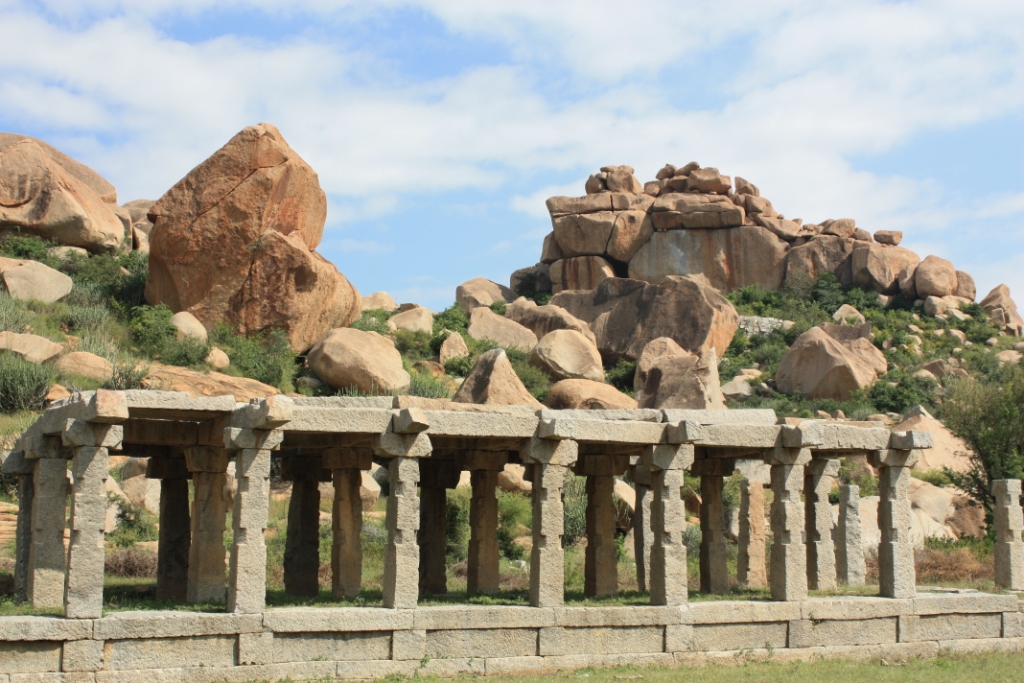
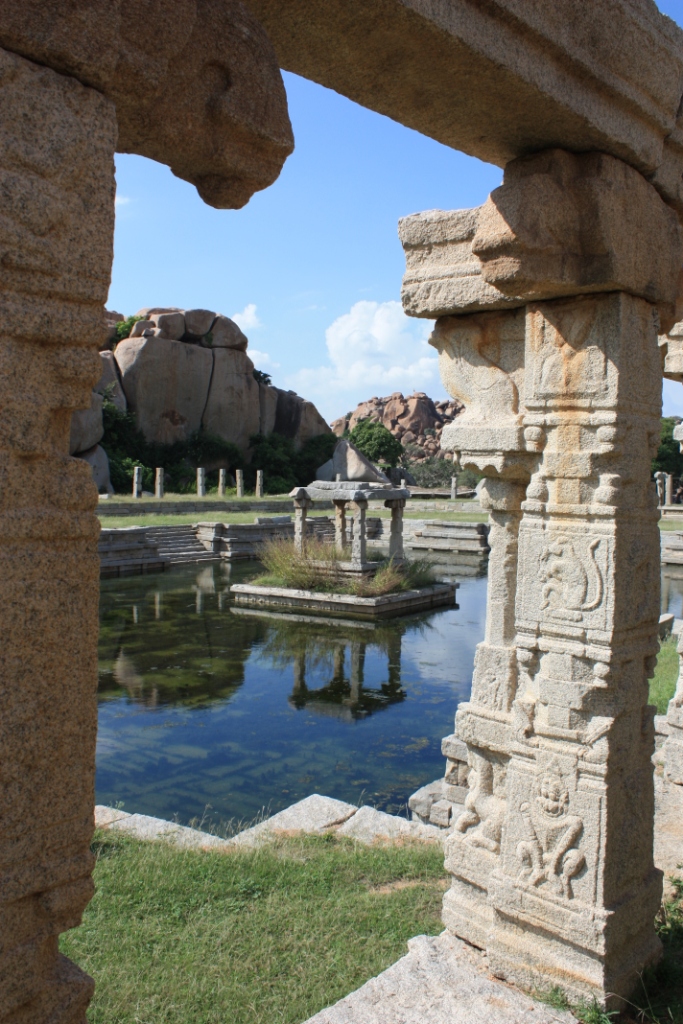
DAILY PHOTO: Courtesan’s Walk, Hampi

Taken in Hampi in November of 2013

A Thousand Feet & a Foot-Long [Common Meter]

The millipede was a foot long,
but, some might ask, whose foot?
Its own feet being quite petite
might suggest Lilliput.

But though it wasn't a footlong foot,
it was long for a bug,
a worm, a beetle, a wood mouse,
a spider, or a slug.

A snake that long would be a babe,
or, at least, quite stunted.
So, now I find my amazement
being a bit blunted.