Taken in Hampi in November of 2013.


Taken in Hampi in November of 2013.
 Zen in Motion: Lessons from a Master Archer on Breath, Posture, and the Path of Intuition by Neil Claremon
My rating: 4 of 5 stars
When one thinks of Zen, one thinks of stillness. Sensory and motor deprivation is what scientists call it. But stillness is a favored term among Zen Buddhists. Being someone who is fascinated by movement and activities at the body-mind intersect, this title immediately snagged my attention despite the narrow print on this thin book’s spine. The value of a Zen state of mind in the practice of movement arts is clear and well-established. Zen in Motion recounts the lessons of the author as a student of the Japanese style of mounted archery (kyūdō.) Claremon studied with a Japanese Kyūdō master residing in New Mexico.
It will be clear to many why mounted archers might take allegiance in Zen. Charging down a trail on a horse towards a small, round target, there’s no time for conscious thought in calculating pull and release. Furthermore, there’s stillness in motion (sounds like a koan) that must be maximized because the slightest imperfection in movement can send an arrow astray.
It should be noted that this is neither the first nor the only book written on the nexus of Zen and Kyūdō. (Though it’s the first one I’ve read in full.) Probably the most famous book on the subject is Eugen Herrigel’s Zen in the Art of Archery, but there’s also a more recent book by John Stevens, entitled Zen Bow, Zen Arrow that tells the story of Awa Kenzō (who was Herrigel’s teacher.) The logical question is what is the value-added of Claredon’s book. If we have two books by more famous authors on seemingly the same subject, why should one read this one? I believe Claremon carved out a good niche with this book that makes it sufficiently different from the books of those other authors.
What is Claremon’s niche? The body portion of the mind-body equation is at the forefront in this book. Claremon directs most of his energies to topics such as breathing, posture, grounding, walking, and balance. While I haven’t read Herrigel’s book completely, I did skim through it. Zen in the Art of Archery seems to focus more heavily on the mind portion of the equation—i.e. the philosophy / psychology of Zen, if you will. This may make it sound like Claremon’s book isn’t much about Zen, which is widely considered a mental pursuit. However, one must remember that postural alignment and breath are crucial in zazen, and that Kinhin, walking meditation, is a well-established practice in Zen Buddhism. Furthermore, I don’t want to imply that Claremon leaves out the mental piece altogether, just that the balance of the discussion is toward the physical. (Whereas, it seems like the balance of Herrigel’s discussion is in the realm of the mental—but Herrigel gets into physical topics as well.) Having said all that, an argument could be made that a more appropriate title might be “Ki (Chi) in Motion” as the author devotes a great deal of space to discussing life energy (Ki in Japanese or Chi in Chinese.)
Another valuable piece of Claremon’s work is that there is plenty of value to individuals who don’t practice archery, but who are interested in discovering how these lessons might apply to other movement arts. For example, I found the topic of the 10-point “Diamond Being” that is a central concept in the book to be quite thought-provoking. The 10 points that are roughly arranged in a diamond shape (vertical alignment of 3 nodes down the left side of body, 4 nodes down the body’s centerline, and 3 nodes on the right side, and all these nodes connected by edges (line segments)) and map to the human body. While much of what Claremon said about this construct was esoteric and not of much use to the scientific-minded reader (i.e. sending ki between the various nodes), the construct had value in thinking about postural alignment, for example. There is an entire chapter devoted to healing that, of course, has a value to non-archers as well as archers.
Some of the concepts that are mentioned can be thought of in terms of the modern-day construct of “Flow,” which is related to Zen states of mind and which has gained a following among modern practitioners of high-speed / high-risk sports.) For example, the idea of perceiving time at a slower rate, which is an established part of Flow states valued by skiers and skydivers, would be a valuable state of mind for shooting an arrow from a moving horse toward a small target. Another example is discussed on the chapter of the fear of falling. Whatever one calls the mental state, avoiding an adrenaline dump and the fear associated with it is critical.
The only graphics are drawings, but they seem adequate to the task.
I enjoyed this book. For me the book’s greatest weakness was a tendency to be ethereal and esoteric. While the author denied believing in magic, there was a fair amount of explanation that no scientifically-minded person could hang his hat on. To be fair, this may in part be because the science of some of these experience isn’t yet well-established. (I recently watched a clip from a Discovery Channel program called “Human Weapon” in which there were some Chi related activities that the technicians and experts said they couldn’t explain for all of their state-of-the-art equipment.) However, it could also be that false experiences were arrived at by the leading statements of a trusted teacher.
I’d recommend the book particularly for those who have interests in activities at the intersection of body and mind.
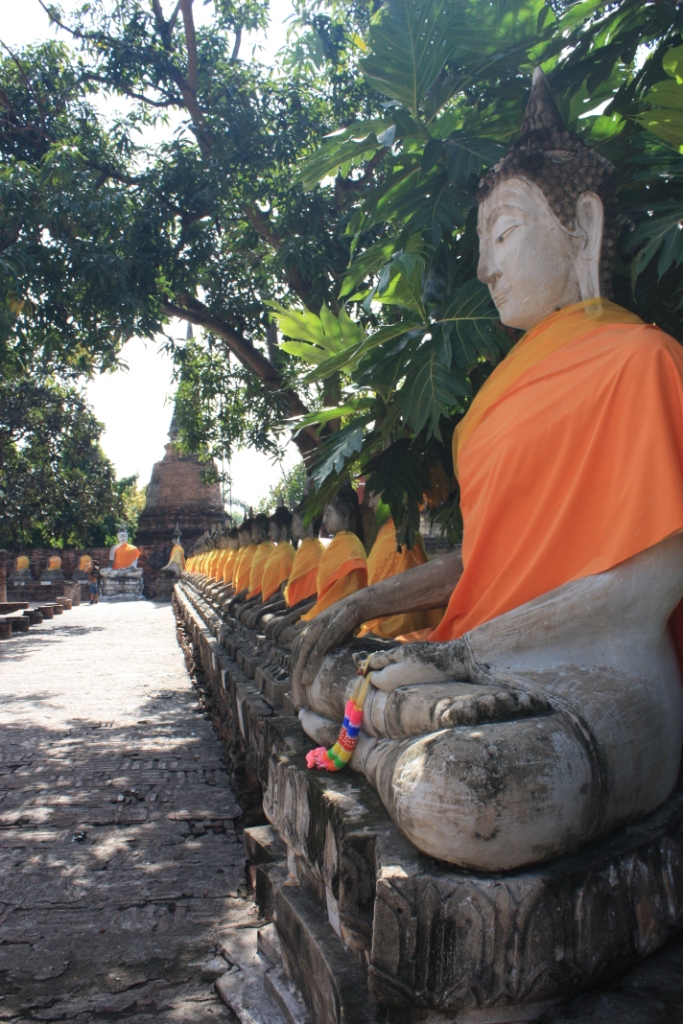
Taken in August of 2014 in Ayutthaya, Thailand.
These Buddhas line the perimeter of an important structure at the Wat Yai Chai Mongkol in Ayutthaya.
 Shantaram by Gregory David Roberts
My rating: 5 of 5 stars
Shantaram is a journey through the life of a convict on the lam, a slum dweller, a prisoner in a crowded Indian jail, a de facto combat medic in the Soviet-Afghan War, and a Bombay gangster. The book is a novel, but mixes in autobiographical elements—at least in broad brush strokes. The author, Gregory David Roberts, was—as with his lead character–an escaped convict who fled his homeland of Australia to find anonymity among the Bombay (now Mumbai) masses. Roberts had taken up armed robbery of banks and institutions to support a heroine habit. However, it’s not clear to what degree the details described in the book echo reality. Roberts is adamant that the other characters in the book are completely fictional, but at least some members of this cast were recognizable as real people—some of whom disagree with the accounting of events in the book.
Most of the book is set in Bombay in the 1980s, and for many the book serves as portrait of the good, the bad, and the ugly of that city. The book picks up with the lead character’s arrival in Bombay, where the gregarious convict soon makes equally vibrant friends. There’s very little backstory, except for one chapter that details the protagonist’s escape from prison. There are occasional mentions of his heroin addiction and crimes peppered throughout the book—often delivered in doleful or apologetic moments. Also, he occasionally mentions the family that is missing in Australia—particularly a daughter—usually when the close nature of Indian familial relationships remind him of what he’s missing. This vague background makes sense as this was supposed to be book two in a quartet. Another book is supposed to be coming out called The Mountain Shadow, that I suspect would be the third book of this quartet.
The book excels at creating characters that are multidimensional in the extreme, but who one still finds engaging. The protagonist and several major characters should be unbelievable, given the degree to which they mix virtue and vice, cynicism and idealism. However, maybe they reflect human nature more than we’d like to admit.
Consider the protagonist. He is called “Shantaram” by the family of his best friend in Bombay. Shantaram means “man of peace,” and that’s supposedly what those characters saw in him, but he’s also a man of violence—by his own admission. He’s stabbed, beaten, and shot at other people, and continues to do so. It’s not just the lead character who is like this. It’s the same for his love interest, his gangster friends, his Mujahedeen friends, and his fellow prisoners. Many of them are anti-heroes, and others vacillate between hero and villain. “Doing the wrong thing for the right reason,” is a recurring theme throughout the book.
It should be noted that the anti-hero characters are also the source of loathing for those who hate the book—and there are those who hate it. It’s not just the frequent and raw violence from the “man of God’s peace,” but how the book glorifies gangsters—at least some gangsters.
There was one feature of the book that made this acceptable to me, and that’s that the character knows he’s flawed. As with any veiled autobiographical book, there’s probably some dancing events around to make the characters look more reasonable and likable than they really were. However, Shantaram does admit his mistakes and flaws. One can see how an element of self-loathing plays into these people’s behavior. The virtuous half of Shantaram can be seen as a desire for redemption.
One of the best encapsulations of his self-loathing is when Shantaram gets a promotion in the Bombay mafia, and he tries to recruit a couple of his friends from the slum. He is shocked to find that they would rather stay slum-dwellers who eke out an existence than to make good money breaking the law—even if only as document couriers (the documents being fake passports and the like.) [To be honest but non-PC, if you think Roberts glorifies gangsters, you should see how he glorifies slum-dwellers.] Shantaram also envies a man who refuses assistance to get his sentence reduced after the virtuous slum-dweller killed a horrible person in the heat of passion. In both of these cases, he has a “who must I be?” moment. Maybe that’s why we believe that this ex-junkie mobster would set up a free clinic in the slum or help his friends without question, he’s in a constant search for redemption. It could be said that the engine of this book is the search for redemption, but it’s a Promethean task because Shantaram keeps accruing karmic penalties in his tight-rope walk between good and evil—or maybe a damaged moral compass.
The book weighs in at almost a thousand pages, but it does a good job of keeping one reading. There many exhilarating and tragic events to keep one turning pages such as a fight against a cholera outbreak in the slum, torture in a Bombay prison, taking fire in the mountains of Afghanistan, the deaths of close friends, and fighting turf wars between factions of the Bombay mafia. However, the glue that binds all those climactic points together is the tension created by the various relationships from the expat community to the slums to the Mumbai mob.
Love it or loathe it, Shantaram is a powerful book. I define “powerful” as attracting love and hate at the extreme. This isn’t a book one feels indifferent about. I’d recommend it for a general audience.

Taken in Bangkok in September of 2014.
This street vendor made crepes in the shape of various cartoon characters. The little drawings hanging from the front of the cart were the pictures you could select from. Or you could get a hot dog rolled in a crepe (pig in a blanket variation.)
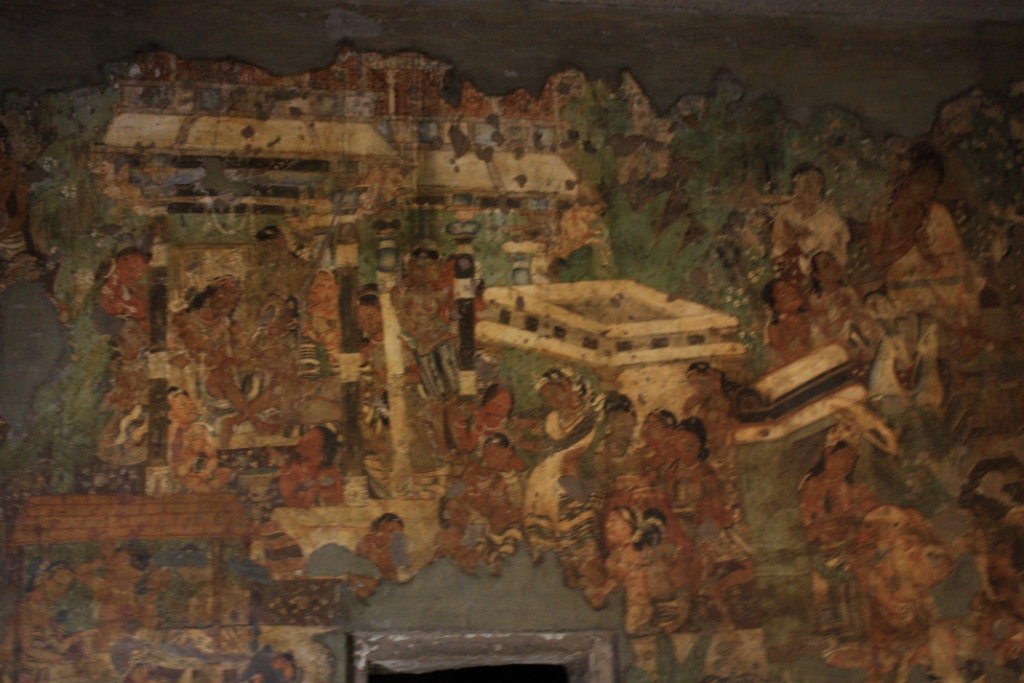
Taken on November 19, 2014 in Ajanta Caves
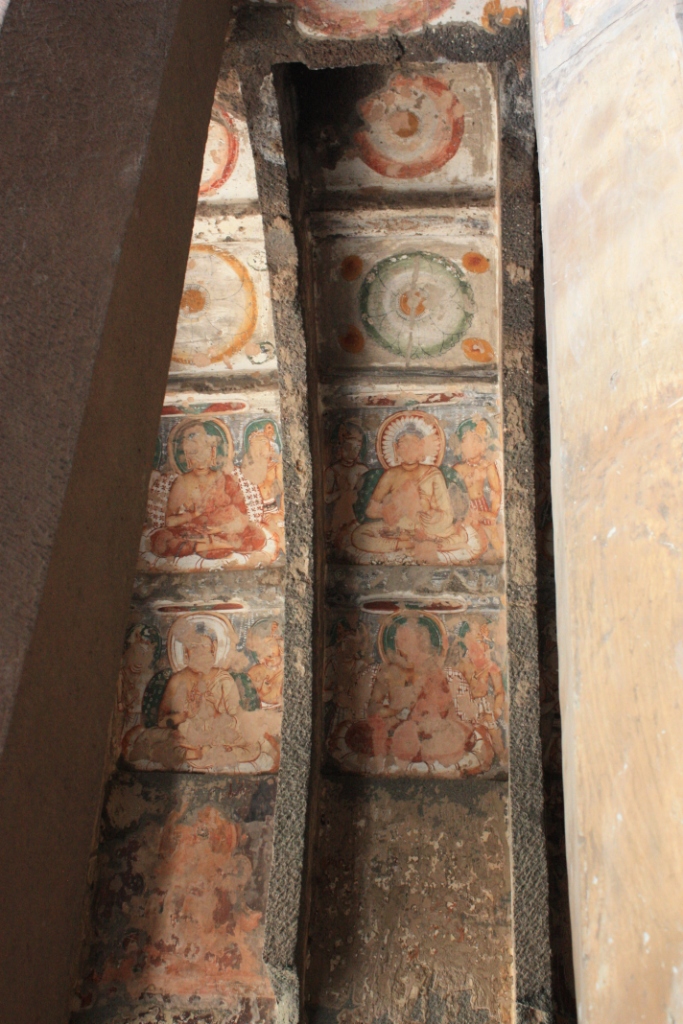
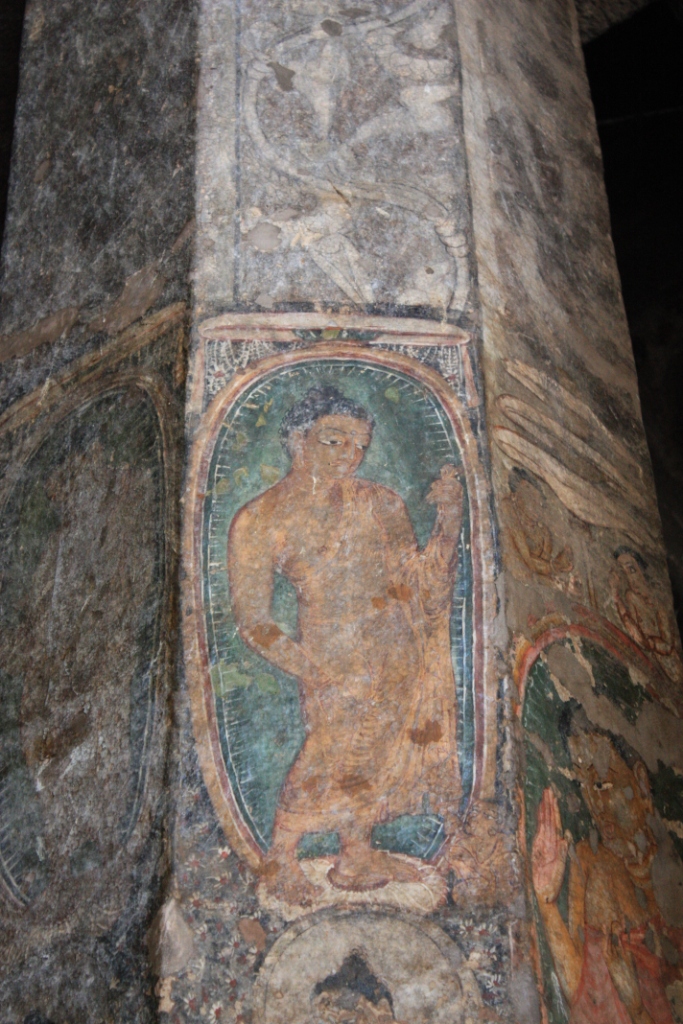
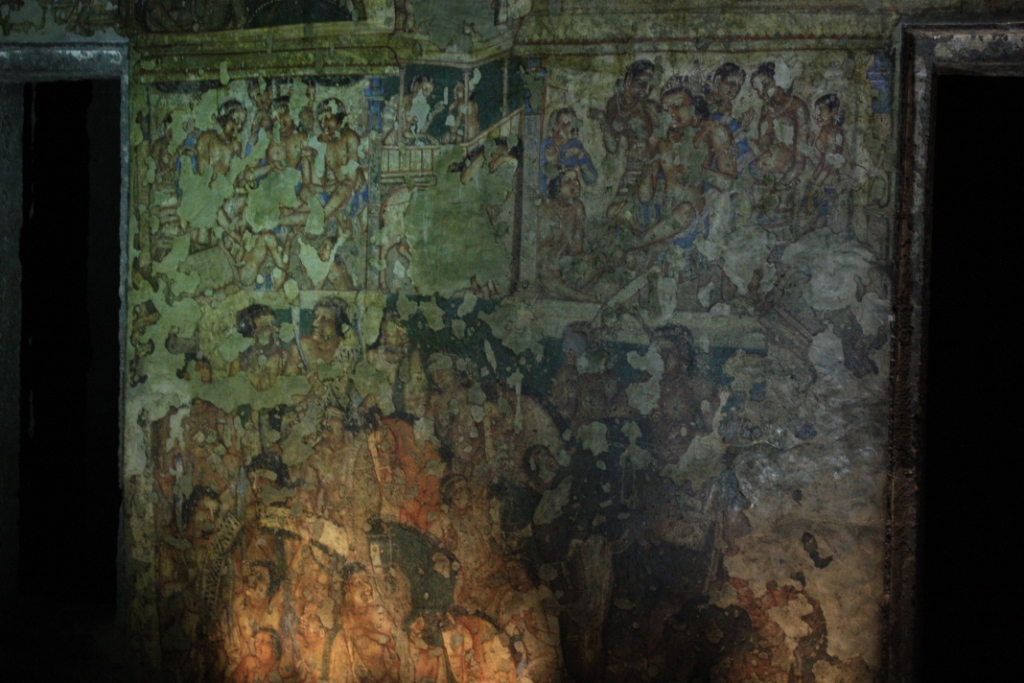
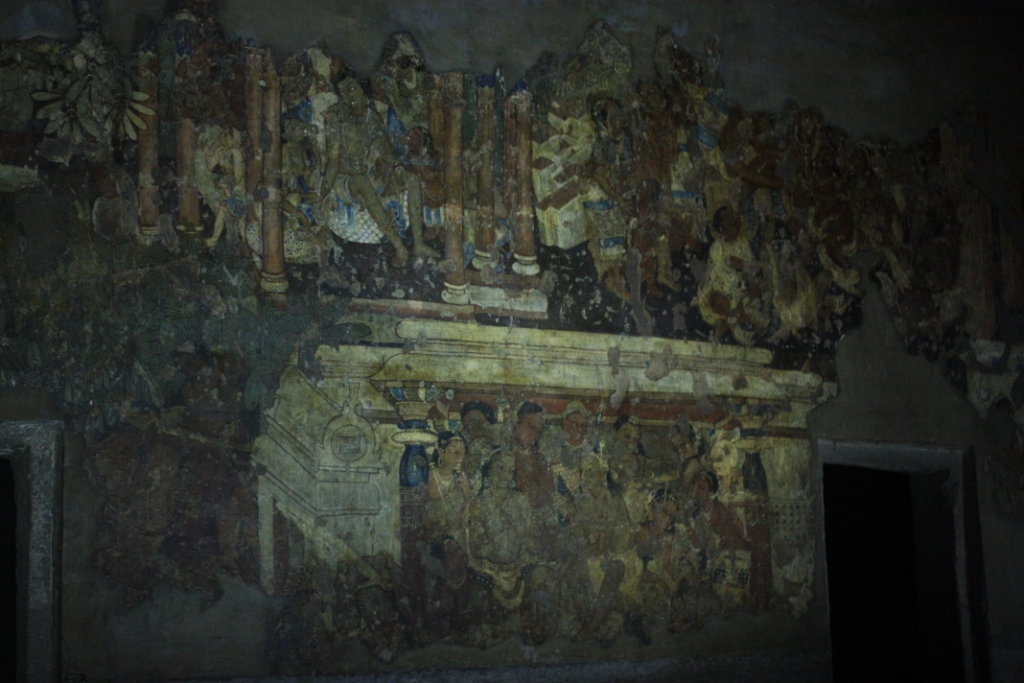 In the caves of Ajanta, many wall paintings have been preserved. As harsh light can damage these artworks, some of which have survived for centuries, flashes and outside lighting are prohibited. Therefore, it’s a challenge get decent photos, but here are a few attempts.
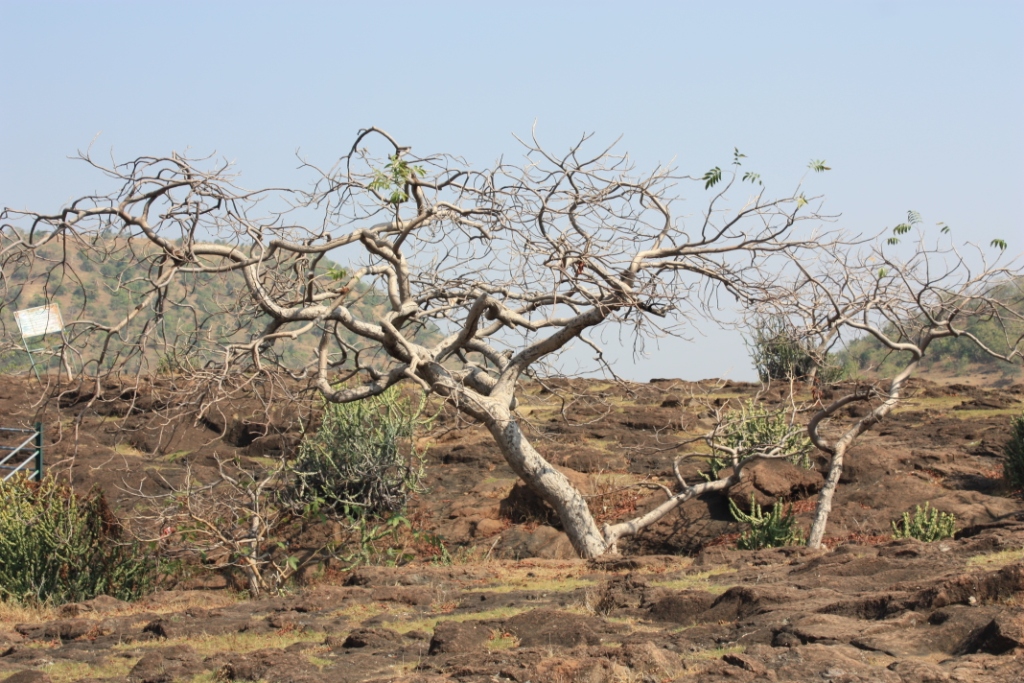
Taken on November 19, 2014 at Ajanta.
 Yogic Management Of Common Diseases by Satyananda Saraswati
My rating: 4 of 5 stars
The title of this book gives one a nutshell description. It’s a book that discusses what yoga practices are beneficial for various common ailments. These practices include not only asana (postures), but also pranayama (breathing exercises), shatkarma (cleansing practices), yoganidra (a relaxation technique), meditational practices, and dietary and other yogic lifestyle practices. The book also discusses both the medical and yogic explanations of various diseases, and provides enough background on the relevant anatomy and physiology to give a layperson an understanding of the basic causes of each disease (if known.)
The book covers about 37 classes of disease, and is arranged into seven parts by bodily system (head and neck, cardiovascular system, respiratory system, gastro-intestinal tract, joints and musculo-skeletal system, urogenital system, and a miscellaneous ailments section that deals with skin diseases and varicose veins.) Some chapters deal specifically with one disease, while others cover two or more related ailments (e.g. Bronchitis and Eosinophilia, Sinusitis and Hay Fever, or skin diseases.)
This book has a number of strengths. First, it’s grounded in a scientific view of these ailments and isn’t selling yoga as a panacea. As suggested above, the title was carefully chosen. It’s “Yogic Management of Common Diseases.” The word “Management” is a critical one. If you’re looking for a book about how yoga can single-handedly cure your Stage IV lung cancer, this isn’t the book for you. If you’re looking for a book on how yoga can help you live a better life if you have arthritis, diabetes, or are hernia prone—possibly in conjunction with medication or other medical treatments—this may be the book for you.
Second, the diseases covered seem to have been carefully chosen. The selection of common ailments is not just to appeal to a broad audience. Many of these ailments are caused by common lifestyle problems that offer relatively easy fixes. Other diseases may not offer any fix per se, and, therefore, the ability to live a high quality of life with the affliction may be valuable. Also, I know a number of the diseases covered are particularly promising candidates for a yogic solution / mitigation.
Having given the strong points, I will say there are a couple of weaknesses to the book as well. First, it’s not illustrated in any way. Given that there is a lot of discussion of biology and anatomy, there are places where a picture might be worth a thousand words. I will note that this isn’t a book for a yoga newbie. It uses Sanskrit names for practices without so much as a glossary. That said, yoga teachers and intermediate/advanced students will probably not find this much of a problem because they will have built an appropriate vocabulary or have the necessary reference close at hand. I didn’t deduct for the lack of explanation, because the book is clearly intended for established practitioners (the Introduction warns as much.)
The second weakness is that there’s no explanation of why the listed practices should work particularly well for the given disease. I think the book does a great job of explaining the nature of the disease for a non-expert reader. However, then it just lists practices by type (asana, pranayama, relaxation, diet, etc.) In some cases, the reader can easily make the connection, but in others it’s not so clear why one should do practice “X” for disease “Y.” I do realize that drawing these connections could be space-intensive and technical. The book is a nice slim 245 pages, and it could rapidly grow to an untenable length. However, I’m concerned that some of the recommendations might not be rooted in experience and observation.
I would recommend this book for yoga teachers and intermediate / advanced practitioners who are interested in yoga as a component of building a healthy body. If you are new to yoga, you will probably want to first familiarize yourself with many of the classic asana, pranayama, and shatkarma practices of yoga—otherwise you’ll have to look up terminology constantly.
It should be noted that this book is put out by the Bihar School (of Swami Satyananda Saraswati fame), and the same publisher has put out a number of books that delve much more deeply into specific ailments. (At least some of these are written by the same author, Dr. Swami Karmananda.) Also, let me say that while the school self-publishes through its Yoga Publications Trust, it puts out books on a large-scale, of high-quality, and they appear to be available globally through Amazon and the like. (Swami Satyananda Saraswati alone was extremely prolific and wrote the APMB, which is one of the seminal reference works on yoga.)
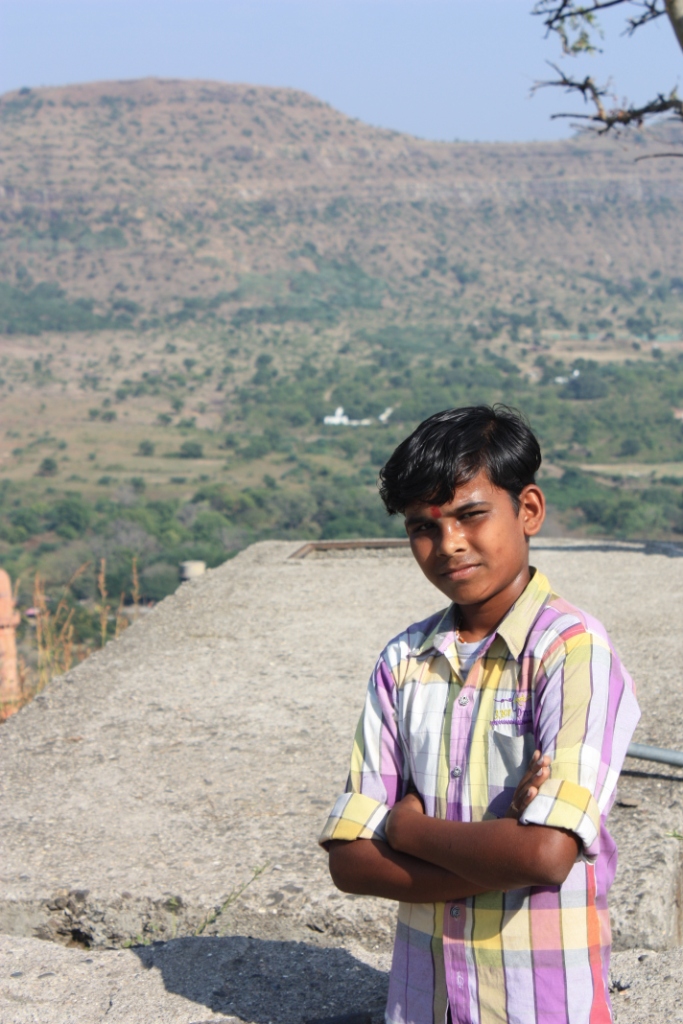
Taken on November 20, 2014 at Daulatabad Fort