Unknown's avatar

About B Gourley

Bernie Gourley is a writer living in Bangalore, India. His poetry collection, Poems of the Introverted Yogi is now available on Amazon. He teaches yoga, with a specialization in pranayama, and holds a RYT500 certification. For most of his adult life, he practiced martial arts, including: Kobudo, Muay Thai, Kalaripayattu, and Taiji. He is a world traveler, having visited more than 40 countries around the globe.

BOOK REVIEW: Good Omens by Terry Pratchett & Neil Gaiman

Good Omens: The Nice and Accurate Prophecies of Agnes Nutter, WitchGood Omens: The Nice and Accurate Prophecies of Agnes Nutter, Witch by Terry Pratchett
My rating: 5 of 5 stars

Amazon page

Nature or nurture? That’s the question at the core of this funny take on the coming of the apocalypse, written by two masters of humorous speculative fiction—the late Terry Pratchett and Neil Gaiman. The end of days is coming. What if the Antichrist responsible for seeing it through had been switched at the hospital and was raised as a normal kid? Would he be evil enough? If not, how would the apocalypse play out? After a chapter that shows the reader the mix up at the hospital, the bulk of the book takes place over a few days that are supposed to be the last few days of humanity.

There’s an extensive cast of characters including the “gang” of Adam the anti-Christ, the four horse-persons of the apocalypse, angels and demons, witches and witch-hunters, and other sundry characters. However, the characters that most carry the tone and message of the book are Crowley (a demon) and Aziraphale (an angel.) With these two, the authors inject some Taoism into an otherwise Biblical world. That is to say, pure evil and pure good are rarities; there’s always a bit of good amid the bad, and vice versa. Aziraphale can be grumpy, and Crowley’s proclivity to be mischievous has its limits. Being in similar positions, the two bond as low-level managers working for Coke and Pepsi might get on because they face similar demands and have similar complaints about management.

Running through the book are mentions of a book called, “The Nice and Accurate Prophecies of Agnes Nutter, Witch.” This witch’s prophecies are quite unusual in that they are invariably correct, and yet are specific. That is, the prophecies aren’t “right” in the sense that astrologers are often “right” by making vague statements that offer no disprovable propositions. This might lead one to believe that the book would be a marvelous guide for making predictions. However, there is still the issue of having been written centuries ago. Items like automobiles and cellphones, that play a major role in life today, were unfathomable. Furthermore, it’s usually not clear who, exactly, a given prophecy applies to. In short, the medieval writing style results in the fact that the prophecies usually only make sense after the fact.

I’d recommend this book for readers of humorous speculative fiction.

View all my reviews

DAILY PHOTO: Kochi Market

Taken in July of 2014 in Kochi (Cochin)

Taken in July of 2014 in Kochi (Cochin)

IMG_1033

What RYT300 Taught Me About Fear

IMG_2752

I recently completed the RYT300 course at Amrutha Bindu Yoga to obtain my RYT500 yoga teacher certification. (i.e. The 200 hour course–which I completed a couple years ago–plus the 300 hour course are the primary requirements for the 500 hour certification.) The essay below is about one of the key lessons I learned in this phase of training.


I walked through the streets of Bengaluru barefoot and with not so much as a 5 rupee coin in my pocket. [If your response to that is “big whoop,” you probably live somewhere like Singapore, Helsinki, Kobe, or Calgary where the streets are immaculate and the rats aren’t so bold. If you’re familiar with what goes on in and near the streets in India, you may be wondering what the hell is wrong with me.]  It was an unconventional teaching tactic to be sure, but it ranks among the most valuable lessons of the training—surpassing no small revelations about postural alignment, pranayama methods, bandha technique, physiology, and yogic philosophy. It was even up there with the experience of advanced shatkarma (cleansing practices) that were completely new to me.


What’s the lesson?  If you’re going to teach yoga–particularly at the intermediate / advanced level that RYT500 is intended to prepare you for–you need to work on not being ruled by fear. That isn’t to say one must be fearless. We imagine fearlessness to equate to courageousness, but courage is action under fear. Neuroscience tells us what a fearless person is like. We know from individuals who’ve had the parts of their brains damaged that are responsible for the emotion—they are paralyzed by indecision. Our emotions provide a basis for choosing–at least as a tie-breaker when no clearly superior path exists. We need our fear, just like our other emotions, but if you can’t move forward because of it you may have a hard time keeping learning.


Not being ruled by fear isn’t just—or primarily—about being able to keep practicing advanced techniques until you can get a grasp on them.  Yes, mastering a handstand requires a fair amount of falling down (hopefully, in a controlled fashion), and that’s a lot of potential for anxiety, but there’s more at stake.  What precisely? One might start, as many do, with what Patanjali has to say on the subject, and one can start from square one. “Chitta Vrtta Nirodhah.” (Quieting the fluctuations of the mind.) Many of the fluctuations of the mind result from anxieties and our obsession with solving them. Our brains are wired to try to anticipate worst case scenarios so we can develop ready-made solutions for them. This can result in excessive pessimism, extended stress, and all the problems that go along with that stress.

IMG_2642

There’s a popular saying that goes, “money is the root of all evil.” But, I think it’s wrong. Fear is at the heart of all evil—not to mention a fair amount of run-of-the-mill pettiness.


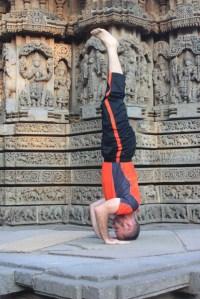
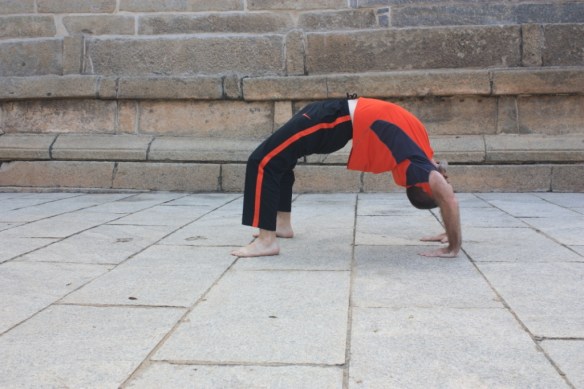
So what is the path to anxiety management? Start small, and dispassionately observe your discomfort. Don’t try to squelch the emotion, just watch it while trying to avoid putting good or bad labels on it. Of course, sources of anxiety are personal. As far as prescriptive yoga practices, that depends upon one’s personal anxieties. For some inversions might do the trick, for others extreme back bends, for some external breath retention, for others it may be balancing. Then, of course, there are the advanced shatkarma practices I mentioned earlier–such as vaman dhauti (cleansing by vomiting) or poorna shankhaprakshalana (i.e. clearing out one’s digestive tract via massive ingestion of salt water.)


I recently finished teaching a Kid’s Camp (a post about that to come.) At the beginning of the camp, I was telling someone that the kids were fearless, but what I came to discover was that kids just allow their enthusiasm to swamp their anxieties. I had seven-year-olds doing pinchamayurasana (forearm stand) and vrschikasana (scorpion) within the first few days. That would be a hard sell for adults. [I don’t think I’ve ever taught those postures to adults.]  It’s not just that kids are bendy, they’re also ready to get up after they fall down. (And since they’re not stressed about the possibility of falling they don’t tense up and get badly injured.) Someone posted a great meme on Facebook recently. It said, “A child who falls down 50 times learning to walk, doesn’t go, ‘I don’t think this is for me.’”

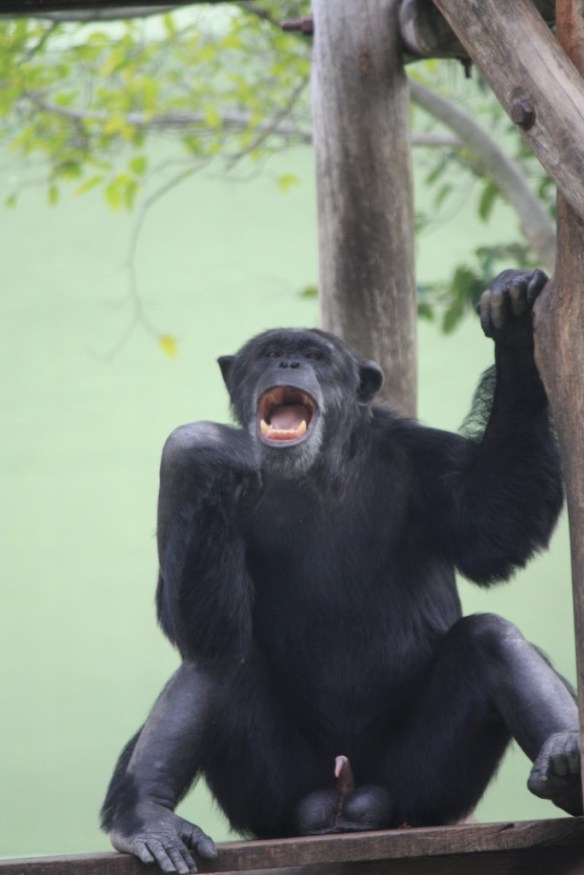
DAILY PHOTO: Uncouth Chimp

Taken in November of 2013 at the Mysore Zoo

Taken in November of 2013 at the Mysore Zoo

BOOK REVIEW: The Yoga of Max’s Discontent by Karan Bajaj

The Yoga of Max's DiscontentThe Yoga of Max’s Discontent by Karan Bajaj
My rating: 4 of 5 stars

Amazon page

Max is a making a good living in New York City, but feels an inexplicable void that leads him to give it all up to travel to India in search of wisdom. This novel is a hero’s journey in which the quest isn’t for adventure (not in the usual sense) but for insight into his mind and a path to bliss. Along the way he finds a teacher and is assisted by others, but must ultimately find his own path. As is appropriate to such a quest, he faces hurdles within and without and it’s not always clear whether he will find what he’s searching for—or even whether it exists.

This book kept me reading. It had humor (particularly in the first part) and maintained awareness that it was a novel throughout. What I mean by the latter statement is that there is temptation for books that deal in spirituality to devolve into a muddle between story and self-help book. However, I think the author avoids that error and keeps advancing the story in a readable fashion. The descriptions of yogic practices don’t bog down the story. Those experienced with yoga will breeze right through said descriptions and know what’s happening, and those without such knowledge won’t lose much by grazing over such segments.

The book consists of 38 chapters divided into three parts. The first part covers the period during which Max moves from the US to India and seeks out a teacher. The second part describes his time studying yoga in a south Indian ashram. The final part is the period after which he’s achieved enlightenment, which he spends in the Himalayas.

I found the first two parts to the most interesting and enjoyable. The first part has all the humor and emotional turmoil one would expect from a well-developed and relatable human character. The descriptions of an austere life amid the harsh landscape of a south Indian ashram that comprise the second part make for a visceral read. Where the third part falls flat for me is that supernatural abilities are introduced, and that makes it more difficult to care about Max anymore. It’s a problem inherent in writing this type of story. While Max becomes wiser in the second section, that part doesn’t fall so flat because the life he’s living is so challenging. It’s certainly not that Max’s life is easy when he moves to the Himalayas, but by then he can speak languages he never learned and create sparks with his mind and as far as the reader knows he may be able to leap tall buildings in a single bound and other superman type magic. I suspect the author was aware of the risk of this because he backs away from having Max start a fire with his mind early in the third part and the last part unfolds much more quickly.

I’d recommend this book for anyone who’s interested in a story about personal transformation. Those who’ve spent time in India will find much that resonates and those who are considering (or curious about) such a quest will glean many insights from this book.

View all my reviews

DAILY PHOTO: Tibetan Murals in McLeod Ganj

Taken in June of 2015 in McLeod Ganj

Taken in June of 2015 in McLeod Ganj

IMG_2516 IMG_2577

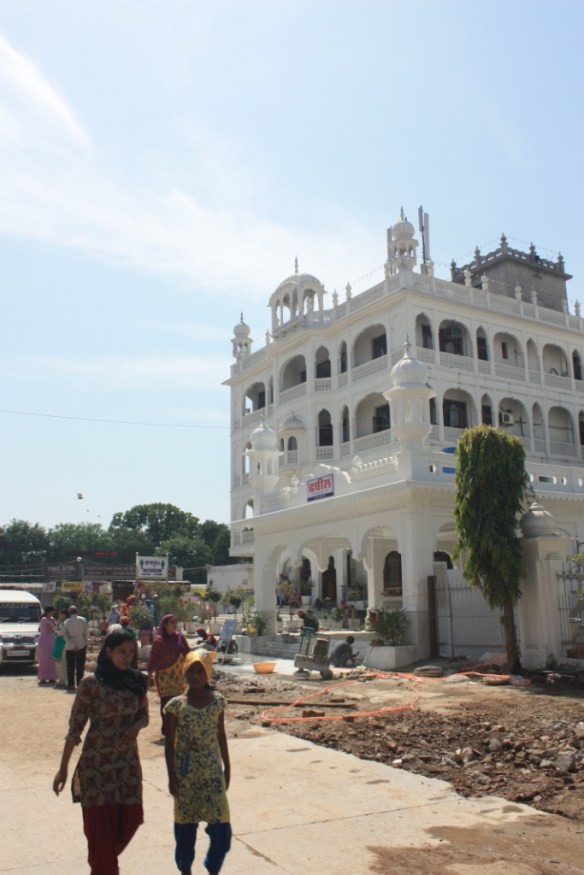
DAILY PHOTO: Mata Ganga Ji Niwas

Taken on April 10, 2016 in Amritsar

Taken on April 10, 2016 in Amritsar

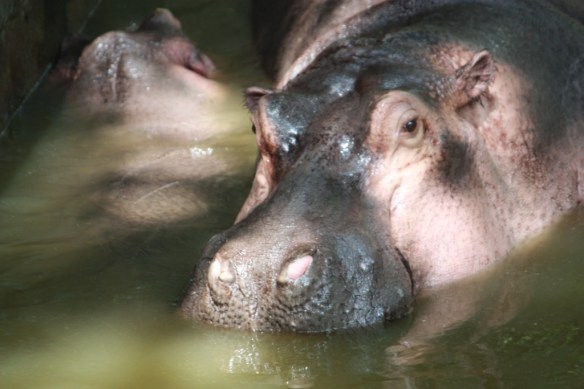
DAILY PHOTO: Hungry, Hungry Hippo Hides

Taken in November of 2013 at Bannerghatta

Taken in November of 2013 at Bannerghatta

DAILY PHOTO: Angkor at Canopy Height

Taken in October of 2012 at Angkor

Taken in October of 2012 at Angkor

BOOK REVIEW: The Little Prince by Antoine De Saint-Exupery

The Little PrinceThe Little Prince by Antoine de Saint-Exupéry
My rating: 5 of 5 stars

Amazon page

A pilot crash lands in the middle of the desert and meets a little traveler who came from a tiny planet. As this “Little Prince” tells of his travels, he shares his child-like (not to be confused with “childish”) wisdom on friendship and how adults misunderstand what are “matters of consequence.” While the Little Prince takes a child’s perspective, one’s responsibility to others is an important theme. Of course, that may just be the theme intended for children. At the same time, the lesson for adults may be to reevaluate what one considers important. (The reader may be familiar with the controversy as to whether this is really a work of children’s literature.)

The book is humorous and light-hearted, but with some serious themes and moments. There are many though-provoking ideas in this classic. Some quotes that struck me as profound are:

“The thing that is important is the thing that is not seen.”

“One runs the risk of weeping a little, if one lets oneself be tamed.”

“’Then you shall judge yourself,’ the king answered. ‘That is the most difficult thing of all.’”

“For it is possible for a man to be faithful and lazy at the same time.”

It’s a tiny book—less than 100 pages, including the many color drawings that feature throughout the book.

I’d highly recommend this book for anyone who hasn’t read it at least once. (There may be a couple of you out there.)

View all my reviews