Unknown's avatar

About B Gourley

Bernie Gourley is a writer living in Bangalore, India. His poetry collection, Poems of the Introverted Yogi is now available on Amazon. He teaches yoga, with a specialization in pranayama, and holds a RYT500 certification. For most of his adult life, he practiced martial arts, including: Kobudo, Muay Thai, Kalaripayattu, and Taiji. He is a world traveler, having visited more than 40 countries around the globe.

BOOK REVIEW: Dreaming: A Very Short Introduction by J. Allan Hobson

Dreaming: A Very Short IntroductionDreaming: A Very Short Introduction by J. Allan Hobson
My rating: 4 of 5 stars

Amazon page

Dreaming is one of the most interesting and ill-understood activities of human existence. Many of us don’t remember most of our dreams—to the extent that a number of people don’t think they even have dreams (while not completely conclusive, the scientific evidence suggests that all of us dream every night—except people who live on RedBull and 2 hours / night until they tragically die young.) However, when we do remember a dream, it’s often a vivid and profound experience. Some people dream lucidly (are aware they are inside a dream as it occurs), and a few people have lucid dreams on a regular basis. This has led people to draw all sorts of conclusions about dreams existing in a realm beyond the physical, and what not.

While there remains a lot that we still don’t know about dreams, a great deal of science has been advanced in recent decades—enough to take dreamland out of the realm of spiritual mumbo-jumbo and even away from the weak (and largely wrong) science of Freud, and into the realm of legitimate science. This book summarizes much of that science in a concise package. The “A Very Short Introduction” (VSI) series from Oxford University Press offers this type of guide for many subjects. They’re usually about 100 pages long, and give a quick and gritty rundown of the subject at hand.

This book is organized into eleven chapters covering: What is dreaming? Why the Freudian approach (and earlier dream interpretation schemes) failed? How the brain is activated during sleep? What is happening at the level of neurochemistry? Why we dream? What can go wrong with dreams? (i.e. sleepwalking, night-terrors, etc.), How dreaming relates to delirium and mental illness? (i.e. it is, after all, a state of hallucination in which we take often bizarre imagery for granted.) There’s a discussion of the new psychology of dreaming which is based in neuroscience and not on an Austrian with a pipe suggesting that it all comes down to penises and vaginas. (Hobson isn’t anti-Freud, though he does want to make clear that the psychology pioneer was quite wrong on this subject.) There’s a discussion of how learning and memory can (and can’t) be advanced through sleep. Hobson discusses the interaction of consciousness and dreams, e.g. lucid dreaming. And there’s a discussion of interpretation of dreams that is rooted in more modern thought.

An interesting feature of this guide is that the author uses his own dream diary entries as case studies to make points clear. That helps make this VSI guide a little less dry than they tend to be by their nature.

I do enjoy the VSI series. I’ve read quite a few of them, and find they are a good way to study up on a subject with a minimal of effort or pain. I also enjoyed this volume specifically. It’s certainly one of the most fascinating topics on which I’ve read a VSI, and the author doesn’t disappoint in bringing interesting facts and anecdotes to the table.

I’d recommend this book if you want to get up to speed on dreaming in a little over a hundred pages.

View all my reviews

DAILY PHOTO: Gigantic Chicken

Taken in Lusaka, Zambia in May of 2016

Taken in Lusaka, Zambia in May of 2016

BOOK REVIEW: Night School by Richard Wiseman

Night School: Wake up to the power of sleepNight School: Wake up to the power of sleep by Richard Wiseman
My rating: 4 of 5 stars

Amazon page

This book is a two-in-one. It’s a pop sci book covering the science of sleep. However, it’s arranged as a self-help guide to teach one how to get the most from one’s sleep life. It covers a wide range of sleep related issues from how to minimize jet lag to how to master lucid dreaming. It also describes the sometimes dire effects of not getting enough quality sleep. Along the way one also learns about interesting anecdotes and research that may not change your quality of sleep, but could prove interesting or useful nonetheless—such as the research that shows a strong correlation between the position in which one usually sleeps and one’s personality.

The meat of the book is divided up into eight sections (called “Lessons” in accord with the theme of “Night School.”) The first few lessons begin with general background on sleep and sleep deprivation, and cover how much sleep one needs and how one can achieve the best possible sleep life. Then the book delves into more specialized topics such as night terrors, sleepwalking, “power napping,” and the question of whether one can really learn in one’s sleep. The last couple chapters deal with dreaming (normal and lucid.)

Along with the eight lessons, there are also eight assignments. Most of these assignments are surveys that help the reader understand what will work for them best specifically—as not all sleep advice is one-size-fits-all. However, there are other assignments like a mid-course recap exam, a call to attempt interpreting one’s own dreams (as opposed to relying on the generic dream interpretation guides which the science suggests are bunk,) and a suggestion to start a dream diary—with instructions for how to go about it.

Another nice feature of the book are its boxed discussions of relevant research on such topics as segmented sleep (instead of sleeping through the night), narcolepsy, snoring, children’s sleep issues, etc. There’s also a Conclusion that reviews key information from the book in the form of a refutation of the common myths that abound on the subject of sleep, as well as a “manifesto” that repeats key elements of advice on good sleep. It’s a scholarly work, and so it include source citations.

I learned a lot from this book. Granted a lot of the advice is commonsense (e.g. sleep in a dark, cool, and quiet place), but there are plenty of not so obvious tidbits as well (e.g. red light is okay, but blue light will keep one from sleeping.) There are also a lot of fascinating stories in the book to keep one interested.

I’d recommend the book for anyone who wants to learn to improve their sleep lives.

View all my reviews

DAILY PHOTO: Dubai Mall with Burj Khalifa in the Background

Taken in May of 2015 in Dubai

Taken in May of 2016 in Dubai

DAILY PHOTO: Dunes & Sky

Taken in the desert outside Dubai in May of 2016

Taken in the desert outside Dubai in May of 2016

DAILY PHOTO: Belly Dancer

Taken in May of 2016 in the Arabian Desert

Taken in May of 2016 in the Arabian Desert

IMG_0741

DAILY PHOTO: Barjeel Guesthouse Courtyard and Windcatcher

Taken in May of 2015 at Barjeel Guesthouse in Dubai

Taken in May of 2015 at Barjeel Guesthouse in Dubai


Windcatchers are common in the old part of Dubai. They’re towers that use breezes to pull away excess heat. One of the many strategies used to keep interior spaces cool, along with high-walled courtyards packed with shade vegetation (also seen herein.)

Surprisingly, we ended up turning the AC off for a significant part of the time because it was staying cool from the thick walls and shuttered windows that faced a courtyard. (Maybe the windcatcher, too. However, I’m not sure the one shown was useful, versus only being ornamental.)

BOOK REVIEW: Running with the Mind of Meditation by Sakyong Mipham

Running with the Mind of Meditation: Lessons for Training Body and MindRunning with the Mind of Meditation: Lessons for Training Body and Mind by Sakyong Mipham
My rating: 4 of 5 stars

Amazon page

Tibetan Buddhists believe Sakyong Mipham is the reincarnation of a great teacher from late 19th century Tibet. He’s also completed many marathons—nine at the time of this book’s publication. He’s certainly qualified to comment on meditation, running, and the nexus of the two–if there is such a thing. However, it may not be clear that the topics are particularly connected. Readers may have an intuitive sense that they are closely connected, but without sufficient understanding of both elements to draw sound conclusions.

The author, himself, proposes that one should recognize the points of contrast as well as comparisons between the two activities. A couple quotes make this clear:
“People sometimes say, ‘Running is my meditation’… in reality, running is running and meditation is meditation… It would be just as inaccurate to say, ‘Meditation is my exercise.’”
“The body benefits from movement, and the mind benefits from stillness.”
Later in the book, the author suggests that the apparent clarity after running usually has more to do with the “wild horse” of the mind being tired, rather than it being tamed. (Taming the mind being the objective of meditation.) That said, Mipham Rinpoche clearly believes that there are benefits to be had from an interaction between these two activities.

The book is divided into six parts. The first part gives background on basics like base-building, breath, what meditation is, and the challenge of starting to build a regime (either of running, meditation, or both.) The rest of the book is organized by way of a Tibetan Buddhist conception about how new skills are learned. This schema relies on animal symbolism. The first level is that of the tiger, and this is when one works on attentively and conscientiously building one’s technique. The lion level follows the tiger. The lion phase is a joyful one because a base capacity and fundamentals have been built and the initial struggle is in the past. The next phase is represented by the Garuda (a mythical eagle-like creature that features in Hindu as well as Buddhist mythology), and it’s expressed by challenging oneself to more demanding practice. The final phase is the dragon, and it involves moving beyond doing the activity for oneself to doing it for others. There’s a final part, entitled the windhorse, that is based on the notion of an energy that Tibetan Buddhists believe accumulates when one follows the aforementioned 4 phase path. This last part is a description of events that might be seen as the culmination of the author’s running career.

Within the aforementioned six parts, there are 40 chapters—most of which are only a few pages and deal with a specific aspect (or pitfall) of that phase of training.

I found this book interesting. Learning about the four phases (tiger, lion, garuda, and dragon) of skill development was illuminating, and I found myself thinking about how this idea could be more widely applied. It’s a handy conception with broad utility. The author uses stories from his own experience to add credibility as well as light-heartedness to the philosophy lessons being taught. While the book may seem ethereal, much of the discussion is on down-to-earth subjects like dealing with pain and injury. It should be noted that the introductory and tiger parts make up a little more than half the book—suggesting the importance of fundamentals. There’s a lot of valuable information on fear, confidence, and how to view pain.

I’d recommend this book, especially for runners and meditators—but not exclusively so. Many people who are interested in mind / body interaction will be able to draw useful lessons from the book, even if running isn’t your thing.

View all my reviews

DAILY PHOTO: Bushbuck on the Trail

Taken in May of 2015 at Chaminuka Game Reserve

Taken in May of 2015 at Chaminuka Game Reserve


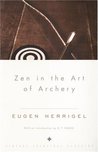
BOOK REVIEW: Zen in the Art of Archery by Eugen Herrigel

Zen in the Art of ArcheryZen in the Art of Archery by Eugen Herrigel
My rating: 4 of 5 stars

Amazon page

Herrigel’s book is part autobiography of his experience learning Japanese archery (kyudo) from the distinguished master archer Kenzo Awa (and through archery, Zen,) and it’s part philosophical treatise on how archery can help one achieve a Zen state of mind.

The book is less than one hundred pages and has a Zen feel itself. Exemplary of this, the book’s divisions aren’t labeled or numbered into chapters—i.e. there’s a general trimming away of the extraneous features of a book. That said, there’s a clear organization to the book, and most of it follows the chronology by which the author (and others) progress in developing deep insight into the mind through the practice of archery.

There are nine sections:
The first section helps the reader understand why one might consider Zen and archery in the same thought–something that will by no means be obvious (even to many Zen Buddhists.)

The second section explains why Herrigel took up Zen and decided to use archery as his vehicle to understand it.

Section three describes the early learning process, and focuses heavily on the importance of breath.

Section four takes place after Herrigel has been practicing about a year, and the theme of purposeless action is at the fore. This idea is one of the recurring central ideas in the book.

Section five is Herrigel’s introduction to withdrawing from attachments, and—in particular—letting go of the ego. It’s not the point at which Herrigel masters this difficult practice, but he’s made aware of it.

The next section is one of the longer chapters and in it Master Awa tries to teach Herrigel the importance of letting “it shoot” rather than making the shot. This is clearly a challenging idea.

In the seventh section, Herrigel has been practicing for five years and Master Awa recommends that he take a test to help him move on to the next stage in his practice.

Section eight is a brief elucidation as to why kyudo is still relevant and how its relevance has long been tied to what it teaches about the mind.

The final section shifts gears into the relation between Zen and swordsmanship. There have been many works written on this subject, and Herrigel’s purpose may have been to convince the reader that kyudo isn’t uniquely a vehicle for Zen. One can engage in many activities (arguably any activity) with the mind of Zen, be it flower arranging, tea ceremony, calligraphy, or spearmanship.

I’d recommend this book for those interested in the mind / body connection. It’s short, readable, filled with food for thought, and is a classic on the subject.

View all my reviews