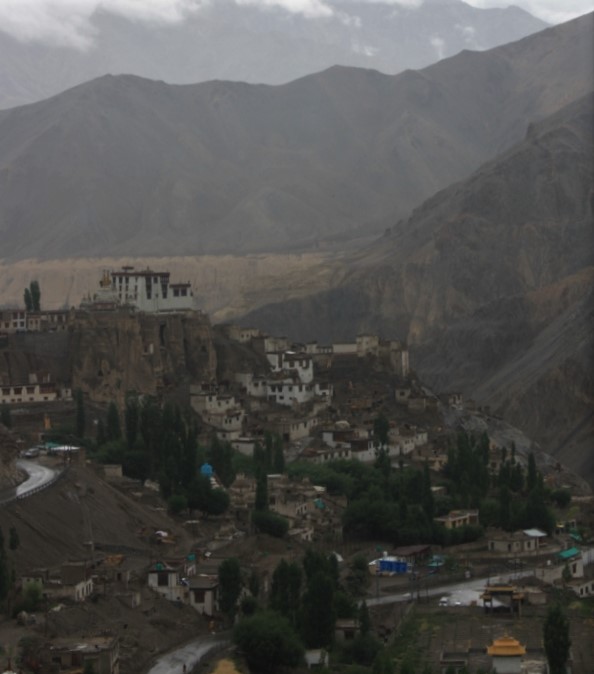
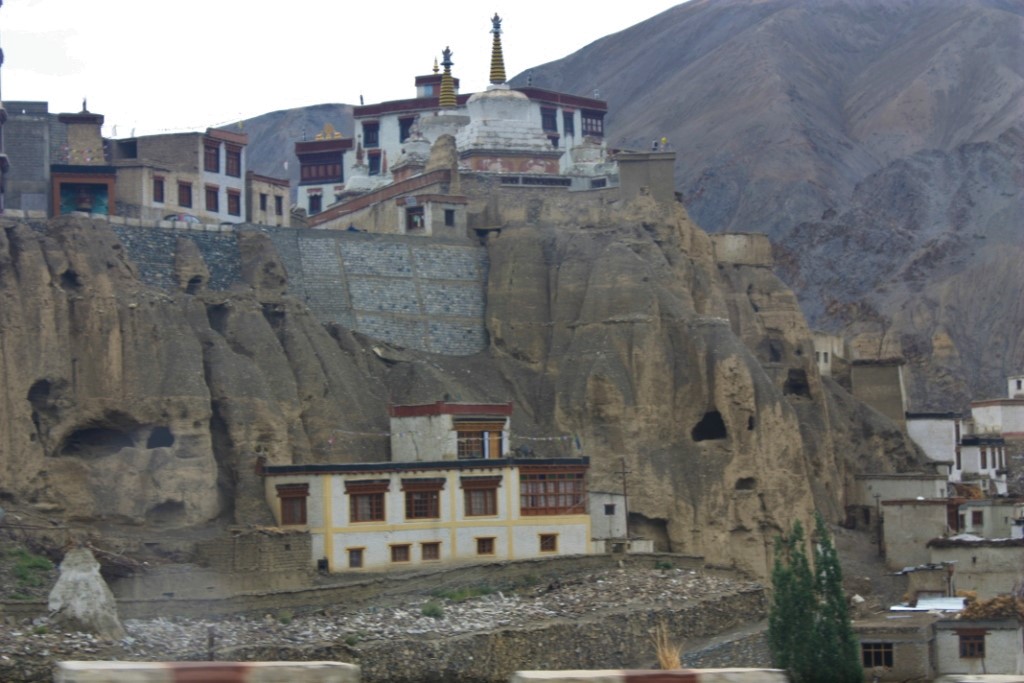
DAILY PHOTO: Lamayuru Monastery, Ladakh

Taken in Ladakh in August of 2016

BOOK REVIEW: Musashi’s Dokkodo ed. Lawrence Kane & Kris Wilder

Musashi's Dokkodo (The Way of Walking Alone): Half Crazy, Half Genius-Finding Modern Meaning in the Sword Saint's Last WordsMusashi’s Dokkodo (The Way of Walking Alone): Half Crazy, Half Genius-Finding Modern Meaning in the Sword Saint’s Last Words by Miyamoto Musashi
My rating: 3 of 5 stars

Amazon.in Page

“The Dokkōdō” consists of 21 precepts written by Miyamoto Musashi in his last days. Musashi was solitary, a minimalist, and single-mindedly resolute as a swordsman – all to extremes few of us can fathom. [Imagine a cross between Diogenes and Muhammad Ali.] These twenty-one sentences barely fill a page, let alone a book. However, as with sutras of yoga and Buddhism, a book’s worth of material comes from elaboration and analysis. This approach is taken in this book by way of five commenters from different walks of life, though all with martial arts experience.

However, normally the explanations would be made by: a.) someone who understands the language (particularly the archaic form the author wrote in – i.e. Musashi’s lifespan overlapped with Shakespeare’s, so consider the changes in the English language that transpired,) or b.) someone with a depth of understanding of the worldview of the author (in this case, that would be someone immersed in a mélange of Buddhism, Confucianism, Taoism, the Chinese classics, and the influence of life in the wake of centuries of feudalism and militancy on a person’s psychology.) This isn’t the approach taken in this book. While the five commenters are clearly well-read and intelligent individuals, they are also firmly ensconced in a worldview that is Western, Abrahamic, and materialistic. [I suspect this was the editors’ intention – to relate to the lives of the likely readership, but it does have stark implications for how the book is perceived.]

If one is looking for a book that will explore what – if anything – from the legendary swordsman’s deathbed lesson aligns with a Western / Abrahamic / American-suburban strip mall dojo lifestyle, this is your book — 5-stars – buy it immediately. However, if one approaches the book from the assumption that Musashi was an exceptional person who must have had valuable insight into how to be exceptional, then one is likely to find this book presumptuous and dismissive of Eastern values and philosophies.

Much of the book is the commenters dismissing Musashi’s ideas as wrong-headed. In some cases, this is because Musashi was such an extremist that few could hope to live a life like his. [It’s not “the way of going alone” for no reason. Though that’s arguably why we are still interested in what Musashi has to say 400 years after his death.] However, in many cases, the commenters seem to be talking past Musashi’s ideas because their assumptions are inconsistent with the swordsman’s cultural milieu.

This is most often seen with respect to a fundamental difference between Eastern and Western psychology. In Buddhism, there are purely mental constructs that have no reality except within the mind, and which can cause suffering with no material upside. For example, in precept #6 when Musashi argues against regret, some of the resulting commentary was as if the precept was “Don’t learn from your mistakes. Never change.” For a Buddhist, not holding onto regrets does not at all mean that one doesn’t learn or make corrections – mid-course or otherwise. It just means that there is this cancerous mental construct that can’t help one because the past is the past, and so it is jettisoned. Another example involves not having preferences, which – again – doesn’t mean that one won’t make a choice (if the situation allows one a choice.) It means not holding onto a mental attachment. [e.g. If I like coffee more than tea, and a choice presents itself, I order coffee. What I don’t do is let my mind obsess about not being offered a choice.]

There are some beautiful insights peppered throughout this book, some that appear to be in line with Musashi’s thinking and others that I suspect the swordsman wouldn’t recognize as related to his own words. However, there is also a lot of commentary that sounds like college students railing against how bad Shakespeare is, in part because they are missing much of the Bard’s nuance and in part because his works seem unrelatable to their experience.

My recommendation of this book would be contingent upon where you fall on dichotomy that I mention in paragraph three. You might love it, or you might loath it.

P.S. If you’d like to know what differences can result from translation, you can find a scholarly translation that is done by a Japanese linguist (Terou Machida) and published in the Bulletin of Nippon Sport Sci. Univ. right here. You’ll note that most of the precepts are (for-all-intents-and-purposes) the same, except the conversion from first to third person. However, you will notice that several precepts (10-12, 15, and 20) are substantially different, and one (#16) is arguably of the exact opposite meaning.

View all my reviews

BOOK REVIEW: Black Widow: Deadly Origin by Paul Cornell


Black Widow: Deadly OriginBlack Widow: Deadly Origin by Paul Cornell
My rating: 4 of 5 stars

Amazon.in Page

This flashback-laden volume revolves around Natasha Romanov’s relations with various men but especially Ivan, a man the Black Widow saw as a father figure. Ivan’s death is an impactful moment in the life of this femme fatale, and it seems like it might be just the start as all the men in her life begin to come under attack (mostly fellow Avengers and other superheroes from the Marvel pantheon.) The story unfolds as the Black Widow tries to unravel the mysterious plot to eliminate her prodigious corps of boyfriends while protecting said friends and (ex-)lovers.

This comic might seem like it would be the perfect entry point for a reader new to the Black Widow character. It offers flashes of insight into the character’s origin, but without the dated feel of old comics that were often marketed toward ten-year-old boys and that didn’t anticipate technological progress and cultural trends any better than most sci-fi does. However, I would argue that it’s a bit of a chaotic read for a newbie to the character (speaking as one.) It’s a four-issue volume and so the glimpses of backstory and the references to arcane Marvel characters and events come in rapid succession.

I found this book a fun and entertaining read, if a bit helter-skelter. I should point out that by the time one gets into the latter-half of the volume everything starts to come into focus.

View all my reviews

Half-Hearted Apology to a Reptile [Common Meter]

Apologies Mister Lizard,
didn't mean to step on you.
But you kind of blend with the rock.
It's not like in the zoo;
where there's a sign and pointing kids
and barriers, to boot.
When one looks just like one's backdrop,
it behooves one to scoot.

Sorry again about your tail.
I'm sure it will grow back.
Call it a teachable moment,
&
get an orange knapsack!

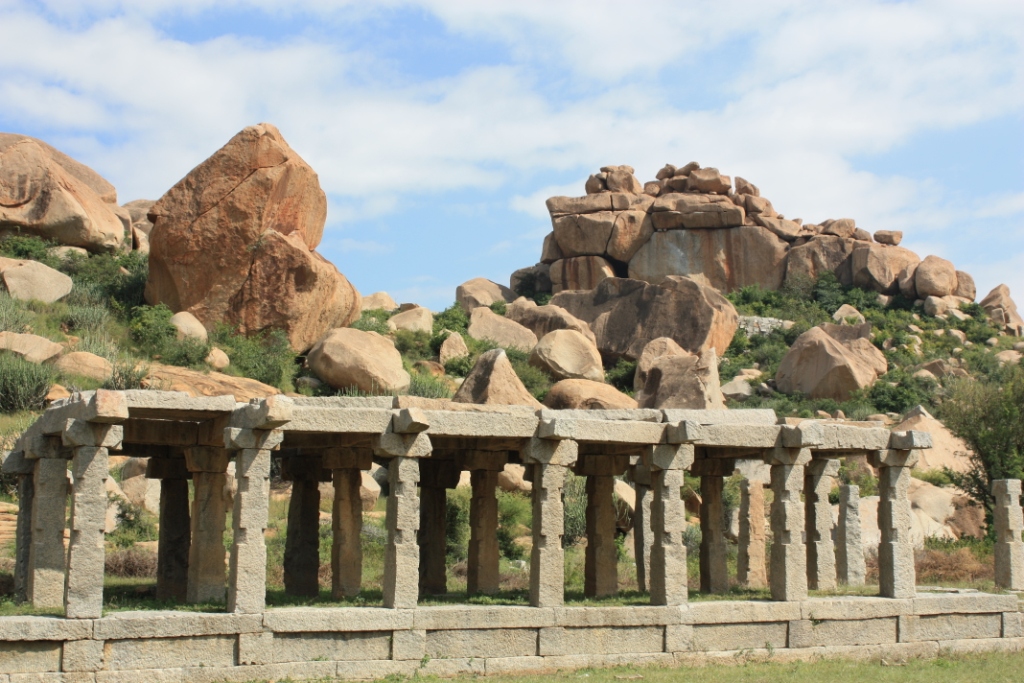
DAILY PHOTO: Courtesan’s Walk, Hampi

Taken in Hampi in November of 2013

A Thousand Feet & a Foot-Long [Common Meter]

The millipede was a foot long,
but, some might ask, whose foot?
Its own feet being quite petite
might suggest Lilliput.

But though it wasn't a footlong foot,
it was long for a bug,
a worm, a beetle, a wood mouse,
a spider, or a slug.

A snake that long would be a babe,
or, at least, quite stunted.
So, now I find my amazement
being a bit blunted. 

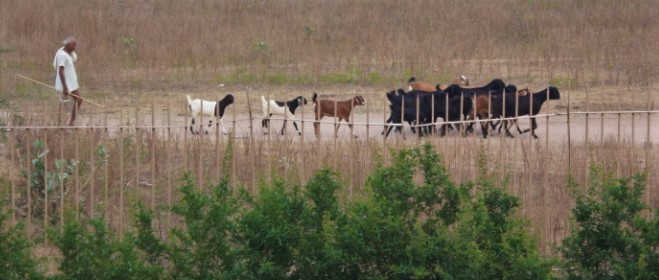
Road Flock [Tanka]

cowbells clang,
the bleating flock trots up
a dusty road;
the rising dust plume
seen before the goats

DAILY PHOTO: Downtown Khajuraho

Taken in October of 2015 in Khajuraho
by night

BOOK REVIEW: The Clouds by Aristophanes

The CloudsThe Clouds by Aristophanes
My rating: 5 of 5 stars

Amazon.in Page

This play scoffs at philosophers and sophists (in general) and Socrates, in particular. An old man, Strepsiades, is beleaguered by creditors, having purchased a horse and chariot for his son, Pheidippides. Strepsiades tries to get Pheidippides to study philosophy because the old man believes it will allow his son to argue away the debt. Pheidippides refuses, and so Strepsiades takes it upon himself to enroll as Socrates’ student. After some strained conversations and ill-timed masturbation, all parties conclude that the old dog can’t learn new tricks, and so Stresiades again tries to recruit his son. This time Pheidippides does join Socrates’ “think-shop” (called “the Thinkery” in some translations.)

Socrates’ characterization isn’t fair to the philosopher in some regards. If the works of Plato and Xenophon hold water, Socrates was neither a know-it-all nor was he obsessed with grandiose topics – rather, he claimed to know little and was said to have been only concerned with questions of how to live a better life (as opposed to lordly enigmas like the origin of the universe or the nature of reality.) However, this isn’t to say that Aristophanes has no valid point. That intense and abstract philosophical debate doesn’t change the hard facts of the world is a legitimate point. Debts aren’t erased by the creditor’s inability to successfully argue niggling points of grammar. Being stabbed by a jilted lover is no less painful if love is an illusion than if it equates to beauty or is a fundamental truth.
Much of the play’s humor is weakened (if not killed) by a lack of common context, but that’s not to say there aren’t jokes that still fly in the 21st century.

This short play is worth reading, as it presents a beneficial counterpoint to the Socratic dialogues.

View all my reviews

BOOK REVIEW: The Valley of Fear by Arthur Conan Doyle

The Valley of Fear (Sherlock Holmes, #7)The Valley of Fear by Arthur Conan Doyle
My rating: 5 of 5 stars

Amazon.in Page

This (book seven of nine of the Sherlock Holmes canon) follows a pattern set by the first Holmes novel, A Study in Scarlet. Both books are arranged into two parts, the first of each is a typical Sherlock Holmes story in which the detective investigates a puzzling crime in England; the second skips back in time (and across the Atlantic) to tell a compelling tale that provides motive and context for the first story.

In “Valley of Fear,” the first story involves the gruesome death of a country gentleman in his own home by sawed-off shotgun blast to the face. While suicide is quickly eliminated, the clues present mixed signals. While it’s not, strictly speaking, a locked-door mystery, its occurrence inside a moat-enveloped manor house leaves open the possibility of an inside-job, but there is confounding evidence that suggests someone fled the scene.

The second story takes place in a mining town in the United States, in a place insinuated in the first part to be “the valley of fear.” This valley, properly named Vermissa Valley, earned this epithet because it was run by a thuggish group of violent men who used a secret society as a cover for the corrupt gangland-like practices they carried out as “the Scowrers.” This story focuses on a new arrival, McMurdo, who we are led to believe was a gangster in Chicago who fled to this quiet – yet gangster-ruled – place to disappear into the protective company of fellow criminals. But, of course, nothing is as it seems.

While this book may be self-derivative, I still found it engrossing. While the two novels use a similar narrative scaffolding, each is unique in its details. In both cases, the second part is especially compelling.

View all my reviews