“Everyone’s Journey” by Sōgi [w/ Audio]

Everyone's journey
through this world is the same,
so I won't complain.
Here on the plains of Nasu,
I place my trust in the dew.

NOTE: This translation by Sam Hamill in The Poetry of Zen (2004) Boston: Shambhala, p. 131.
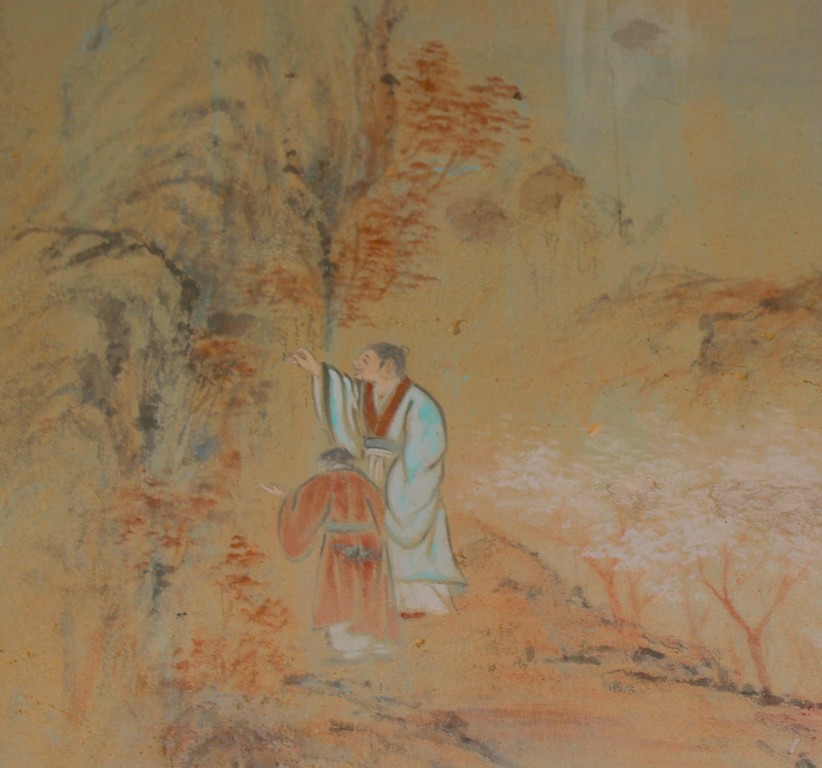
Temple Mural [Tanka]

a temple mural
shows monk and novice
admiring Fall leaves,
as I admire the mural -
surrounded by Spring green.
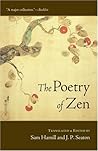
BOOK: “The Poetry of Zen” Ed. / Trans. Sam Hamill & J.P. Seaton

The Poetry of ZenThe Poetry of Zen by Sam Hamill
My rating: 5 of 5 stars

Publisher Site – Shambhala

This poetry anthology consists of translations of Chinese and Japanese poetry that play in the Zen aesthetic. They are not Zen Buddhist poetry in the sense of being sutras or sutra-like expositions on Buddhist philosophy or theology (at least, not mostly.) And while there are many monks and Buddhist layperson poets represented, not all of those included were Buddhists. (In fact, there is even some verse from the Daodejing included, though Taoism is certainly philosophically related to Zen.)

About half the book is Chinese poetry, including pieces from Han Shan, Li Bai, Bai Juyi, Wang Wei, Du Fu, and many other greats of Chinese poetry. (Note: my spellings of author names varies from those used in the book because Hamill and Seaton use Wade-Giles spellings.) The other half of the book consists of works by Japanese poets, including: Saigyo, Dogen, Basho, Ryokan, Buson, Issa, and others. The Japanese part includes a few haibun (prose poems interspersed with haiku,) adaptations of Chinese-style poems, as well as the various Japanese fixed form styles (i.e.. haiku, tanka, etc.)

The two translators, Sam Hamill and J.P. Seaton, initial the poems that each translated (some were dually translated and others singularly.) I enjoyed the translations and felt they were fine reading in their own right. With haiku and tanka, the translators stuck fairly close to the traditional form (in as much as the aesthetic could be maintained doing so,) but with Chinese lyric styles they often took a freer approach to form.

If you’re interested in poetry that conveys Zen sentiment, this book is worth investigating.

View all my reviews

Family Resemblance [Kyōka]

Chinese temple pond:
dragonhead tortoise sculpture.
live turtles swim
and sun in those waters.
do they see the likeness?

Lanterns [Kyōka]

rows of lanterns —
a jack-o-lantern patch —
lights the temple
on a dark, rainy night;
rain splats on a tin roof.

Pillbox Bunker [Tanka]

pillbox bunker from
a war a lifetime ago
sits in a field.
what the farmer must think
as he plants around it.

Worldly Concerns [Kyōka]

Buddha's lap,
a pigeon lands:
a monk shoos
the bird away,
but Buddha didn't mind.

Sleeping Bear [Kyōka]

the sleeping bear
seems at peace, and still does
when its eyes open,
but my mental state - and
my drawers - are quite changed.

Gray Baby [Kyōka]

an autumn sapling,
red leaves on a stiff twig,
shakes in the breeze;
i can't help but think of it
as a gray-haired baby.

Slow Convergence [Tanka]

morning valley hike:
i slowly walk toward
the sunny-side
as the sunny-side walks
toward me - slower still.