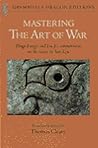
BOOK: “Mastering the Art of War” by Zhuge Liang & Liu Ji [Trans. & Ed. by Thomas Cleary

Mastering the Art of War: Commentaries on Sun Tzu's Classic (Shambhala Dragon Editions)Mastering the Art of War: Commentaries on Sun Tzu’s Classic by Zhuge Liang
My rating: 5 of 5 stars

Publisher Site — Shambhala

This book combines the writings of two prominent Chinese strategists, Zhuge Liang and Liu Ji. Both men came after Sunzi, author of The Art of War, and Cleary describes these two works as commentaries on the work of Sunzi.

Zhuge Liang’s piece is called The Way of the General and it collects short essays from Records of the Loyal Lord of Warriors. Like many, I first became acquainted with Zhuge Liang from his novelized personage in the Chinese classic, Romance of the Three Kingdoms, in which he is called “Kongming” and is a force to be reckoned with in service to Liu Bei of the Shu Kingdom. Zhuge Liang’s ideas are conveyed as short topical discussions, not unlike Sunzi’s work.

Liu Ji’s manual, Lessons of War, is a bit different in that the explanation of the strategy is briefer than in the works of Sunzi or Zhuge Liang, but Liu Ji always includes an exemplary story from history. This makes Liu Ji’s work a little more narrative. It is interesting to see the varied approach to conveyance of the concepts under consideration.

Because the works of Zhuge Liang and Liu Ji are thin, the book has a fair amount of padding in the form of Translator’s Introductions, both an overall Introduction and one per included work. I was happy with how these were done. They do not drone on but rather give some background that will be useful to the average reader without getting lost in the weeds.

If you’re interested in strategy, be it applicable to war or otherwise, I’d highly recommend this book.

View all my reviews

PROMPT: Reread

Daily writing prompt
What book could you read over and over again?

If plays count as books, then most of Shakespeare’s plays. I’ve already reread a number of them (e.g. Hamlet, Macbeth, Merchant of Venice, and A Midsummer Night’s Dream.)

I’ve read Whitman’s Leaves of Grass, a couple times in full (and segments of it many times over) and expect to get to it again. I’ve read Voltaire’s Candide a couple times.

I could definitely see rereading Journey to the West, Water Margin, and Romance of the Three Kingdoms, but at this point I’m hoping my Mandarin will get good enough to read them in Simplified Chinese.

I’ve read a number of nonfiction texts multiple times — e.g. Sunzi’s Art of War, Miyamoto Musashi’s Book of Five Rings, Laozi’s Dao De Jing, and Emerson’s Selected Essays.

I’m generally not a fan of rereading books because there is so much awesome stuff out there to be read a first time. For all the reading I’ve done, there is still a massive number of classics that I have yet to touch. Usually there has to be a good reason for a reread, e.g. a new translation that promises to be improved / simplified, the book is just so potent as to still have lessons packed in after the first read, it’s a challenging read and the first go leaves a lot on the table, or — like The Little Prince — its enjoyment-to-time investment ratio is high.

FIVE WISE LINES [January 2025]

“Reality is that which, when you stop believing in it, does not go away.”

Philip k. dick

“The Wu and the Yue peoples hate each other. But in the same boat in a storm, they work together like left and right hands.”

SunZi in The ART of War

“Travel changes you. As you move through this life and this world you change things slightly, you leave marks behind, however small. And in return, life – and travel – leaves marks on you. Most of the time, those marks – on your body or on your heart – are beautiful. Often, though, they hurt.”

anthony bourdain

What allows great kings and generals to win, more frequently than ordinary men, is foreknowledge.
Foreknowledge cannot be attained by spirits or deduced or calculated.”

Sunzi in The ART of war

“Only those who risk going too far can possibly find out how far one can go.”

T. S. Eliot

BOOKS: 孙子兵法 [Sunzi’s Art of War] by Sunzi

孙子兵法白话全译孙子兵法白话全译 by 史哲 文
My rating: 5 of 5 stars

Available online – YellowBridge

In thirteen short chapters, Sunzi lays out a masterclass in strategy. One sees in Sunzi’s work the mark of a Taoist mindset, seeing it in the book’s emphasis on engaging in warfare only when necessary, doing things the easy way whenever possible, and never letting one’s ego write checks one isn’t able to cash in lives.

There is good reason that this is one of the world’s most well-known (if not the most well-known) treatise on warfare. Far from being complicated and technical, this guide is full of pithy teachings such as: “War is the way of deception.” “No country ever benefited from a long war.” “Defeating the enemy without fighting is supreme excellence.” “To be undefeated lies in oneself, to be victorious lies in the enemy.” “Know the enemy and yourself and victory is assured; know heaven and earth and victory is complete.” (And these teachings are even more concise in the original Chinese.)

In addition to basics like leadership, maneuver, and terrain, the book devotes chapters to both the use of fire and spies in warfare. (One’s level of understanding is central to strategic victory throughout Sunzi’s teachings.)

I’d highly recommend this book for anyone interested in strategy, martial arts, or other strategic pursuits. The book may be ancient, but it’s not obsolete by any means.

View all my reviews

FIVE WISE LINES [December 2024]

Today as in ancient times
it’s hard to write a simple poem.

Mei Yaochen in Poets’ Jade Splinters

To be undefeated lies with oneself;
to be victorious lies with the enemy.

Sunzi in The ART of War (孙子兵法)

A buddha is an idle person.
He doesn’t run around after fortune and fame.
What good are such things in the end?

Bodhidharma; Bloodstream Sermon

Not what we have, but what we enjoy, constitutes our abundance.

Epicurus

Take more time, cover less ground.

Thomas Merton