6 Science Books That Martial Artists Should Read

When one has a passion for an activity,  it’s easy to get tunnel vision and miss out on the many avenues of information by which one might improve oneself.  I’ve done many posts on martial arts books, but I thought it might be useful to do one about books that aren’t about martial arts per se, but which have none-the-less contributed to my thinking as a martial artist.


1.) On Killing: The Psychological Cost of Learning to Kill in War and Society by LTC Dave Grossman

OnKillingWhat it’s about? Psychologically, it’s a lot harder to kill another human being than one might think. Even when one is a combatant in a just war, the reluctance to kill–even one’s sworn enemy–is intense. Grossman examines the roots of this reluctance, what methods have been employed to get soldiers over it, and what the cost of doing so is.

The book also goes into a topic one might find surprising: video games. Not to give too much away, but military researchers discovered that getting infantrymen to kill required conditioning them to shoot targets that look human. This resulted in moving from bulls-eye targets to silhouettes, pictures of humans, and even Firearms Training Simulators (i.e. FATS, systems that run shoot / no-shoot scenarios on a screen, like an interactive movie.) It turns out that shoot-em-up video games may contribute to a child’s conditioning to be willing to shoot another human being.

Why it’s a good read for martial artists? Martial arts vary radically in realism and relevance to combative situations, but it’s easy for students of the martial arts–even martial arts that seem “hardcore” and self-defense oriented–to have unrealistic notions about the realities of combat. As François de La Rodefoucauld said, “One cannot answer for his courage when he has never been in danger.” By reading this book one might, perhaps, begin to rethink one’s assumptions, and change how one prepares to defend oneself and others.

Further reading on related topics:  I’ve heard good things about the works of Rory Miller–particularly Facing Violence and Meditations on Violence, but I haven’t gotten around to reading his books yet. If you have, please feel free to comment with your thoughts.


2.) The Rise of Superman: Decoding the Science of Ultimate Human Performance by Steven Kotler

RiseOfSupermanWhat it’s about? Kotler examines a state of mind that is widely call “flow,” and how extreme athletes are tapping into flow to achieve unprecedented advances in performance. There are a number of ways by which this state of mind can be defined, e.g. neurochemically (i.e. a neuro-cocktail of serotonin, anandamide, endorphins, dopamine, and norepinephrine), neuroanatomically (transient hypofrontality), neuroelectrically (high theta / low alpha wave–i.e. between meditation and resting wakefulness), or psychologically (intense concentration on a challenge that’s just beyond one’s present skill level.)

Kotler proposes that risk is an important trigger for entering a deep state of flow, and that this is why extreme athletes are proving so much better at achieving these states (and translating them into radically increased performance) than many other groups who seek to master flow.

Why it’s a good read for martial artists? It should be noted that not only is flow not a newly discovered state of mind, but it sounds a lot like the state of mind that martial artists have sought for centuries in the practice of their arts–often in conjunction with disciplines such as Zen or Vajrayana Buddhism. What is new, which makes this book worth reading, is an understanding of the science behind flow states. By moving beyond the hazy mix of truth and falsehood embodied in systems of spirituality, one may be able to find a way to more reliably increase one’s performance.

Further reading on related topics:  Flow in Sports: The Keys to Optimal Experiences and Performances is a book that is co-authored by the granddaddy of flow research Dr. Mihaly Csikszentmihalyi.


3.) Becoming Batman: The Possibility of a Superhero by E. Paul Zehr

Becomingbatman

What it’s about? (Arguably, this is a martial arts book, but I’m including it because one wouldn’t get that from the title or blurb.) This book’s central question is whether a real life person could achieve the level of crime-fighting bad-assery that is the Batman, and–if so–what combination of genetics, training, and conditioning would be required. It also addresses what would be the cost in terms of wear and tear on one’s body and how long one could be expected to maintain said abilities. (Also, for the martial artists of feminine persuasion, how Batgirl or Catwoman might fair in combat against Batman.)

Why it’s a good read for martial artists?   There is tons of great information relevant to martial artists about the toll of extreme practice and regular fighting on one’s body (e.g. concussions, broken bones, etc.), what the limits of human performance are, by what means those limits are approached, and how realistic it is to have an unreciprocated policy prohibiting lethal weapons.

Further reading on related topics: Actually, if you know of any books on related topics, I’d love to hear about them. There are a number of such books, but they’re on textbook pricing (i.e. insanely expensive.)


4.) Extreme Fear: The Science of Your Mind in Danger by Jeff Wise

ExtremeFear

What it’s about? This book is about the mental and physical effects of mortal peril, and why some people’s performance excels under dire threats while other people just let themselves die while cowering in a fetal ball. The book asks what we can all learn from those people who manage to keep their heads about them when death seems certain.

In the interest of full-disclosure, as of this writing I’ve not completed this book. I just started it and am only in the second chapter. However, so far it’s been both informative and interesting.


Why it’s a good read for martial artists? Much like On Killing, I think this book may be valuable because there are many martial artists with daydream-induced misconceptions about how they will perform in dangerous situations. This book may help one evaluate one’s true state of preparedness, and discover how to go about making changes to improve one’s level of preparedness for a worst-case scenario.

Further reading on related topics:  If you want a scholar’s account, the book Anxious by Joseph E. Ledoux may be more your style. (Wise is a popular science writer.) I see that Ledoux is cited a lot in books I’ve been reading as of late, but I can’t say I’ve read any of his books yet. However,  I know he’s widely regarded as one of the foremost experts on fear. It looks like his book isn’t so much on mortal peril as Wise’s book, and covers all kinds of anxiety and fear.


5.) Faster, Higher, Stronger: How Sports Science is Creating a New Generation of Superathletes–and What We Can Learn from Them by Mark McClusky

FasterHigherStrongerWhat it’s about? The super-long subtitle says it all. It’s about how athletic performance is being improved by bringing scientific methods to the study of sports, and–as the second half of the freakish subtitle suggests–it explains how amateurs can put this information to good use. There are some methods used by elite athletes that aren’t at all suitable to the run-of-the-mill martial artists (e.g. don’t consume mass quantities of baking soda.) However, there are other approaches to nutrition and training that are readily translated to amateurs without much downside.

Why it’s a good read for martial artists? You may or may not think of yourself as an athlete. I can hear some martial artists saying, “I don’t practice a sport, I’m a martial artist. I deal in lethal combat, not games. yada, yada, yada…” Maybe so, but fitness, nutrition, and conditioning matter. If you want to be able to hold your own against more skilled opponents, you need to improve your capabilities and capacities. Fitness matters. If you think technical proficiency will get you through any situation, you haven’t run up against someone who is both technically skilled and highly fit–and when you come up against said person, your disillusionment will be swift.

Further reading on related topics:  As with the Becoming Batman book, most of the books on this subject are textbooks and are outrageously priced. If you know of other books in this vein, I’d love to hear about them.


6.) Buddha’s Brain: The Practical Neuroscience of Happiness, Love, and Wisdom by Rick Hanson et. al.

BuddhaBrainWhat it’s about? This book turns the lens of modern science on the serene, immovable state of mind that martial artists have historically sought out through Buddhist and yogic systems. It discusses how Buddhist practices help people to be more cognitively effective and less prone to emotional manipulation or disturbance.

Why it’s a good read for martial artists?  If one reads the works of warriors–ancient and modern, one will discover that the greatest warriors place a premium on the importance of the mind.

Consider the famous swordsman Miyamoto Musashi. Musashi was exceedingly successful in defeating his enemies by making them angry. He would show up late and behave disrespectfully, and he would make his own mind imperturbable. This allowed him to easily defeat warriors who were considered at least his equal in terms of technique.

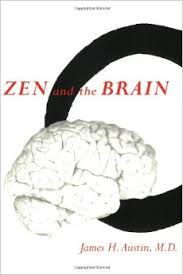
Further reading on related topics: There are many books that look at similar questions.  Zen and the Brain is probably a better book in terms of the amount of information / insight provided, but it’s a much more daunting read. I wouldn’t put the latter in the category of “pop science” as much as just “science.”  (Zen and the Brain is also a much older book.)


These are my recommendations, I’d love to hear about yours in the comments section.


The Science of Inversions: or, Why and How to Get Off the Wall

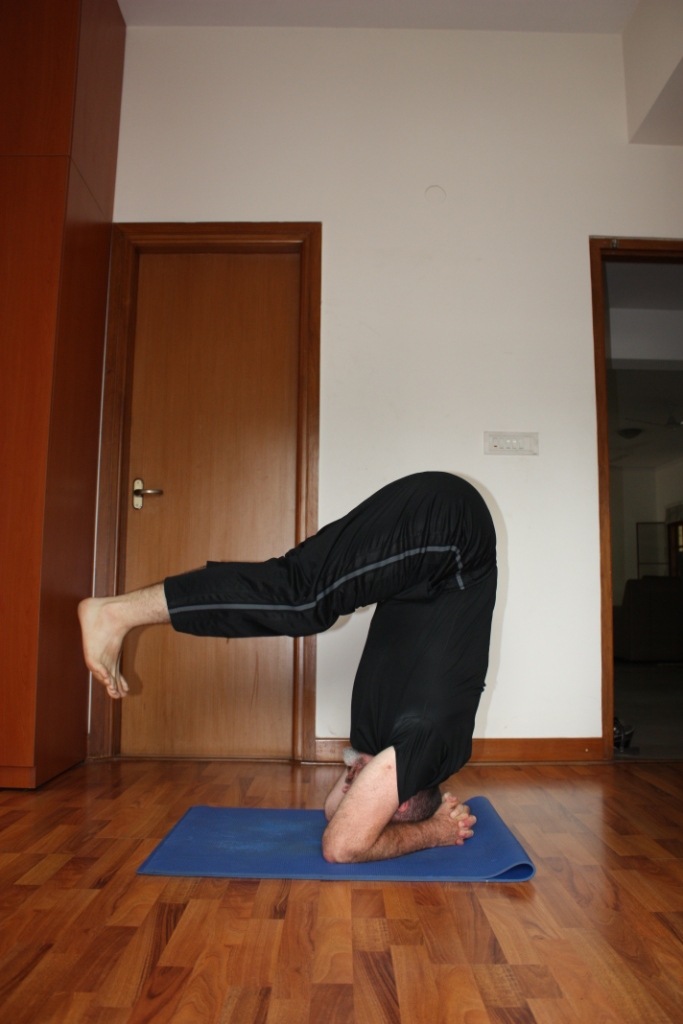
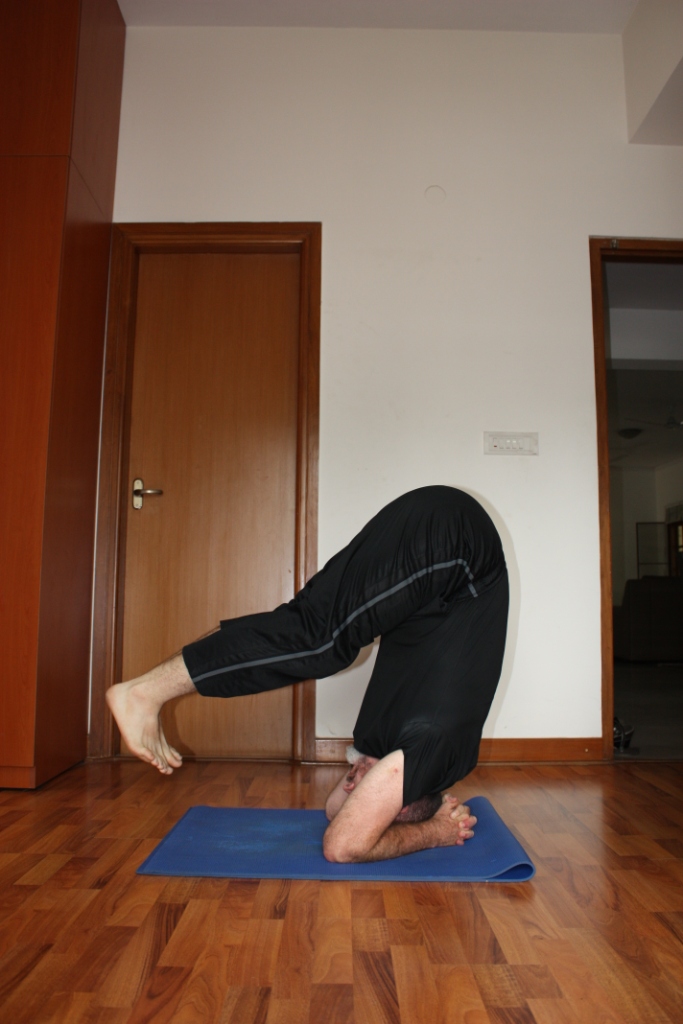
IMG_0835Inversions are a class of postures (asana) in which part or all of the body / limbs are raised above the head. The classic inversions are: headstand [shirshasana], shoulder-stand [sarvangasana], plow pose [halasana], forearm-stand [pinchamayurasana], and handstand [adho mukha vrksasana], but there are many more–some of which are easier and others of which are more challenging than these basics. Other than a few partial inversions (e.g. down-dog [adho mukha svanasana] and leg-up-the-wall pose), inversions tend to be daunting for beginners (and even intermediate students) at a mental as well as a physical level.

In this post I’ll focus on headstands. Most students seem to achieve shoulder-stands and plow pose relatively easily because it feels more stable. I’ll note that those two asana require as much or more care and caution as any inversion given the flexed state of the neck. On the other hand, by the time one is perfecting one’s handstand, one will likely be over the issues that I’m addressing in this post. I’ll save those poses for a later post with a different thrust.

Let’s first consider the effect inversions are supposed to have (and then the effect they tend to have in reality.)

What inversions are supposed to do:  The story is supposed to go like this: 1.) The body inverts. 2.) Our body’s sensors recognize that the blood flow to the brain is far beyond its needs.  3.) The body quiets our vital signs.

What inversions (too often) actually do: It may surprise some readers that inversions are supposed to have a calming effect because the chain of events is often as follows: 1.) The body inverts. 2.) The amygdala fires, triggering the physiological responses associated with fear. 3.) One’s conscious mind imagines the pain and suffering of falling. 4.) The amygdala fires some more. One is in “fight or flight” mode, and the flight the body wants to make is to a right-side-up position.

While I’ve had to work hard to improve my inversions, I had a much easier time with this issue than many. Before you dismiss me as a narcissist, let me state unequivocally that I have no special gift for inversions . I’m not claiming to be a yoga prodigy by any stretch. Why was it easier for me? I’ve practiced a martial art for many years that required training in breakfalls (ukemi.) Therefore, I had no particular fear of falling over onto my back, because my body is trained to tuck and roll. [My only fear when I first started doing headstands in studio sessions was that someone, e.g. the teacher, would walk into my blind spot. Note to all: don’t walk behind someone’s back when they’re inverted unless you’re sure you’re out of the “timber” zone.]

Why are breakfalls so beneficial to the development of one’s inversions?  Because it allows one to get off the wall. A lot of practitioners get addicted to the wall. “Addicted” may sound like a harsh term, but like addicts they think they can quit anytime and that they will quit at some undesignated point in the future–sometimes they do, but often they don’t. Reliance on the wall is reinforced by the fact that one may find one can only spend a couple anxiety-filled seconds inverted without the wall, but one can spend minutes comfortably against the wall. There’s a reason for this great disparity, and understanding this reason is crucial for knowing why doing 2 or 3 seconds unsupported (at first) is better for one’s long-term development than staying for three minutes leaning on the wall.

Here’s the deal. When you invert, your body needs to make subtle corrections to keep you on balance–at least until you reach the level of yoga genius. If you stand up with your feet together, your eyes closed, and you pay attention to your feet and legs, you’ll see that this is true when you’re upright as well. It’s just that your body is used to being upright. It knows how to make all these micro-corrections without conscious thought. The good news is that one’s nervous system rapidly learns to do the same thing when one is upside-down. When I say “rapidly” I’m not talking about the first, second, or even the twelfth time you try to do an inversion. [Trust me, despite what your mother may have told you about her darling genius, you didn’t achieve stability upright on your first few tries either.] The first several times, you’ll fall down almost immediately. However, if you keep trying, your body will learn and you’ll achieve progressively longer inverted stays. You can’t make these corrections at the speed of conscious thought. But the beauty part is that your body will learn to achieve stability solely through practice without any intellectual activity whatsoever.

Why doesn’t your body learn this when you use the wall? The cornerstone biological principle for those interested in fitness, movement, and sports is: Your brain and body are lazy; they will not develop any capability that you don’t force them to by challenging activity. Your muscles don’t get bigger without overloading them and causing little micro-tears in them that they must heal up better than before. Your bones don’t get more dense unless you put more load on them (see: Wolff’s Law.) And your nervous system will not wire itself to keep you upright in an inversion if you’re propped up against a wall. You can invert against a wall for a thousand years and not get the same benefits as from an hour of struggling to get off the wall. This principle is reflected in nature from Darwinian evolution onward.  Gazelles don’t learn to run 500 miles an hour. Once it can accelerate (on average) fast enough to survive the cheetahs that prey on it, it passes on genetic material and the evolutionary pressure is off. Gazelles don’t keep getting increasingly faster than their predators for shits and giggles.

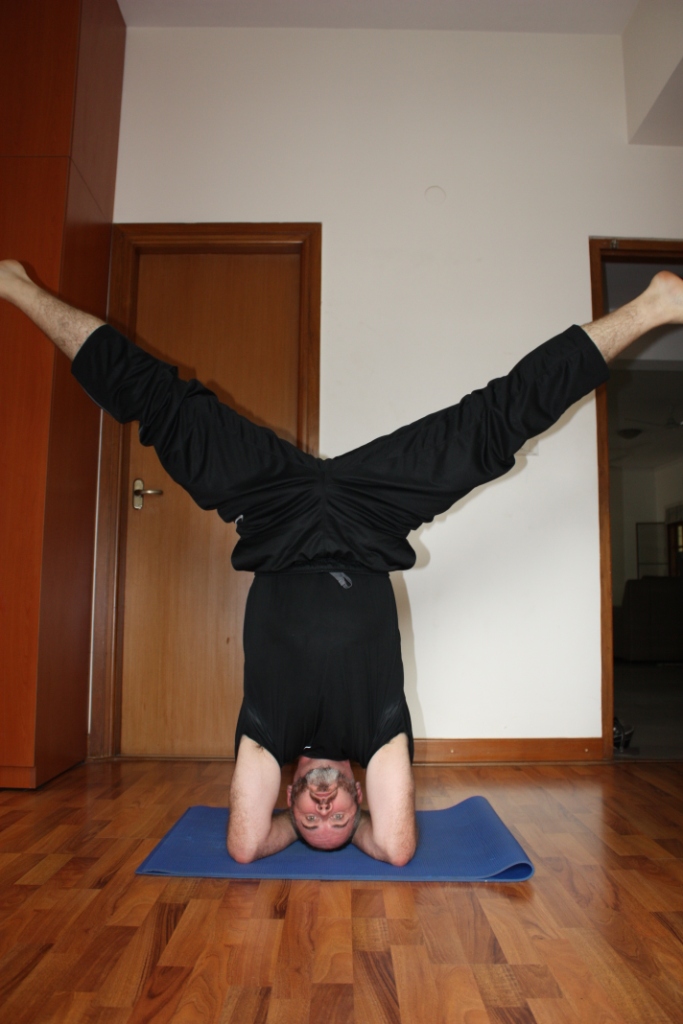
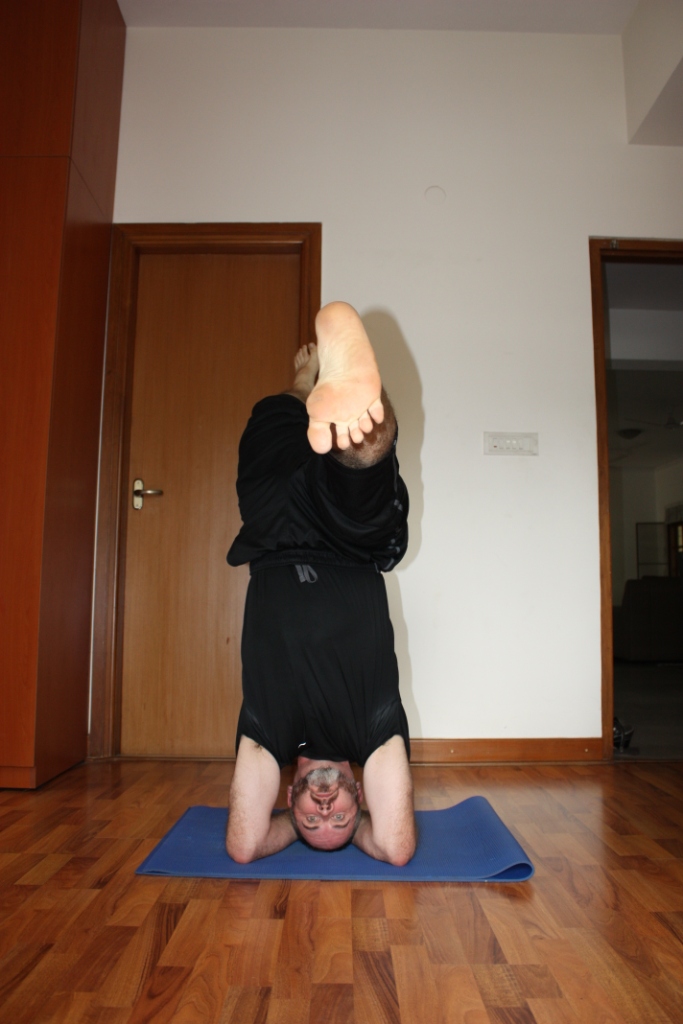
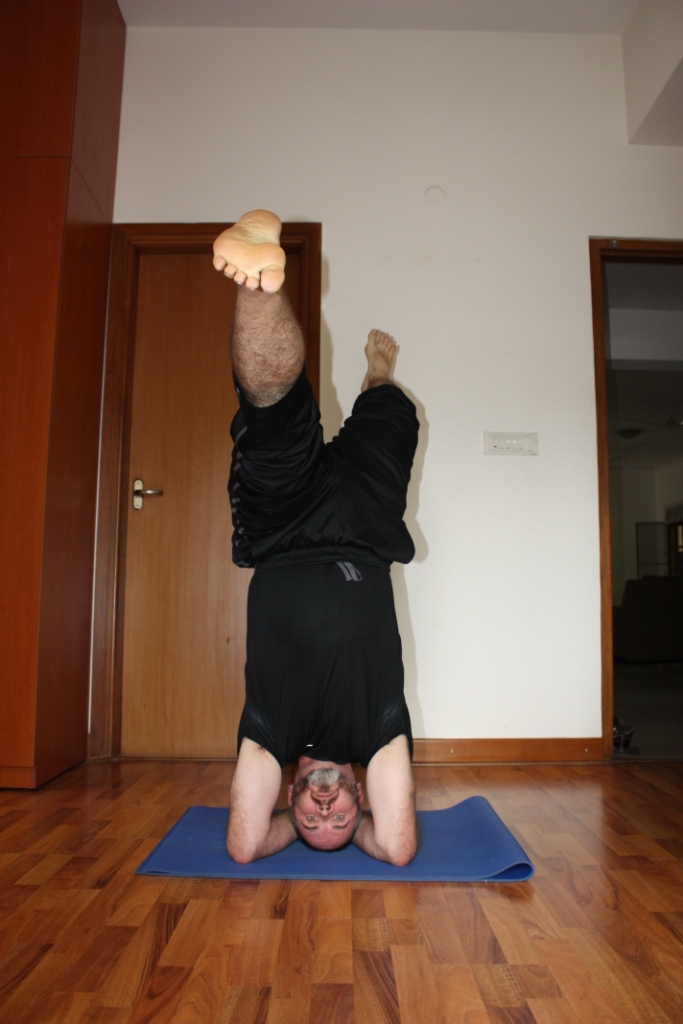
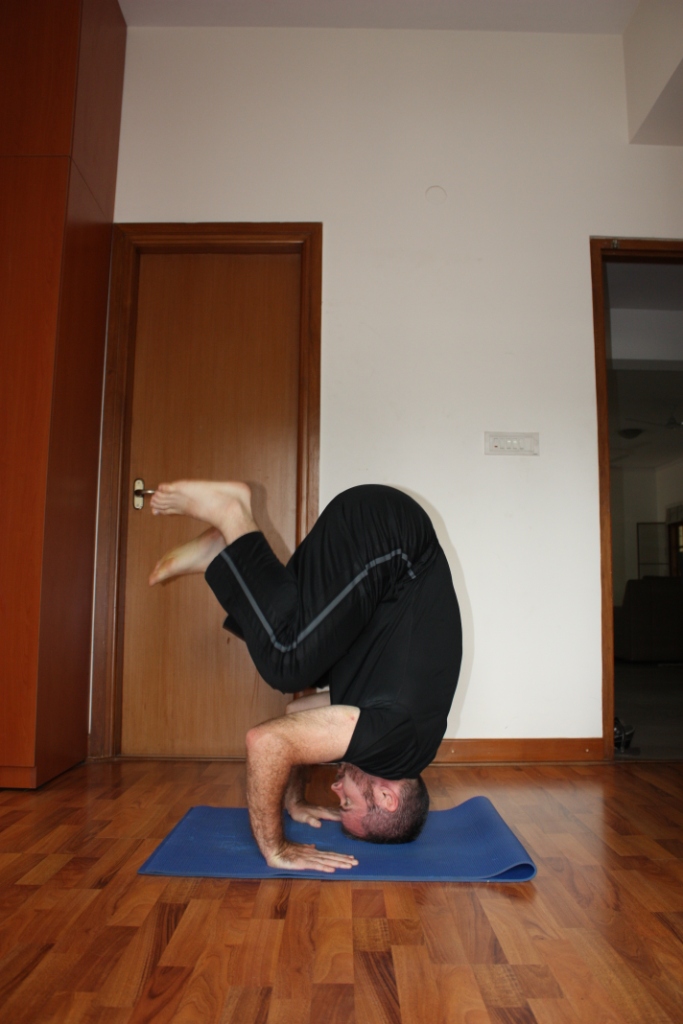
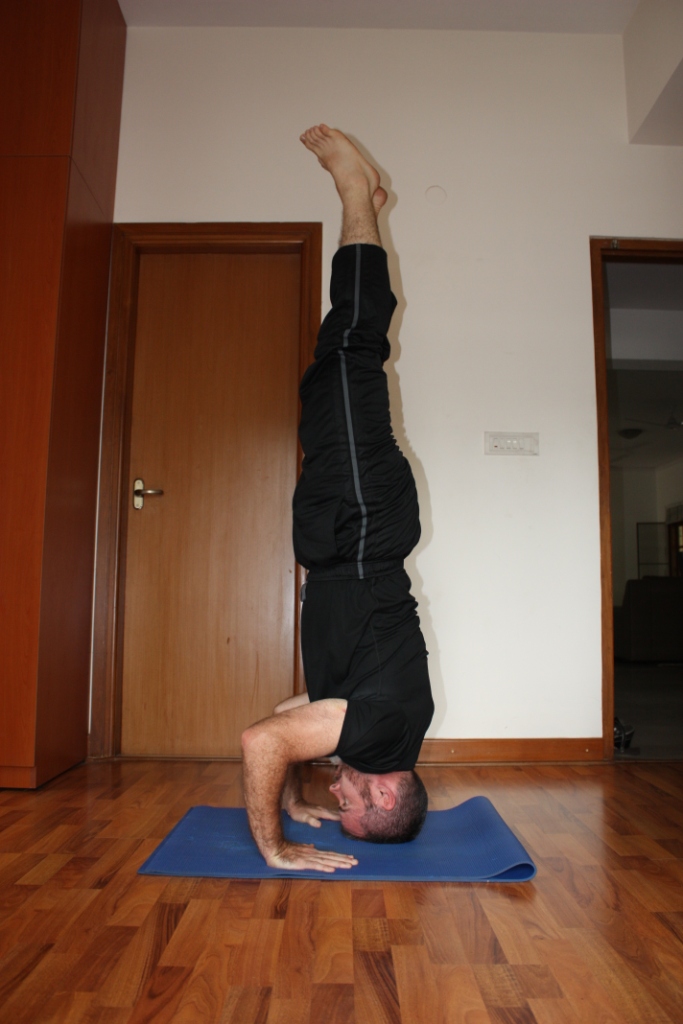
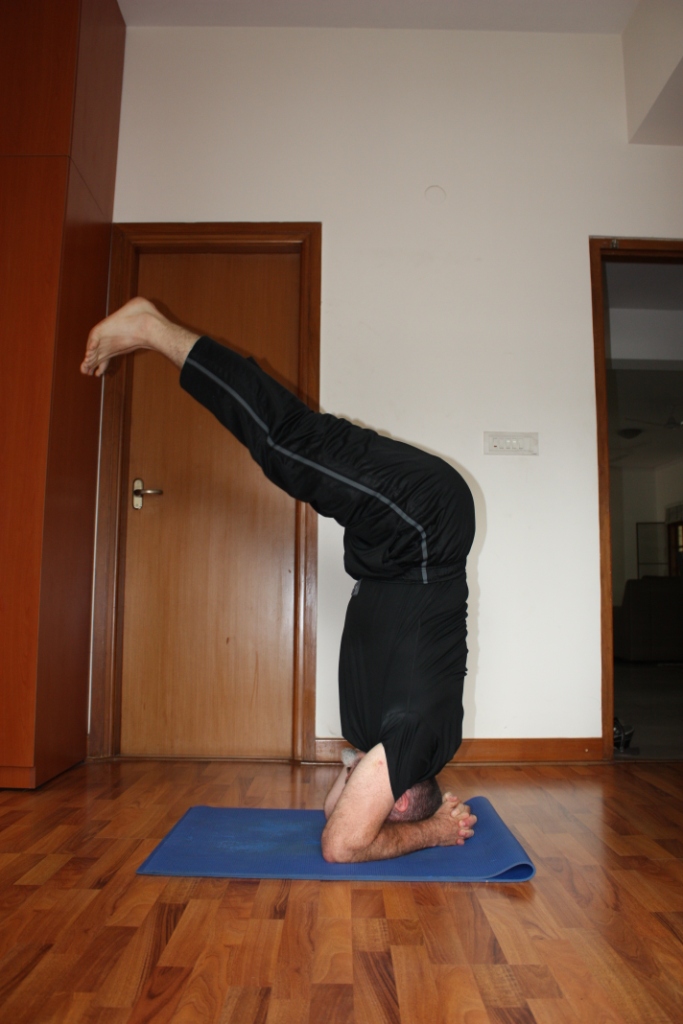
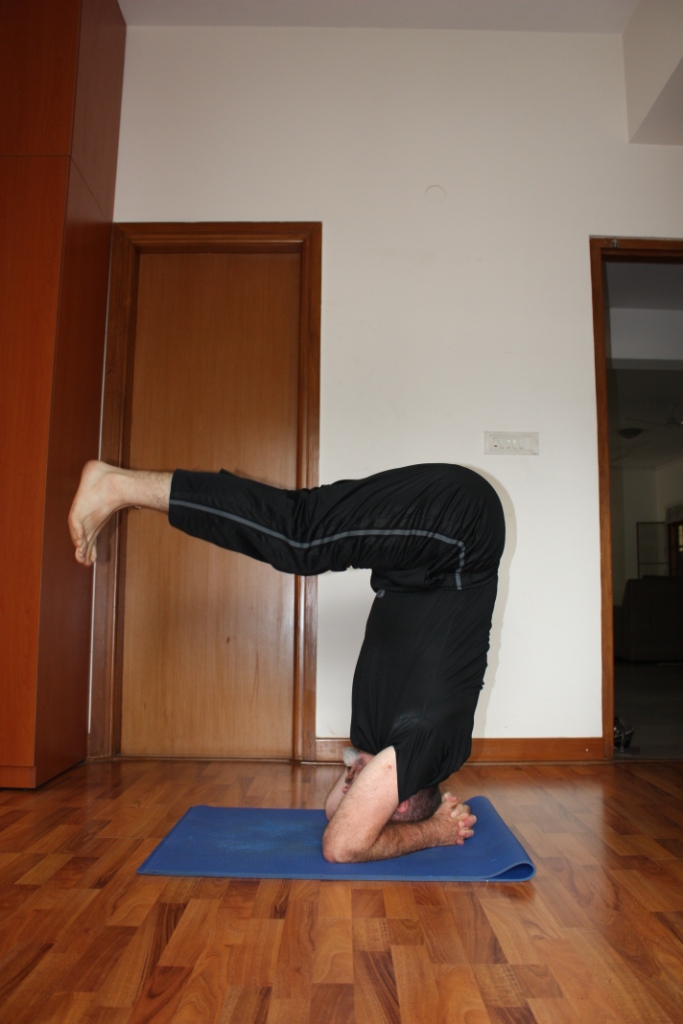
Incidentally, this is also why you should keep challenging yourself, and not rest with getting the basic form. There’s always somewhere new to take it. For example, one can look at moving between splits like so:


IMG_0834IMG_0836IMG_0837


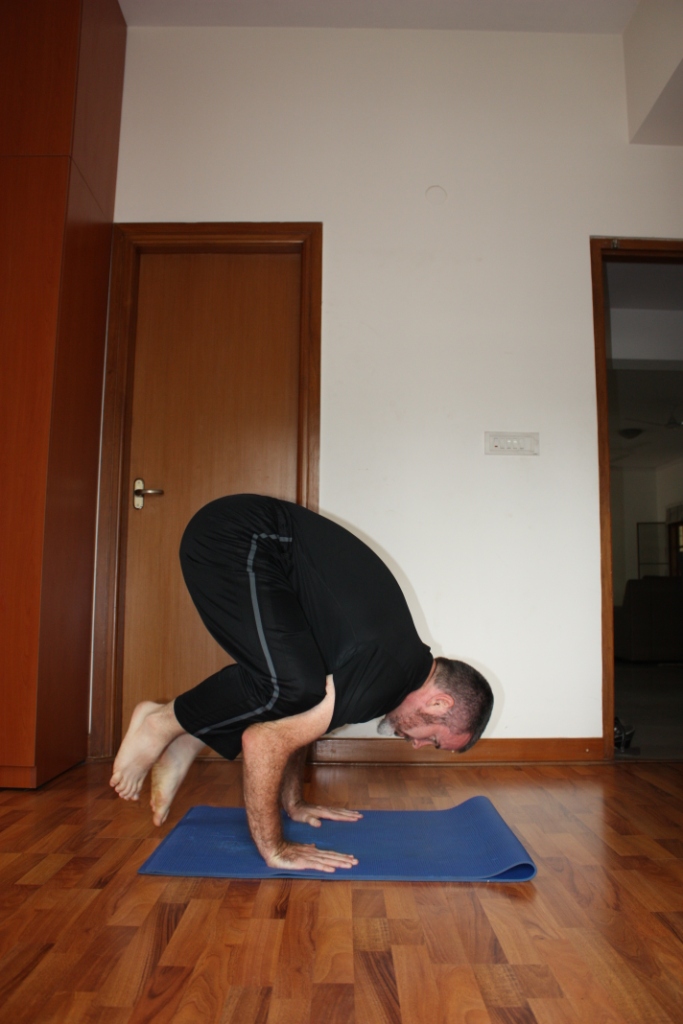
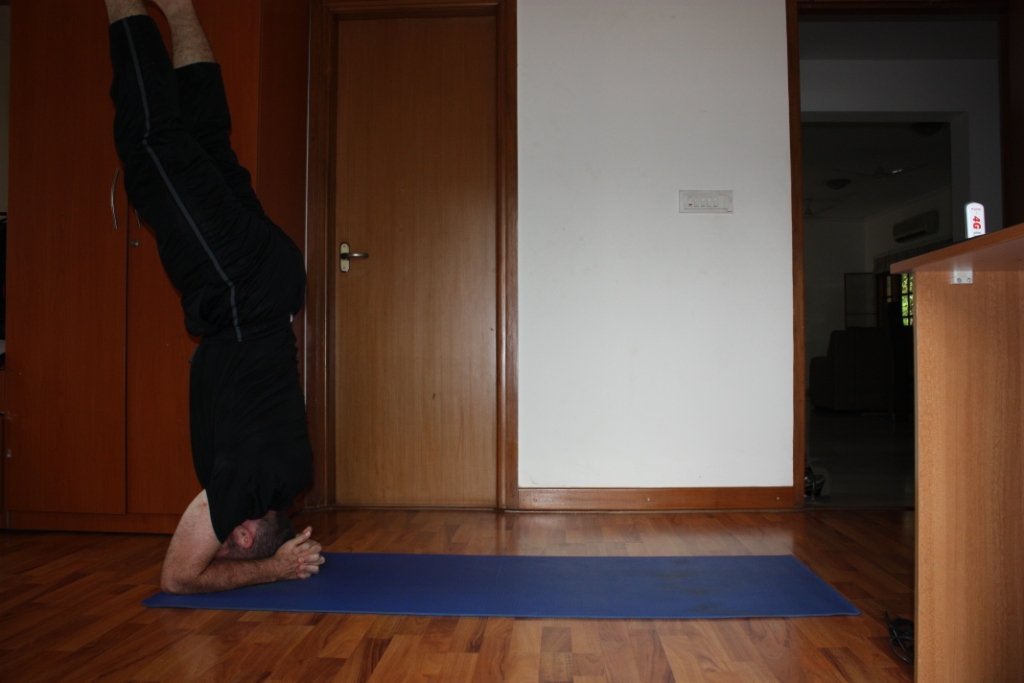
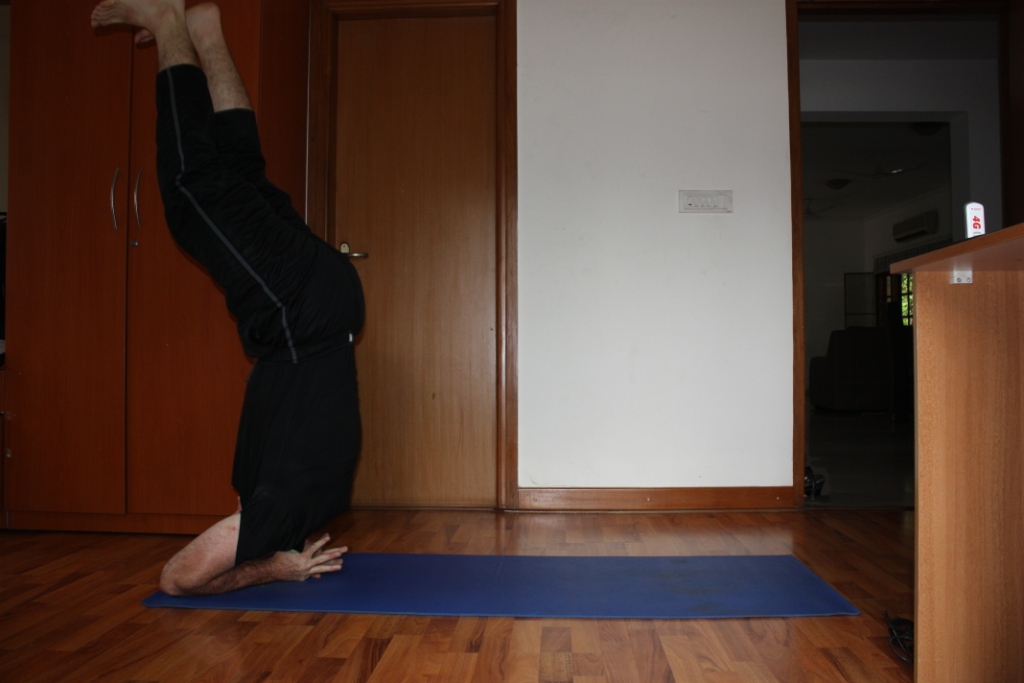
Alternatively, one can work on a different form of the pose, such as the tripod headstand. Transitioning from crow pose [kakasana] to tripod headstand is a good way to start to learn the bodily control that will serve one well in intermediate and advanced practice.


IMG_0851IMG_0853IMG_0859


Yet another option is to practice a controlled descent. The inverted “L” is quite a challenge. Not as one might think because it requires tremendous core strength, but because it requires gradually leaning into the direction of falling backwards in order to counterbalance the weight of your legs.


IMG_0844IMG_0846IMG_0847IMG_0849


A few notes on headstand breakfalls:

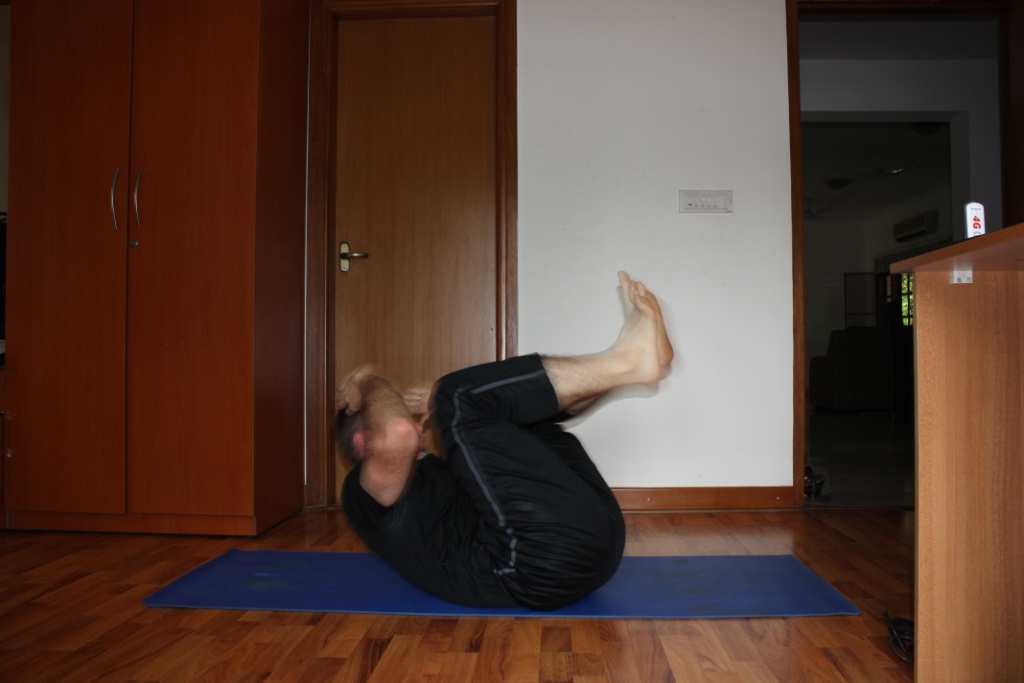
– Make sure you have room in all directions to fall without crashing into anything or anyone. While it would be nice to always fall back onto one’s feet, it’s neither realistic nor beneficial to your development. Why not? If you’re always distributing your weight to fall onto your feet, you will be keeping muscles tense and will have trouble finding a relaxed state of balance. Furthermore, there is a tendency toward panicked motion if one starts to lose balance in the wrong direction, and speed is your enemy in inversions.  (One wants to do everything from entering the inversion to falling in as slow and controlled a manner as one can possibly manage.) If you get your feet up high enough to be on balance, you need to accept the fact that you’re as likely to roll onto your back as on to your feet.

– If one is doing the basic forearm-supported headstand, don’t tightly interlock one’s fingers. “Tightly” is the key word here. It’s alright to interlock your fingers, but one doesn’t want to create ridged hands such that one’s neck rolls over a 3 to 4 inch (7 to 10 cm) ledge if one falls backwards.  One wants the hands to collapse.

– Tuck and roll. Don’t reach back with your foot / feet and try to arrest your fall. If you have enough strength, flexibility, and timing to make that work you probably don’t need my advice and haven’t read this far. (i.e. you have advanced gymnastic skill.) If you’re the more typical yoga practitioner, you’re more likely to injure your back, toes, feet, or some combination thereof by arching into a back-bend to arrest your fall.

– Counter-intuitively, you probably don’t want to put anything behind you to soften your fall. You don’t want your spine rolling over surfaces that are at different levels–even if one them is relatively soft. It’s usually best to roll over a level surface, even if that surface may be a bit hard. Furthermore, if you think you’re going to save yourself by working entirely on a softer surface, you’ll probably find yourself falling more often and for a longer period. Softer surfaces are harder to maintain balance on. That’s why one of the primary ways that we make an exercise more challenging is to do it on a softer (more rolly) surface.

– Don’t let your neck crumple. On a related aside, never look around while you’re in a headstand. If you need to see something, e.g. the teacher’s demonstration, come out of the headstand.

– However you come out of an inversion, don’t neglect the counter-pose. For the headstand, child’s pose is a common counter posture, and you should spend some time there upon exiting the pose.

– It’s best to begin one’s practice of inversions under the supervision of a qualified teacher. As one develops confidence and one’s body begins to learn how to maintain stability, one can make these postures an increasing part of one’s practice.

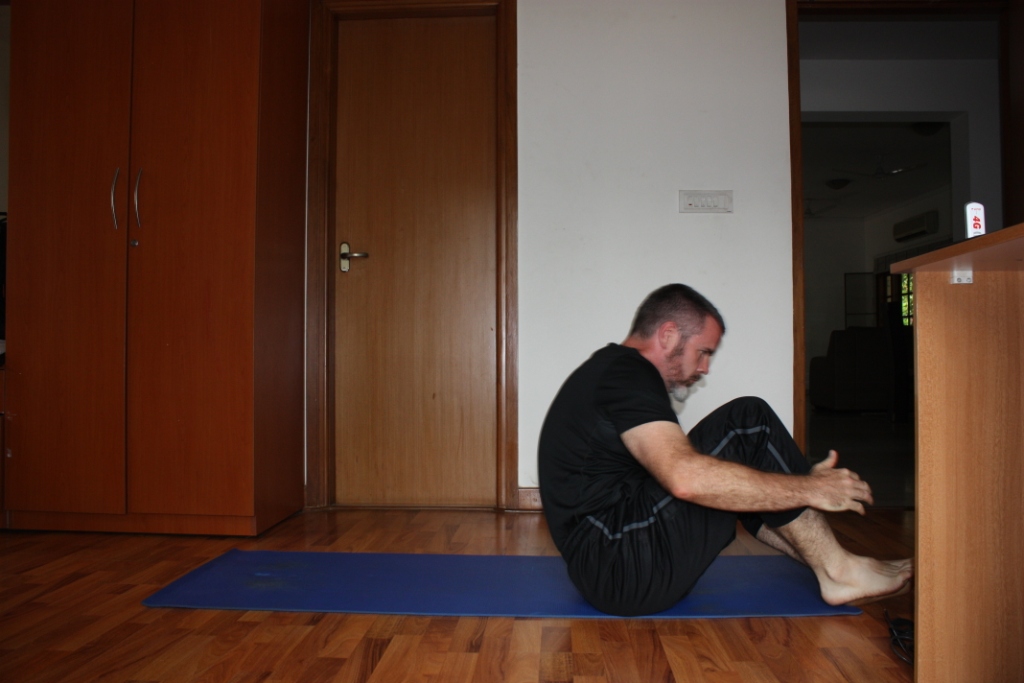
It’s hard to get get a good sequence of pics to show how to breakfall–given my limited photography skills, that is. But here’s my attempt.

So it begins with crumpling balance

So it begins with crumpling balance

Get those fingers open so your neck doesn't flow over an interlocked fist

Get those fingers open so your neck doesn’t flow over an interlocked fist

Tuck and roll

Tuck and roll

Don't arrest your roll.  Let momentum carry you forward. Gradually dissipate the energy.

Don’t arrest your roll. Let momentum carry you forward. Gradually dissipate the energy.

Happy inverting.

BOOK REVIEW: Becoming Batman by E. Paul Zehr

Becoming Batman: The Possibility of a SuperheroBecoming Batman: The Possibility of a Superhero by E. Paul Zehr

My rating: 5 of 5 stars

Amazon page

[Note: This book is about sport and exercise science, particularly as they pertain to the martial arts. If you’re a martial artist or are interested in fitness and movement arts at the extremes of human capacity, you’re in the right place. If you’re interested in the comics and an overview of topics including how many billions Bruce Wayne needs and what technologies Batman must master, those aren’t questions addressed in this book. Such readers may find the book delving into depths they aren’t interested in on biological science. There are articles on the web that deal with topics like the “Cost of being Batman.”]

Next summer an eagerly awaited movie entitled Batman v Superman: Dawn of Justice hits theaters. Who knows how much screen time will involve the fight between the titular characters, but the same battle has played out a number of times in the comics, and its appeal is clear. What are the limits of human capability given training, technology, and sufficient smarts? Can a man really defeat an alien that’s faster than a bullet and more powerful than a locomotive? A popular fanboy mantra is, “I like Batman, because I could be Batman. Batman has no superpowers.” So, yes, if you were a billionaire, genius, with the physique of a Greek god, and knew 127 martial arts, you too could be Batman. Or could you? That question is at the heart of Zehr’s book.

Becoming Batman is arranged into sixteen chapters divided among five parts. It begins logically with the question of whether Bruce Wayne needs to begin at any particular point to achieve success in transforming himself into Batman? (At the extreme, one probably can’t imagine Bruce Wayne becoming Batman if he was born with one leg a foot longer than the other and with a Quasimodo hump, but given a Bruce who is starting out “average,” what are his limitations.) In other words, how much does genetics come into play. In the first part, Zehr introduces a character, Bob Wayne, who doesn’t appear in the comics. Bob is Bruce’s twin, and is used throughout the book for comparison purposes, i.e. to convey what Bruce Wayne would look like if he didn’t train fanatically to be Batman. The question of how much of Batman is innate and how much is painstaking built by exercise and training is critical to determining how many of those fanboys really could be Batman.

There a series of chapters explaining the mechanism by which stressors result in a stronger, faster, more powerful, and more resilient Batman. The idea is that Mother Nature doesn’t over-engineer. The only way one gets stronger muscles is by overloading them, which triggers a process of rebuilding them bigger and better than before. Wolff’s Law defines the same concept for bones, i.e. bone density increases in response to increased loading. (Incidentally, the same is true of the mind. A more agile mind is achieved only by working it, and zoning out in front of the television results in a dumbening.)

The next section shifts from generic exercise science to questions of Batman’s martial arts training. What kind of martial arts (or arts) would Batman practice? There is an often quoted statement in the comics to the effect that Batman had mastered 127 martial arts. (This is ridiculous, but it does spur the intriguing question of how many systems does Batman need to learn to have a well-rounded skill-base without being a dabbler? Many will say one art—the right one–is enough, others will say that–given the varied cast of villains he must defeat–Batman needs a broader skill-set than any existing art provides.) More to the point, how many hours does one need to practice a technique to ingrain the movements into one (e.g. neurologically it takes repetition to optimize efficiency.) This is among the questions discussed in this book.
The fourth section deals with the ravages of being Batman, and how much any human could be expected to endure. In this section, one will learn about the cumulative toll of concussions, the likelihood of Batman avoiding broken bones and other injuries that would necessarily sideline his crime fighting, and the effect that working the night shift would have. (The latter might seem trivial in comparison to the former two topics, but—in fact—it’s not. It’s well established that night workers have higher incidence of some cancers and other ailments. Furthermore, as Bruce Wayne has to keep appearances up, it means not only fighting circadian rhythm issues, but also frequent sleep deprivation—the hazards of which are even clearer and occur in short order.)

There are a number of interesting topic that aren’t don’t pertain to the core question per se, but which are interesting for fans of the Batman canon and the character’s mythos. Famously, Batman doesn’t use guns or lethal force. This raises the question of how realistic it is to regularly fight hardened knaves and miscreants without killing them. One can only knock out so many of Gotham’s baddies before one doesn’t get up.

There’s a chapter about what a fight between Batman and Batgirl would be like. While strength would definitely be to Batman’s advantage, there are advantages that an equally skilled female fighter might bring to the fight? How would Batgirl (or Catwoman) need to fight to put those advantages to use? Finally, for those of us who are no longer spring chicks, there are chapters about how Batman could expect to age, and how long he could keep performing at a level at which he could defeat his enemies.

I enjoyed this book and found it both educational and interesting. It should be clear that Batman is just a teaching tool used to explore the limitations of the human body and its ability to endure a life of fighting. That said, references to the Batman comic books and movies makes for a readable text. Perhaps what I like most about this book is that most of the books that address these subjects are textbooks that are sold on the textbook pricing model (i.e. we have a limited but captive audience so let’s make them pay top dollar.) This is one of the few books that takes on these topics at the readability and pricing model of a popular science book.

I recommend it for those interested in the science of performance, martial arts, and injury.

View all my reviews

BOOK REVIEW: Free Will by Sam Harris

Free WillFree Will by Sam Harris

My rating: 2 of 5 stars

Amazon page

I had high hopes for Sam Harris’s book Free Will, but they didn’t pan out. It’s a very short book (less than 100 pages) on the subject of free will–or the lack thereof. While I’m normally a huge fan of brevity and conciseness, Harris could have put some more pages to good use. My two principal complaints regard the lack of information: a. substantiating the notion that free will is always and everywhere an illusion as Harris asserts; b. suggesting what logic is at the root of decision if our conscious thoughts are irrelevant. (If they were random synaptic firings our behavior wouldn’t be nearly so consistent. Self-preservation of genes? The hand of god? You won’t know from this book.)

Harris might claim that that’s not the purpose of this book, that one should familiarize oneself with the vast literature on the topic before getting to this book. In that case, my complaints remain two-fold. First, he shouldn’t take on such a bold and presumptuous title as Free Will (no subtitle) if he’s not going to educate us from the ground up on the titular topic. Second, if the reader has done all the scholarly reading on the subject, why should we care about Harris’s opinions?

I will say that if you liked Matrix Revolutions, the third Matrix movie, you will love this book. SPOILER: In that movie, we find out that Neo is the central element of an elaborate plan to fool people into thinking they have some control over their own lives. In Harris’s book, Neo is replaced by the conscious mind.

There’s a scientific literature supporting the notion that free will is an illusion–though Harris only touches on it. This conclusion has been reached by observing that subconscious parts of the brain involved with decision-making light up well in advance of the conscious parts of the brain. [On a note unrelated to the book: we also know that individuals with damage to the emotional centers in the brain become unable to make decisions because all options hold the same weight.] The most illuminating example offered is an experiment in which participants were asked to press a button to select a letter or number of their choosing from among a string of changing letters / numbers. Some subjects felt the scientists had mastered precognition (a class III impossibility according to physicists–i.e. impossible according to the laws of physics as we know them.) What was really happening was an exploitation of the lag between when the individual’s subconscious decided and when their consciousness became aware of their decision.

Harris briefly mentions a couple of these neuroscience experiments, but then expects that the reader will treat the free will illusion as law. That is, we are to accept that always and everywhere people’s subconscious minds decide some measure before their conscious minds. Maybe there has been a broad enough scientific investigation of the topic to safely conclude that free will is always and everywhere an illusion–but Harris does make this point.

Harris tells us about couple of studies in which, a.) there’s no cost differential between the different options; (i.e. is it possible that the mind treats decisions about picking a spouse or a house differently than picking a letter or number for which there is no objectively better or worse option?) b.) those studied are a random sample of individuals who have no particular expertise with their minds—probably mostly college undergrads. (If I drew a random sample of people and asked each to lift 300 lbs over his or her head. If no one could do it, would I be safe in concluding that lifting 300 lbs was something forever beyond the capacity of every member of the human race? In other words, what if exercising conscious control over decision-making requires training and expertise with the mind.)

There are a couple of red-flags for me about Harris’s approach to the subject. First, Harris scoffs at the suggestion that it might be that the conscious can overrule the subconscious, and seems to deem this as unworthy of study because it would just be the subconscious making a second decision instead of the conscious truly vetoing. Anytime a scholar is dismissive of another scholar’s attempts to further probe into a question signals that a pet theory has become a sacred cow.

Second, Harris suggests that anyone who truly studied his own mind in action couldn’t help but realize the fallacy of free will. People who can’t imagine that others see the world differently than them are also a point of concern when it comes to getting sound information. Could it possibly surprise Mr. Harris to learn that there are people who’ve spent far more time alone with their minds than he, who’ve concluded quite the opposite?

Alright, I may have overstated Harris’s position when I suggested the conscious mind is relegated to a Matrix Revolutions-style (and Rube Goldberg-esque) machine for tricking us into thinking we have choice and control over the direction of our lives. I suspect Harris would agree that evolution doesn’t over-engineer, and a conscious mind that is just part of a trick would be the vastest act of over-engineering in the history of the universe. (Unless the universe is a hologram, as some physicists are now suggesting–presumably based on the notion that their math works out in 2-D.)

I just don’t have a good idea of what purpose Harris thinks the conscious mind serves. His central point seems to be that we still need to keep putting rapists and murders in jail so they can be kept off the streets. We just shouldn’t bear any ill-will toward them because they had no control over their decisions. However, if we set a tone with our conscious thought stream, then whether the individual’s decision to act was conscious or not they would have culpability by virtue of stage-setting. If we don’t have any control over our conscious thought stream then there would be no benefit to courses of study that help one improve one’s state of mind, but there’s also a scientific literature showing that people who begin meditative practices, yoga, and the like do see tangible positive changes. (Not to mention that Harris should give all the money back for the books he has sold about meditation, i.e. Waking Up.) If we have conscious control of our thought stream, but that thought stream is irrelevant, then we should be walking around in a constantly perplexed state.

To add to the confusion, Harris uses the term “choices” to refer to his “decisions,” but according to his paper he doesn’t make any choices. He—like all of us—are slaves to some unknown–or at least unexplained–process. Black boxes aren’t persuasive.

I can’t say I’d recommend this book, unless you’ve read extensively on the topic and are rounding out your reading experience. This book isn’t the ideal starting point for engaging this subject—as it seems when you are reading the blurb–because you’re as likely to come away more confused than when you began reading.

View all my reviews

READING REVIEW: April 24, 2015

I completed three books this week. The first was Richard Wiseman’s Night School. I wrote a lot about this book in my last Reading Report. Night School examines what happens when we sleep, what happens when we don’t, and a host of events that happen in and around our sleeping life (i.e. nightmares, night terrors, sleep walking, etc.)  The notion that dreams and nightmares are our subconscious working out waking life problems is well established, but there was some interesting discussion of how to change one’s dreamscape (i.e. lucid dreaming) that was fascinating.

NightSchool


The second book I finished was Sam Harris’s Free Will. I had high hopes for this book, but they didn’t pan out.   It’s a very short book (less than 100 pages) on the subject of free will–or the lack thereof. There’s a well-established scientific literature supporting the notion that free will is an illusion. This conclusion was reached by observing that subconscious parts of the brain involved with decision-making light up well in advance of the conscious parts of the brain. The most illuminating example offered is an experiment in which participants were asked to press a button to select a letter or number of their choosing from among a string of rotating letters / numbers. Some subjects became convinced that the scientists had mastered precognition (a class III impossibility according to physicists–i.e. impossible according to the laws of physics as we know them.)  What was really happening was an exploitation of the lag between when the individual’s subconscious decided and when they became aware of their decision.

While I’m normally a big fan of brevity, Harris could have put some more pages to good use. First, he barely mentions a couple of the neuroscience experiments, and expects that the reader will treat this all as law. That is, we are to accept that always and everywhere people’s subconscious minds decide some measure before their conscious minds. Harris also scoffs at the suggestion that perhaps the conscious can overrule the subconscious. He seems to deem this as not worthy of study because it would just be the subconscious making a second decision. So we learn about a couple of studies in which a.) the decision-maker has no stake in the decision (is it possible the mind treats decisions about picking a spouse or a house differently than picking a letter or number in which there is no more costly outcome?) b.) those studied are a random sample of individuals who have no particular expertise with their minds. (If I drew a random sample of people and asked each to lift 300 lbs over his or her head. If no one could do it, would I be safe in concluding that lifting 300 lbs was something forever beyond the capacity of every member of the human race? In other words, what if exercising conscious control over decision-making requires training and expertise with the mind.) Maybe all of this has been studied (e.g. high stakes cases and cases with monks and meditators), and we can safely conclude that free will is always and everywhere an illusion–but Harris didn’t make this point. He concludes we will take it as a given just as he has. (Much like he suggests that anyone who truly studied their mind would understand this point already. Would it surprise Mr. Harris to learn that there are people who have spent far longer alone with their minds than he, who have concluded quite the opposite?)

Second, if the conscious mind is just a Matrix Revolutions-style (and Rube Goldberg-style) machine for tricking us into thinking we have choice and control over the direction of our lives (what happened to evolution not over-engineering?), what guides all of these “decisions?” Given that they produce, I might point out, a fairly orderly world. Harris doesn’t answer this. One might guess that he would point to Dawkinesque suggestion that it’s all about genes advancing their own agenda. (A proposition that seems to me has trouble explaining a corporeal who throws himself on a grenade to save his comrades.) I shouldn’t put words in the author’s mouth. Quite frankly, I have no idea whether he believes there are rules or some guide to these subconscious decisions, because he doesn’t tell us. (Maybe he thinks they are random neuronal firings, but I doubt it.) From what I’ve heard of his other books, he doesn’t think it’s a god making these decisions–a sentiment I share. However, there must be something underlying these decisions, and an author writing about this topic should at least make some effort to address it. Black boxes aren’t persuasive.

FreeWill


The final book I finished this week is entitled The Sensual Body. This is a book that discusses a number of systems of movement and bodily activity as means to increase bodily awareness. Among the systems included are Tai chi, Eutony, Kum Nye, running, Aikido, and massage. It’s an interesting overview, but without sufficient detail of anything in particular to be of practical value. It’s the kind of book one might read to see what kind of classes one should take or what more focused books would be of benefit.


Besides the aforementioned books, I spent most of my reading time on two books that look at two very different subjects from the viewpoint of neuroscience. The first is Wired for Story, and it’s a how-to book for writers that sets itself apart by explaining how humans are hardwired by evolution to love stories. Just as a few notes produce an infinite variety of music. There is an inherent limiting / shaping structure to stories that is ignored at the writer’s peril. Much of the advice offered isn’t that different from other books on writing or storytelling, but one gets insight into which advice one should really treat as inviolable because it touches upon something fundamental to our human nature.


Wired for Story


The other book is the only book I purchased this week. It’s entitled Brainwashing: The Science of Thought Control and is by Kathleen Taylor. So far the book is intriguing. The chapters I’ve read so far provide an overview of brainwashing and cults. The middle section of the book delves into the neuroscience behind brainwashing, and the final section gets into practical matters such as how one can make oneself resistant to thought control techniques.


Brainwashing_Taylor


READING REPORT: April 17, 2015

This wasn’t a big week for reading, but I’ve completed about 60% of a book by Richard Wiseman entitled Night School: Wake up to the power of sleep. (I may or may not finish it over the weekend.) This book examines topics such as sleep deprivation, sleepwalking, dreams, nightmares, night terrors, and the power and purpose of sleep. I like that this book crosses boundaries. There are a number of dry self-help books to teach one about how to sleep. There are also a number of creative nonfiction books with fascinating historical and scientific tidbits about sleep, but which have no practical implications beyond providing some intriguing cocktail party banter.  This book crosses streams to good effect. It also helps keep one’s attention by using the “night school” premise to interactive ends. There are little quizzes along the way that serve as summaries and encourage one to retain key information.

NightSchool


I only bought one book this week, and that was a short, technical book by Loren Fishman M.D. entitled Pain in the Butt: Piriformis Syndrome: Diagnosis, Treatment, and Yoga Fishman is a medical doctor who uses yoga therapeutically–primarily for musculoskeletal afflictions like back pain, scoliosis, plantar fasciitis, arthritis, and–obviously–piriformis syndrome.

PainInTheButt


That’s all for this week. I hope to have more to mention next week.


BOOK REVIEW: Why Do People Get Ill? by Darian Leader and David Corfield

Why Do People Get Ill?Why Do People Get Ill? by David Corfield

My rating: 4 of 5 stars

Amazon page

This book’s title might suggest that it’s about the germ theory of disease or genetic anomalies, but it’s actually about why some people exposed to germs or carcinogens don’t get ill, while other people become ill at the drop of the hat—even when they have no exposure to the immediate cause of illness. (e.g. A Japanese study found that hypersensitive subjects had skin reactions when exposed to a harmless leaf when they were told that it was from a lacquer tree [i.e. that it was mildly toxic.]) It’s well established that stress plays a role in one’s level of health. Of course, it’s not merely the presence of stress, but the nature of it and how it’s dealt with that matter. Our bodies are supremely skilled at conquering invaders and repairing damage as long as our parasympathetic nervous system is engaged sufficiently for our body to do the work of fighting infection and healing. Leader and Corfield’s core argument is that it’s how we worry rather than what we worry about (or even whether we worry) that influences proclivity to become ill. More specifically, the authors propose that the inability to communicate feelings can play a significant role in one’s propensity for illness.

The authors review many interesting studies from medical literature. For example, rhinovirus may be a necessary condition for a cold, but it’s not a sufficient condition. In other words, many exposed individuals never become symptomatic. The same has been shown for tuberculosis, malaria, and a host of other ailments. (It may be true for all ailments.) Another fascinating study found that sporadic bombing in London’s suburbs correlated with higher ulcer rates than the constant bombardment in the city. This suggested that the predictability of a stressor was important vis-a-vis its health effects—apparently more important than the presence or severity of the stressor. Also, there are the many studies about the correlation between certain times / events and disease onset (the most well-known of these is that the most frequent time of death from heart attack is between 8 and 9 in the morning on a Monday.)

Leader and Corfield make a compelling argument in support of their thesis that’s rooted in an extensive review of the scientific literature on the quirky complexities of illness. I’m not certain that I’m completely convinced that what they believe is most important is what is in reality most important. (To be fair, it’s not a matter of deficiency of approach so much as the complexity of disease onset and the difficulty of establishing a hierarchy of importance.) However, the beautiful part of the scientific approach is that even if one doesn’t buy the authors’ arguments hook-line-and-sinker, the book is still a valuable read because it presents a great deal of research–as well as some interesting food for thought on the present state of the medical establishment. I suspect the authors didn’t win many friends with medical doctors, given the strong critique they present. Leader and Corfield point out, what most of us have long suspected, that the money-makers in healthcare are expensive pharmaceuticals and surgery, and that this has created a dangerous incentive. Of course, the authors’ point is that this has undermined the value that psychological approaches might have, but the same could be said to be true for postural realignment therapies or other neglected approaches to treatment. The last chapter is a searing critique of the state of the medical profession that suggests that doctors are disproportionately ill-conditioned to listen to patients and to get to the root causes of their ailments.

The book’s organization is reasonable, but could have been improved. There’s a great chapter on the immune system, but it’s chapter 11 of 15 chapters. It would have been useful to move that text closer to the front of the book so that readers would have access to this primer as they considered why the solution might be found internally rather than in the medicines and surgeries that they are conditioned to believe are in virtually all cases necessary.

Of course, I understand that the authors’ thrust is on the psychological rather than the biological/physiological front, and this undoubtedly played into the organizational decisions. It may be true that the book isn’t about how a body can knock out ailments, but why it occasionally fails to; however, understanding how we defeat illness is an important part of the backstory.

There are important chapters on heart conditions and cancer. These are important not only because those diseases are major killers, but because these are the nasty diseases that many will be skeptical of the relevance of mind-body factors. In other words, many will accept that our attitude and approach to stress may be relevant in whether one breaks out in hives, catches the flu, or gets an ulcer—but may not except that a force as powerful as cancer can be swayed by one’s mindset and behaviors.

I’d recommend this book for anyone interested in how good health can be fostered.

View all my reviews

The Science of Wisdom & The Wisdom of Science

Shrine_nearRoppongi_statues

For the purposes of this post, wisdom is neither a collection of trite adages, nor is it an accumulation of arcane or esoteric scripture. Wisdom is:

1.) the ability to quiet the mind

2.) the ability to suppress inclinations to be petty in a healthy way

3.) the ability to override instinct with conscious thought when it’s beneficial to do so

4.) the ability to know when it’s beneficial to do so (see #3)

5.) mastery of (rather than being mastered by) one’s emotions

The objective of these activities is to increase happiness, reduce strife, and exercise better and healthier decision-making.


While these are secular objectives, the pursuit of this form of wisdom has to a large extent become entwined with certain breeds of religion or spiritualism. Mystical religious traditions are the style of spiritualism that are most commonly associated with these pursuits. (Here I use mysticism in its scholarly sense, i.e. traditions that believe in a god or gods and who believe that the space in they can interact with said god is to be found inwardly. This is as opposed to the ill-defined colloquial meaning of mysticism that has a negative connotation and is infused with judgement about hippy-dippiness.) One sees the pursuit of this form of wisdom in yogic philosophy, in most branches of Buddhism, in Taoism, etc.


I’m not sure why this connection should be so entrenched. Why should agnostics and atheists forfeit the pursuit of such forms of personal improvement? Maybe the scientifically-minded think that they are knowledgeable and knowledge is wisdom, and so they think they are already on the path. I can tell you that knowledge isn’t wisdom. I base this on the experience of knowing intellectually brilliant people who couldn’t get along with anyone, who perpetually said the wrong things, and whose personal lives were a wreck. Skeptics and geeks are as subject to strained relationships, stress, and unhappiness as their pious neighbors.


Another possible explanation is that many scientifically-minded people just don’t think that such goals are achievable because the routes to them have too often been couched in supernatural terms.   However, there’s a growing literature on how these objectives can be pursued that is rooted in neuroscience and neuroplasticity, and for which the presence or absence of a deity is irrelevant.  I’ve been reading a book called Zen and the Brain lately that offers an understanding of the effects of meditation that is firmly rooted in the science of the brain. I also recently purchased a book entitled Buddha’s Brain that takes a look at how neuroplasticity allows for a “rewiring” the brain to a healthier state. (Yes, I realize the irony of citing two books that have religious references in their titles in this post. I’d argue that this is how inexorably tangled these pursuits have become with religion. However, both of the scientist/authors of the aforementioned books, James H. Austin and Rick Hanson, have books with more secular titles if you’d prefer.)

BuddhaBrain Zen&Brain


I was once eating in a university cafeteria when I heard a religious man make the argument to a fellow he was trying to “educate” that went like this:  “If there’s not a God, why should I be nice to my wife–why shouldn’t I kick the hell out of my dog?” My first thought was that this man desperately needed therapy. If the only reason he wasn’t being a violent asshole is because he feared the wrath of an invisible, omnipotent entity who–by they way–would have to be showing a complete indifference to what people do to each other in real-time, then he’s an accident waiting to happen. If he either: a.) loses his fear of said deity, or b.) begins to think that the deity is telling him to go another way (since whatever the deity is “telling” him is almost certainly just his mind telling him), then his wife and dog are in great peril.


My second thought was, “this is the cafeteria in an institution for higher learning, how’d this guy get in without at least the rudimentary training in logic to imagine a basis of moral behavior that’s not rooted in the supernatural smiting ability of a deity [who–I might add–sees a helluva lot of smite-worthy activity on a daily basis.]”


If you’re considering an action that seems questionable, you don’t need to ask what Jesus would do? You can start by asking the question: Would my life (or those of my loved ones) be adversely impacted by living in a world in which everybody did what I’m about to do in the manner I intend to do it? (Implied is the idea that, if the action in question involves doing something to someone, you would be subject to being on the receiving end of same action sooner or later.)   If the answer is “yes,” don’t do it. If the answer is “no” there still may be reasons not to do the activity that have to do with what is good for you personally. (We’ll get into that a little further down.)


I realize that the above standard isn’t perfect, but it’s far less subject to user error than WWJD and it explains why the fellow from above shouldn’t beat his wife or his dog unless he likes rigorous and regular beatings himself. Some people might say that they don’t think they or their loved one’s would be adversely in the slightest if everyone went about walking around naked. Others might believe that they would be stressed out (or overstimulated) in such a world. However, the above approach has already gotten us to the fringe of questionable activity. Yes, some people might be traumatized if their neighbors walked around in the nude. But I suspect if everybody did it (as per the question) it would become not weird (definitely not harmful) in short order. There are those people who are so fragile that they can’t sleep knowing that a couple engaging in intercourse in privacy of a room three doors down are probably not using a missionary-approved posture. Said people need the kind of wisdom I’m talking about more than any because part of it is accepting that there may be more in heaven and earth than is dreamt of in their philosophy. Now that we know how to kill stray asteroids, if humanity ever dies out it will be at the hands of people who can’t bear anyone living by rules not those that they took for themselves.


At any rate, I think there are two reasons why the above approach is difficult for homo religiosis (religious human.) First, there are many activities that homo religiosis wants to see universally abolished because their religion considers forbidden, but which don’t adversely impact others. (e.g. Jains are pretty easy-come-easy-go, but imagine you were told you’d have to forgo onions because of that religion’s moral belief that no food should come from a plant that’s killed by harvesting. [FYI: Let me laugh now at the religious people who say “but there’s nothing crazy like that in my religion?” That just means you are so untraveled and uneducated that you can’t fathom how completely wacky some of your “moral” beliefs / practices are. e.g. How about eating salmon on Fridays as a sacrifice in lieu of eating a hamburger? That’s just nutty on all sorts of levels.])


Second, many believers really do believe that they have a special place in god’s heart and, therefore, aren’t subject to the same limitations as those poor, god unloved people. The idea that said person shouldn’t commit rape because they wouldn’t like it if someone else raped them or their sister or their mother is non-sense, because their god would never let someone else get away with shit like that with them. (Yes, there are people who’ve lived sheltered enough lives to believe that god punishes others but–at most–“tries” them.)


Most of us must accept that when it comes to being a person, we are the same as all the other people. While one may be stronger, faster, smarter, or in some dimension more talented than others, this doesn’t endow one with a different set of rights and responsibilities. On a genetic level there are no chosen people.


Earlier I mentioned that the “if everyone else did it” standard might leave one on the horns of a dilemma as to how to behave or what decision to make. Here’s where we’ve got to use our brains because the hard and fast rules go out the window. Evolution has programmed us with some guidelines that were beneficial given the constraints of the world our ancestors lived in. However, this programming of pleasure and pain may or may not be great advice given the ways in which humans have changed our own world.


Let me give some examples. Our nervous system suggests we eat foods that are sweet and fatty. We crave chocolate and bacon, and pleasure centers in the brain light up when we consume these foods. In our hunter / gatherer existence, this was excellent guidance because a.) these foods were relatively rare, b.) these foods had dense caloric content, c.) sweet foods are less likely to be poison, and d.) we worked our asses off in physical labor (i.e. high caloric demands.) However, today these high caloric foods are mass-produced, we require almost no caloric expenditure to obtain them (or to do most anything else in our cubicle-dwelling work lives), and in some cases people are literally (I don’t use “literally” lightly) killing themselves with such foods.  So part of the wisdom I’m talking about is developing the capacity to exercise conscious control over decisions about whether to eat such foods, how much of such foods to consume, and what activities to do to counter act the flood of empty calories. Our biology is a harsh mistress, and it can require intense efforts to keep such impulses under control.


We are also programmed with love, a trait which has served us well over all. I know some of you are cringing about the idea of “evolutionarily programmed love”–so unromantic. It’s simple. Those who could build connections with others disproportionately survived to pass their genes on. This further fed into our species’ rise because, while we think of ourselves as the planet’s dominant species, we produce the most vulnerable 1 year olds (or 8 year olds for that matter) of any species on the planet. A human three-year-old is good for two things–learning and food. It takes a lot of love to make sure its the former and not the latter. An extremely intense experience of love is essential to our species’ ability to not just wander off and let our pain-in-the-ass children get eaten. This gives us plenty of time to teach kids more than just how to elude a saber-tooth tiger. We have time to teach kids language, social niceties, and trigonometry.


We can, therefore, use our gigantic brains to noodle out whether a given action is best for us,  in addition to whether it does no harm to those around us. The complexity of our brains allows us to rewrite our rule book in unprecedented ways. Some of the religious “morality” that seems vacuous (e.g. don’t eat shellfish, but feel free to own as many people as you can afford) probably had a logic in that time (e.g. people were getting sick from eating shellfish because they didn’t yet know how to prepare it.) The problem is that one has to be ready to jettison obsolete advice, and that’s hard to do once it’s entrenched as dogma. This is where being Homo sapiens, the thinking human, comes into play.


READING REPORT: February 20, 2015

This week’s Reading Report will be short. I didn’t complete any books this week.


Most of my reading was divided between two books that I’ve mentioned in earlier reports. The first is Zen and the Brain by James H. Austin. This is probably the most expensive book that I’ve purchased since the ridiculously overpriced textbooks of college. While I’ve been known to pan decent books for being overpriced (e.g. most recently Zen Mind, Strong Body by Al Kavadlo), I will say that I’ve found this book to be worth it. There are vast numbers of books on the fascinating findings of neuroscience research. Also, there is a vast canon on Zen, meditation, and the quieting and mastering of the mind. However, there are only a small (though growing) number of books that deal with the intersection of these two subjects, and none covers the subject in as much depth as Austin’s work–as far as I’ve seen. The chapters I’ve been reading of late deal with emotions, visceral drives, and memories–all relevant issues for one who is seeking personal development in a scientifically-minded manner. The next chapter will deal with GABA. I’m looking forward to this because I know there is scientific evidence that yoga can reduce depression through its effect on GABA levels, and I look forward to having a better understanding of how this works.

Zen&Brain


The second book that’s consumed a lot of my time over the past week is The Pyjama Game. I’m about 2/3rd of the way through this book and will finish it in the upcoming week. It is in part a micro-history of judō and in part an account of what it’s like to be a practitioner of the martial art of judō. While the micro-history chapters are chronological, they’re interspersed with chapters that are more of a personal accounting of the author’s experience (and the experience of individuals with which he interacted with first-hand–i.e. other amateurs.)  The era that was covered in my reading of the past week was an interesting one. It chronicled judō’s shift from a time in which Japan completely dominated the sport to one in which Russians, Europeans, and Americans started to make headway and—in some ways–unique contributions to the art. This includes judō‘s rise to Olympic status, and how the sport has progressed since that time.

pyjamagame


There were another couple of books that I read substantial parts of as research for the novel I’m writing. The first of these is The Taiheikiwhich is–as was the style in medieval Japan–a mix of part history and part literature. It tells the story of Emperor Go-Daigo’s retention of power, largely through the efforts of valiant loyalist warriors–most notably the famous Kusunoki Masashige.

Taiheiki


The second research work is entitled Fighting Techniques of the Oriental World: AD 1200 – 1860As my novel takes place partly in 14th century Japan, China, and Southeast Asia, this reference comes in handy for learning about the activities of warriors across several nations.

FightingTechniquesOrientalWorld


I purchased three books this week. In a way, I was successfully (and happily) suckered. For those who haven’t realized, Amazon is very clever. If you look at a book once or twice, the price will often rise a little when you go back. This drives a few suckers to buy it at a higher price before it rises to some imagined peak price. I’ve noticed this on enough occasions to believe that it’s not just coincidence. Furthermore, as one trained as an economist, I know this is a sound pricing strategy. What I’d not yet experienced is that if one keeps periodically checking on the books–but not buying–the prices will creep back down to a new low, probably only a tiny bit under the first price you saw. I bought three books that I’ve been looking for both on Kindle and at my local bookstore, but which have stayed above my reservation price.


The first, and most expensive, was Buddha’s Brain, which is along similar lines to the aforementioned Zen and the Brain. The book is by a neuroscientist who specializes in neuroplasticity, and who examines how one can go about “rewiring” one’s brain to be happier and more well-adjusted.

BuddhaBrain


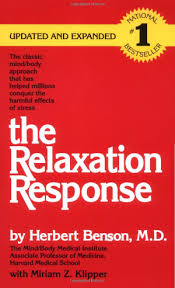
The second book is called The Relaxation Response. It was the cheapest book of the three and is much older than the book Buddha’s Brain. In it Dr. Benson (Harvard MD) describes the relaxation response as the body’s counterpoint to “fight or flight” mode. In this state of relaxation, the body–among other things–goes to work on repairing what ails it. There’s a lot of evidence that a human body can repair most of what can ail it if it gets enough rest–i.e. sufficient break from stress.

Relaxation Response


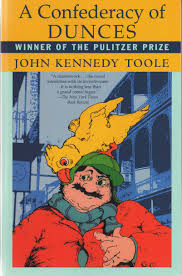
My final purchase was A Confederacy of Dunces. This book is considered to be one of the best comedic novels in American literature. It’s also a book that all depressed writers (which is to say all writers struggling to get things published) should read for the cautionary tale of the novel’s tragic back story. The author, John Kennedy Toole, committed suicide (at least in part) because he couldn’t get it published. His mother then took up the torch, shopping it around. It took her seven years, but she finally got it published after convincing the novelist Walker Percy to look at it, and having achieved his recommendation. In 1981 it won the Pulitzer Prize for fiction.

confederacy of dunces

BOOK REVIEW: How Pleasure Works by Paul Bloom

How Pleasure Works: The New Science of Why We Like What We LikeHow Pleasure Works: The New Science of Why We Like What We Like by Paul Bloom

My rating: 3 of 5 stars

Amazon page

Paul Bloom’s book is about why we take pleasure in peculiar actions, proclivities, and objects. These are the pleasures that aren’t readily or directly explained by our evolutionary hardwiring. Evolution has programmed us to experience pleasure with sex and eating to encourage procreation and nourishment. In other words, those who experienced pleasure with sex had sex more often, and passed on their genes more successfully. Those who had a healthy appetite, ate more, became stronger, survived, and passed on their genes.

However, just because the pleasure of sex is readily understood through biology, doesn’t give us insight into the panoply of activities that people find pleasurable in a sexual way that have no value for procreation whatsoever. Bloom uses the example of masochism, but there are all sorts of kinky fetishes out there that one might also consider. It’s the peculiar pleasures that Bloom tries to explain. This is not to suggest that Bloom’s book is entirely about food or sex. He addresses each of those subjects with a chapter of its own, but they aren’t the sum total of the book. Both he and I, no doubt, rely heavily on food and sex because they are such fundamental pleasures and ones whose domains have blossomed far beyond the dictates of biology.

So what does the book address besides food and sex? It examines why people collect things that were once owned by famous people? Bloom sites a study showing that Joshua Bell anonymously playing violin in the subway in street clothes can barely garner a collective $32 in an afternoon, even having been passed by people who will pay $200 each to hear him later that evening as he wears a tuxedo in a concert hall, though playing the same songs on the same $3.5million violin. Why do we sit around watching television and movies? If any of these pleasures seem self-evident, I would encourage you to ask yourself why they should be? It’s by no means clear that we should value something more highly because of who previously owned it, and it’s certainly not clear why we should get value by watching others play act lives that seem more interesting than our own.

The theory that Bloom presents is called essentialism. It’s the idea that each of these things that give us pleasure represents the essence of something or someone in our minds. So a person who pay’s 500 times the going rate for a used guitar solely based on the fact (x-factor) that it once belonged to John Lennon is, according to Bloom, imagining that there’s some sort of essence of Lennon that rubbed off onto the guitar. Yes, the guy buying the guitar could be buying it entirely based on economic considerations, but the only reason there’s an economic benefit (economic rents in economist terminology) to be made is that there are people out there (many of them) who desire to possess a famous artist’s instrument even though it costs them far more than an equivalent guitar not owned by a famous person. Things become even clearer when one looks at an item like JFK’s tape measure—i.e. a mundane item that is not tied to the man’s fame. (Said tape measure sold for an absurd amount.)

Bloom discusses art forgeries to elaborate this concept of “essence” versus the intrinsic value (i.e. the beauty of the art.) There are many cases of paintings being sold for millions because they were believed to be painted by a certain “artistic genius” and then they become trash when it’s discovered that they were painted by a nobody—a nobody who’s genius was clearly sufficient to convince all the experts that he was some other genius for a while, mind you. If what we cared about was the beauty of the painting, its value would have nothing to do with its origins. In this example, it might seem to be all about rarity (a dead artist paints no more, and, thus, has a limited stock of paintings), but there is reason to believe that’s not the whole story.

We can see the value of these essences ubiquitously. There have been a number of blind taste test experiments that show that oenophiles (wine lovers/experts) can’t tell nearly as much about a wine’s delicate intricacies when they don’t have its label on hand. Famously, there was the CEO of Perrier who couldn’t pick his own company’s water out of a blind line up of waters, though insisting it was a superior product. (It took him five tries out of seven waters.) Even after that event there were people willing to spend twice as much for Perrier because it gave them some pleasure that was completely delinked from its taste or nutritional characteristics.

Bloom’s thesis is interesting, and he presents a lot of fascinating examples in this book. What the book doesn’t really explain is how come certain essences act heavily on some people and not at all on others. It also seems like a theory that begs for another level of explanation. Why should such essences exist, i.e. what is their root cause? The latter may prove difficult given the degree to which individuals vary in their peculiar pleasures from one to the next.
I found this book to be intriguing, and would recommend if for people with interests in the oddities of human behavior.

View all my reviews