BOOKS: “The Book of Five Rings” by Miyamoto Musashi [trans. by Thomas Cleary] [w/ Yagyu Munenori’s “Book of Family Traditions”]

The Book of Five Rings: A Classic Text on the Japanese Way of the Sword (Shambhala Pocket Library)The Book of Five Rings: A Classic Text on the Japanese Way of the Sword by Miyamoto Musashi
My rating: 5 of 5 stars

Publisher Site – Shambhala Publications

This edition, i.e. The Shambhala Pocket Library edition, contains two guides to strategy, tactics, and philosophy of combat by famous early Edo Period swordsmen. The titular work is Miyamoto Musashi’s The Book of Five Rings, but the volume also contains Yagyu Munenori’s The Book of Family Traditions. The naming of the book is meant to capitalize on the continuing popularity of Musashi, who remains well-known to this day not only because of his own works and legend, but because of an afterlife in pop culture that ranges from Eiji Yoshikawa’s novel to a recent Netflix animated series. That said, one shouldn’t conclude Yagyu Munenori was some sort of slouch. He was, in fact, a martial arts teacher to the Shogun’s son, and he founded a branch of his family’s martial arts school that continues to this day.

It is interesting to see these two guides back-to-back, being by authors whose lifespans largely overlapped, though – in other ways – their lives were quite different. While there is some conceptual overlap in these guides, the two definitely show two very different minds at work, Musashi the pragmatic eccentric and Yagyu the Zen philosopher of noble standing.

Miyamoto Musashi is probably the most famous swordsman in Japan’s history. Oddly enough, he’s not known for his experience in battle (he lived at the tail end of the Warring States period and was only in a couple battles), but – rather – for his 62 duels. The Book of Five Rings and other works he left behind are certainly important factors in his continuing fame. Musashi was a bit of a renaissance man: painter, poet, and sculptor in addition to a swordsman. He also left behind a school of swordsmanship, Niten Ichi-ryū.

The Book of Five Rings is divided into five parts: earth scroll, water scroll, fire scroll, wind scroll, and void scroll.

The earth scroll provides an overview of martial science and an introduction to Musashi’s school, which is noted for its simultaneous use of both the large and short sword. A section is devoted the rhythm of martial arts, a crucial topic. It also includes what might be considered Musashi’s 9-point budō kun (a list of warrior precepts.)It’s worth mentioning a couple of these:
#7 Become aware of what is not obvious.
#9 Do not do anything useless.

The Water scroll describes Musashi’s approach to swordsmanship. It covers a range of elements of a martial art including footwork, the focus of one’s eyes, physical posture, mental posture, techniques, and approaches to cutting and thrusting.

The Fire scroll deals with the strategic or interactive aspects of the battle.

The Wind scroll explores other martial arts. Musashi discusses martial arts that use an unusually long sword, an atypically short sword, that focus on powerful strikes, and those that focus on many rapid strikes. He contrasts other martial arts with his own on subjects such as their focus with the eyes and their footwork.

The void scroll deals with, well, emptiness. It’s actually a short wrap-up.

Yagyu’s guide is much more philosophical and mind-centric. It’s not that Musashi doesn’t deal with such topics, but he also devotes considerable space to more practical nuts and bolts of swordsmanship and strategy. It’s also true that Yagyu gets into technical considerations such as control of distancing (if in a bit more poetic way than Musashi.) One can get a feel for the nature of Yagyu’s Book of Family Traditions [on the Art of War] by seeing how it is organized into three parts: “The Killing Sword,” “The Life-Giving Sword,” and “No Sword.” The latter two indicating the author’s belief in the importance of not equating warrior and killer (nor winning with killing) as well as not fixating on the sword.

These two men had great insight into strategy and the tactics of swordsmanship, their guides are worth being read and reread. And the two authors do offer two intriguingly different approaches to a similar subject.

View all my reviews

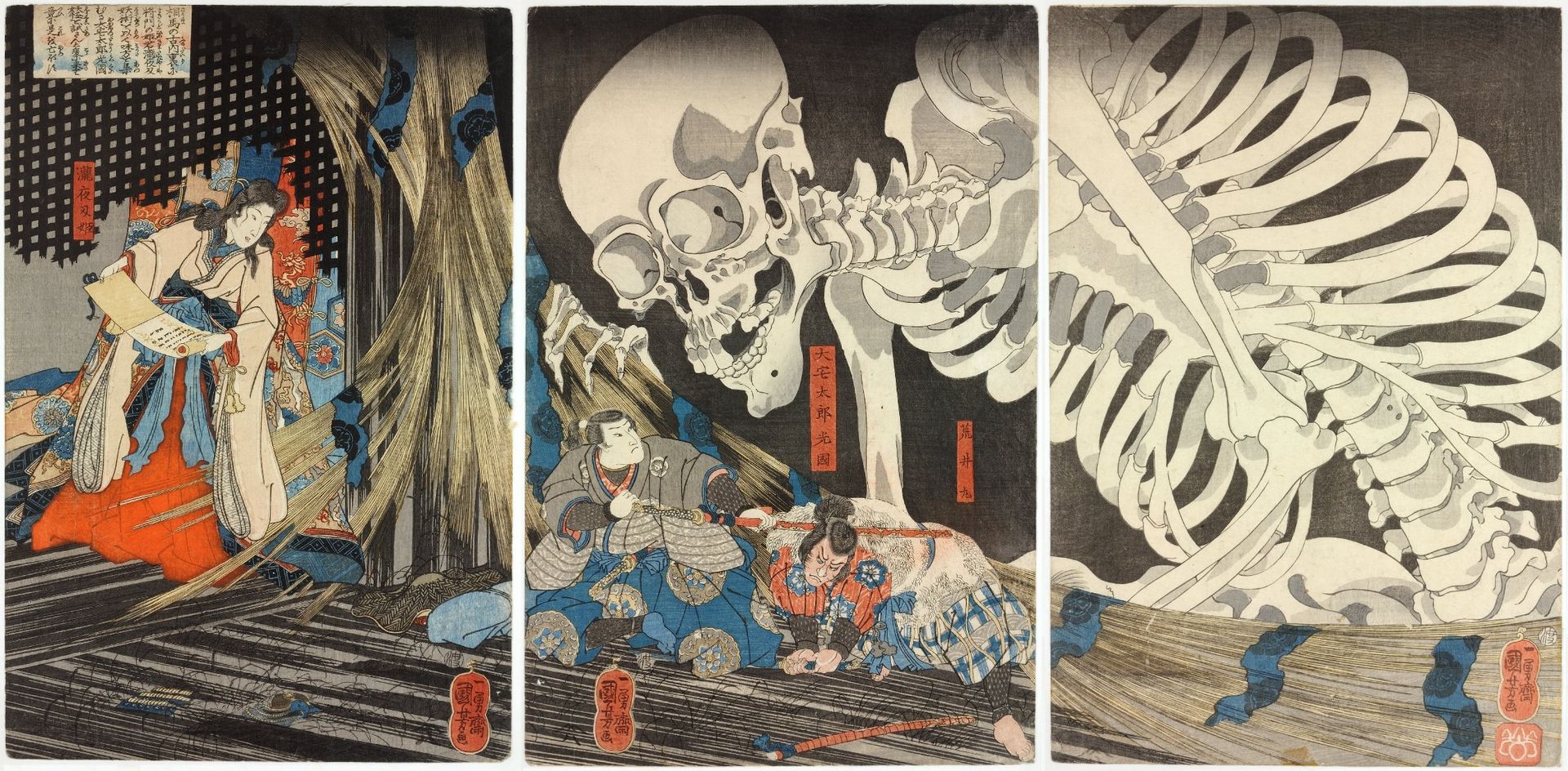
Witch & Skeleton [Free Verse / Senryū]

Takiyasha the Witch and the Skeleton Spectre; Utagawa Kuniyoshi (1844)
PREMISE:
Princess Takiyasha
 summoned a skeleton to
  kill a samurai.

MORAL?:
"Don't bring swords
 to a giant skeleton-ghost 
  fight!"

CONCLUSION:
Yet, in settled dust,
 the world was less one
  Princess-witch.

Of Samurai & Cats: Issai Chozan’s Neko no Myōjutsu

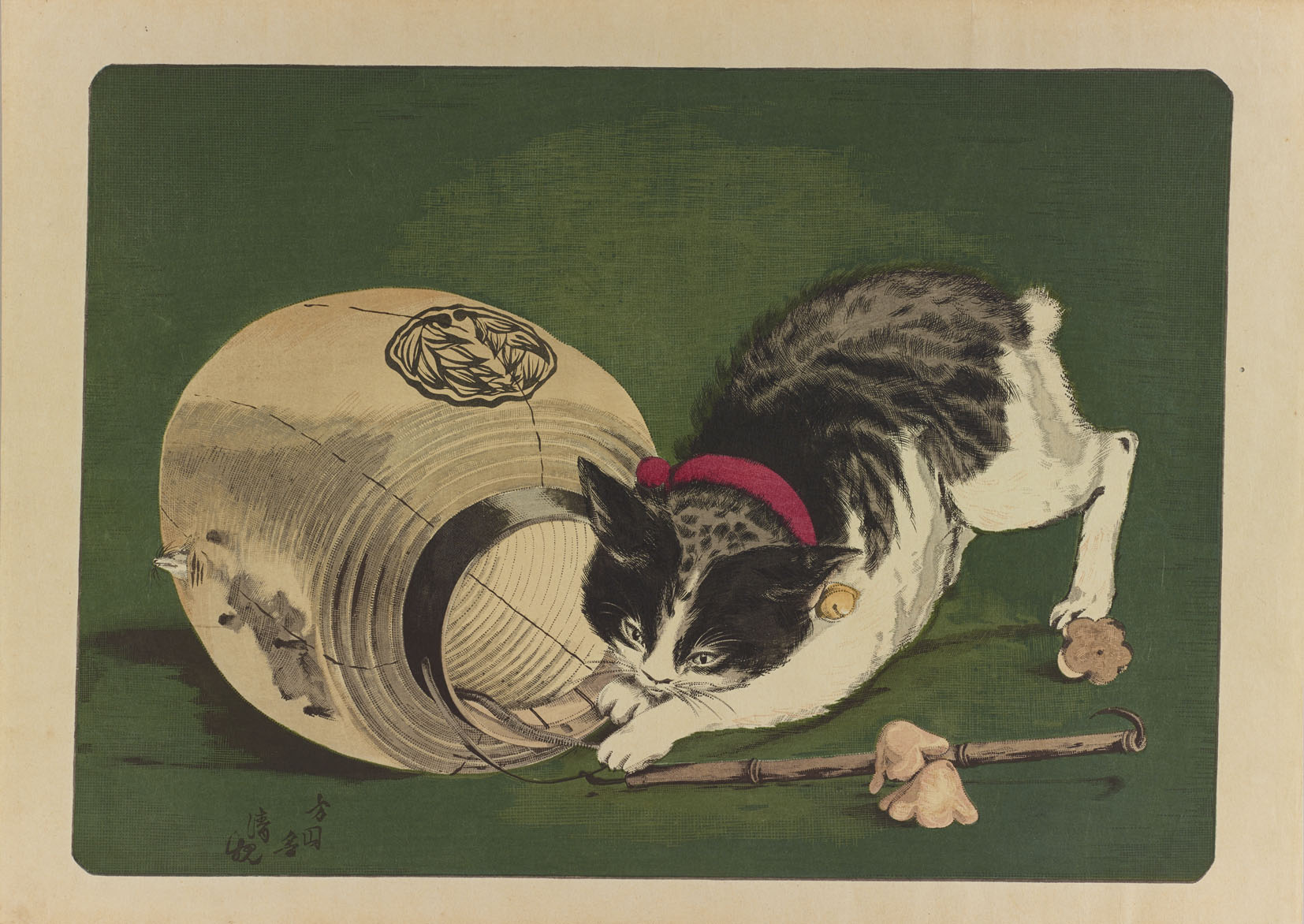
Cat & Lantern (1877) by Kiyochika Kobayashi

BACKGROUND: Issai Chozan’s Neko no Myōjutsu (“Eerie skills of the Cat”) was published in the book Inaka Sōji in 1727. It’s an example of dangibon, a light-hearted form of instructional short story, a form for which Issai Chozan is said to have been one of the originators. On the surface a story of rat-catching cats, in reality it’s a lesson in strategy and philosophy of combat.

SYNOPSIS: I’ll include citations and links below, so you can read the story in its entirety, should you choose to do so. But for now, a brief synopsis: A samurai, Shoken, has a rat in his house, and it’s driving him crazy. Shoken’s housecat is terrorized by the rat. The samurai brings in the best rat-catching cats from the neighborhood, and each is soundly defeated by the rat. Shoken decides to take matters into his own hands, chasing after the rat with a wooden sword (bokken,) but the rat evades each attempted strike and, ultimately, bites the samurai on the face. Finally, Shoken brings in a legendary elder cat from across the city, a cat who doesn’t look like much, but who effortlessly evicts the rat from Shoken’s house. The balance of the story is a conversation between the successful old cat and three of the skillful younger cats who’d failed to catch the rat (as well as with Shoken.) Each of the three explains its approach to achieving victory, and in turn the master cat explains the limitations of each one’s approach. The old master goes on to explain how when he was younger, he’d met a tomcat who slept all day, and yet no rat would come within miles of it. He asked how the tomcat achieved this, but the tomcat was unable to explain it.

THE LESSON: The first cat, a young black cat, explained that it was a master of technique. The black cat was agile and strong in movement of all kinds and practiced diligently to streamline and perfect all of its techniques. The old cat pointed out that focus on technique still left the black cat with too active a mind, thinking too much about how it would defeat its opponent. The master went on to say that there is value in technique, but it can’t be allowed to be the extent of one’s abilities. He emphasized that one’s clever actions must be in accord with the Way.

The second cat, a tabby, proudly proclaimed that all of its effort went into building its energy or spirit (ki, also called chi,) and that it could defeat most rats with a gaze (though not the one in question.) The old master explained that spirit is a fine thing but being too conscious of it hurt the second cat’s ability. The master went on to say that one can never be sure that the opponent won’t have more spirit than one, and so complete reliance on ki can lead one to a defeat.

The third cat, a gray one, said that its philosophy relied on yielding and never forcing a fight. The old master explained that this was a misunderstanding of the principle of harmony, and that this kind of yielding was a man-made contrivance that was not in accord with nature and often led to muddiness of the mind. While the old cat goes on to say that none of these elements (technique, ki energy, or yielding) is without value, it’s clear as he continues that the answer isn’t as simple as being a combination of them, but rather requires a completely new way of being, of experiencing and perceiving the world.

To Shoken, the old cat explained the importance of not thinking of swordsmanship as a means to defeat an enemy but, rather, a means of understanding life and death. The old cat went on to discuss mushin (i.e. “no mind,”) a serene state of mind that allows one to be flexible to whatever comes along. The old cat emphasized the importance of eliminating distinctions of object and subject through a process of self-realization and explained that the process of seeing into one’s being one can trigger satori (sudden enlightenment.)

CITATIONS:

Matheson Trust for Comparative Religion translation, available online at: https://terebess.hu/zen/neko.pdf

Ozawa, Hiroshi. 2005. The Cat’s Eerie Skill. Essence of Training in Japanese Culture: Technique Acquirement and Secret of Kendo. Online at: https://tenproxy.typepad.jp/recent_engagement/files/essence_of_training_in_japanese_culturee.pdf

Suzuki, D.T. 1959. The Swordsman and the Cat. Zen and Japanese Culture. New York: Pantheon Books. pp. 428-435

Wilson, William Scott. 2006. The Mysterious Technique of the Cat. The Demon’s Sermon on the Martial Arts. Tokyo: Kodansha International

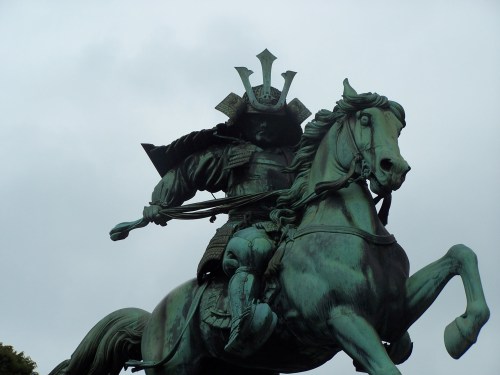
DAILY PHOTO: Kusunoki Masashige, the Loyal Samurai

Taken near the Imperial Palace in Tokyo in the summer of 2008

BOOK REVIEW: The Taiheiki trans. / ed. by Helen Craig McCullough

TaiheikiTaiheiki by Helen Craig McCullough
My rating: 3 of 5 stars

Amazon page

Let me be blunt, “The Taiheiki” isn’t a book you pick up to read a gripping story. While it’s considered a work of fiction, it reads like a history. In some sense, it is a history. It does follow the broad brush strokes of the events in Japan in the early 14th century. However, there are way too many characters to keep track of, or to remember who is on the side of whom, or even to know whether a given individual is worth remembering or whether they’ll soon die an ignominious death. If you don’t believe me, here are the words of the book’s translator and editor, “In short, the ‘gunki monogatari’ [the war tales of which ‘The Taiheiki’ is one] are not great literature. But the best of them are worth reading.”

I agree with McCullough’s point about these books (and this one in particular) being worth reading, but I would add an “if.” “The Taiheiki” is worth reading, if you have an interest in medieval Japan, samurai, or civil war life. The time period in question was fascinating, and it was characterized by war and intrigue. The Hōjō clan was ousted. (They were the military clan that administered the government.) A compromise had been in effect in which the mantle of Emperor was to be alternated between two opposing lines. However, an ambitious Emperor Go-Daigo refused to relinquish the title, and this led to a war between the courts. It’s a story of both warriors of legendary loyalty (most famously, Kusunoki Masashige) and those of shifting loyalties.

While the book is too fractured to form a clear and interesting story overall, that doesn’t mean it isn’t filled with intriguing episodes of battles, espionage, siege warfare, and even the occasional ghost or goblin story. There are many interesting individuals that are dealt with in sufficient detail to make them intriguing—the aforementioned Kusunoki Masashige stands out among them. The book offers insight into the medieval Japanese mind and to some degree the modern mind as well. There are discussions of philosophy and strategy worked into the narrative that help one to understand from whence the individuals were coming.

The book has a few features that help non-expert readers. The first is an extensive introduction written by Dr. McCullough that serves to provide background for the book and the era in which it took place. The second is frequent footnoting. There are also several plates of artworks and photos interspersed throughout the book. These help the reader visualize the environs and how these individuals would have looked.

If you have an interest in medieval Japan, in samurai, in ninja, or even in pre-modern war generally, I’d recommend this book. (If you’re looking for a gripping tale of intrigue set in 14th century Japan, not so much.)

View all my reviews

BOOK REVIEW: Ninja: A History by John Man

Ninja: 1,000 Years of the Shadow WarriorNinja: 1,000 Years of the Shadow Warrior by John Man
My rating: 3 of 5 stars

Amazon page

The author, John Man, isn’t the first historian to fall for the siren call of ninja history only to plummet into a catch-22, but he’s the one I’m reviewing right now. So, while his book isn’t exceptionally bad, it’s tremendously flawed in a manner common across ninja histories. What is said catch-22? On the one hand, ninja excite the imagination and a half-way decent book on them is sure to sell. On the other hand, there’s very little known about the ninja. If the myth of the ninja is an elephant, the ninja as we truly know him is a grasshopper. [So much so that the first Westerner to write such a history, Stephen Turnbull, has now spun 180, proposing that the ninja never existed but were purely a post-Warring States construct.] While it would seem that Turnbull goes too far given the existence of manuals and vague mentions, what we don’t know about are the nitty-gritty details of ninja missions and those are the stories that the reader desires but which time and the ninja’s legendary secrecy have put forever beyond our reach.

What is in the book? If not tales of ninja stealing into castles to abscond with information or to assassinate an enemy General, and the effect of those actions on the outcome of wars? First, there’s a lot of information that is already widely available in other English language books, such as the influence of Sun Tzu’s chapter on espionage on the birth of the ninja (probably spurious given the centuries in between) and description of the seven types of disguises. Second, there’s a lot of general Japanese history that is necessary to some degree as background, but at some point one realizes the author has ventured beyond background into padding. Finally, speaking of padding, about a third of the book by page count (cleverly disguised as only three chapters) occurs long after the end of the ninja. Don’t get me wrong; some of the World War II material is fascinating, but it’s as if one were reading a biography of Blackbeard and—all of a sudden—one finds oneself reading about a Somali hijacking of container ships in 2011. (Even while you are fascinated, you can’t help but feel that you’ve been the victim of bait-and-switch.) In short, the book has a lot of repetition and padding, and not much that’s both new and on topic. (One of the reasons that I didn’t give the book too low a rating is that if it’s the first book you are reading on the subject, it’s readable and interesting.)

There’s one more flaw that comes from the dearth of information. The author cites everyone and anyone who has said something interesting on the subject, but we don’t really know how reputable said sources are. Some may be sterling and others full-of-shit. It’s easy to say something fascinating about the ninja; it’s much more difficult to say something that’s true and fascinating.

So what does the book do right? It’s well written in terms of being readable and offering frequent mind candy. The author does challenge a few statements as he reports them. My last paragraph may have led one to believe that Man just shot-gunned information out there, but he actually takes a suitably skeptical view for addressing such a murky topic. The problem is that we don’t know how serious to take claims he refutes or those he appears to endorse because he’s not an expert in the field. He is an Asianist historian with a list of books that is all over the map. [I did see just one factual error in which he refers to the companion sword of a samurai as a tanto. A tanto is a dagger, the companion to the katana is the wakizashi. But I don’t know how big of a deal to make out of that sin as I can’t say that I noticed any others (not that I necessarily would as I’m no expert either.) On the other hand, a little fact checking…]

If you’ve never read a history of the ninja before, you’ll probably find this one interesting. If you’ve read the other books out there, it’s less clear that you will. However, I did find the discussion of Iga no Ran (the battle of Iga, a campaign meant to crush the ninja of Iga) to be intriguing. At any rate, as long as you realize the last one-third of the book is off-theme and are alright with that, you should find it palatable.

View all my reviews

BOOK REVIEW: Cimarronin by Neal Stephenson, et. al.

Cimarronin: A Samurai in New Spain #1Cimarronin: A Samurai in New Spain #1 by Neal Stephenson
My rating: 4 of 5 stars

Amazon page

Cimarronin opens in Manila in 1632 with a masterless samurai (i.e. a ronin, hence the latter part of the name) about to commit ritual suicide. The ronin, Kitazume, is interrupted by a Catholic priest who Kitazume knows and who—it’s hinted—has the kind of nefarious past that one has trouble reconciling with the priesthood. The priest offers Kitazume a mission.

The opening hooks one. It raises several questions that the reader will want answered: Why is a Japanese samurai hanging out in the Philippines in 1632? Students of Asian history will recognize that Japan’s long warring period is a couple of decades past and there are a lot of warriors out of work. But is that all? Is the priest really a priest, and, if so, how does a blackguard end up a holy man? And most crucially, will Kitazume take the mission, and—if so—will he succeed (and will he be glad he did?) The reader always knows that the priest has something up his sleeve, but it’s only gradually revealed what that is.

We soon discover that Kitazume has some skill as a detective. This enhances our curiosity about the character. The higher echelons of law enforcement in feudal Japan were staffed by samurai, but it still adds another interesting dimension to the character.

The three book collection continues with the discovery that the priest is facilitating the transport of a Manchu princess to Mexico. (Philippines to Mexico, hence the “New Spain” subtitle reference.) The priest’s plot unfolds in the middle book, and we get a better picture of his scheme.

The second book ends with a fight with the Cimarrones—a bellicose, indigenous tribe (and the reason for the first part of the title,) and in the third and final book the Manchu Princess’s own scheme is revealed. The differing goals of the various major characters set up the potential for an excellent story. Kitazume has the simplest goal: to have a mission that makes life worthwhile and to conduct his life with some semblance of the virtue for which the samurai were known. The priest and princess weave a more complex web of scheming.

The story is peppered with flashback sequences that give us some of Kitazume’s backstory, and a substantial part of the third book is such backstory. The graphic artist uses a subdued scheme to make it readily apparent which panels are flashback and which are in the timeline of the story arc.

As this is the first three books of a larger collection, the ending is lacking (which is to say it’s not so much an ending as the set up for the story to unfold.) The story is much stronger in its beginning than its ending. The third book ends trying to entice one to read the concluding volumes more than it tries to wrap anything up. This situation also results in the fact that we don’t get a good picture of why Kitazume is the lead character in the story. I suspect that’s why there is so much backstory, to try to build sympathy and curiosity for the character while making him weak enough that his success is not apparent. At any rate, Kitazume doesn’t come off as the strongest or most competent character in the book by a long shot. Hopefully, this is so that he can pull out an underdog save in the end, but that’s just speculation.

I found this collection to set up an interesting story, but it doesn’t stand alone. It does have plenty of action and intrigue. If the historical fiction premise intrigues you, you may want to get the complete collection.

View all my reviews

Tsukahara Bokuden Defeats a Braggart

[Note: There are many versions of this story, and these events have even been attributed to other warriors. The tale was likely passed around orally before it was written down myriad times in myriad different ways (most famously in the Kōyō Gunkan.) The details of the story aren’t important; it’s the overall moral of the story and that remains the same from one version to the next.]

Bokuden Boat

Tsukahara Bokuden listened to the braggart nauseating the ferry passengers with graphic details of his “exploits.” Bokuden would have happily ignored the young samurai, but the cocky youth seemed eager to take offense at the lack of interest in his tales of hacking people to bits and was looking for a fight. The other passengers on the boat were all commoners: an elderly man who was probably a craftsman or a small business merchant, and a mother with her young child.

“Do you doubt me? Do you have the audacity to call me a liar,” The young man said, having not received a suitably enthusiastic response to his stories. And he stood, one hand on his scabbard and the other brushing his sword’s hilt.

Tsukahara Bokuden said, “Easy, young man. No one is calling you a liar. These good people are just not used to such bloody stories.”

The young samurai turned to eye Bokuden, who had appeared to be napping in the back earlier. The braggart asked, “And who are you to challenge me?”

“I didn’t challenge you. I merely explained these people’s lack of enthusiasm for your yarns. But if you must know, I am Tsukahara Bokuden,” he replied, hoping his name might give the bragging samurai pause. Bokuden was well-known, having traversed Japan in musha shugyō (sometimes related to the European “knights errantry,”musha shugyō was a time in a samurai’s life–particularly in times of relative peace–when he traveled the land engaging in matches with individuals from other schools to increase his skill and notoriety–i.e. if he didn’t get killed, which was not uncommon, even when the fight was with wooden swords.)

“I’ve never heard of you. What’s your style?” the cocky samurai asked.

“Mine is the School of No-Sword,” replied Bokuden.

“I’ve never heard of that school, but it sounds weak,” the braggart said.

“I assure you, the technique is quite powerful,” Bokuden said.

“Are you suggesting that you could defeat me with this so-called ‘no sword’ technique?” the braggart said, his hand tightening on his scabbard.

“I said nothing of the sort. I would just like to enjoy the remainder of the ferry ride in peace,” said Bokuden.

“Are you scared to have a match to see who’s style is better?” the cocky youth asked.

“Not in the least, but I see no benefit in it either,” Bokuden replied.

“I’ve had enough of your lip, old man, prepare to defend yourself,” said the young samurai.

Bokuden sighed, “If you insist upon a match, let us at least do so where these good people’s lives will not be in peril. Surely you’ll agree that it would do no great honor to the samurai class if we were to injure or kill innocent bystanders.”

At this the braggart just harrumphed, “Who cares, but I’ll take you on wherever you wish.”

Tsukahara Bokuden said to the oarsman, “Sorry to trouble you, but would you mind diverting to drop us on that outcrop so that we can spare these people the swinging blades.”

The oarsman was readily agreeable. He didn’t want two samurai fighting on his ferryboat any more than Bokuden did.

He rowed them to a stony outcrop that jutted up out of the water. The uneven rocky ground wasn’t ideal for a match, but it would spare the other passengers and would provide a challenge.

When the boat’s bow ground up against the rock, the young samurai jumped out, twisting around in air, and landed on the rock. The braggart held his scabbard and hilt at the ready for a swift draw. The young man was eager to do battle, and it was clear that he was annoyed with Tsukahara Bokuden’s slow movement. The older swordsman took out both of his swords and asked one of the passengers to hold the swords. The oarsman and the passengers were surprised by this disarming behavior, but they’d heard him call his school the “school of no-sword.”

Tsukahara Bokuden then moved up to the boat’s bow as if preparing to move ashore.

“Might I borrow your oar, young man?” Bokuden said to the oarsman. The oarsman nodded and handed Bokuden the long oar with two hands, and with his head bowed. The general assumption was that the older samurai wanted to stabilize the boat against the rock so he could pass ashore smoothly.

Taking the oar, Bokuden drove one end into the outcrop, and grabbed the other pushing the boat away from the rock. The boat glided out from the rock in an accelerating fashion.

Lunging toward the water’s edge, the perplexed braggart called out, “What on earth are you doing, old man?”

To which Bokuden replied, “I’m defeating you with the school of no sword.”

By the time the young samurai could remove his swords and tug away his outer garment, Bokuden had rowed out to deep waters and returned the oar to the oarsman.


The Good and Ugly of Olden Times

This was posted in my martial arts blog, Jissen Budoka, as well.

I’ve been doing a lot of reading about Japan’s past recently. In my spare time, I’m working on rewrites for a novel in which 14th century Japan features prominently. Being my first foray into historical fiction, I’m finding the need to go back and do a lot of research about the time because the quick and dirty draft I wrote needs a lot of gussying up. I just finished reading Charles Dunn’s Everyday Life in Imperial Japan,  which is about a later period but one which would have shared much in common when it comes to everyday life. Presently, I’m reading The Taiheiki–which is about the 14th century, but which blends fact and fiction.

Doing such research encourages one to consider what it meant to live during that time. We all build constructs of the world to adjust for our limitations in knowledge. Some of these constructs hold up better than others, but they’re all simplifications. When one reflects upon a time before one’s experience–and particularly regarding a place with which one has limited familiarity–there are two major forms of fallacious reasoning that can take hold:

1.) The Golden Age Fallacy: This is the thought that everything was better back in the day–back before humanity started slouching toward craptasticness.

2.) The Outhouse Fallacy: This is the idea that any society that couldn’t manage indoor plumbing couldn’t possibly be worthy of emulation.

Of course, these simplifications are both true and false in some regard, and–as absolute statements–are absolutely false. The truth is something more like what Ralph Waldo Emerson suggested in Self-Reliance. Emerson described society as a wave, receding on one side as quickly as it advanced on the other. In other words, changes maybe seen as progress, but they also bring about the destruction of valuable knowledge. In martial arts terms, the spear becomes obsolete and the art of spear-fighting dies.

LastSamuraiThe movie entitled The Last Samurai revolves around this premise. Of course, in Hollywood fashion the forces of modernity are made entirely villanous and our heroes, the samurai, are entirely virtuous. In a way the movie is perverse in that it suggests we root for the medieval approach over our own.

When considering feudal Japan, Golden Agers point to it as a time during which virtue was paramount, craftsmanship was exquisite, and much culture flourished. They are right; but don’t set your time machine just yet because Outhouse Agers are also correct when they say that it was a time during which most of the population had no rights, wars ravaged the country, and in which farmers were not allowed to partake of many of the products they produced–but rather had to feed and cloth their families with inferior substitutes.

One should be careful to neither romanticize nor vilify the samurai. We should keep what is of value of the old ways without being a slave to the worst ways of our predecessors’ nature. One shouldn’t abandon everything old on the assumption that by definition everything abandoned to the past is refuse.

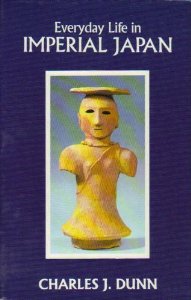
BOOK REVIEW: Everyday Life in Imperial Japan by Charles Dunn

EverydayLifeImperialJapanEveryday Life In Imperial Japan by Charles J. Dunn

My rating: 4 of 5 stars

Amazon page

This interesting little book is invaluable for anyone researching what life was like for people in Japan before the Meiji Restoration. While it’s an essential volume for a writer of historical fiction, those interested in Japan more generally will find it readable and packed with interesting tidbits of information. For example, I would recommend it for those who study traditional Japanese martial arts (i.e. kobudō)to get a better insight into the art they study through knowing the society from which it sprang.

This type of work is relatively rare, but is a writer’s dream come true. It’s not a history book, but–as the title implies–tells one how people of various classes and occupations lived day in and day out. That is, its approach is more anthropological than historical.

The range of occupations in Japan’s pre-modern period were far fewer than in society as we know it, and so the book takes broad job classes as its primary unit of organization. It begins with the group that undoubtedly draws the most interest, the samurai. It proceeds to the occupation which is most numerous in any pre-modern society, the farmers. Beyond that, it covers the lives of skilled craftsmen, merchants, courtiers, priests, doctors, intellectuals, actors and outcasts. The concluding chapter looks specifically at life in the city, and–in particular–life in Edo. Edo is the city that would become known as Tokyō, and which became the capital of the Shogunate in 1603 and eventually the nation’s capital.

Japan’s relative isolation throughout its early history has made for many intriguing national peculiarities. It’s true that Japan’s literary, religious, and philosophical systems were greatly influenced by China, but–in all cases–these cultural elements were forged into a uniquely Japanese form. This uniqueness provides many “ah-ha” moments while reading.

One learns why warriors were required to wear extra long hakama (a very billowy form of pleated pants that look like a long skirt–though having individual pant legs.)One learns about how one got around on the early highway system in a time when infrastructure (e.g. bridges) were minimal, and who was allowed to use the roads–such as the famous Tōkaidō road. The book tells how police went about arresting armed samurai. The roles played by women in society are discussed. While this was obviously a patriarchal society, women weren’t locked entirely outside the domain of power.

This was a feudal society with the samurai owning the land and the farmers toiling in hopes of having a little left over to support their families. While farmers made silk, they were, by law, not allowed to wear it. Farmers sometimes resorted to selling daughters to brothels to make ends meet.

There were many types of craftsmen from saké brewers to carpenters to makers of lacquer-wares. Japan has a long history of appreciation for master craftsmanship as is most apparent in sword-making. The Japanese sword was the cutting weapon perfected. Its folded steel design offered a flexible spine with a hard edge that could be honed to razor sharpness.

Merchants were a class that was both looked down upon and increasingly powerful during this period. Samurai were often barely making a living then, but merchants were beginning to flourish. Japan’s first indigenous money wasn’t introduced until 1636. Prior to that Chinese coins were used, much in the same way that some present-day countries use US dollars for currency–thus avoiding inflation that would be inevitable if they had their own currency and governance. There is an extensive discussion of the early sea trade.

Some of the most interesting careers were those more peripheral. Doctors practiced something akin to Traditional Chinese Medicine. There were wandering street performers and holy men of a wide variety.

I’d recommend this book for anyone interested in Japan’s history, and would call it indispensable for a writer addressing pre-Meiji Restoration Japan.

View all my reviews