


I never met a one I didn’t like.
PROMPT: Physical Activities or Exercises
Reply

I never met a one I didn’t like.
What is your favorite form of physical exercise?
I’m a big fan of them all. I like to move it, move it.
Each in its time.
Though the less special equipment I need access to, the better. I’m a firm believer that one needs only the body and mind to keep a fit body. It’s all a matter of how, how often, how intensely, and how safely one moves one’s body. Gadgety fitness can become too fetishist, and not build integration of the body as much as is ideal.
How often do you walk or run?
Daily. I don’t live in an aquarium (thus allowing swimming as the predominant mode of transport,) nor am I a potted plant that stays where I’m set. Also, flying is out of the question, except in an airplane.
I’m a morning person and am typically at fairly high energy levels first thing in the morning, So, that time is generally active, filled with exercise and / or physical activity of varied varieties (calisthenics, walking, running, and — of late — the occasional swim [which I normally do latter in the day.])
[Of course, there is the obligatory urinating, washing, toothbrushing, etc. (sequentially not concurrently,) but that seems like it would go without saying and would be strange to ask strangers about.]
That’s trickier than it seems. I quite enjoy reading and many forms of bodily movement activities (e.g. swimming, yoga, taiji, qigong, exercise, etc.,) but I’d count them more as personal development activities than leisure activities. (Even something as seemingly non-purposeful as juggling.) I sometimes watch TV / movies, but I don’t know that I’d say I enjoy that so much as find it an opportunity to zone out.
I don’t have a favorite, but there are several that I could not maintain health and sanity without, including: hiking, yoga, calisthenics, taiji / qigong, free movement, and at least one cardio (I currently swim and run.) I’m currently struggling with juggling.
What is your favorite form of physical exercise?
I play no favorites. I love calisthenics, yogasana, running, swimming, functional movement, movement drills (e.g. martial arts,) etc.
I do have least favorites though, and – collectively – those are exercises where I have to go somewhere in particular to have access to some specialized equipment. So, for example, I don’t care for weight lifting or using ellipticals or climbers, etc. (I still enjoy the exercise well enough, but it’s more hassle than it needs to be.)
My whole equipment inventory consists of a yoga mat, a pull-up / dip apparatus, and a few resistance bands, and I can make do without those quite nicely — e.g. when traveling.
 Walking Meditation by Thich Nhat Hanh
 Life at the Extremes by Frances Ashcroft
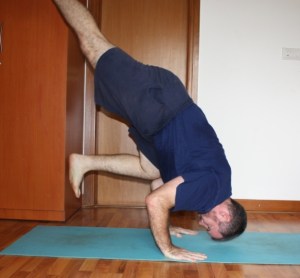 This is month ten in my year of studying altered states of consciousness, and this post will be on movement and the mind.
There are many downsides to being introverted, but one upside (at least in being a kinesthetic-oriented introvert) is that I can get out of my head and in touch with my body quickly and efficiently when I’m in motion. It can be a blissful state when the inner yakking pipes down and my awareness becomes attuned to sensation.
I would differentiate three types of movement that have very different effects on my state of consciousness. First, there are highly repetitive acts of movement such as running. Now, I do run because it’s great exercise, but it doesn’t tend to put me in the state of mind I’m talking about. Your results may vary. I know many people find “runner’s highs” or achieve a quieting of the mind when running. For me, running tends to produce a daydream-centric state of mind. I sometimes counter this by focusing my awareness on my breath, stride, or sensations, but — left to its own inertia — my mind goes into daydream mode.
Second, there are fixed sequence series of movements — preferably with a flow. The best example that I can think of — and which I currently practice — is taiji. I’ve been practicing Yang Style Taiji for a few years now, and find it’s conducive to this state of mind. However, the point that differentiates this type of movement from the next is that it takes some time to get to that point. One has to ingrain the sequence of movements into one’s body, then coordinate the breath, and then correct minute mistakes in the movement. It’s worth it, but it’s not an instant ride to altered consciousness. While you’re getting the fundamental movements down, the conscious mind is necessarily quite active and it’s hard to tune into the movement and the sensations.
Third, this is what I would call free movement. Some people think of it as a kind of dance, but not one with a fixed choreography, which would fit more in the second category. Free movement is just letting your body move (usually to music) with awareness to the body, but without conscious direction. While the feel created is much like that of the second type of movement, mentally it bears more resemblance to free writing, which I discussed last month. That is, one is trying not to direct the body consciously, but rather let the movement come about (perhaps mediated by the music.) Rather than trying to consciously direct the movement, the conscious mind is used to direct and maintain awareness of sensations. Sometimes, I keep my awareness on the soles of my feet, feeling how various movements — subtly or unsubtly — change the distribution of weight on the feet.
In doing this, I find that sensitivity to sensations — external and internal — dials up. While I’m focusing on internal sensation. I often notice tactile sensations that would usually not register. There’s also a more visceral experience of the effect of music, which is another subject in its own right. The blissful effect of music seems to be amplified by the body in motion.
In thinking about the difference between the second and third types of movement experience, I was reminded of the argument that a ritual is an essential element of plumbing the depths of the mind. As the argument goes, there’s something about inggraining a sequence of actions into one’s muscle memory and continually performing them that tunes one into something vaster than the self.
I’m still planning to do two more posts in this series, although I’m bouncing around alternative subjects for November and December, those joining this experience in progress and curious about previous posts can find them:
January – Psilocybin Mushroom
February – Sensory Deprivation / Float Tank
March – 30 Days of Meditation
April – Hypnosis
May – EGG Feedback
June – Breathwork
July – Lucid Dreaming
August – Sleep Deprivation
September – Free-writing / Poetry


 Tiger Riding for Beginners