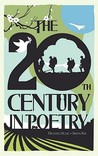
The 20th Century in Poetry is an anthology of over 400 poems written in the 20th century that take (often tenuously or symbolically) historical events as their prevailing theme. The poets included in this collection range from household names to those who’ll be well-known only to poetry lovers to a few obscure choices. Among the more famous poets included are: Rudyard Kipling, A.E. Housman, James Joyce, W.B. Yeats, D.H. Lawrence, Ezra Pound, Robert Frost, Carl Sandburg, T.S. Eliot, Langston Hughes, William Carlos Williams, A.A. Milne, Countee Cullen, Edna St. Vincent Millay, W.H. Auden, e.e. cummings, Dylan Thomas, Allen Ginsberg, Bob Dylan, Sylvia Plath, John Updike, Chinua Achele, Robert Penn Warren, and Seamus Heaney.
Read the title carefully, this isn’t a collection of the best or most popular poems of the 20th century. Many of the works included aren’t even among the best known works of poet authoring them—though there are a few exceptions (e.g. William Carlos Williams’ Red Wheel Borrow and Dylan Thomas’ Do not go gentle into that good night.) Having “clarified” this point, one should note that many of the poems aren’t written about 20th century events. In other words, they’re all written in the 20th century, and they’re mostly about (or around) historical happenings, but sometimes those happenings are from a much earlier time period. However, the editors could well argue that the decision to reflect back on ancient events at that particular time speaks to perceived corollaries in the contemporary era.
I remember reading the reviews on Amazon for this book when I was considering whether to purchase it. The few reviews were overwhelmingly positive, but there was one negative review. Now usually when there’s one negative review and several positive ones, one can dismiss the negative review as that of a curmudgeon—the same person who returns his or her steak three times because the cook can’t get it within one minute and half-a-degree of what that person has determined is the ideal state of cookedness. However, I gave this negative review the benefit of the doubt and read it. What I found was a well-reasoned and uncurmudgeonly explanation of why that person didn’t like the anthology. Still, I dismissed the review and bought it. While I’m glad I did, I can see that reviewer’s point.
What was said critique? It was that the entire anthology was bleak and depressing. At the time of purchase, I shrugged that off. It’s poetry. Of course, it leans to the dark and morose. Poets aren’t generally known for their cheery dispositions (Augden Nash, Dr. Seuss, and Shel Silverstein notwithstanding—and, of course, none of those individuals’ works is in this book.) There are times when the doom and gloom obviously strikes the right tone (e.g. poems about the Depression, the World Wars, and various genocidal atrocities.) However, the 20th century was not all war and holocaust; it was also a time of great advancements in science, technology, and quality of life. But even the best times of the 20th century are painted depressingly in this collection. To give an example, there are three poems about the moon landing and they all come across as works of petty douchebags. (I suppose the underlying sentiment was, “Why are we spending millions going to the moon when there are poets who can’t make a decent living moping about and painting word pictures of the world as seen through shit-colored glasses.)
As this book is proclaimed as an attempt to capture the history of an entire century through poetry, it’s worth pointing out that this is clearly an English language centric view of history. To be fair, the editors do go to lengths to include poems from both Indian (i.e. South Asian Indian) and African poets whose works were published in English.
The poems are arranged in 7 chronological parts: 1900-1914, 1915-1922, 1923-1939, 1940-1945, 1946-1968, 1969-1988, and 1989-2000. Anybody remotely familiar with the history of the 20th century should be able to tell what world events drove this particular delineation of timeframes. For readers who aren’t history buffs, one nice feature is that each part begins with a prose discussion of world events during said era.
I would recommend this book to individuals interested in poetry as long as they don’t currently suffer from depressive disorders.
Amazon recently put out a list of 100 Books to Read in a Lifetime. I appreciate the mega-bookseller taking a less doctrinaire approach than, say, The Guardian’s 1000 Novels Everyone Must Read. Also, props to Amazon for including a number of contemporary works—though I guess that is self-serving of them (i.e. $10 versus $0 sales price)—so never mind.
Whenever I see one of these lists—and there are so many of them—I always feel a bit inadequate. I suspect I’m not alone, given a recent generic list posted by The Millions, entitled 28 Books You Should Read If You Want To. That author’s approach is laudable. She doesn’t hand out exact titles as if we all need the same books, but rather suggests the kind of books one should consider reading (but only if you want to.)
I read like a fiend. While I usually don’t read rapidly (I can; I learned how in grad school, but I prefer savoring to injecting words), I’m constantly reading. So it’s a little disappointing to see how I stack up in the grand scheme of list-makers.
So this brings me to the point of this post, which is to boost my self-esteem by building a list of books, all of which, I’ve read. As I considered the books I’ve read that I would be so bold as to recommend “everyone” read, I saw trends. First, I read a lot of thin books, or, perhaps, they stick with me more. Don’t get me wrong, I’ve read some monsters Moby Dick (on everybody’s list—I don’t know why), Atlas Shrugged (on the Libertarian Book-of-the-Month Club list, and not much else), and 1Q84 (given a few years, it’ll be on all the lists.) However, it’s the thin books that have stuck with me, and they often get kicked aside by the [other] pretentious list makers. Also, shorter forms (e.g. essays, short stories, poems, and novellas) often don’t get properly recognized because everyone wants to talk about novels and tomes.
Second, while I like to consider myself an international reader (e.g. I’ve read a fair number of translated Japanese and Chinese classics), the fact of the matter is that I’ve had a skewed reading history. I’m an American, and have disproportionately read books that are either by Americans or that speak to the American worldview / mindset (my list will be both.) This isn’t so much an issue for most of the list makers as they simply propose that every Nigerian, Thai, and Peruvian should read a canon devoid of any Nigerian, Thai, and Peruvian authors (but instead that is 50% British, 30% American, and 20% all others.) While the list may be targeted toward U.S. audience, these books are good for everybody, and everybody should read outside the familiar.
Without further ado, my list, 30 Thin Books That Every [Attention-Challenged] American Should Read:
Because poetry is good for the soul. Yes, this anthology is skewed toward dead poets, but it’s not only thin, it’s cheap. It’s got Whitman, Dickinson, Frost, Sandburg, and Hughes.
Because, screw totalitarianism, that’s why. This is like 1984, but without the villainy clubbing one over the skull. Therefore, you can introduce the kids to commie-hating early and without giving them nightmares—well not bad ones. Plus, it’s thinner than 1984.
Because virtue is good for the soul. This is Plato’s account of Socrates’ defense at his own trial and his subsequent explanation of why he was going to drink the hemlock. Yes, it’s technically three books, but they are often bundled together as one book. Even with all three, it’s pretty thin.
Because Orwellian dystopia isn’t the only dystopia. In Huxley’s book, tyranny wasn’t a matter of force, but manipulation. This book shows how dystopia can be disguised as utopia by keeping the population adequately drugged and well-sexed.
Because satire is good for the soul. No sacred cows escape roasting in this thin volume. A naïve young man travels out into the world to find that evil is ubiquitous.
Because how often does a book coin a common phrase. (FYI- “A Clockwork Orange” was a phrase Burgess borrowed for the book that was common in some parts, but Heller invented the term “Catch-22.”) The story revolves around the notion that one can’t get out of the war by reason of insanity, because if one is trying to get out of the war one is sane by definition, and if you are insane, you don’t try to get out.
Because if you’re going to break the law, you should know how to do it do it virtuously and not like a dirtbag. (Hint: It’s more painful than you think.) This essay tells of Thoreau’s imprisonment because he refused to pay taxes that would fund the war with Mexico. It’s usually bundled with other essays.
Because books are good. The title comes from the temperature at which books burn, and it’s set in a dystopian future in which the protagonist, “Fireman” Guy Montag, goes around collecting and burning books.
Because you should know how to turn someone down (e.g. I would not eat them on a boat, I would not eat them with a goat.) Or, because learning to be playful with words may serve one well. Or, because you should try new things. In the story, an unnamed narrator is subjected endlessly to green eggs and ham, which he steadfastly, refuses until the end.
Because you think you’ve got a weird family. Hamlet exacts revenge when he finds out that his uncle killed his father to marry his mother and usurp the throne.
Because you don’t want to underestimate Mother Nature when you strike out to build your indomitable American spirit. This is the true story of a college graduate who gives away his bank account, burns his pocket-money, cuts ties with his upper-middle class family, and sets off to become self-made. Ultimately, he ends up in Alaska, and it does not end well.
Because, stop being such a gloomy-Gus. Admittedly, this is an unconventional choice– both because it’s not particularly skillfully written and a few of its conclusions may not be as true as they once were. However, it does inject a dose of reality for those who view the world through shit-colored glasses. As the title suggests, the authors argue that life in America is getting better year after year. We are getting healthier and richer. Being economists, they present much of their findings as graphic representations of statistical data.
Because sometimes the world actually looks better through shit-colored glasses, Seriously, because you need to know how to get on with it when life is at its toughest. Viktor Frankl was a psychiatrist and Holocaust survivor who writes about what kept people going at places like Auschwitz.
Because, just get on with it. This was actually a kind of “Notes to Self,” written by the Roman Emperor to remind himself to be virtuous, to live, and to not fear death.
Because you don’t get enough of the word “rickety” these days. But seriously, you get to “see” a lot of America through Kerouac’s poetic language. It follows the road trips of a beat generation protagonist through America.
Because Faulkner’s language rocks, and this is a gripping and gritty tale. It’s the story of an upper class co-ed who’s dragged down into the underworld and some desperate times by a couple bad decisions, not the least of which was going for a ride with a stupid drunk.
Because you need a pep talk to think for yourself. Emerson proposed that one stand as an individual and stop letting political parties, religions, or other organizations decide what one believes. Emerson and Twain both saw a sad trend brewing in which people were starting define their beliefs by identifying with a party and then letting that party’s opinion leaders tell them what to think. Sadly, this trend only grew since there day to the point that many people have extremely strong beliefs that they can’t begin explain in a logically and factually consistent way.
Because one day China is going to collect on our debts, and well need some grasp of their culture. Seriously, you should read outside your culture. In the process, you’ll find that the Taoist stream of thought isn’t all that far off our own—“f#@k authority and pretentiousness and all the bureaucratic formalities.”
Because, screw Melville, this is the great American novel. Yes, I realize that it’s not particularly thin, but compared to Moby Dick it is—and it reads more quickly because there aren’t long drawn out sections on the minutiae of whale pineal glands and what not. This book follows the adventures of that rapscallion, Huck, as he flees a drunk father and a lady who wants to make him civilized, and takes to rafting on the Mississippi with an escaped slave. Yes, it has the n-word like a billion times, but if you read all the words (and not just that one) you’ll see there’s a positive message about the development of mutual friendship and respect between Huck and Jim.
Because you need to get outside more. It’s the story of a dog who is taken from the good life as a pet in California to the wilds of Alaska, and what said dog must do to survive.
Because you need to be concise AND coherent. In the age of Twitter, people are mastering the former while losing the latter. This is a thin books that tells you most of what you need to know to write intelligibly in English.
Because America has a dark side, and nobody writes it better than Poe. Any of the many collections of Poe’s short stories (some including poems and/or long-form works) will do. One definitely wants “The Pit and the Pendulum,” “Tell-tale Heart,” “The Murders in the Rue Morgue,” “A Descent into the Maelstrom,” and, of course, the title poem.
Because we need an injection of Stoicism to counteract the prevailing trend toward whining and moaning. Epictetus was a slave who became one of the most famous Greek sages. His sayings are mostly about not crying over spilt milk, but to be careful not to be the one who spills the milk. In other words, don’t whine about what the world gives you, devote your energies to being virtuous and conscientious.
Because you should understand your place in the ecosystem, and Lewis Thomas describes it artfully and concisely. This is a series of essays that covers a lot of ground with respect to the subjects of biology and physiology.
Because you may just want to take over the word someday. This is advice about how to rule. It may not make one popular as a middle manager, but there are bits of wisdom throughout.
Because someday it’s all going to come to an end, and it will probably end badly. This is the story of a father and son wandering through a post-apocalyptic wasteland. I realize I’ve put a lot of dystopianism on this short list, but I’m going to say that’s part of the American condition. America has had it good for long enough to realize that all things come to an end.
Because we should not give the short story short shrift, and Hemingway—like Poe—did them well. Besides the title story, this collection includes “The Killers”, “The Gambler, The Nun, and the Radio”, and “A Clean, Well-lighted Place.”
Because you need to get out of the country and experience some of the rest of the world. This is about the travels from Paris to Pamplona of a group of men who’ve all fallen for the same woman with that woman—of course—along for the ride.
Because you need to get out of the house, away from your cubicle, and out into nature. This is an essay extolling the virtues of putting one foot in front of the other like you mean it.
This is the story of a little boy’s dreamtime journey to a world inhabited by “monsters” and his interaction with them. Like Green Eggs and Ham, you should have read this as a kid. If you didn’t, I’m sorry about your defective parents, but get over it. Since you probably don’t want to read this as an adult on the Metro going to work, you can get Christopher Walken to read it for you on YouTube.
So that is it. That is my list of 30 Thin Books that Every [Attention-Challenged] American Should Read.
Wind kicks at her hem. The skirt flaps and snaps. White cotton surrendering to stiff seaside gusts. A palm shoots to thigh to bar the immodest scene of goose-bumped flesh.
II.
A fishing boat chugs through the sound. Puttering on sputtering engines –then silence and drift. A surefooted seamen stands and slings a net that splays open like pizza dough. It lands gently on shimmering seas, and sinks into green-blue waters in slow motion. Trying to snare an unsuspecting catch.
III.
Snorkelers ride the swells like drifting corpses. Legs unkicking Arms unstroking Mesmerized by a new world below Awe expires from tubes, rising and evaporating in sun-warmed air
IV.
Sailboats rock like metronomes– masts counting out a rhythm, a planetary pulse
V.
Trudging ashore, retreating seas pull sand underfoot He leans into the trudge, his body-weight barely defeating the sea’s suction.
VI.
Red and white lanterns drift aloft. Slanting up into night skies over the bay. Light flickers and dances before flashing into cinder that will fall silently into churning waves.
VII.
Water gurgles in rocky sumps at the sea’s edge. The tiny caverns floods like a heart chamber, scurrying metallic green crabs flee out onto the rocks. No two tides are identical–nature surprises even veterans.
Three series are collected into one volume. Each series is organized into four parts: Life, Love, Nature, and Time & Eternity. The connection between these themes and the verse contained therein is generally clear, and the latter category is largely concerned with death—a popular topic for Dickinson. While Dickinson is known for being morose, her poems often manage to be both playful and dark at the same time. The best example of this odd combo of grim / playfulness may be one of her most quoted poems, The Chariot.
Because I could not stop for Death, He kindly stopped for me; The carriage held but just ourselves And Immortality.
We slowly drove, he knew no haste, And I had put away My labor, and my leisure too For his civility.
We passed the school where children played, Their lessons scarcely done; We passed the fields of gazing grain, We passed the setting sun.
We paused before a house that seemed A swelling of the ground; The roof was scarcely visible, The cornice but a mound.
Since then ‘t is centuries; but each Feels shorter than a day I first surmised the horses’ heads Were toward eternity.
Dickinson’s life story is well-known, at least in broad brushstrokes. She was a 19th century poet who was introverted in the extreme, and eventually became an outright recluse. According to her own words, she didn’t take up writing poetry until she was in her 30s. This existence was facilitated by the fact that she was from a well-to-do family and had no pressing need of a husband or an income.
Dickinson’s introverted nature is touched on throughout her work, and no doubt contributes to her appeal among those similarly afflicted. The opening poem of the Second Series, another of Dickinson’s most famous, speaks to this aspect of her personality.
I’m nobody! Who are you? Are you nobody, too? Then there’s a pair of us! Don’t tell! They’d banish us, you know.
How dreary to be somebody! How public, like a frog To tell your name the livelong day To an admiring bog.
I enjoy Dickinson’s work, but it’s the playful nature, rather than the macabre, that appeals to me. This is accomplished by short lines, use of rhyme, or at least slant rhyme, that makes the poems melodious to the ear. I’m fond of lines such as:
Success is counted sweetest By those who ne’er succeed
God permits industrious angels Afternoons to play
Hope is the thing with feathers That perches in the soul
Faith is a fine invention For gentlemen who see; But microscopes are prudent In an emergency!
A word is dead When it is said, Some say. I say it just Begins to live That day.
There is no frigate like a book To take us lands away,
You cannot fold a flood And put it in a drawer,– Because the winds would find it out, And tell your cedar floor.
He fumbles at your spirit As players at the keys Before they drop full music on; He stuns you by degrees,
Deals one imperial thunderbolt That scalps your naked soul.
For we must ride to the Judgement, And it’s partly down hill.
While simple-hearted neighbors Chat of the ‘early dead,’ We, prone to periphrasis, Remark that birds have fled!
And if my stocking hung too high, Would it blur the Christmas glee, That not a Santa Claus could reach The altitude of me?
This Kindle version is readable. A common complaint about good books, particularly those that are cheap or free, is that the Kindle formatting detracts from the reading experience. That is not the case here. There is a first line index at the back. This is useful as most of the poems don’t have titles, and Dickinson’s first lines are often attention grabbers.
Gitanjali is the most well-known work of the Bengali polymath Rabindranath Tagore. Tagore was the first non-European winner of the Nobel Prize for Literature (1913.) While Gitanjali is a work of poetry, Tagore didn’t restrict himself to this form, but also wrote stories, novels, plays, and music.
Gitanjali translates to “Song Offerings” and while the English version is a translation, it was translated by Tagore himself. Thus, there is no need to wonder whether the translator got it right or injected too much of his own worldview into the process.
This collection of 103 poems (the original Bengali has 157)displays both beautiful language and thought-provoking sentiments. This may be why the work is so beloved and stands the test of time.
I’ll share a few of my favorite passages:
“The child, who is decked out with prince’s robes and who has jeweled chains round his neck loses all pleasure in his play;…” -Poem VIII
“O fool, to try to carry thyself on thy own shoulders! O Beggar, to come to beg at thy own door!” -Poem IX
“On the day when the lotus bloomed, alas, my mind was straying, and I knew it not.” -Poem XX
“On the seashore of endless worlds children meet.” -Poem LX
“In the moonless gloom of midnight I asked her, ‘Maiden, what is your quest, holding the lamp near your heart? My house is all dark and lonesome,– lend me your light.’ She stopped for a minute and thought and gazed at my face in the dark. ‘I have brought my light,’ she said, ‘to join the carnival of lamps.’ I stood and watched her little lamp uselessly lost among lights.” -Poem LXIV
“And because I love this life, I know I shall love death as well.” -Poem XCV
The edition I have, which is published in India by Rupa Press, contains Tagore’s Nobel Prize acceptance speech as well. (The Amazon page I’ve linked to shows the edition that I read, but the cover shown above is a different version. The poems are all the same because Tagore self-translated, it is only the supplemental matter that is different.)
This is a collection of 101 poems by 39 different American poets. It begins with a poem by Anne Bradstreet in the 17th century and proceeds through to a work by W.H. Auden of the 20th century. In between are many poets that one would expect, such as Poe, Whitman, Dickinson, Sandburg, and Cummings. There are others that might be unexpected such as Abraham Lincoln, Herman Melville, and Stephen Crane. While the poems aren’t all jingoistic in nature, there is a recurring theme of celebration of America.
Most of the poems in this tiny anthology will be familiar to poetry readers. This is a $1 Kindle e-book of a Dover Thrift Edition, and so one won’t find living poets represented, or poems that tap into the zeitgeist du jour— at the risk of mixing loan words. However, most of these poems deserve to be read and reread.
A few of my favorites are below with title, author, and a fragment.
The Builders by Henry Wadsworth Longfellow Nothing useless is, or low;
Each thing in its place is best;
And what seems but idle show
Strengthens and supports the rest.
The Raven by Edgar Allen Poe Once upon a midnight dreary, while I pondered, weak and weary,
O Captain! My Captain! by Walt Whitman O Captain! my captain! our fearful trip is done,
the ship has weather’d every rack, the prize we sought is won,
I’m nobody! Who are you? by Emily Dickenson I’m nobody! Who are you?
Are you nobody, too?
Then there’s a pair of us–don’t tell!
They’d banish us, you know
The New Colossus by Emma Lazarus “Give my your tired, your poor,
Your huddled masses yearning to breathe free,…
Solitude by Ella Wheeler Wilcox Laugh, and the world laughs with you;
Weep, and you weep alone
War is Kind by Stephen Crane Do no weep, maiden, for war is kind
Sence You Wend Away by James Weldon Johnson Seems lak to me de stars don’t shine so bright,
Sympathy by Paul Laurence Dunbar I know what the caged bird feels, alas!
When the sun is bright on the upland slopes;
Fire and Ice by Robert Frost Some say the world will end in fire,
Some say in ice.
From what I’ve tasted of desire
I hold with those who favor fire
The Road Not Taken by Robert Frost Two roads diverged in a wood, and I–
I took the one less traveled by,
And that has made all the difference.
Chicago by Carl Sandburg They tell me you are wicked and I believe them, for I have seen your painted women under the gas lamps luring the farm boys.
Fog by Carl Sandburg The fog comes
on little cat feet.
Thirteen Ways of Looking at a Blackbird by Wallace Stevens Among twenty snowy mountains,
The only moving thing
Was the eye of the blackbird;
The Red Wheelbarrow by William Carlos Williams so much depends
upon
a red wheel barrow
The Love Songs of J. Alfred Prufrock by T.S. Eliot The yellow fog that rubs its back upon the window-panes,
First Fig by Edna St. Vincent Millay My candle burns at both ends;
It will not last the night;
But ah, my foes, and oh, my friends–
it gives a lovely light.
Ars Poetica by Archibald Macleish A poem should not mean
But be
I, Too by Langston Hughes I am the darker brother.
They send me to eat in the kitchen
When company comes,
Little Old Letter by Langston Hughes You don’t need no gun nor knife–
A little old letter
Can take a person’s life.
Nothing struck me as conspicuously absent from this collection, but I’d be curious what poems people feel should (or shouldn’t) be in such a collection.
Classic Haiku is a collection of 106 poems by masters such as Matsuo Bashō, Kobayashi Issa, and Yosa Buson. It’s logically arranged into five sections: Spring, Summer, Autumn, Winter, and New Year’s Day. While haiku has come to be thought of as any poem in a 5-7-5 syllable arrangement, those familiar with traditional haiku know that there are other requirements that are at least as fundamental as the syllabic arrangement. One of these is that the poem be pure observation devoid of exposition. Another criteria is that it be rooted in nature. A final criteria, historically, has been that the poem indicate the season, if not giving an explicit seasonal word or phrase. This makes the season an optimal organizational unit for the book.
One nice feature of this book is that it includes the English translation, the Japanese romaji version (i.e. the way it would be spoken in Japanese but using roman alphabet characters), and the version using the Japanese system of writing. Granted, for those who aren’t fluent in Japanese, these features might not seem to add much. However, sound can be evocative itself in poetry, and so it can be interesting to read the Japanese for that reason. Furthermore, there are those who argue that 5-7-5 syllables is not the closest facsimile to Japanese haiku for haiku written in English. Because of the average length of syllables, some say that a 2-3-2 accented syllable pattern for English haiku is closer to the original Japanese form. Reading the Japanese, gives one an idea of the sound characteristics of Japanese haiku.
[Furthermore, if one loves a haiku enough to want to get it tattooed in Japanese on one’s body, one can double-check the characters before one gets it done at a Chinatown tattoo parlor only to find that what one really has tattooed on one’s butt is, “Syphilitic nightmare – Ketchup bottle mayhem day – Rides the goat to school”]
Here’s a sampling my favorites:
the raftsman’s straw cape brocaded with the storm-strewn cherry blossoms
– Yosa Buson
calm and serene the sound of cicada penetrates the rock
– Matsuo Bashō
in summer grasses are now buried glorious dreams of ancient warriors
– Matsuo Bashō
oh, cricket act as grave keeper after I’m gone
– Kobayashi Issa

 The 20th Century in Poetry by Michael Hulse











 Tiger Riding for Beginners