BOOK CHAT: Walking by H.D. Thoreau

WalkingWalking by Henry David Thoreau
My rating: 5 of 5 stars

Amazon page

Thoreau paints a portrait of walking in such grandiose terms that one will cease to think of putting one foot in front of the other as one of life’s mundane tasks. He’s not talking about just any walking, however. He’s not talking about the mall walkers who briskly exercise in temples of consumerism. He’s not talking about those who walk through the park with top 40 hits blaring from their iPod ear buds.

Thoreau is talking about those individuals he calls saunterers. To saunter, as to stroll, is to walk in a leisurely and aimless fashion. Thoreau’s walking is that which:
-takes place in nature.
-leaves worldly worries behind.
-is not a trivial time commitment.
-is more an exercise of the mind and spirit than of the body.

To the mall walker, Thoreau would point out the error of a missed opportunity to get away from mankind’s chaos and enjoy nature. As he puts it, “The most alive is the wildest.” and “…all good things are wild and free.” He’s also clear in that walking for exercise misses the point by injecting hurriedness into a time that should be about slowing down.

On those with iPods, cellphones, or other contrivances that distract one from the environs, Thoreau is equally clear, “What business have I in the woods if I am thinking of something outside the woods?”

Thoreau’s essay broadens as it progresses. From a commentary on the virtues of sauntering, the essay turns to the glories of nature, the character of America, and the state of thought in his contemporary society. These may seem like unrelated concepts, but there is a string of logic that connects them.

The connection to nature and the virtue of wildness should be clear. It’s nature that is the optimal backdrop of sauntering. It’s in nature that one can be set free from the troubles of the world of man and obtain a glimpse of god. It’s in nature where creativity breeds with chaos turned down and native brilliance turned up.

Thoreau’s discussion of America is tied to the theme of walking in a couple of ways. The first is as a land made for walkers. For example, he points out that a man could pitch a tent almost anywhere in North America without great risk of becoming a meal. The same couldn’t be said of India or Africa or Siberia, where man isn’t the sole predatory creature. The second is America as a place with room to venture out into uncharted territory. Thoreau points out that we may look to the East for the lessons of our predecessors, but a person should look West for opportunities to grow in one’s own right. Of course, Thoreau’s America was different from today’s America.

The end of the essay broadens out even further. Thoreau comments upon mankind and the state of ideas and thought. He echoes Socrates when he talks about that age-old question of whether it’s better to be ignorant (to know one knows little) or deluded (to think one knows a lot, but be drowning in false knowledge.) A reader may suggest that this is a false dichotomy. Why can’t one know most everything and not have a one’s body of knowledge rife with false knowledge? I can’t say, but all of the evidence suggests that if such a state exists, it’s the domain of God or gods (if such entities exist.)

Thoreau also bemoans what he sees as the decline of thinking man. What does this have to do with walking? I think Thoreau answers in the following quote:
“So it would seem few and fewer thoughts visit each growing man from year to year, for the grove in our minds is laid waste—sold to feed unnecessary fires of ambition, or sent to mill—and there is scarcely a twig left for them to perch on.”

I think that everyone should read this thin book–really an essay and not a full-scale book. The problems Thoreau notes have only gotten worse in our modern age. Far too few take the time to walk, and to acquire the benefits of sauntering.

View all my reviews

BOOK REVIEW: The Mind of the Guru by Rajiv Mehrotra

The Mind of the Guru: Conversations with Spiritual MastersThe Mind of the Guru: Conversations with Spiritual Masters by Rajiv Mehrotra

My rating: 3 of 5 stars

Amazon Page

The Mind of the Guru is a compilation of 20 interviews with various teachers and spiritual leaders. While most of the individuals are from Indian spiritual traditions or offshoots thereof, the author makes concerted efforts to represent a range of religious and spiritual traditions.

The list of interview subjects is impressive and includes: The Dalai Lama (Tibetan Buddhism), Thich Nhat Hanh (Zen), S.N. Goenka (Vipassana), BKS Iyengar (yoga), Deepak Chopra (medical doctor and spiritual pundit), Sri Sri Ravi Shankar (Art of Living founder), Desmond Tutu (Christianity), and The Aga Khan (Islam.)

The book is at its best when these gurus are discussing their thoughts on development of the mind and spirit. Obviously, there is a lot of this type of discussion as that is the expertise of most all of the assembled teachers.

A brief forward by The Dalai Lama sets the theme of the discussion. His Holiness states that in Buddhist tradition one becomes a teacher because one has students. Consider this in contrast to traditions that fallaciously believe the title of teacher is granted from above. A master teacher may grant a teaching licence, but that’s just a piece of paper unless someone shows up to one’s lessons. He then goes on to say that one should abandon teachers who act in an unwholesome manner. This, too, is an important point. Having invested oneself in loyalty, it can feel like betrayal to leave a teacher who no longer suits one.

His Holiness is the lead chapter interviewee. In the early part of the chapter, he presents many thoughts on Tibetan mind science. “Mind science” may seem like a strange term, but there’s an important part of Tibetan Buddhism that deals not with deities and conceptions of morality, but with understanding and improving how the mind operates.

If one comes from a tradition in which science and religion are in tension, this may seem unusual, but there is a definite scientific approach (observing the mind and playing out experiments with it.) One doesn’t see a rift between science and religion in Tibetan Buddhism. In fact, His Holiness says that if certain parts of the religious tradition were proved not to exist, they would have to be abandoned. (For those beginning to raise objections, shown to be unlikely and disproven are two different things.)

A second Tibetan Buddhist, Sogyal Rinpoche, addresses the topic of death, and lends the book one of my favorite quotes: “If you are worried about dying, don’t worry, you will all die successfully.”

The first part of this five part book also includes interviews with Thich Nhat Hanh and S.N. Goenka. The former talks about mindfulness and the “interbeing,” and the latter describes the Vipassana approach to meditation and its development. Interbeing is a term coined by Hanh to address a being who is connected to all things. For those unfamiliar with Vipassana, it’s a meditation practice that emphasizes 10-day intensive meditation retreats. There are many retreat centers where this is practiced around the world, including one in the city in which I currently live, Bangalore.

The second part deals with the unity of mind and body. BKS Igenyar, head of a self-named branch of Hatha yoga, opens the chapter with discussion of his background and approach to yoga. Deepak Chopra talks about the intersection of science and spirituality. David Frawley talks about Ayurvedic medicine as well as some more “out there” subjects, such as astrology.

I hadn’t heard of two of the three interviewees in part three, Swami Ranganathananda and Mata Amritanandamayi. However the third interview was Sri Sri Ravi Shankar, a guru well-known internationally for his soft-spoken teachings that combine yoga with a secular spiritualism rooted in Hinduism but not explicitly advocating it. Swami Ranganathananda is from Ramakrishna’s order, which was a secular spiritualism movement rooted in Vedantic traditions but embracing diversity of belief. Mata Amritanandamayi is one of only two women interviewed for the book, indicating women haven’t achieved equality in guru-hood just yet–for all the talk of enlightened thinking. (This is not a dig at the author, who probably went out of his way to include these two to have diversity in gender as well as diversity of tradition.)

The fourth part adds to the diversity by opening with an interview with Sufi Muslim, Pir Vilayat Inayat Khan. Sufi is the mystical branch of Islam. (Mysticism meaning a belief structure in which God is considered to be part of one and is accessed by mindfulness and introspection. This in contrast to the largest strands of the world’s major religions in which God is conceptually something distinct from the self and is an entity to be worshiped. Most major religions have mystical elements or a mystical branch, including Christianity and Islam.) This interview eases us away from the traditions that are either of India or have their roots in India. (By that I mean that Buddhism has its roots in India, though, for example, Zen is different from Buddhism as practiced in India today.)I say “eases us away” because the mystical nature of Sufi would not create much cognitive dissonance in yoga practitioners, Hindu spiritualists, or Zen monks, but, instead, shares much common ground.

The second chapter in part 4 is that by the other female guru, Radha Burnier, who is a practitioner of Theosophy, which means “divine wisdom.” This modern development is secular in that it doesn’t advocate a particular religion, but rather engagement to fix societal problems and eliminate biases and divisions. In the interview we get a hint of the divides that plagued this organization.

Part four is rounded out by interviews with Swami Parthasarathy and U.G. Krishnamurti (not to be confused with Jiddu Krishnamurti, who probably would have been included in this book if he hadn’t died in the 1980’s.)The former speaks about the end of knowledge and the latter about his role as an anti-guru, rejecting traditional approaches to thinking about spirituality.

The fifth part of the book is entitled “The Ethics of Engagement” and I’m afraid it’s where the wheels roll off. It has six excellent authorities, Desmond Tutu, Baba Amte, Ajarn Sulak Sivaraksa, Swami Agnivesh, The Aga Khan, and Karan Singh.I don’t criticize the selection of interviewees, but what happens here is that the chapters predominantly become about politics and policy. Some of this discussion is present throughout the earlier chapters, it’s a point that the author/interviewer finds either intriguing or salable. For example, he asks The Dalai Lama about the politics of Tibet and China, but only after much wisdom is shared.

Here is my–sure to be highly controversial–view on the subject. Wise people show the least wisdom when they’re speaking of politics and policy. I understand why readers may want to hear their thoughts, and I know that as leaders they shape movements in these domains. However, their thoughts on such subjects rarely pack the wallop of value they do when they are talking about subjects like improving one’s mind or living a moral life–subjects on which they have great authority.

What happens when the wise talk about policy is the same thing that happens when most people do, they fail to understand the complexity of the issues and they end up making a lot of “have our cake and eat it too” statements. The most common of these is that we need to: a.) raise all the poor to a certain standard of living (a noble cause), b.) eliminate attachment to materialism and consumerism (also a fine cause, no one should be addicted to “stuff.”)

As one trained as an economist, however, when I see these statements issued by the same person in the same interview, I laugh. We have no idea how to achieve these two things simultaneously; anybody who tells you they do is living in a dream world or is deceiving you. If everybody decided tomorrow that they didn’t need a bunch of new gadgets and widgets, this wouldn’t help pull the poor out of poverty. On the contrary, it would lessen their opportunities to raise their quality of life. Conversely, if you want to pull people out of poverty, they have to produce and sell things that other people want. Rising incomes result from rising productivity, and rising productivity comes with rising production–but someone has to buy that increased production. If you have a way to truly get around this dilemma and it’s one that economist haven’t thought of before and which hasn’t either been proved wrong or internally inconsistent, I will personally lobby for you to be nominated for next year’s Nobel Prize in Economics, and would place a bet on you to win.

I will say that some of the authors seem more savvy of the political and societal domain than others. For example, Mata Amritanandamayi says, “Even if we remove all nuclear weapons from our armories and transfer the to a museum [that last bit is, admittedly, a really bad idea], it wouldn’t bring an end to war. The real nuclear weapons, the negative thoughts in our mind, should be eliminated.” In other words, you can’t fix society’s problems through dictates, particularly when those dictates are in contradiction.

One of my lesser complaints with the book is that the author sometimes asks leading questions (i.e. he subsumes a conclusion in the way he forms the question.) However, almost invariably the speaker sets the record straight, but it makes one wonder about how the message is shaped by the interviewer.

There may be a little too much cultural self-congratulation going on throughout the book for some. There’s a primacy fallacy theme throughout the book that India had everything perfect until it was infected by Western ideas. This isn’t to imply there aren’t fantastic ideas and cultural developments that have come out of India. I wouldn’t have read the book if I didn’t believe there were, but there was also the caste system and some other fairly giant issues of institutionalized injustice like women essentially being sold off into marriage.

An example of this bias can be seen in the talk of Swami Ranganathananda. He says of Socrates, “Had he been in India, he would have been honored and worshipped.” Yeah, if he were of the right caste, maybe, but he also might have been bludgeoned to death in a fashion far more brutal than having to drink hemlock.

Overall, I would recommend the book. It is an impressive collection of teachers and all of them have something intriguing to offer in food for thought. One just needs to go back to The Dalai Lama’s Forward and not be so awe-inspired that you fail to look critically at the message of each.

View all my reviews

MASTER WORKS: Apology by Plato

ApologyApology by Plato

My rating: 5 of 5 stars

Amazon page

Apology is Plato’s account of the trial of Socrates. This brief work presents Socrates’ defense of himself as well as his reaction to the death sentence verdict against him. Of course, it is all through the lens of Plato, as Socrates left us no written works.

Socrates was charged with impiety and corruption of the youth. He acknowledged both that he was eloquent and that he was a gadfly of Athens (the latter being a role for which Socrates believes he should be valued.) However, he denied both of the formal charges.

Socrates refuted the charge of corrupting the youth first by denying that he had taken money in exchange for teaching. Taking money was a component of this charge. Socrates’ claim is supported later when Socrates tells the court that he can only afford a very small fine, even in the face of the alternative–a death sentence.

Socrates says that he sees nothing wrong with taking money for teaching–if one has wisdom to share. Socrates says that he has no such wisdom, and suggests the philosopher/teachers that are taking money aren’t in error for taking money, but rather because they really don’t have wisdom themselves.

This is summed up nicely by this pair of sentences, “Well, although I do not suppose either of us knows anything really beautiful and good, I am better off than he is–for he knows nothing and thinks he knows. I neither know nor think I know.”

While Socrates raised the ire of the Athenian leaders with what they no doubt believed to be his arrogance, in fact it wasn’t that he thought himself wiser than they, but that he thought they were deluded in thinking themselves wise.

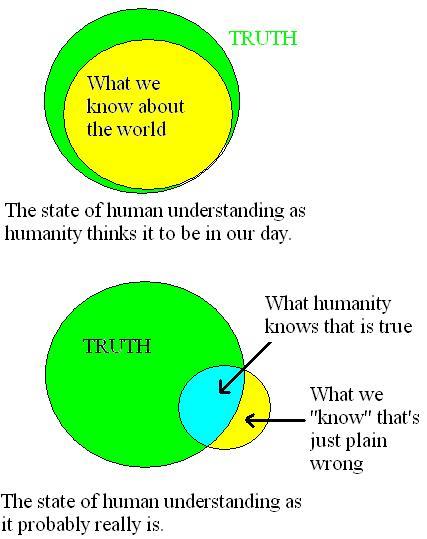
Socrates’ lesson remains valid today. It is the scourge of all ages to think that have finally attained true understanding of the world. Our posterity may know more, but we know all of the essentials and are rapidly converging on a complete picture of our world. We think our generation to be humanity’s sage elders, when, in fact, we are the impetuous teen whose growth spurt has made him cocky. I would propose to you that in all likelihood, even today, the sets of “that which is true” and “that which humanity ‘knows'” form a classic interlinking Venn Diagram. That is, some of the body of knowledge that we take to be proven true is, in fact, false. This occurs because we cannot accept that there are things we are not yet prepared to know, so we use sloppy methodology to “prove” or “disprove.” This one reason we have all these conflicting reports. E.g. coffee is good for you one week, and carcinogenic the next.

VennDiagram_WhatWeKnow

Socrates uses the method that today bears his name, i.e. the Socratic method, to challenge the arguments of Meletus, the prosecutor. The Socratic method uses questions as a device to lead the opposition to a conclusion based on premises they themselves state in the form of their answers. Socrates proposes that if it is he alone who is intentionally corrupting the youth, they would not come around–for no one prefers to be subjected to evil rather than good.

Socrates denies the suggestion that he does not believe in the gods, and in fact indicates that the very suggestion by virtue of the charges against him is a contradiction. What Socrates is guilty of is encouraging those who come around him to develop their own thoughts on god, and not to subordinate their thought to anyone–an idea the leaders found disconcerting.

Socrates goes on to say why he is unmoved by the death sentence. He wonders why it is thought he should beg and wail, when he doesn’t know for sure that an evil is being done against him.

The moral of the story is that those in power fear and will attempt to destroy advocates of free thinking.

This book should be read in conjunction with a couple other Platonic Dialogues, Crito and Phaedo.

View all my reviews

Who Am I?

“I” am a collection of cells.
some  expressly invited by “my” genes
others are interlopers,  “my” guts their cross-town bus
but these interlopers defend “me”  daily
fending off worse marauders
thankfully
so “I” let them stay inside “me”
“my” greatest shame? “I” am a slave owner.
the  mitochondria in “my” cells  are trapped and  forced to serve “me”
all this begs one fundamental question,
am “I” really just a “me?”
or  a  whole society?

If “my” parts
needn’t be fully integrated
where do “I” end and “you” begin?
can “I” say that “I” have been everywhere?
well, everywhere on this tiny, spherical-ish speck of galactic dust?

BOOK REVIEW: The Journeys of Socrates by Dan Millman

The Journeys of SocratesThe Journeys of Socrates by Dan Millman

My rating: 4 of 5 stars

The Journeys of Socrates shines the spotlight on Dan Millman’s mysterious teacher from The Way of the Peaceful Warrior. We discover that Socrates was born Sergei in Russia to a Cossack father and a Jewish mother.

His youth is scarred by tragedy. His mother died in labor with him and his father died of alcohol poisoning while Sergei was away at military school. His only remaining relative that we know of, his grandfather, dies. He flees military school to avoid having to harass Jews as a soldier, and in the process he has to battle his arch-rival. He marries into a family, but that brings its own tragedy. His family by marriage are Jews living under false identities at a time when it is very dangerous to be a Russian Jew.

It is after this tragedy that Socrates’ search for warrior skills and revenge drive the narrative. In injecting so much tragedy into his life, Millman makes the main character’s transformation all the more impressive. At every turn, Socrates is faced with events that should fill him with bitterness and hatred, but he must keep going and learn to control his emotions to become the warrior that he wants to be.

He proceeds to train under a warrior trained in the way of Japanese swordsmanship, a man named Razin. Razin only reluctantly accepts him as a student. He then lives at a hermitage, learning to reign in his mind and to respond freely and appropriately to attacks. His teacher at the hermitage, Father Serafim, teaches him to fight, while encouraging him to give up his vendetta. Finally, he travels abroad to train with a convened collection of sages from various traditions (Taoism, Buddhism, Judaism, Christianity,etc.)

Socrates narrative arc is well developed. He is pitted against a powerful enemy named Zakolyev, aka Gregor Stakkos, a military school rival who became an antisemitic Cossack gang leader. Socrates is reluctantly drawn into a final decisive battle with this nemesis, but there is a twist at the end to further complicate that event.

I’ll admit I’ve had mixed feelings about Millman’s work. I was a big fan of the original books Way of the Peaceful Warrior and to a lesser extent Sacred Journey of the Peaceful Warrior. Those books provided great insight into mind-body development in a readable narrative form. However, I later picked up one of his subsequent books and found it to be some sort of numerology/astrology drivel. That was disconcerting not only because it offended my sensibilities as a Cartesian skeptic, but even more so because it seemed to fly in the face of the Peaceful Warrior message– which was one of self-empowerment, not passive acceptance of some randomly bestowed fate.

So I picked The Journeys of Socrates reluctantly. However, I found this book to be the most readable of all. It is written like a novel or the memoir of someone who led the rare novel-shaped life.

View all my reviews

BOOK REVIEW: Ishmael by Daniel Quinn

Ishmael: An Adventure of the Mind and SpiritIshmael: An Adventure of the Mind and Spirit by Daniel Quinn

My rating: 4 of 5 stars

A man answers an ad that says, “Teacher seeks pupil. Must have an earnest desire to save the world. Apply in person.” Expecting to find a charlatan, the man is surprised to find his new teacher is, in fact, a gorilla.

Like Socrates, this gorilla, Ishmael, uses questions to guide his pupil toward crucial knowledge. Ismael teaches his student to challenge some of his most deep-seated beliefs such as, the world was made for humans, humans are the ultimate culmination of biology, humans are inherently separate from (and above) nature, and that humans are fundamentally flawed in such a way as to make ruination of the planet inevitable.

The core of the book differentiates two human cultures. The author calls them the “takers” and the “leavers,” but they correspond to what we might call “us” and the “aboriginal peoples.” Takers are specialized, agricultural, and technologically advanced (if you’re reading this review on a computer and not chiseled on a cave wall, you, my friend, are a taker.)

The lives of “Leavers” aren’t that different from those of humans 10,000 years ago. They are tribal as opposed to (to borrow Desmond Morris’s term) super-tribal. [In a tribe everyone knows everyone else. Morris suggests that things go to shit –re: war, crime, and deviant behavior– in super-tribal societies.] Leavers live like animals in that they tend towards equilibrium within their ecosystem. Takers do not.

If you long for thrillers or potboilers, this isn’t the book for you. It’s a thinking person’s book. The nice thing about Ishmael’s use of the Socratic method is that one can think through the questions in parallel to the narrator’s discovery. In this way, the reader can install himself or herself into the conversation.

At the most generic level, the book’s value is in showing one how much one takes for granted. We can’t see forests for trees.

One may agree or disagree with the author, but either way one will be subjected to powerful food for thought. Some of the discussion may evoke a visceral emotional reaction that one may have trouble reconciling with logic, such as the discussion of the morality of feeding the starving.

The downside of the book is that the dialogue can be strained in places and it can get a bit repetitive. The latter serves to reinforce key concepts, but some of them feel as though they are reinforced inordinately. In making the narrating protagonist struggle, Quinn creates a lead who seems a bit dense sometimes. Also, as I indicated, the journey is by-and-large in the mind, and so the tension is limited. There is some drama when the narrator shows up one day to find that Ishmael has been evicted. However, this is resolved without too great a difficulty and they resume lessons with  Ishmael’s irritability being the only change to be seen. There is drama at the end that will remain unspoiled herein.

I’d recommend this book as a thought-provoking exercise for the mind.

View all my reviews

TODAY’S RANT: Emerson Haters

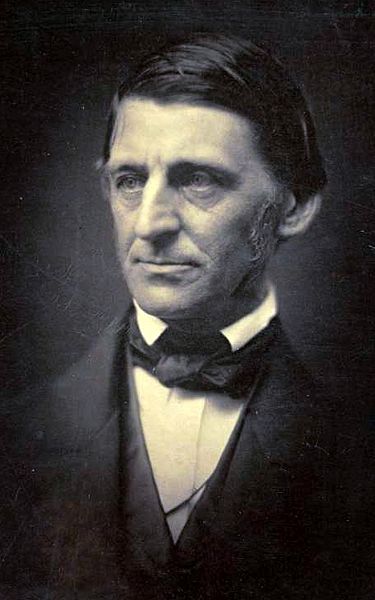
Ralph_Waldo_Emerson_ca1857_retouchedI began reading the Best American Essays of 2012 and was disappointed by the first  essay entitled, The Foul Reign of Self-Reliance by Benjamin Anastas.

Self-Reliance: In or out of the canon?:

Anastas rails against the essay Self-Reliance by Ralph Waldo Emerson. The only nice thing he has to say about Emerson (as a parenthetical insert) was that the philosopher spoke out against slavery and the poor treatment of American Indians.  Anastas suggests Emerson’s essay should be eliminated from the  canon of required reading. This desire to censor ideas that he (or his collective) find objectionable is a telling indicator of why he finds Emerson so vile. In my ideal world, students would read Emerson and Marx and Jefferson and Socrates and Confucius and eventually even the likes of Hitler and they’d make up their own minds about what ideas were sound and which were suspect. I’m  confident that on the whole that a free-thinking people will overwhelming reject the poorest and most vile of ideas. Obviously, not all will draw the same conclusions as I about which ideas are best, but I prefer the company of such people to those who completely agree with me but have turned their thinking caps off. Anastas seems to favor control of the flow of ideas to those society or teachers or some collective finds agreeable.

An undeniably powerful idea:

About all that Anastas and I agree on is that the thesis of Emerson’s Self-Reliance is powerful. By a powerful idea, I mean one that has the ability to grab a reader by the collar and demand his or her attention –whether they like it or not. Where Anastas sees Emerson’s ideas as perniciously powerful, I see them as sagely powerful. While we seem to be in near complete disagreement, I don’t want to go into a point by point refutation. I want to focus on what I believe is Anastas’s central point, that our current political dysfunction is the fault of Emersonian thinking. On this I think Anastas is shows perfection in his wrongheadedness.

The reason I don’t bother arguing point by point is because  much of my difference of opinion with Anastas comes down to being on radically different places on the Borg-Anarchist continuum. Reasonable people may disagree. I have a set of beliefs that inform my position on the Borg-Anarchist continuum that range from my opinion on free will to ideas about the value of optimizing (minimizing) what I would call “social friction” (others have used that term in another way.) That’s neither here nor there, Anastas may have his own justification for his views, though he doesn’t lay them out. For example, he uses the phrase, “excessive love of individual liberty” without indicating what he believes would be the appropriate amount to love liberty, let alone how he drew his conclusion. It may be that he doesn’t have a rationale, but rather has suborned his views to some collective that he believes is representative of society (that would be the true anti-Emersonian approach.)

The Borg-Anarchist continuum:

I should explain what I call the “Borg-Anarchist continuum” for those who are neither Star Trek fans nor wonky. Humans are inescapably both individualistic and social creatures. We know that people get morbidly depressed when they feel they aren’t valued as individuals (Tom Hanks at the beginning of Joe Versus the Volcano), but it’s also true that people go nuts when they are completely isolated from others (Tom Hanks in Castaway.) [Please, don’t draw conclusions about which is “better” on the relative merit of those two movies.] This leads to one of our most fundamental dilemmas. Where our individuality bumps up a social unit, how does one reconcile theses conflicts?

We can imagine a continuum where at one end are the Borg and at the other end are Anarchists. Borg were a powerful enemy in the Star Trek universe. The Borg were a collective in which any given individual was inconsequential and all gave themselves fully to the objective of the collective (i.e. universal domination.) Anarchists are those who feel there should be no authority over the individual. Virtually no one fits into the extreme camps because they’re both blatantly flawed. No one would have any incentive to do anything in Borg world, and an anarchy will inevitably devolve into chaos. No one would invite the Borg or Anarchists to their cocktail party. In practice, one might think of a Communist-Libertarian continuum. Communists believe the state owns the means of production and should be able to regulate ideas as intimately personal as religion, but they don’t attempt to completely stamp out all vestiges of individuality (e.g. people still have names instead of the Borg’s “4 of 7.”) Libertarians believe that authority over the individual should be minimal, but that there’s a role for governance in punishing the illegitimate use of force or the use of fraud.

Yes, I realize that in being one-dimensional, a Republican and a Democrat could occupy the exact same space on the continuum (i.e. wanting the same amount of governance, just not in the exact same domain.)

Is political dysfunction a product of Emersonian thought?:

So, let’s go back to the issue of blaming political dysfunction on Emersonian ideals. It’s my belief that we have political dysfunction because politicians aren’t following Emerson’s advice, rather than that too many are doing so. Let’s consider Anastas’s argument.

“’A man is to carry himself in the presence of all opposition,’ Emerson advises, ‘as if every thing were titular and ephemeral but he.’ If this isn’t the official motto of the 112th Congress of the United States, well, it should be.”

Anastas is saying that the idea that one shouldn’t bend to the ideas of other men, as suggested by Emerson, is the cause of the problem. However, this requires us to believe that politicians engaged in free thinking consistently come down in the perfectly bifurcated set of positions required for grid-lock to take hold on a wide range of issues.  This is dubious. I find it much more probable that politicians do not think freely, but rather they subordinate their opinion to their party and to what the people of their district think. That, my friends, is the source of the problem. Politicians are doing exactly what Anastas wants, which is subordinating their opinion to the majority in their districts. The two-part problem is that: a.) districts are drawn to have clear winners. b.) our society has abandoned the Emersonian idea and taken party and sect as a substitute for thinking. We’ve created a two-party grid-lock machine, and we’re surprised that it works.

Yes, Emerson tells us to be obstinate in holding to ones own beliefs in the face of other people. If every politician did this, our political field would be much richer with many sets of opinions and not just the two captured by the party platforms of the two ruling parties. (At least it wouldn’t hold sway always on anything important.)  What Emerson does not ask of us is to be obstinate in the face of new or better information. Anastas’s own selection of quotes says as much.

“Speak what you think now in hard words,” Emerson exhorted, “and tomorrow speak what tomorrow thinks in hard words again, though it contradict every thing you said today.”

In other words, Emerson is suggesting that one should be able to change one’s mind (one just shouldn’t do this in deference to the views of other people.) One should changes one’s mind when one has new or better information or one’s thinking about the subject is clearer. Changing one’s mind has a bad rap in our political system. There’s a kind of changing of one’s mind that should leave us with a bad taste in our mouths, and that’s pandering. However, not all mind-changing is pandering. If we ask a politician why he changed his mind and he says, “Because I learned X, and that new information made me conclude Y,” then that person should be applauded. The ideas of people of party and sect don’t change regardless of new information. This stagnancy is part of the problem as well. An individual can change his or her mind rapidly but an ideological organization is never swift. When people subordinate their thinking to their sect, this is when we end up unable to get out-of-the-way of slow-moving freight train problems like many that we face today.

The animus that characterizes our political domain is not a function of Emersonian thinking. While Emerson may not address it because it isn’t part of what he’s trying to get across in this essay, it stands to reason that if everyone thinks for themselves people will draw different conclusions. The Maytag repairman is not the loneliest person; the loneliest person in the world is a free-thinker who can’t get along with people who don’t share his exact slate of thinking across a range of  subjects. Thinking for oneself is not only consistent with tolerance, it breeds it. It’s only when one conforms one’s thinking to that of a collective that one can afford to act like people who think differently from one are pure evil.

Other thoughts on the subject:

For another post of mine about Emerson’s Self-Reliance see here.

Also, Emerson was not the only one in the 19th century who was dismayed by the trend toward subordinating political views to party, Mark Twain had a lighter essay on the subject called Corn Pone Opinions.