PROMPT: Technology

What technology would you be better off without, why?

That’s a tough question. While not a Luddite, I do think there are a number of technologies that are out of control, figuratively (or may – literally – become so.) But that doesn’t mean I think they should be gone altogether (it just makes me wishful that people can find a way to moderate their use.)

I’ll go with nuclear weapons, the one technology whose only use lies in not being used. I choose them because they result in low-level existential dread and inflated tax bills. [There is the argument that they may have staved off a colossal Third World War, but one can also argue that two really shitty wars in rapid succession led to institutions (e.g. UN agencies & permanent alliances) and approaches (e.g. low-intensity proxy wars) to avert such a war as well (Those things also being extremely expensive, but not so much with the existential dread.)]

BOOKS: “Nuclear War” by Annie Jacobsen

Nuclear War: A ScenarioNuclear War: A Scenario by Annie Jacobsen
My rating: 5 of 5 stars

Amazon.in Page

Release Date: March 28, 2024

Annie Jacobsen’s new book is fascinating and — quite frankly — horrifying from cover to cover. The book presents a hypothetical minute by minute unfolding of events that culminate in full-scale nuclear war and the end of the world as we know it. A four-hundred-page book that breaks down the events of an hour may sound like a recipe for tedium, like Joyce’s seven-hundred-plus page elaboration of the events of a single day in “Ulysses.” But, it is anything but. There is so much to explore amid the concepts like “the nuclear football” and MAD (Mutually Assured Destruction,) and EMP’s (Electromagnetic Pulse weapons.) There is also so much to go wrong, and much that is virtually certainly go wrong.

That last sentence might suggest that the book takes an excessively pessimistic view to create drama. Sadly, it does not need to. The ultra-fast timeline of nuclear calculus does the work of ensuring that many things will go terrifyingly and irreparably wrong. Decision makers have a short window to make decisions, and “use-’em-or-lose-’em” thinking plays a major role in decision making. (i.e. One can’t count on delaying a decision about a counter response because one’s delivery infrastructure — notably, the human bit of it — will likely be destroyed if one absorbs the first strike.) There is also the fact that — counter to all the abort buttons seen in the movies — once missiles are launched, there is no way to stop them. [A bit of “Dr. Strangelove” writ into the system.] At many of the points at which it may seem that Jacobsen is being pessimistic for effect, she explains the basis for her pessimism: from historical events like the failure of the nuclear hotline to commentary by experts.

Lest one think that nuclear warfare is a threat of the past, and that it’s a solved problem, Jacobsen’s scenario reminds us that it’s not just a matter of NATO v the Warsaw Pact (i.e. America v the USSR in the common conception) anymore. She does this by using North Korea as the instigator. We don’t ever learn the Kims’ theoretical motivation, but all one really needs to know to make one nervous is that the DPRK has been quite happy playing the role of pariah, engaging in a number of activities in violation of international law and norms, as well as that Kim Jong Un might just believe some of the ridiculous things his yes-men tell him. (Not to mention the famines and other destabilizing conditions that could lead some other inside actor or group of actors to take unanticipated actions.) The truly disturbing part is to see how easily a strike by the DPRK could draw Russia or possibly China into the nuclear exchange. [Russia because it’s in the path between the US and the DPRK, and China because it could suffer massive casualties from strikes on North Korean facilities near the border that send radiation to sizable Chinese population centers.]

This book is a must-read for anyone who thinks nuclear weapons are the problem of a bygone era.

View all my reviews

PROMPT: Un-invent

If you could un-invent something, what would it be?

Being acquainted with the Law of Unintended Consequences, there isn’t a thing I’d un-invent. You start arrogantly messing in the natural progression of things, and you never know what kind of monster you’ll birth.

Once upon a time, I might have said nuclear weapons (still a strong contender for ender of our species.) Then again, who knows what kind of horrific World War III we might have had, had we not been forced to sober up a little.

Foul Winds [Free Verse]

As a boy, I remember reading about 
the horse latitudes.
Those were the places in the ocean
where - at times - the winds didn't blow
for long periods at a time. 

Drifting in the middle of the Atlantic,
sailors would cut loose anything that
wouldn't keep them alive
& which might weigh them down,
that sometimes meant shoving horses
overboard to tread water 'til
they died from exhaustion.

People used to live or die by the winds.
Today, we only die by them.

That's what occurred to me as we sit
closer to nuclear annihilation than we've been
since I was a teenager,
and as I reflect upon
the prevailing winds. 

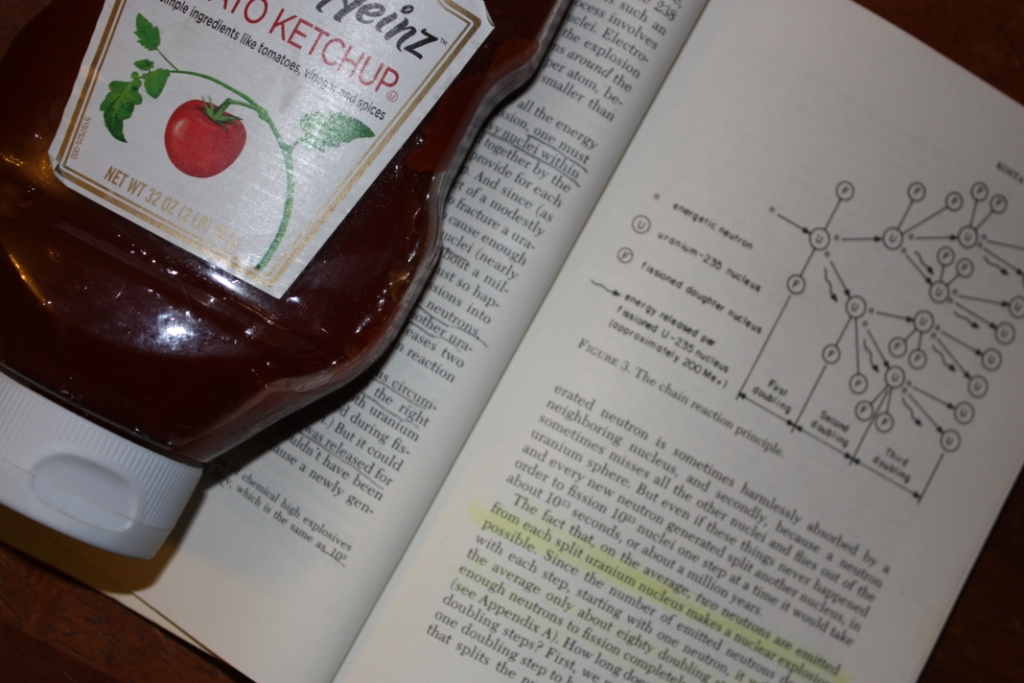
TODAY’S RANT: Nukes and Ketchup

Why was there no Manhattan Project for Ketchup?

Why was there no Manhattan Project for Ketchup?

How come we mastered the thermonuclear warhead decades before we did the ketchup bottle?

Building a nuke took:

– the greatest scientific minds Hungary ever produced (You scoff, but Hungary’s claim to fame is driving out more Nobel Laureates and top-rate scientific minds than most countries will ever hope to produce. [e.g. Teller, Szilard, Wigner, von Neumann, etc.] If they didn’t let jackwagons run their country, they’d probably rule the world by now.)
– $42 billion in current-year US dollars
– the Project Manager who built the Pentagon
– and a whopping two or three years (for the fission weapon)

Building a decent ketchup bottle shouldn’t have even required an Algonquin Round-table  It could have been achieved by two morons sitting around at a barbecue.

Moron one says, “You knows what would be delightful, if this bottle was squeezable plastic, not glass.”

Moron two says, “Dude, you are so right, and what if they turned it upside-down so that all the ketchup stayed near the hole?”

Bob’s your uncle, the ketchup bottle is perfected.

Do you know what kind of Galactic douche-bags this makes humanity look like? It makes it seem like we don’t care about our condiments.
Oh, but we do. I’ve seen it. I’ve seen a man in Boise use no less than 42 packets of ketchup on his fries. I saw a rotund woman in Phoenix use half a jug of mustard on her hot dogs. I saw a canuck slather mayo on his burger (what is up with that, Canada.) From sea to that other sea, amid the prairie dogs, through the alligator-infested swamps, across those bruised mountains, I’ve seen a divinely inspired love of sauces throughout our great nation (and that ancillary nation to the north.)

No wonder aliens haven’t visited us; they probably haven’t received word across the light-years that we’ve mastered ketchup. Or maybe it’s the fact that we haven’t built a plastic fork whose tines could stick up to a sturdy gherkin. (But that outrage is for another day. Yes, manufacturers of disposable flatware, you too will taste my wrath.)