BOOKS: “The Dangerous Life and Ideas of Diogenes the Cynic” by Jean-Manuel Roubineau

The Dangerous Life and Ideas of Diogenes the CynicThe Dangerous Life and Ideas of Diogenes the Cynic by Jean-Manuel Roubineau
My rating: 5 of 5 stars

Amazon.in Page

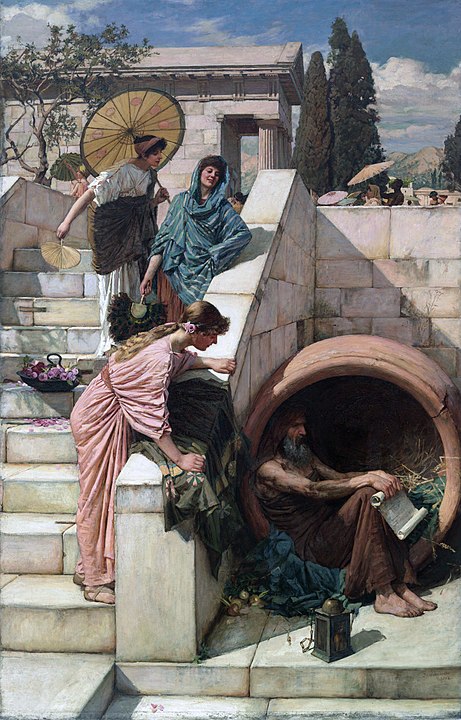
This is a translation of a French book about the life and philosophy of Diogenes the Cynic. It’s a thin volume, as there is much that’s unknown about the life of Diogenes, and the dearth of surviving texts means that some of what is believed about Diogenes and Cynic philosophy maybe corrupted by the reports of detractors. I learned a great deal from reading this book, but not because I learned much new about Diogenes, himself. The colorful anecdotes from his life have been extensively discussed.

With respect to what I did learn, it largely fell into three categories. First, I gained insight into the context and environment in which Diogenes lived. Second, I discovered that many of the stories of Diogenes’ life are far less certain than we have been led to believe through the presentations of them in so many books. For example, we know Diogenes was exiled from his native Sinope in relation to a scheme involving currency debasement. This is often straightforwardly stated as “Diogenes was a counterfeiter,” but Roubineau shows that we don’t know much (if anything) about the degree to which Diogenes was involved (i.e. whether he was mastermind, accomplice, or an unwitting pawn.) Third, I benefited from the comparing and contrasting of Cynic philosophy with that of predecessors (e.g. Socratics) and successors (e.g. Stoics,) and – in a few cases – comparisons between Diogenes and other Cynics.

The book consists of four chapters. The first is a discussion of what is known about Diogenes as a historical figure. The second focuses on the Cynics views on economy, wealth, and related ideas. The third explores the Cynic view of the human body and related topics like sex, pleasure, and pursuit of health and well-being. The last chapter considers Diogenes as a teacher and the Cynic approach to practicing philosophy.

I’d highly recommend this book for readers interested in philosophy.


View all my reviews

PROMPT: Objects / Can’t Live Without

Daily writing prompt
What are three objects you couldn’t live without?

I’ll need some sort of container capable of holding water, some variety of pointy stick, and something sharp like knapped flint or a length of hard metal.

BOOKS: “Hōjōki” by Kamo no Chōmei; Trans. by Matthew Stavros

Hojoki: A Buddhist Reflection on Solitude: Imperfection and Transcendence - Bilingual English and Japanese Texts with Free Online Audio RecordingsHojoki: A Buddhist Reflection on Solitude: Imperfection and Transcendence – Bilingual English and Japanese Texts with Free Online Audio Recordings by Kamo no Chōmei
My rating: 5 of 5 stars

Amazon.in Page

Release Date: May 7, 2024 [for Tuttle’s bilingual edition]

This is the Japanese Walden, except that it was written several hundred years before Thoreau’s essay and was predominantly philosophically informed by Buddhism rather than Transcendentalism. (Though those philosophical systems do agree on a number of points, most relevantly that materialism is not a sound route to happiness.) Like Walden, Hōjōki is an autobiographical promotion of the hermitic lifestyle. Both works sing the virtues of life in a simple, rustic cabin in a natural setting, a life of minimalism and subsistence living.

There are many translations of this work available, and so I’ll spend the remainder of this review on what differentiates this edition from the two others that I’ve read. First and foremost, the other versions I’m familiar with were presented as prose essays. This edition is presented in verse, which I understand to be the form that the original Japanese work employed. I should say that in some places the work comes across as poetic in the conventional sense, though in others it seems like a versified essay.

Secondly, this edition has a few handy ancillary features. One is that it is bilingual. Romanized Japanese allows the reader to experience the sound quality of the original. This edition also has graphics in the form of maps, artwork, and photographs. Some of the graphics support or expand upon the information delivery while others seem to be more a matter of creating atmospherics. Also, there are explanatory endnotes that help readers unacquainted with Kamakura Period Japan to understand some of the book’s references that might otherwise remain unclear.

I enjoyed and benefited from reading this edition, even having read others. If you are looking for insight into the ascetic life, I’d highly recommend it.

View all my reviews

Five Wise Lines (February 2024)

“If one conforms to the world,
He’s bound to suffer.
If he doesn’t,
He’s considered mad.

Kamo no Chōmei, Hōjōki; [Stavros Trans.]

But nothing ever bores me. So much the worse for those who are moulded of boredom.

Salvador Dalí, Hidden Faces

All of humanity’s problems stem from man’s inability to sit quietly in a room alone.

Blaise pascal

I am in no way interested in immortality, but only in the taste of tea.

Lú Tóng (Poet of the Tang Era)

The man who wears the shoe knows best that it pinches and where it pinches, even if the expert shoemaker is the best judge of how the trouble is remedied.

John Dewey

Bonus Quote:

If you have a garden and a library, you have everything you need.

Marcus tullius cicero

PROMPT: Write Space

You get to build your perfect space for reading and writing. What’s it like?

Just a small, quiet room with a window for day and a light for the night. Minimalist. The less to distract, the better.

PROMPT: Ideal Home

Daily writing prompt
What does your ideal home look like?

It should be small enough that I won’t acquire new things without asking whether they are necessary, and whether their value exceeds their spatial cost. [And, also, such that it encourages spending time outside.] Besides that, it should be an environment within which one can live healthily.

PROMPT: Shop

If you were going to open up a shop, what would you sell?

Experiences. There are already too many stores selling geegaws and tchotchkes, and people are too good at buying and collecting them. Experiences! Now there’s a market with plenty of room for growth.

PROMPT: Comfort

What strategies do you use to increase comfort in your daily life?

I don’t, but I have a lot of strategies for being more content in the face of various situations and environments — including uncomfortable ones. These include the yogic practice of dispassionate witnessing, minimalism, travel (and specifically minimalist travel to places – the less familiar the better,) and intense physical activity.

I think comfort as a major objective in life is overrated, and virtually insures a discontented life. A life in which one can be content, whatever may come along, is a happy life.

Cynic Limerick

The philosopher named Diogenes
was like a dog... known to have fleas.
-failed to find an honest man.
-didn't let "Greatness" block his tan.
But he lived simply, and as he pleased.

Simplify [Free Verse]

One item per day 
was abandoned
until living got hard.

But like Diogenes -- 
who gave up his cup
upon seeing a boy 
slurping from cupped palms -- 
eventually, it all was gone.

Each item hand-weighed,
its weight against is usefulness,
and all were found expendable.