BOOK REVIEW: Stealing Fire by Steven Kotler and Jamie Wheal

Stealing Fire: How Silicon Valley, the Navy SEALs, and Maverick Scientists Are Revolutionizing the Way We Live and WorkStealing Fire: How Silicon Valley, the Navy SEALs, and Maverick Scientists Are Revolutionizing the Way We Live and Work by Steven Kotler
My rating: 5 of 5 stars

Amazon page


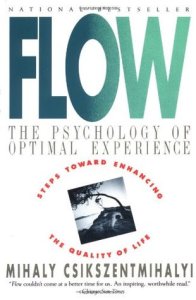
“Altered states of consciousness” conjures visions of rogue scientists hitting hallucinogens and then sealing themselves up in sensory deprivation tanks until they either have a breakthrough or a breakdown. This book may touch on such activities, but it’s about something else. It’s about the states of consciousness in which the part of the mind that is critical, overly cautious, and always creating worst case scenarios fades into the background, allowing one to be more effective, happier, and to drop one’s neurotic tendencies. Kotler and Wheal refer to this as ecstasis, borrowing from the Greek word meaning “to get outside oneself.” They differentiate it from the Flow of Mihaly Csikszentmihalyi with which it clearly has overlap. (One of the authors, Kotler, wrote a great book on the exploitation of Flow by extreme athletes entitled “The Rise of Superman.”) [I’d love to see a Venn diagram of how they see these states overlapping, but—alas—one isn’t provided, though there is some discussion of it.]


The book is organized into three parts. The first part consists of three chapters and it both explores what ecstasis is and why it’s so hard to find. The story of how the Navy SEALs designs training to build group Flow states on command is illuminating as is the second chapter’s discussion of how Jason Silva found ecstasis through freewheeling philosophizing. The third of the chapters describes three prominent barriers to achieving these states of mind. These barriers are among the reasons for the rarity of these altered states even though they’re available to everyone.


The heart of the book is the second part which describes four avenues by which people pursue these altered states of consciousness: psychology, neurobiology, pharmacology, and technology. The chapter on psychology uses a dialogue series between Oprah and Eckhart Tolle as a stepping off point, probably more because of what it tells us about the scale of yearning for ways to get outside of one’s head than because of the dialogues’ value in facilitating that condition. Positive psychology as recipient of a mantle once held by religion and spiritualism is an important theme in this chapter.


The neurobiology chapter isn’t just about the biology of the brain and nervous system; it’s about the integration of brain and body. In it, we learn about how expressions, postures, and gestures can influence our state of mind.


Many apparently believe that the story of pharmacology is a much bigger part of this book than it actually is, but it’s a part that’s hard to ignore. As one who seeks non-pharmacological approaches to Flow (I’m more about yoga, meditation, and movement) I still found this chapter fascinating, and perhaps most so in its discussion of other species’ pursuit of chemically induced highs [particularly that of dolphins.]


The technology discussed covers a range of approaches from biofeedback devices designed to help one navigate one’s way into the zone, to gear to help one engage in trigger activities at lower risk. For example, the mix of defiance of gravity and high-speed gliding experienced wing-suiting seems to be a potent trigger for ecstasis. It also seems to kill anyone who keeps doing it long enough. So the question is whether one can create the sensation and still achieve the trigger without inevitably experiencing an untimely demise.


The grimness of that last paragraph is an apropos lead-in to discussion of the book’s final part, which considers how one can organize one’s pursuit of ecstasis without running into the many pitfalls that coexist with it—from becoming a pleasure junky to dropping out of life to killing oneself. The first of three chapters in the final part discusses the Burning Man festival phenomena in great detail as well as other avenues by which people find themselves drawn into the pursuit of altered consciousness. The next chapter describes how both government and commercial firms have sought to exploit the bliss of these altered states. The last chapter is about how to merge daily life and pursuit of ecstasis in a balanced way so one avoids becoming a pleasure junky who runs his life aground on rocky shoals in pursuit of the next ecstasis fix.


The book is endnoted, and has some nice ancillary features—a number of which are available online with the link being given at the back of the book. An appendix that I found interesting was one entitled “Notes on Inside Baseball.” This section discussed a number of controversies that were outside the scope of the book, but which readers might wish to research in greater detail.


I found this book to be highly engaging. The authors use the narrative approach throughout to keep it interesting, while at the same time conveying complex ideas in an approachable fashion. They scour many disparate realms in search of this altered consciousness, and so there’s never a dull moment.


I’d recommend this book for anyone interested in learning more about how to shut down that perpetually critical and gloomy part of the brain so that one can achieve one’s optimal potential.

View all my reviews

5 Untruths Worth Pretending Are True

pretend_play_preschool


William James famously suggested that the path between emotion and expression wasn’t a one-way street. In other words, it’s not just that having an emotion causes us to express it through facial expressions and body language, but also that by assuming a given expressions we create the corresponding emotional state. James might have gone a little far in proposing the emotion can’t exist devoid of its expression, but he came by the belief that you could get to emotion through expression honestly enough.


I read about how James, suffering a bad cases of the blues, asked himself what would happen if he behaved as though he was in a happier state of mind. He decided to carry out this experiment, and he soon found himself in a much better mental state. This got me thinking about what else one might pretend that would yield positive results.


It should be noted, that there’s been a lot of research on this topic, and it’s been dubbed the “as if principle,” though colloquially people talk about it as “faking it till you make it.” Some of you may be familiar with this idea from the study showing that adopting a Wonder Woman stance made subjects feel more confident. If not, Amy Cuddy’s TED Talk can be viewed here.


So, here are five ideas–true or not–that are worth believing:


[Note: You’ve got to pretend as if you were a five-year old. Don’t bring those pathetic and puny adult imaginations.]


5.) I’m happy:  Starting with the self-ruse most widely known and which James brought to our attention. You may have heard the following advice: if you’re ever feeling down, stand up and pump your fists in the air at an upward angle such that one’s body forms a “Y” (or an “X if you want to keep your feet wide.) This is a hardwired victory behavior written into our evolutionary coding, and it’s hard to be depressed while doing it.


4. Oneness / Unity:  Try pretending that you’re connected to everything in the universe. The experience isn’t uncommon with mystics and meditators, as well as those in the Flow. This is an attempt to work it around from the other direction.

Now, some mystic-scientist out there is going to say that this isn’t an untruth because there’s evidence that we are connected to everything, citing quantum entanglement and such like. Maybe so, but as there’s no reason to believe we have a sensitivity to happenings at that quantum state, the pretending is still necessary. (i.e. Even if such entanglement exists, we can no more sense it than we could recognize if a force of 1-trillionth of a gram touched our skin.) Evolution doesn’t grant us capabilities beyond what are needed to survive to procreate, and so I’m doubtful that we have some untapped power to sense quantum entanglement lurking within us.) The oneness we feel has to do with the part of the brain that tracks the “I v.) not-I” divide fading out of operation–rather than an awareness of some web of subatomic entanglement.

This self-subterfuge is a way to simultaneously put one’s worries in perspective while not becoming demoralized about being an insignificant speck in a vast universe. One is an infinitesimal speck in an infinite universe, but one is tied into the universe such that one is simultaneously an infinite universe.


3.) Chi / Prana: I don’t think there’s any reason to believe that the immaterial energies of Eastern traditions (Taoism and Yoga, respectively) exist. However, I wouldn’t argue that there’s no benefit from imagining them to exist.  There seems to be little doubt that visualizing the flow of these energies can have benefits–regardless of whether they’re the traditionally advertised benefits or not. Even if you don’t succeed in pulling energy into one’s body directly, sans the middlemen of food and oxygen (so one can live off the dew on a single ginko leaf–ala “Kung Fu Panda”), visualization is good for the brain and the invigorated feeling one creates in pretending chi exists can’t hurt.


matrix

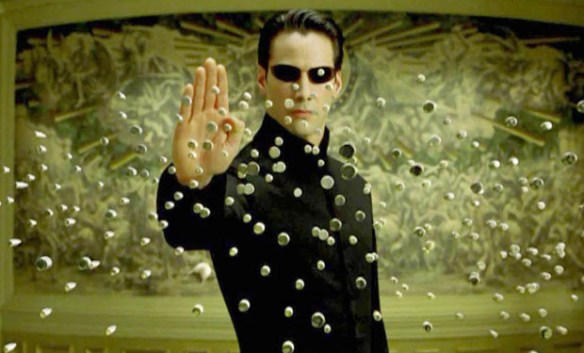
2.) “There is no spoon:”  This, of course, comes from the movie “The Matrix” in which a young sage / savant attempts to teach the protagonist, Neo, how he can bend a spoon with his mind. The upshot is that one doesn’t try to bend the spoon, one realizes that the spoon is a figment of the imagination.

The idea that we are part of a simulation may turn out to be less far-fetched than it seems. I cite, for example, the TED Talk by physics Nobel Laureate George Smoot.

At any rate, the virtue of the thought exercise of pretending this is true is two-fold. First, one can ask whether one would lead the same life and give events the same weight if one was to discover that one was living out a simulation designed to advance the understanding of some entity (e.g. an alien race, a colossal supercomputer, etc.) Second–and more importantly–one may become more attuned to the fact that one’s own mental / emotional world is full of dream-like simulations. One’s brain is designed to anticipate worst-case scenarios, and it’s exceedingly good at fabricating scenarios that taint our perception of the world with anticipated negative possibilities–most of which will never come to fruition. There are many variants, attributed to various speakers, of the following Mark Twain quote:

“I’ve had a lot of worries in my life, most of which never happened.”


1.) There is no I:  A core tenet of Buddhism is that there is no self. Depending what a self has to be to exist as an independent entity, science may yet converge on a similar conclusion. The self seems, at best, to be an emergent property. In the Anil Ananthaswamy book I recently reviewed, it’s compared to a center of gravity. There’s no molecule that can be called the center of gravity, it’s a property that moves around as the body does. It’s definable, but not in terms of a specific location or physical existence.

Pretending there is no self may help put many worries into perspective. Like #4, it may also help one feel more connected to a larger world. But most importantly, it may help one to turn off those parts of one’s mind that are prone to self-loathing, self-denigration, or just self-consciousness.


Happy pretending.

nightsky

BOOK REVIEW: Incognito by David Eagleman

IncognitoIncognito by David Eagleman
My rating: 4 of 5 stars

Amazon page


This is the book that started me on a fascination with the science of the subconscious mind. In it, Eagleman explains that our subconscious mind has a much bigger role than our consciousness lets us believe. We feel that the conscious mind is in charge of the whole enchilada of our mental being, but in reality the conscious is often late to the party while still managing to weave a narrative about how it saved the day. The conscious has an important role, but one much more limited than it seems, but because consciousness Is the frame through which we are aware the world, it’s easy to miss how much the subconscious handles.


The book is organized into seven chapters. The first chapter sets up the notion that the mind is like an iceberg, the subconscious is the more massive portion that lies below the waterline, and the conscious is the peak that lies above.


The second chapter explores the interface of the senses and the mind. We think that our sensory experience of the world is like looking through a spyglass, but it’s much more a secondary rendering—subject to editing and corruption. Eagleman discusses many illusions that serve to show us that our sensory experience is not as true as we feel it to be.


Chapter three investigates why it is that in some cases the more we think about a task the worse we do with it, and how biases show up even among those who swear they don’t have a racist notion in their body. A number of interesting cases, such as chicken sexing, are used to convey where our conscious mind is of no use to us. Anyone who’s practiced a martial art is aware that sometimes thinking is death.


The fourth chapter explains concepts like instinct and our perception of beauty and attractiveness. It’s entitled, “The Kind of Thoughts That Are Thinkable,” and that gives some insight into the theme.


The next chapter covers one of the most important ideas of the book, that our brains are not all on one page on any given idea. This is one thing that our conscious mind dupes us into believing, that we have a certain belief and that we are uniformly of that view. In fact, our reasoning and emotional systems often have quite different perspectives on a matter. As I mentioned earlier the people who think they don’t have a racist notion in their body. In one sense, they are correct in that they can reason that it’s illogical to think of people differently based on skin color, but such a person still often shows a marked bias when asked to make associations that are made more quickly when they are not at odds for the subconscious.


Chapter 6 gets into the policy ramifications of what has been discussed to this point. If decisions aren’t a product of the conscious mind, then are we right to send people to prison for crimes that they didn’t consciously decide to commit and couldn’t have consciously overruled? The case of Charles Whitman who took up a sniper position in the University of Texas clock tower in 1966 takes center stage in this discussion. Whitman suffered a great change of behavior that was posthumously (by autopsy) linked to the development of a tumor. Eagleman proposes that the traditional question of blameworthiness is the wrong one.


The last chapter reflects upon what it means to be a human person in light of a mind arising from material activity. A central idea is the self as an emergent property rather than the “thing” we feel it to be.


The book presents many monochrome graphics of various types to support the text. It’s also annotated and has a substantial bibliographic section.


I’d recommend this book for anyone interested the nature of the subconscious mind. Eagleman uses interesting cases to demonstrate his points. This makes it quite readable while conveying some challenging ideas.

View all my reviews

5 Ways to Manage Your Email & Social Media Addiction

Addiction? That seems harsh. It feels like I’m equating a person who has his phone in hand several times every hour with a heroin junky or a nymphomaniac. But, the difference is in the word “Manage.” I wouldn’t write a post entitled “How to Manage your Heroin Addition.” I’d write one called, “Quit that Shit Before it Kills You.”  I’m not suggesting that one needs to do away with checking email and social media. These are great tools that allow us to be much more productive (potentially.)


Still, if we’re honest about it, most of us at some point get caught up in the compulsive checking of emails, social media, internet feeds, click-bait sites, sale pages for online retailers, and stats pages. There’s no denying it. A pile of evidence has accumulated about the extent to which people are dismayed by their own e-world activities. I just started reading Kotler and Wheal’s “Stealing Fire” (out February 21, 2017) and they site a study that found that about 2/3rds of those surveyed admitted checking their status page when they woke up in the middle of the night. It might seem off topic for book about altered states of consciousness to report on such matters, but its not because it’s all about the pursuit of a neurochemical bump. (Also, as I’ll discuss, a major problem of this addiction is in keeping one from slipping into the Flow with one’s work, family, or hobby activities.)


So, below are five methods I’ve found useful in my own on-going struggle with this addiction.


5.) Set a timer:  The problem with this addiction is that when one falls into habitually checking one’s status, one isn’t able to stay on task, and that means that one won’t achieve that elusive state of optimal performance called Flow. One needs time to immerse oneself in a task.


When I’m writing and editing, I set a timer, and until it beeps I do nothing off topic. I don’t make it some Herculean effort. I use 60 and 90 minute intervals. After the alarm rings, I can check email, do Tai Chi, get a cup of coffee, or work on my handstands. A longer time period may be more–or less–beneficial for you. (Isaac Asimov was said to only take a break after 5,000 words, but few writers have that in them.) The point is to make it long enough that one can get into a focused state of mind, but not so long that you become distracted and run down.


4.) Know your high energy period: This point relates to the last because it’s about blocking one’s productive time, and putting the more Flow-demanding activities when one is at one’s best. e.g. Are you a lark or an owl? (i.e. morning person or evening person.)


For example, I’m a morning person. This creates a potential problem. While I find it easy to get up with the sun, I’m at risk of saying, “Oh, I’ll just check emails, Facebook, my blog stats, a couple YouTube channels, and then I’ll get to work.” Then it’s noon, and the hours in which my mind was at its very best are gone. From 7pm until I go to sleep is when I should check these feeds because by that time my mind isn’t good for editing or writing tasks that require a high level of attention to detail.


3.) Go Cold Turkey [for a few days]: Sometimes it’s easier to make changes when one is forced by circumstance to quit. Then one can be more conscientious in resumption of the activity in question. (Moving to India helped me break a lot of bad habits.) If nothing else, this will help to give you confidence that the Earth won’t roll off it’s axis just because you aren’t checking on it twice an hour.


I can offer two examples from my own life. Every year my wife and I go on an extended trek in a place where there are no bars and saving batteries is essential. The past couple years, this has been in the Himalayas because we’ve been living in India, but anywhere remote will work. I also did the Vipassana Meditation Course last year. (If you’re interested in the latter, you can read my account of it here.)

img_1397


2.) Meditate: Why? Because when you start meditating regularly, you tend to do less and less out of mindless habit. You become conscious of what you’re doing, and that’s the first step to making changes. You also start to become attuned to those very subtle dopamine bumps, and in that way you  aren’t fighting it the impulse blindly. The high of the click is infinitesimally more subtle than taking mind altering substances, and so it’s easy for this all to take place below the waterline (analogizing the mind to an iceberg but instead of the majority of the mass of ice below the waterline, it’s the conscious mind above and the subconscious below.)

img_1556


1.) Substitute: In the immortal word of the rock band “The Who.” If your problem is so extensive that it does more than block your attempts to hit the Flow, you may need to find a healthier alternative to wean yourself away.


What does one look for in a substitute? If it’s going to fill the same space, it requires immediate feedback and a mix of “fails” mixed in with “successes.” These are the components that make the e-world so addictive. We know immediately whether we got something or not, and that keeps us clicking–not unlike the famous rats that would keep pressing a button for pleasure even to the point of forgetting to eat.


Some people may work on games that will help build their brain. (Warning: just don’t trade one unproductive addiction for another.) I’m an advocate of working on physical activities (e.g. trying to develop new capabilities in calisthenics or yoga), but these often involve a demoralizing amount of fails to reach the optimal level (the optimal being that one has enough fails to keep it from being boring but not so many that one is brutalized.)

POEM: Mind Gravity: or, The Heft of Mental Putrefaction

depression-in-bed

Gravity pulls her head down into the pillow.

Like tar through a garden hose, thoughts flow.

Thoughts weighty, not freed of mass and matter.

As stuck in time and lost to reason as the Hatter.

Thoughts arise because they’re lighter than air.

Hers fell sodden, a lead balloon in the state fair.

The infection arose from a single putrid notion.

One drop floating free to fester across an ocean.

That she wasn’t enough. Enough for whom? Enough for what?

Unanswerable questions that congealed into a sluggish pus.

They say truth has weight, but truth lifts one to fly free.

What pulled her head to pillow was the mass of negativity.

As her thoughts hardened into a slag, devoid of truth or reason.

She summoned the strength for a search in her final season.

She scoured the four corners of the Earth for a fabled cure.

But it lie in a place close at hand, but vastly more obscure.

5 Books to Introduce You to Your Subconscious

In a world free of frontiers, the subconscious mind is the final frontier.


Below are a few books that I found useful. The hyperlinks forward to my review on GoodReads or the book’s GoodReads page.


Also, I’ve included three honorable mention books that I haven’t yet reviewed, but which seem both relevant and intriguing.


5.) Brainwashing by Kathleen Taylor: What makes some minds more malleable than others and how are minds bent to a given purpose? In learning the answers, one discovers that the bases of our beliefs are often more deep-seated than one might believe.

brainwashing_taylor


4.) Sleights of Mind by Macknik & Martinez-Conde: Magicians and mentalists are notoriously skilled at exploiting the chinks in the armor of  our minds.

sleights_of_mind


3.) Subliminal by Leonard Mlodinow: Physicist and pop science writer, Leonard Mlodinow, explores the many ways in which our behavior is more influenced from the back of the house than we feel to be the case.

subliminal


2.) The Tibetan Yogas of Dream and Sleep by Tenzin Wangyal Rinpoche: This is my nod to the fact that the Western scientific community isn’t the only entity that has something useful to say on this subject. Tibetan Buddhists have a long tradition (arguably predating Buddhism and into the Bon-era) of dream yoga (lucid dreaming) and our dreams offer the greatest portal to the subconscious.

tibetanyogas


1.) Incognito by David Eagleman: Eagleman tells us that our conscious mind represents the tip of the mental iceberg, and he explores the many ways in which we are subject to the vagaries of what exists below the surface.

incognito_eagleman


Here are a few others.


The Man Who Wasn’t There by Anil Ananthaswamy: I just finished this book. In it, the author investigates whether there really is  such a thing as the self by studying a number of diseases and phenomena of the mind that look like negations of self. (e.g. Cotard’s Syndrome in which people insist they are dead, depersonalization disorder in which life seems a dream in a literal rather than poetic sense, out-of-body-experiences in which there is a hallucination that one is outside one’s body, etc.)


The Attention Merchants  by Tim Wu: I haven’t read this one yet, but it’s said to be good and is about how our programming is exploited to keep us clicking. If you’ve ever wondered why you can’t seem to just drop social media even when it seems like a phenomenal waste of time–why it exerts such a strong pull–this book delves into what proclivities of the mind have been seized upon.


Reality is Broken by Jane McGonigal: I’m about 1/3rd of the way through this one. It has some overlap with the Wu book. In it, McGonigal asks why games have so much appeal–even to the extent of becoming addictive. As with why we keep clicking, the answer has a lot more to do with the primitive parts of our mind than the high tech subject matter might suggest.

BOOK REVIEW: The Geography of Bliss by Eric Weiner

The Geography of Bliss: One Grump's Search for the Happiest Places in the WorldThe Geography of Bliss: One Grump’s Search for the Happiest Places in the World by Eric Weiner
My rating: 5 of 5 stars

Amazon page


This book combines travel writing with pop science discussion of what makes people happy (or unhappy.) Weiner travels to ten countries in pursuit of happiness, and reflects upon the cultural components of bliss.

Some of the countries, like Switzerland and Iceland, rank among the world’s happiest in international surveys. Some of the countries, such as Qatar and America, have every reason to be happy, but aren’t necessarily as blissful as the rest of the world would expect. Some of them, like India and Thailand, have good reason to be unhappy, and yet they manage to be global exemplars of happiness [at least within certain domains.]

Then there are a few nations that have unique relationships to happiness. Bhutan has a national policy on happiness [plus it’s a Buddhist country, and Buddhism probably offers the most skillful explanation of what it takes to be happy of any world religion.] Moldova provides a counterweight as it’s one of the least happy countries in the world. Weiner visits the Netherlands in part because one of the biggest academic centers studying happiness is located in Rotterdam, but it also offers an opportunity to study whether the country’s unbridled hedonism (drugs and prostitution are legal) correlates to happiness. That leaves Great Britain, a country known for wearing the same happy face as its sad, terrified, and enraged faces.

I’ve been to half of the countries on Weiner’s itinerary, and—of the others—I’ve been to countries that share some—though not all—of the cultural constituents of happiness. (e.g. I haven’t been to Qatar, but I’ve been to the UAE. I haven’t been to Moldova, but I’ve seen somewhat less grim Eastern European states. I haven’t been to Switzerland or Iceland but I’ve been to cold countries in Western Europe. I haven’t been to Bhutan, but I’ve been in areas where Tibetan Buddhism was the dominant cultural feature.) This allowed me to compare my experiences with the author’s, as well as to learn about some of the cultural proclivities that I didn’t understand during my travels. And I did find a lot of common ground with the author, as well as learned a lot.

I found this book to be interesting, readable, and funny. Weiner has a wacky sense of humor that contributes to the light-hearted tone of the book—perfect for the subject. That said, some people may be offended because the author doesn’t pull punches in the effort to build a punchline, and this sometimes comes off as mocking cultures. However, in all cases—even that of Moldova—Weiner does try to show the silver lining within each culture.

The paperback edition I read had no graphics or ancillary matter. There are no citations or referred works (except in text), and the chapters are presented as journalistic essays. The chapters largely stand alone, and so one could read just particular countries of interest. He does refer back to events that happened in earlier chapter or research that related to another country’s cultural proclivities, but not often. The first chapter, on the Netherlands, would be a good one to read first because he describes many of the scientific findings on happiness in that one.

I would recommend this book for anyone interested in what makes some places happier (or sadder) than others.

View all my reviews

5 Hyphenated Yogas That Miss the Point of Yoga

The laissez-faire and easy-going yoga community has spawned some phenomenally ridiculous mergers. I have “yoga” as a term on Google News, and almost every week I get fed a new example. I’m not saying every new approach to yoga is bad, but there’s one disturbing trend–i.e. the distraction yoga.


In the title, I refer to “hyphenated yogas,” but what I’m really ranting about is “distraction yogas.” A distraction yoga is one in which an element is brought into the practice so that one doesn’t have to keep one’s mind on one’s breath, alignment, and / or mental state. (Because who wants to think about that shit when one can be thinking “Wow, that kitten sure is cute.” or–believe it or not–“This beer has hoppy undertones.”)


Now before I get accused of hating puppies or beer, let me point out that nothing could be further from the truth. What I’m ranting against is the notion that you can marry any two good things and make a great thing. If you don’t believe me, please allow me to dip my nachos in your banana split. See, there are plenty of things that are awesome independently that make abominations when forced together.


I’ll include links as I go, lest you think I made this stuff up for hilarity’s sake.


5.) Beer Yoga: This is one of the most recent and intriguing distraction yogas. I’m not saying that one needs to follow a strict Vedic approach to life to practice yoga, but–come on–could you stop drinking for a couple hours to pretend your body is a temple (or at least that it’s not sitting in a trailer park with the windows busted out.) Unless “calf slaughter-yoga” catches on, it’s hard to imagine a less yoga-like practice than consuming intoxicants during the practice of yoga. By the way, there’s also a marijuana yoga, but I’ll lump these together as intoxicant yogas.

beermug


4.) Goat Yoga: This is one of many “animal yogas.” Like the others, the point is to have cute creatures around. How it’s supposed to help one’s yoga, I can’t fathom. Actually, I can fathom the suggested logic, probably something to do with calming and engendering feelings of compassion and well-being. But, ultimately it’s distraction by cuteness. Note: you can also do yoga with cats, dogs, horses, and probably river otters.

goatyoga-461x346


3.) Karaoke Yoga: Talk about distraction–nothing better than pounding music and reading a prompter to keep one’s mind off that ache in one’s hamstring.

karaoke_yoga


2.) Rave Yoga / Club Yoga: This might be a cheat because it’s similar to the previous one on the list, and I’m trying to lump these together so as to not be too repetitive. However, it’s not exactly the same, and is the perfect example of a distraction yoga. (There’s also Harmonica yoga and other musical yogas, but I won’t double-dip anymore.)

bombay_yoga-2e16d0ba-fill-735x490


1.) Tantrum Yoga: It wasn’t easy to determine whether I’d include this one or not. On the one hand, it’s not a distraction yoga in the sense that the others are. On the other hand, it takes the award for being least yoga like on the grounds that it’s not about dispassionately witnessing one’s emotional state but rather feeding one’s negative emotions. Note that I don’t group laughter yoga into the same class. I’m not sure whether laughter yoga is beneficial (or to what degree it’s a yoga), but I know that many people benefit from it because it bolsters positive emotional states.

tantrum


Now, one may have noticed that there are many seemingly strange (hyphenated) yogas that I haven’t mentioned. I haven’t said a thing about surf board-yoga, stripper pole-yoga, or acro-yoga–and I specifically excluded Laughter Yoga from the wrath of my rant. That’s because this isn’t a rant about people being innovative or non-traditional, it’s about people missing the point of what yoga is supposed to be (i.e. a means to quiet the mind.) I don’t know whether I can see myself doing yoga on a surf board or a stripper pole, but I’m certain that one has to give it one’s full attention–it’s not about finding a distraction to make yoga more palatable to hipsters.

BOOK REVIEW: Brain Rules by John Medina

Brain Rules: 12 Principles for Surviving and Thriving at Work, Home, and SchoolBrain Rules: 12 Principles for Surviving and Thriving at Work, Home, and School by John Medina
My rating: 4 of 5 stars

Amazon page


As the title suggests, this is a book of guidance about how to get the most out of one’s mental life. Medina goes a mile wide, looking at twelve areas in which one can improve the performance of one’s brain, including: exercise, attention, memory, sleep, stress management, sensory integration, and visual acuity. It also has chapters that explain how evolution and gender affect the way in which one’s brain operates.

After an Introduction that sets up the premise of the book, there are twelve chapters. The first chapter explores the well-documented connection between exercise and mental performance, and offers insight into what type of exercise has been shown to be most helpful to the brain. The second chapter pertains to our brain’s evolutionary history. The conscious mind housed in the cortex is but the top floor of a multi-story enterprise, and understanding this has important ramifications for how one gets the most out of one’s brain. Chapter 3 explores the way brains are wired, which turns out to be flexibly and diversely. By flexibly, I mean that brains can be rewired by way of what is called neuroplasticity on the proviso that neurons that fire together wire together. By diversely, I mean that each individual’s brain is a bit different, and these differences can explain how someone gifted in one domain may be an idiot in other aspects of life. The next chapter deals with attention and explains why humans suck at multi-tasking (despite thinking they are the bomb) and why an extended ability to concentrate is essential to success.

The next two chapters both deal with memory, but with different types of memory—each having its own unique considerations. The first, chapter five, describes the peculiarities of short-term memory, that part of the memory that can hold a finite amount of data points at the forefront of our minds for a limited period. Chapter six deals with long-term memory, the part that holds vast stockpiles of information for extended periods (sometimes across a lifetime) but with lower fidelity and accuracy than we generally believe. While the rule offered for both forms of memory is simple—i.e. repetition is key—there is much to consider in the details. For starters, there are many other ways to divide up memory other than with respect to the short-term / long-term dichotomy (e.g. procedural v declarative) and differences in the way these types of memory work affect how they are both optimized.

The influence of sleep on mental performance is the subject of chapter seven. There is a vast pile of research on this subject, including a number of famous cases of extreme sleep deprivation—some of which are touched upon herein. It’s true that there is a great deal of variation in how people sleep (e.g. morning v non-morning people, and those who can power nap and those who can’t.) However, one thing remains unambiguous and that’s that we need sleep and must have full cycles of it in order to not suffer mental degradation. Chapter 8 is about how stress can kill mental performance. Of course, not all stress is the same. When one feels in control, short bursts of stress can be just the motivator one needs, but when feeling out of control stress can become crippling.

Chapters 9 and 10 are both about the senses. The first, nine, explains how one can obtain synergistic outcomes in a multi-sensory environment, and the second focuses on vision—arguably our most dominant sense. Our sensory experience is much more a product of the brain (and much less a pure representation of the outside world) than we tend to believe.

Chapter 11 reports on the gender differences that have been discovered with respect to brains. Before anyone lights a torch or sharpens a pitchfork, this isn’t the old “boys do math and girls do language” line. The differences are more nuanced, and it’s not clear in every case that the differences matter—or how. E.g. Men have bigger amygdala (involved in emotional response) and produce serotonin more quickly. While it’s not clear that these differences make a big difference, it’s know that men and women use their amygdala differently in times of stress, men activate the right amygdala and tend to remember more of the gist of events while women trip the left and remember more emotional details. The last chapter is about our human proclivity to explore, but it focuses heavily on infancy and childhood, during which the world is novel and the impulse to explore is at its height.

Each chapter ends with a summary box that both restates the rule and offers a few bullet points of key takeaway lessons, which may either be more specific guidance or summary of relevant research findings. There aren’t many functional graphics—by functional I mean as opposed to the ornamental drawings used throughout. I only remember one brain drawing. However, the reason for the dearth of graphics may be that there is a link to a 45 minute video that one can access, and the publisher probably thought that was a much more useful way to impart graphic information. It should also be noted that in the Kindle edition that I have, the references are also on-line.

I found this book to be useful. As I mentioned, it’s a broad overview. One can get books that dive more deeply into all of the topics addressed. But this is a nice mix of popular science and self-help. It’s readable, and the summaries and concise statement of rules help make the content stick more effectively.

I’d recommend this book for those who are seeking a book that covers a lot of ground, and which offers practical guidance as to how to put scientific discoveries on the brain into use in one’s own life.

View all my reviews

BOOK REVIEW: The Discourse Summaries by S.N. Goenka

Discourse SummariesDiscourse Summaries by S.N. Goenka
My rating: 4 of 5 stars

Amazon page


I began reading the summaries before I attended the Vipassana meditation 10-day course. While most of one’s days are spent in meditation, each evening they play video-taped discourses by S.N. Goenka, with each running for an hour to an hour-and-a-half. As the title suggests, this book consists of edited transcripts of those talks. As the course is known for being challenging (approximately 10 hours/day in meditation, noble silence [no talking–or even acknowledging–anyone but the teacher and staff], and no distractions [no phones, no books, no journals, no i-Pods, etc.]), reading the discourses was a way to mentally prepare for the course. (Though I’d already read a book call “Equanimous Mind” by an individual who’d completed the course.)

Let me provide background for those unfamiliar with Vipassana meditation. It’s nominally a Theravadan Buddhist practice, but its religiosity is stripped to a minimum and it’s presented in a largely secular manner. That doesn’t mean that a scientifically-minded skeptic such as myself isn’t occasionally left scratching his head and thinking “that’s not right.” However, it’s repeatedly emphasized that one should take what is of value to oneself and leave the rest behind, and so while there are a few notions mentioned during the discourses that aren’t supported by evidence, one needn’t believe anything controversial to benefit from the practice. (e.g. Karma and reincarnation are mentioned, but if one doesn’t believe those are likely realities, it doesn’t change the effectiveness of the meditation.)

Moving on, Theravadan Buddhism is the branch that is most commonly practiced in Southeast Asia. (It’s sometimes called Hinayana, but—as I learned during a discourse—that’s considered a derogatory term by many Theravadans. “Hinayana” means “lesser vehicle” in contrast to Mahayana’s “greater vehicle,” and the implication is that it’s a path by which only a more select group can achieve enlightenment. One can readily see why this would be objectionable to Vipassana practitioners as they emphasize that the practice is available to everybody [one need not even identify as Buddhist] and that the practice is the heart of the path to enlightenment.) Vipassana meditation involves systematically scanning one’s body for sensations and acknowledging them without attaching positive or negative thoughts and labels to them. The idea is to train oneself to not mindlessly react to sensations, nor to mindlessly attach values to them.

There are eleven discourses, corresponding to the days over which one is at meditation center. However, the new information is mostly in the discourses from days one through nine. The last two discourses consist of a review and a discussion of to how to keep one’s practice going—should one choose to do so.

The discourses present two types of information. On one hand, they provide a primer on Buddhist philosophy regarding the path to enlightenment. For example, Goenka explains the Four Noble Truths and the Eight-fold Path. The Four Noble Truths describe human suffering, its causes, and the path to moving beyond this suffering. That path brings one to the Eight-fold Path which describes eight areas in which one must properly align one’s approach in order to eliminate said suffering.

On the other hand, the discourses provide information about the meditational practices and the logic that informs them. During the first few days of the course, one focuses on respiration and related sensations over a progressively smaller area around and on the nose. Then, on the fourth day, one gets into the Vipassana practice as mentioned above (scanning the body for sensation), but one practices several variations of this over the last few days of the course. It seems that one practices these different ways both because one becomes capable of more challenging approaches and because not everybody experiences the same types of sensations, and so some methods work better for some types of sensations than others. To give an example, on day one might scan one arm at a time, but then one shifts to scanning both arms simultaneously.

There are no graphics and the only ancillary matter consists of a list of Pali quotations as well as a Pali term glossary. (Pali is the language in which the Buddhist scriptures were originally written.) However, there was really no need for either graphics or notations.

I found these summaries were worth reading even having gone through the course and heard the discourses at the center. For one thing, there’s a good amount of information packed into the lectures. While it’s not hard to understand, there’s a high density of information content. For another, Goenka was a charming and humorous individual, so it’s not boring to watch the taped discourses even if one has previously read them.

I would definitely recommend reading the Discourse Summaries if one is considering taking the Vipassana course.

View all my reviews