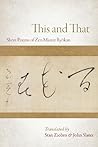
BOOK: “This and That” by Ryōkan [trans. by Stan Ziobro and John Slater]

This and That: Selected Short Poems of Zen Master RyokanThis and That: Selected Short Poems of Zen Master Ryokan by Ryōkan
My rating: 5 of 5 stars

Publisher Site — Monkfish Books

Release Date: March 24, 2026

This is a new selection of Ryōkan’s short poetry (haiku, tanka, and Chinese-Style poems) as translated by Stan Ziobro and John Slater. Ryōkan was a Buddhist monk who lived across the late 18th / early 19th century. These translations are evocative and present the sometimes whimsical and sometimes haunting work of Ryōkan well. While the forms are just three, i.e. haiku, tanka, and kanshi [Japanese Poetry in the Chinese Style,] the style varies, some being imagist and some being more philosophical. Being a monk, Ryōkan’s work is heavily influenced by a Buddhist worldview, as well as by philosophies that interacted with Buddhism — e.g. Taoism.

While I usually have no basis to judge a translation as translation and am left to reflect on it purely as stand-alone verse, in this case, I have enough experience reading translations of Ryōkan to have a feel for his work. I immediately recognized some of Ryōkan’s more famous poems: e.g. the one’s translated in this book as, “Poems? no way // when you see that my // poems aren’t poems // then we can talk poetry” or “Left behind by thief // bright moon // in my window” Yet, at the same time, I felt the translators left some of their own imprint on the poems, and their influence / voice resonated with me.

The book does have front matter to set the stage for readers, and there is a “Notes” section that includes useful background on the poems. I found this ancillary matter useful, but not excessively verbose or intrusive.

If you enjoy Japanese poetry or Buddhist influenced poetry, I’d highly recommend this selection.

View all my reviews

“Precept-Breaking Monk” by Ikkyū [w/ Audio]

A precept-breaking monk for eighty years --
still, I'm ashamed of Zen that ignores cause and effect.
Sickness is the result of past karma.
Now how can I honor my endless connections?

Translation by Kazuaki Tanahashi and David Schneider in: Essential Zen. 1994. HarperSanFrancisco. p. 126.

“Everyone’s Journey” by Sōgi [w/ Audio]

Everyone's journey
through this world is the same,
so I won't complain.
Here on the plains of Nasu,
I place my trust in the dew.

NOTE: This translation by Sam Hamill in The Poetry of Zen (2004) Boston: Shambhala, p. 131.

“Who says my poems are poems” by Ryōkan [w/ Audio]

Who says my poems are poems?
They aren't poems at all.

Only when you understand my poems aren't poems
Can we talk poetry.

This translation by Sam Hamill in The Poetry of Zen (2004) Boston: Shambhala, p. 159

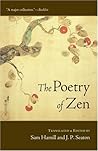
BOOK: “The Poetry of Zen” Ed. / Trans. Sam Hamill & J.P. Seaton

The Poetry of ZenThe Poetry of Zen by Sam Hamill
My rating: 5 of 5 stars

Publisher Site – Shambhala

This poetry anthology consists of translations of Chinese and Japanese poetry that play in the Zen aesthetic. They are not Zen Buddhist poetry in the sense of being sutras or sutra-like expositions on Buddhist philosophy or theology (at least, not mostly.) And while there are many monks and Buddhist layperson poets represented, not all of those included were Buddhists. (In fact, there is even some verse from the Daodejing included, though Taoism is certainly philosophically related to Zen.)

About half the book is Chinese poetry, including pieces from Han Shan, Li Bai, Bai Juyi, Wang Wei, Du Fu, and many other greats of Chinese poetry. (Note: my spellings of author names varies from those used in the book because Hamill and Seaton use Wade-Giles spellings.) The other half of the book consists of works by Japanese poets, including: Saigyo, Dogen, Basho, Ryokan, Buson, Issa, and others. The Japanese part includes a few haibun (prose poems interspersed with haiku,) adaptations of Chinese-style poems, as well as the various Japanese fixed form styles (i.e.. haiku, tanka, etc.)

The two translators, Sam Hamill and J.P. Seaton, initial the poems that each translated (some were dually translated and others singularly.) I enjoyed the translations and felt they were fine reading in their own right. With haiku and tanka, the translators stuck fairly close to the traditional form (in as much as the aesthetic could be maintained doing so,) but with Chinese lyric styles they often took a freer approach to form.

If you’re interested in poetry that conveys Zen sentiment, this book is worth investigating.

View all my reviews

BOOKS: “Soseki Natsume’s Collected Haiku” trans. by Erik Lofgren

Soseki Natsume's Collected Haiku: 1,000 Verses from Japan's Most Popular Writer (Bilingual English & Japanese Texts with Free Online Audio Readings of Each Poem)Soseki Natsume’s Collected Haiku: 1,000 Verses from Japan’s Most Popular Writer by Natsume Sōseki
My rating: 5 of 5 stars

Publisher Site — Tuttle

Natsume Soseki is widely considered one of 2oth century Japan’s greatest writers. While he is best known for his novels, such as Kokoro and I Am a Cat, Soseki wrote broadly, including the one-thousand haiku collected in this volume.

The collection, as is common among haiku volumes, is organized seasonally. Season words being a common feature of classical haiku. That said, these poems are not all classical haiku (though most are.) With respect to form, they are all haiku, but – with respect to content – some are senryū (a style that is the same as haiku in form, but uses more humor and humanistic elements and is less strictly natural and imagist) and others are more idiosyncratic experiments.

One excellent feature of this collection is that it includes both the Japanese characters and Romanized phoneticizations for each poem. This is great for readers who know some level of Japanese, but having the pronunciations allows readers to take in the sound quality of the original — even if they don’t read Japanese.

The translations are optimized for readability by English readers. By this I mean that the translator, Erik Lofgren, doesn’t pare the lines down to maximize sparseness of sound. There are different strategies for translation, and I think Lofgren’s approach is best for a general readership because the translations don’t draw attention to themselves by reading in a fashion that is clunky or tone deaf in English. That said, I suspect some readers would prefer translations more stripped of articles, conjunctions, and other function words.

If you enjoy haiku and modern Japanese literature, I’d highly recommend this book.

View all my reviews

“Spring Rain” by Natsume Sōseki

Spring rain:
a walk amid
wet willows.

“Circular Portrait” by Ikkyū [w/ Audio]

The monk’s entire body is present
in this great circle.
Xutang’s true face and eye
emerge from it.
The blind singer’s love song delights
flowers for ten thousand springs.

Translation by Kazuaki Tanahashi and David Schneider in Essential Zen (1994) HarperSanFrancisco.

“The great road has no gate” by Tiāntóng Rújìng [w/ Audio]

The great road has no gate.
It leaps out from the heads of all of you.
The sky has no road.
It enters into my nostrils.
In this way we meet as Gautama's bandits,
or Linji's troublemakers. Ha!
Great houses tumble down and spring wind swirls.
Astonished, apricot blossoms fly and scatter -- red.

Translated by Mel Weitsman and Kazuaki Tanahashi; printed in: Essential Zen. 1994. HarperSanFrancisco, p. 136.

Note: While Rujing was Chinese he was teacher to the prominent Japanese Zen Teacher, Dōgen Zenji, the latter published this and other poems, hence the dual categorization of it as Chinese and Japanese Literature.

“Ox” by Ikkyū [w/ Audio]

Among other creatures this is what I was.
Abilities depend on the realm;
realm also depends on abilities.
At birth I forgot completely by which path
I came.
I don't know, these years, which school
of monk I am.

Translation by Kazuaki Tanahashi and David Schneider in Essential Zen. 1994. HarperSanFrancisco.