BOOK REVIEW: Angels: A Very Short Introduction by David Albert Jones

Angels: A Very Short IntroductionAngels: A Very Short Introduction by David Albert Jones
My rating: 5 of 5 stars

Amazon.in Page

This book offers an overview of angels in the Abrahamic religious traditions (i.e. Judaism, Christianity, and Islam.) [It does take a quick dip into angel-like beings from other religious traditions – e.g. Hindu and Parsi – but generally comes down on the side of it doing a disservice to everybody to equate such beings across mythological traditions – with the possible exception of the New Age angel which is predominantly an offshoot from Abrahamic mythology.] The book considers the evolution of theological thinking on angels: how they’ve been portrayed in art; what they are [made of;] what their purposes are (i.e. messengers, healers, guardians, warriors, etc.;) and, occasionally, how they play into popular culture.

I took away a great deal from this book. For example, I learned about the differences between the djinn of Islam mythology and demons of Judeo-Christian mythology, and the theological underpinnings of this difference (i.e. Muslims do not believe angels have free will, and thus angels can’t be fallen, and so the djinn are a separate entity altogether [rather than being fallen angels.]) I found the book to be readable, interesting, and balanced in its approach to the topic. If you’re looking to learn more about how angels (and related beings, e.g. fallen angels / demons) have been treated by thinkers of various ages, without getting deep into the minutiae, this is a fine book to consider.


View all my reviews

BOOK REVIEW: Saints: A Very Short Introduction by Simon Yarrow

Saints: A Very Short IntroductionSaints: A Very Short Introduction by Simon Yarrow
My rating: 4 of 5 stars

Amazon.in Page

This is an overview of the history of sainthood in Christianity: how the canonization process changed over time (i.e. from mostly dispersed to increasingly controlled by Rome,) what types of individuals have been selected (from ascetics and martyrs to the heads of orders and other more conventional candidates,) the changing incidence of women saints (while always far less than males, at times almost nonexistent,) and who were some of the more prominent (or atypical) saints.

The book’s organization is primarily a chronological flow, but there are a couple chapters that are of a more topical nature (e.g. on female saints and about hagiographies [“biographies” of saints that mix fact and fiction.]) It was fascinating to me to learn that we are amid a resurgence of canonization. The making of saints had fallen off for a time around the 1800’s (presumably at least in part because it became increasingly challenging / embarrassing in an “Enlightened” age to argue for miracles [“proof” of which is necessary as part of the process.]) However, that can’t be the full story because since John Paul II there’s been a substantial increase in canonization, while we have less reason to believe in supernatural phenomena than ever.

The book takes an agnostic / scholarly stance on the rightness or wrongness of sainthood and doesn’t go out of its way to discuss the scandalous. However, it does not shy away from – here and there – mentioning misbehavior of the Church (e.g. Papal Indulgences and political canonization.) The economist in me found it fascinating that Indulgences gained fungibility – i.e. tradable as an intermediary of value, i.e. like cash.

I found the book interesting despite its occasional drifts into obscure theological / historical territory. It’s readable and, at times, fascinating.

View all my reviews

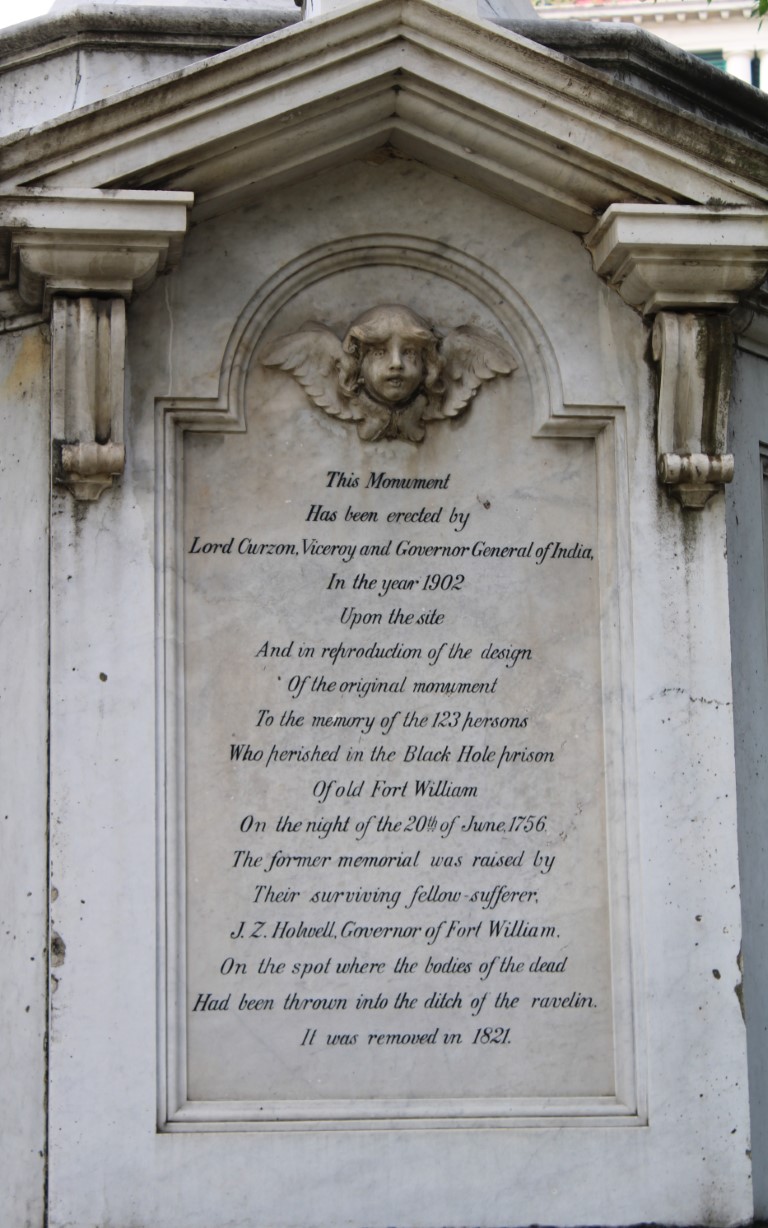
DAILY PHOTO: Black Hole of Calcutta Memorial

Taken in December of 2021 in Kolkata

BOOK REVIEW: The Devil: A Very Short Introduction by Darren Oldridge

The Devil: A Very Short IntroductionThe Devil: A Very Short Introduction by Darren Oldridge
My rating: 5 of 5 stars

Amazon.in Page

This brief guide examines the shifting landscape of thought about Christianity’s Devil. Over the centuries, the Devil has been considered a person, a fallen angel, a metaphor or abstraction, a voice, and a literary device. Satan’s stock has risen and fallen, up with the Dark Ages, down with the Enlightenment, and, on the verge of outright demise, reconsidered when the mid-20th century brought such horrors that the human mind couldn’t cope with them sans supernatural explanations. At the same time, the power of the Devil waxed and waned in the face of philosophical challenges. There’s the Devil so strong he can give God a run for the money, a Devil reduced to whispering in ears, and a Devil who’s practically irrelevant – having no power whatsoever beyond making for an entertaining plot device.

I thought this book did a laudable job of showing the Devil through the light of history, philosophy, art, and literature. It offers a great deal of food for thought about how the Devil has been viewed over time, and what factors influenced these changes in perception. If you’re interested in the role the Devil has played in theological thinking over time, this book does a fine job of shining a light on the subject.

View all my reviews

BOOK REVIEW: Darjeeling by Jeff Koehler

Darjeeling: A History of the World's Greatest TeaDarjeeling: A History of the World’s Greatest Tea by Jeff Koehler
My rating: 5 of 5 stars

Amazon.in Page

As Bordeaux or Tokaj are to wine, Darjeeling is to tea, producing a quality beverage considered by many to be the best in the world. However, this isn’t merely the story of how this region of northern Bengal (or, alternatively, Gorkhaland) came to produce a unique kind of tea that would be sought-after around the world. It’s also a story of empire and how Britain’s insatiable demand for tea drove major developments in geopolitics. It’s yet further the story of recent troubled times of Darjeeling tea, from labor shortages to environmental degradation, and what tea estates have done to adapt – from management / organization changes to organic production techniques.

Lessons in the history and geography of tea may seem niche and uninteresting, but the story of tea is actually quite fascinating, involving Opium Wars, the Black Hole of Calcutta, and an industry shakeup resulting from India’s independence.

I found this book compelling, and thought it did a good job of zooming in and out between local and global (and past to present) to maintain the interest of a diverse readership. Whether the book is exploring attempts to transplant tea shrubs and expertise from China or the changing customer base for Darjeeling tea, it’s an engaging and thought-provoking story. If you’re interested in tea, world history, or agribusiness, you’ll likely find something in this book to hold your attention.


View all my reviews

BOOK REVIEW: Tibetan Buddhism: A Very Short Introduction by Matthew T. Kapstein

Tibetan Buddhism: A Very Short IntroductionTibetan Buddhism: A Very Short Introduction by Matthew T. Kapstein
My rating: 4 of 5 stars

Amazon.in Page

This book outlines the philosophy, theology, history, and future prospects of Tibetan Buddhism. It’s a big topic because Tibetan Buddhism is a unique amalgam of Buddhism, indigenous beliefs (e.g. Bön,) and adapted teachings from Yoga and Tantra.

For a concise guide, the discussions of history and philosophy can get deep in the weeds. However, to be fair, Tibetan Buddhism has a long and complicated history, and has produced deep metaphysical ideas, particularly with regards to philosophy of mind. Furthermore, it’s not a unitary religion, having schismed into a number of sub-sects.

Special attention is given to Tibetan Buddhism’s teachings on Enlightenment and death. Even those who aren’t familiar with Tibetan Buddhism may have heard of the “Tibetan Book of the Dead,” and may not be surprised to learn the topic is given its own chapter. I learned that the Bardo (e.g. a lobby between death and rebirth) was in part hypothesized to help reconcile the idea of Anatta (there being no persistent self, or soul) with reincarnation. [i.e. The question arises, what’s reincarnated if there’s no persistent “I” (i.e. atman, soul, etc.?) The book doesn’t really explain how the existence of a Bardo achieves this reconciliation, but achieving accord with the two ideas appears complicated, and -arguably- spurious.]

The book ends with a look at the religion’s prospects for the future, which are darkened by the Chinese government’s desire to subvert the religion’s influence, but may also be brightened by the fact that the current Dalai Lama has been open to dialogues, and – in particular – has made Tibetan Buddhism arguably the religion with the most cordial relationship to the scientific world. (No mean feat for a religion that is as superstitious as any in the modern world.)

If you’re interested in a concise overview of Tibetan Buddhism, give it a read.


View all my reviews

BOOK REVIEW: Henry VIII by William Shakespeare

King Henry VIIIKing Henry VIII by William Shakespeare
My rating: 5 of 5 stars

Amazon.in Page

This play takes place over a period of time, for want of a better measure, straddling the first two [of six] marriages of Henry VIII. It doesn’t reach the ill-fated end of Anne Boleyn, but rather finishes with the baptism of the girl child she birthed [Elizabeth, who will later be Queen.] [Of course, the failure to produce a male child was the downfall of Katherine of Aragon’s Queenship, so the birth of Elizabeth doesn’t bode well.]

In as much as a history has a theme, this one would be the conflict between the aristocracy and the clergy. This is first, and most extensively, seen through the rise and fall of Cardinal Wolsey, who wins the favor of the King in the Cardinal’s conflict with the Duke of Buckingham, but later Wolsey gets ousted after an aristocratic cabal diverts the Cardinal’s mail to the King. Henry discovers that Wolsey has recommended denial of an annulment of Henry’s marriage to Katherine, despite the fact that Wolsey was telling the King to his face that the marriage’s end had his endorsement. Later, we find aristocrats (the King’s Council) taking on the Archbishop of Canterbury, Cranmer, but Henry sides with the Archbishop as he once had with Wolsey.

The play’s major events are the execution of Buckingham, the divorce from Katherine, the marriage to Anne Boleyn, and the birth of Elizabeth.

This isn’t the most compelling of the Shakespearean histories, but it does have its intrigues. No doubt it would be a bolder play in the absence of the authoritarian nature of monarchy, but it’s still worth reading.

View all my reviews

BOOK REVIEW: Richard III by William Shakespeare

King Richard IIIKing Richard III by William Shakespeare
My rating: 5 of 5 stars

Amazon.in Page

Like Macbeth, this is the story of one man’s unchecked ambition bringing about his ruin. Richard wants to be king. The problem is that his eldest brother (Edward) is already king. The good news for Richard is that Edward is sick. The bad news is that Edward has two sons (and a daughter,) and there’s another elder brother (i.e. Clarence.) While Richard is willing to let nature take its course with Edward, he’ll have to get rid of everyone else between himself and the Crown.

Richard is different from Macbeth in that Richard’s psychopathy is more like that of Iago from “Othello.” Macbeth is conflicted and, though he keeps digging himself deeper, the burden of guilt leads to a descent into madness. Richard is anxious, but it’s not clear that he feels bad about what he’s done (i.e. having his brother’s boys killed, as well as his own brother, his wife, and a number of aristocrats.) When his own mother tells him she wishes she’d strangled him to death with his umbilical cord it rolls off him with the cool detachment one expects of a psychopath. That said, in the last act, he is visited by a series of ghosts. These visitations and his subsequent monologue might give indication that he’s realized how awful he is, but one could also argue that he’s just worried about the precarious state of his kingship.

The hammer drops when Richmond, a nephew of Henry VI, leads forces against Richard. In part, the aforementioned ghosts (which could be interpreted as bad dreams) psychologically do in Richard. (Though the ghosts also visit Richmond with the opposite message, a positive one.) But also, Richmond has proven his leadership skill by forging alliances with the French and the Scots, and turning Lord Stanley (despite Stanley having a son held hostage by Richard.)

While this play not only lacks the character nuance of Macbeth as well as The Scottish Play’s brilliant poetic language, it does have more great lines than the other “War of the Roses” plays (i.e. Henry VI, Pt. I – III.) [e.g. It opens with “Now is the winter of our discontent” and, of course, there’s “A horse! A horse! My kingdom for a horse!”]

This conclusion to the War of the Roses story is well worth reading.

View all my reviews

BOOK REVIEW: Jesus: A Very Short Introduction by Richard Bauckham

Jesus: A Very Short IntroductionJesus: A Very Short Introduction by Richard Bauckham
My rating: 4 of 5 stars

Amazon.in Page

This book explores the life of Jesus, the historical context of that life, his approach to teaching, the nature of his identity, the story of his death, and concludes with the origins of Christianity. The book rests on a couple of controversial ideas, the most influential of which is that the four gospels of the New Testament are valid historical sources and that they’re more useful than competing sources (e.g. the Gnostic Gospels.) Rather than asking the reader to take this as a given, Bauckham does present his argument in the second chapter.

I found this book to be intriguing and worth reading – surprisingly, once I realized it was written by a theologian, and not a Religious Studies scholar or historian. (Theologians have skin in the game of religious teachings, whereas Religious Studies scholars and historians are expected to be more objective with regards to religious claims.) It’s telling that I didn’t realize Bauckham was a theologian right away; he does generally present the material with the dispassionate objectivity of a scholar. However, eventually, he slips into the proclivities of a theologian, such as the stance that in the absence of strong evidence either way one might as well accept the truth of religious teachings. Also, he gives Jesus a free ride on shady behavior (as when Jesus compares a Gentile to a dog – which Bauckham calls “almost rudely negative” before rationalizing away said negativity.)

For me, the discussion of Jesus’s teaching style (Ch.5) was the book’s strongpoint. That chapter shows the reader how Jesus became such a big deal. Believer or not, one will come away impressed with Jesus as a teacher.

If one is looking for a book that considers the gamut of views about Jesus, this isn’t the book you’re looking for – e.g. Chapter 6 on Jesus’s identity doesn’t give time to the view that he was just a smooth-talking preacher whose followers likely absconded with his body – let alone that he was a fiction. That said, there is a great deal of interest in the book, and I found it well worth reading.

View all my reviews

DAILY PHOTO: Miniature Displays, National Museum of Vietnamese History

Taken in Hanoi at the National Museum of Vietnamese History in December of 2015