a slow kick
flipped it over
jiggling
not yet rigid
soon to be brick block
unyielding and unmoving
but dissolving
as sugar cubes in hot coffee
and when no trace remained
ubiquity

a slow kick
flipped it over
jiggling
not yet rigid
soon to be brick block
unyielding and unmoving
but dissolving
as sugar cubes in hot coffee
and when no trace remained
ubiquity

I’m too happy to be crazy,
but the happy makes me lazy
Not lazy, but lacking focus.
Madness is a creative locus.
A sad gravity weighs one down,
as lip corners into a frown,
but in the pit resides a muse.
People pay to hear the blues.
If you could peer inside my mind,
you’d see stacks of rotting rinds.
The rinds pile up and they ferment.
Maybe to a soulful lament?
Or maybe they just start to sour,
becoming fouler by the hour.
Until you can’t believe the stink,
and every word is wasted ink.

Public domain image of Epictetus, sourced from Wikipedia
There’s a story about Epictetus infuriating a member of the Roman gentry by asking, “Are you free?”
(Background for those not into Greek and Roman philosophy. Epictetus was a Roman slave who gained his freedom to become one of the preeminent teachers of stoicism. Stoicism is a philosophy that tells us that it’s worthless to get tied up in emotional knots over what will, won’t, or has happened in life. For Stoics, there are two kinds of events. Those one can do something about and those that one can’t. If an event is of the former variety, one should put all of one’s energy into doing what one can to achieve a preferable (and virtuous) outcome. If an event is of the latter variety, it’s still a waste of energy to get caught up in emotional turbulence. Take what comes and accept the fact that you had no ability to make events happen otherwise.)
To the man insulted by Epictetus, his freedom was self-evident. He owned land. He could cast a vote. He gave orders to slaves and laborers, and not the other way around. What more could one offer as proof of one’s freedom? Of course, he missed Epictetus’s point. The question wasn’t whether the man was free from external oppressors, but whether he was free from his own fears? Was he locked into behavior because he didn’t have the courage to do otherwise?
I recently picked up a book on dream yoga by a Tibetan Lama, Tenzin Wangyal Rinpoche. Lucid dreaming has been one of my goals as of late. I wasn’t expecting to learn anything new about practices to facilitate lucid dreaming because I’ve been reading quite a bit about the science, recently. I just thought that it would be interesting to see how the Tibetan approach to lucid dreaming maps to that of modern-day psychology. Tibetan Buddhists are–after all–the acknowledged masters of dream yoga, and have a long history of it. Furthermore, I’ve been doing research about the science behind “old school” approaches to mind-body development, lately. At any rate, it turns out that there were several new preparatory practices that I picked up and have begun to experiment with, and one of them is relevant to this discussion.
This will sound a little new-agey at first, but when you think it out it makes sense. The exercise is to acknowledge the dream-like quality of one’s emotionally charged thoughts during waking life. Consider an example: You’re driving to an important meeting. You hit a couple long red lights. You begin to think about how, if you keep hitting only red lights, you’re going to be late and it’s going to look bad to your boss or client. As you think about this you begin to get anxious. But there is no more reality in the source of your fear than there is when you see a monster in your dreams. There’s a potentiality, not a reality. Both the inevitability of being late and the monster are projections of your mind, and yet tangible physiological responses are triggered (i.e. heart rate up, digestion interfered with, etc.) It should be noted the anxiety isn’t without purpose. It’s designed to kick you into planning mode, to plan for the worst-case scenario. Cumulatively, one can get caught up in a web of stress that has a negative impact on one’s health and quality of life. For most people, when they arrive on time, they forget all about their anxiety and their bodily systems will return to the status quo, until the next time (which might be almost immediately.) Some few will obsess about the “close call” and how they should have planned better, going full-tilt into a stress spiral.
Mind states have consequences, whether or not they’re based in reality. I’ve always been befuddled by something I read about Ernest Hemingway. He’d won a Nobel Prize for Literature and was universally regarded as one of the masters of American literature, but he committed suicide because he feared he’d never be able to produce works on the level that he’d written as a younger man. There seems to be more to it than that. Many others managed to comfortably rest on their laurels when writing became hard[er]–including writers with much less distinguished careers. The monster may be imaginary, but if you feed it, it still gets bigger.
As you go about your day, try to notice your day-dreams, mental wanderings, and the emotional states they suggest. You might be surprised to find how many of them have little basis in reality. They are waking dreams.

“The Sleep of Reason Produces Monsters” by Francisco Goya
I awoke exuberant that I’d achieved lucidity in my dream and that I’d apparently slain a nasty character (picture Hans Gruber on a bad day)–a task that had seemed impossible before my eureka of “I’m lucid!” Only my exuberance was short-lived when I realized that Hans was also me. Do you have the courage to talk it out with your dream world nemesis instead of reacting from fear?
I was thinking that I should do a post on yoga for International Yoga Day (June 21st), but what to write about? My answer came in the wee hours of the morning when I had a minor breakthrough in lucid dreaming–also known as, dream yoga. I know this seems like a stretch because, despite “yoga” being right there in the name, this practice is much more firmly associated with Tibetan Buddhism than Hatha Yoga. But my last couple yoga posts (which were a while back on my experience with RYT300 teacher’s training and teaching a Yoga Kid’s Camp) were fairly conventional, so I’m due one that’s out there. Furthermore, I promise to try to make clear the relevance of dream yoga to my hatha yoga practice. (If you read the aforementioned posts, you’ll see that the theme of freeing oneself by managing one’s fears and anxieties is a recurring theme across all these posts. And that is the crux of the relevance of lucid dreaming to unifying mind, body, and breath [i.e. yoga.])
What is lucid dreaming? It’s becoming aware that one is in a dream as one is dreaming. One can then exert influence over the course of the dream. Maybe half of you have had this experience at some point in your lives, and so what I’m saying will not seem far-fetched. For those who don’t actively practice lucid dreaming, it’s much more common among the young, so maybe you had such dreams as an adolescent but don’t have them anymore.
For the other half, the whole idea may seem like poppy-cock. I could easily have been such a doubter. Without following a practice, I almost never remember dreams–let alone dreaming lucidly. At best, I get disappearing fragments of dreams that are ephemeral and hazy. I’m one of those people who might claim that he virtually never dreams, except that I read the science, which suggests that each of us dreams every night that we sleep long enough to cycle through REM (rapid eye movement) mode (and commonly 4 or 5 times a night.) We just don’t recollect these dreams. [However, I have had lucid dreams on rare occasions, and so my skepticism on the subject was curbed.]
Why do I practice dream yoga? While it wasn’t part of my formal hatha yoga training, dream yoga isn’t as far removed as one might think. I have been trained in yoga nidra (yoga sleep), which is an exercise that takes place in a hypnagogic state (on the edge between waking and falling asleep.) Commonly, yoga nidra is used as a deep relaxation exercise, but it can also help one to access the subconscious (as is reflected in repeating a sankalpa [a resolution] in the yoga nidra state.) Lucid dreaming is another approach to assessing the subconscious in order to see what’s going on in there and to try to make changes as necessary. Curiosity about the subconscious mind and its–largely unseen–influence on my daily life is what drew me to dream yoga. It’s just another aspect of knowing oneself and trying to expand one’s capacities of mind and body.
How does one practice dream yoga? Hardcore practitioners set alarms to wake themselves up when they think they’ll be in REM sleep. This, as I understand it, helps them reconnect with the dream when they drift back and greatly speeds the process. As I sleep with a wife who would clobber me with a brick if I set alarms for random times in the middle of the night, I’m not among those hardcore. My practice consists of three main aspects. First, I make resolutions to remember my dreams and to dream lucidly as I’m drifting off to sleep. Second, when I’m not making said resolutions, I try to just observe the subconsciously generated imagery that pops up as a witness–rather than letting my conscious mind go into its preferred mode of planning for an uncertain future. [One can tell the difference because the subconscious images don’t make a lick of sense, and–for me–are devoid of any verbal/language element–i.e. it’s all imagery.] Finally, I keep a journal in which I record any dreams or fragments that I can recall–sometimes with drawings to supplement the text (though my artisticness is lacking, to say the least.) The first and last of these are among the most common recommendations one will hear from experts.
I should point out that there are a number of books on the subject by individuals much more qualified than I. Said books give detailed guidance into how one can begin one’s own practice. One that I recently finished reading and would recommend is Charlie Morley’s “Lucid Dreaming: A Beginner’s Guide to Becoming Conscious in Your Dreams.” At some point, I’ll post a review of that book. Also, there is “Dreaming: A Very Short Introduction” by J. Allan Hobson, which I have reviewed.
As I wrote up the entry in my dream journal, I made a resolution to stop attacking the “bad guys” in my dreams and to try to understand them. Note: I don’t recommend this approach for dealing with real world axe-wielding maniacs, but I highly recommend giving it a try in one’s dreams.
Sweet dreams.
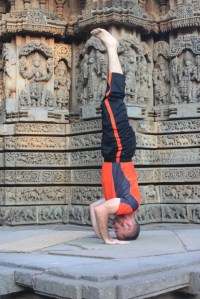
I recently completed the RYT300 course at Amrutha Bindu Yoga to obtain my RYT500 yoga teacher certification. (i.e. The 200 hour course–which I completed a couple years ago–plus the 300 hour course are the primary requirements for the 500 hour certification.) The essay below is about one of the key lessons I learned in this phase of training.
I walked through the streets of Bengaluru barefoot and with not so much as a 5 rupee coin in my pocket. [If your response to that is “big whoop,” you probably live somewhere like Singapore, Helsinki, Kobe, or Calgary where the streets are immaculate and the rats aren’t so bold. If you’re familiar with what goes on in and near the streets in India, you may be wondering what the hell is wrong with me.] It was an unconventional teaching tactic to be sure, but it ranks among the most valuable lessons of the training—surpassing no small revelations about postural alignment, pranayama methods, bandha technique, physiology, and yogic philosophy. It was even up there with the experience of advanced shatkarma (cleansing practices) that were completely new to me.
What’s the lesson? If you’re going to teach yoga–particularly at the intermediate / advanced level that RYT500 is intended to prepare you for–you need to work on not being ruled by fear. That isn’t to say one must be fearless. We imagine fearlessness to equate to courageousness, but courage is action under fear. Neuroscience tells us what a fearless person is like. We know from individuals who’ve had the parts of their brains damaged that are responsible for the emotion—they are paralyzed by indecision. Our emotions provide a basis for choosing–at least as a tie-breaker when no clearly superior path exists. We need our fear, just like our other emotions, but if you can’t move forward because of it you may have a hard time keeping learning.
Not being ruled by fear isn’t just—or primarily—about being able to keep practicing advanced techniques until you can get a grasp on them. Yes, mastering a handstand requires a fair amount of falling down (hopefully, in a controlled fashion), and that’s a lot of potential for anxiety, but there’s more at stake. What precisely? One might start, as many do, with what Patanjali has to say on the subject, and one can start from square one. “Chitta Vrtta Nirodhah.” (Quieting the fluctuations of the mind.) Many of the fluctuations of the mind result from anxieties and our obsession with solving them. Our brains are wired to try to anticipate worst case scenarios so we can develop ready-made solutions for them. This can result in excessive pessimism, extended stress, and all the problems that go along with that stress.
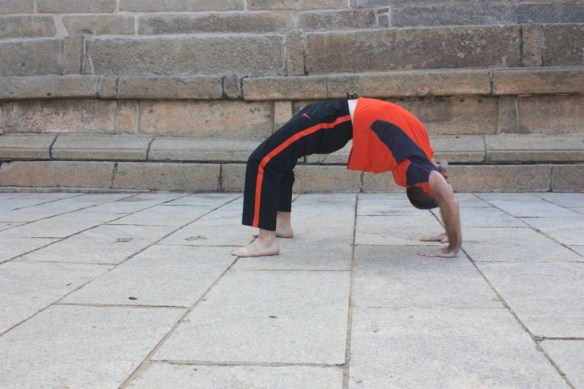
There’s a popular saying that goes, “money is the root of all evil.” But, I think it’s wrong. Fear is at the heart of all evil—not to mention a fair amount of run-of-the-mill pettiness.
So what is the path to anxiety management? Start small, and dispassionately observe your discomfort. Don’t try to squelch the emotion, just watch it while trying to avoid putting good or bad labels on it. Of course, sources of anxiety are personal. As far as prescriptive yoga practices, that depends upon one’s personal anxieties. For some inversions might do the trick, for others extreme back bends, for some external breath retention, for others it may be balancing. Then, of course, there are the advanced shatkarma practices I mentioned earlier–such as vaman dhauti (cleansing by vomiting) or poorna shankhaprakshalana (i.e. clearing out one’s digestive tract via massive ingestion of salt water.)
I recently finished teaching a Kid’s Camp (a post about that to come.) At the beginning of the camp, I was telling someone that the kids were fearless, but what I came to discover was that kids just allow their enthusiasm to swamp their anxieties. I had seven-year-olds doing pinchamayurasana (forearm stand) and vrschikasana (scorpion) within the first few days. That would be a hard sell for adults. [I don’t think I’ve ever taught those postures to adults.] It’s not just that kids are bendy, they’re also ready to get up after they fall down. (And since they’re not stressed about the possibility of falling they don’t tense up and get badly injured.) Someone posted a great meme on Facebook recently. It said, “A child who falls down 50 times learning to walk, doesn’t go, ‘I don’t think this is for me.’”
 Extreme Fear: The Science of Your Mind in Danger by Jeff Wise
My rating: 4 of 5 stars
Extreme Fear examines the science behind fear—particularly the fear of life and death situations. In doing so, the author presents findings from scientific research as well as cases that demonstrate the concepts behind those findings. People are often so close to their fears that they take them for granted, and feel that there’s nothing to be done about them. However, there’s a great deal to be learned about how fear operates and how one can improve one’s performance in fearful situations. By replacing the lens of shame with one of science, one can see what fear is objectively, and make the emotion more of a help and less of a hindrance.
A central idea in the book is that fear evolved to maximize one’s chance of survival against the age-old threats facing mankind. These pre-historic threats were relatively straightforward: saber-tooth tiger attacks, clubbing by members of warring tribes, fire, famine, flood, etc. Ancient threats often called for hauling ass, freezing in place, or getting stabby. The problem is that our present-day threats often call less for gross motor skills (run, kick, or throw) and more for creative or nuanced solutions to technological problems (i.e. sliding cars, falling planes, or malfunctioning assault rifles.)
Motor learning is one means by which this mismatch between what our brain tells our body to do in a stressful situation and what is called for in our modern world. Take the case of the infantryman with the jammed rifle. Without training, he might pick up the rifle like a club, intending to use it to unleash blunt force trauma. That is, if he’s still alive then the enemy gets into cudgeling range. Alternatively, the soldier may drop the rifle and run for his life. However, because he had a drill sergeant who made him practice clearing his weapon over and over, his body can go to that behavior while his conscious mind is blinking out.
Still, motor learning only takes us so far. Sometimes creativity is called for, and that’s a tall order in the face of where our body / brain want to put limited resources. In fact, Wise begins the book with the story of a pilot who was flying an old plane when the wing support broke and the wing flipped up, threatening to rip off. Somehow the pilot figured out—based on a vague memory and lots of experience—that he could flip the plane over and fly it upside-down and the wing would snap back into place. Then he had to figure out how to land: a.) upside-down crash, or b.) try to flip the plane over at the last second. The brain systems that this pilot smoothly accessed are among those that one doesn’t expect to be operating in life or death situations—e.g. those involved with long-term conscious memory and abstract problem solving.
The question of how some people can keep their wits about them, as the above pilot did, while others crash and die is the one that Wise really wants to answer. It turns out that it’s not such and easy question. During World War II, the military conducted studies to try to determine which soldiers could be counted on under life and death stress. The answer didn’t readily present itself. Among the problems in finding an answer is that courage and fearfulness aren’t as unitary or straightforward characteristics as one might think. Wise presents the case of Audie Murphy as a prime example. Murphy was at once one of the most decorated American soldiers in World War II—a man who’d taken on a company of Germans single-handedly—and a man of great social anxiety.
The book’s 13 chapters are divided into three parts. The first part presents fear and its effects. The middle section deals with various forms, aspects, and facets of fear, including: social v. life-and-death fear, choking behavior in sports, and fear of fear v. fear of an outcome. In the last part of the book, Wise suggests how one might achieve better performance in the face of fear.
I found this book to be informative and interesting. Wise did a good job of picking cases to illustrate the concepts discussed in the scientific literature. I’d recommend this book for individuals who are interested in the science of the brain and the ways to achieve ultimate human performance.
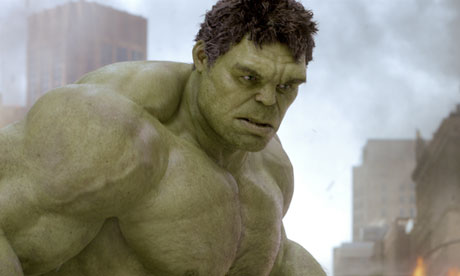
Source: Avengers movie
“That makes me so mad!” One hears it all the time. It has to be among the most commonly uttered phrases in the realm of emotional experience. And, of course, it’s completely and utterly wrong. Your anger is a wholly contained neurochemical response. To credit something external with your anger is to grant that person or thing power over you–to enslave yourself. (Stoic philosopher, and former slave, Epictetus was known to piss off gentlemen citizens by asking them if they were “really free.”)
This isn’t to say there isn’t just anger. However, think about what emotions are. Our emotions are a system evolutionarily evolved to allow us to make decisions with limited or no information. Without emotions our species, if we ever came to be, would have likely become extinct by way of “paralysis by analysis.” We know that happens to people who have neurological damage that keeps them from experiencing emotion. You might think they would become cold and rational Mr. Spocks, but the defining characteristic of such people is that they become paralyzed by indecision. It turns out that we make a lot of decisions with limited information or from an inability to determine a clear winner by way of facts and reason. Emotion plays and important role in those cases.
Chances are that if your immediate gut reaction to something is anger, you probably haven’t worked out a rational argument for your preference. If one has a clear line of reasoning rooted in fact, anger isn’t necessary to justify a position or decision. If your gut reaction to something is emotional, see whether you can noodle out a rational reason before you swing into too rash an action…. unless the crosstown bus is careening at you.
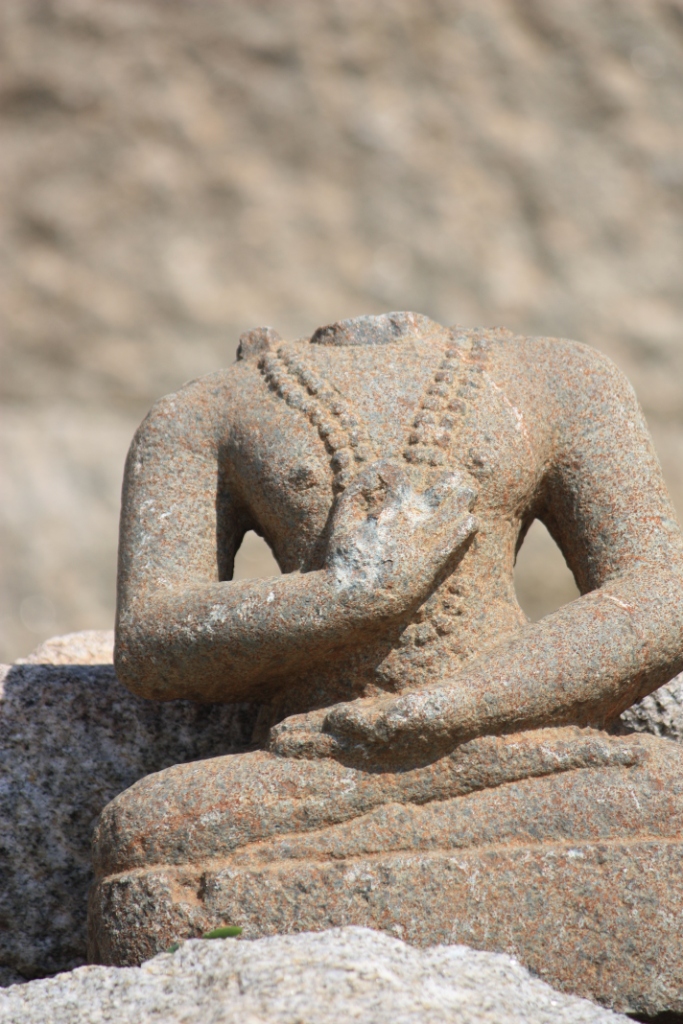 Left to its own devices, the mind is like Indian traffic: chaotic, noisy, slow-moving, relentless, and brimming with latent rage. Meditation is a tool to help unsnarl the traffic jams so that one can observe the mind as something other than indecipherable chaos.
Meditation isn’t the end game. If one goes to the gym daily to lift weights, but one has no interest in–or use for–putting one’s muscles to practical use, one is engaging in an act of vanity more than one of personal development. In the same way, if one builds one’s awareness of the mind, and doesn’t use it for betterment in one’s daily life, what is the point? What do I mean by betterment? I mean defeating the petty elements of one’s nature that cause oneself and others suffering and that keep one living in a world of delusion.
Meditation trains one to take note of the daydreams and obsessive thoughts that run through one’s mind, and to do so progressively sooner—before they can coalesce into a full-blown avalanche of negativity and delusion. In meditation, we observe these errant thoughts and then let them float on down the river. As one lives one’s waking life, however, one may take time to consider what these thoughts and daydreams are doing for one. Often one can remain ignorant of the purposes these thoughts serve, realizing only that they make one feel better temporarily.
A few of the purposes that these errant thoughts may serve are:
martyrdom (i.e. thinking the world is against one so whatever goes wrong is the result of outside forces)
-ego-boosting (imaging one has the confidence to do something one doesn’t in reality)
-empowerment (fantasizing one has power in the face of feelings of powerlessness)
-wishful thinking (imagining a perfect life just a PowerBall ticket away)
So, if these thoughts make one feel better, why shouldn’t one let them fly? For one thing, they keep one from seeing the situation as it is. The fantasy or obsessive thought becomes one’s reality and one remains ignorant of what is real. The problem is that if one wants to fix the problem, one must know what it is (i.e. have a true view of it.) If one imagines that one has no role in the problem, then how can one fix the problem? If the problem is one’s unhappiness, one can always do something—even if one can’t change the external situation. One’s unhappiness is a function of one’s mind, and is, therefore, under one’s control.
Second, by giving into obsessive thoughts and fantasies, one becomes dependent upon them as crutches, and becomes stuck in a cycle of helplessness.
Third, when one removes oneself from the problem, one denies one’s power to change the situation—or the emotional result. One makes oneself vulnerable to manipulation. If one doesn’t recognize the ability of another person to “make one mad,” one denies them that power. (But this requires accepting that one has a responsibility for one’s emotional state, a sometimes uncomfortable proposition.)
I have a theory that the steadfast pursuit of an enlightened mind will either result in enlightenment or insanity. Why should it result in insanity? Because, the process involves stripping away the coping mechanisms that got one through each day. If one has the internal confidence (i.e. fudōshin, or immovable spirit) to stare in the mirror and see one’s flaws and weaknesses, one may achieve an enlightened state. If one lacks such confidence, seeing those flaws and weaknesses may be depressing. Of course, fudōshin is just one side of the coin, it also matters whether one has the relative freedom from stress to lead an introspective life or whether one feels the constant pressure that propels most people back into old habits. It’s easier to make positive changes when one’s life radically changes, then the power of routine and habit lose hold.
The challenge is that the pursuit of an enlightened state of mind is a constant job. Some branches of Buddhism and other mystic religions suggest that enlightenment is a tipping point, and that once one achieves that state one is forever enlightened. I’m not in a position to refute such beliefs, but it seems that it’s more like being a sober AA member–there is an ever-present potential to revert to old habits of the mind. So, one must be ever vigilant. There’s no rest until one is dead… as far as I know.
This video begins on the peaceful banks of a river in a nondescript Japanese town. The first minutes of footage is unremarkable except that the water level is quite low, but as it might be in dry season or low tide. Then there is a shrill siren and an urgent warning by loudspeaker–events that will replay periodically throughout the video. Twenty-five minutes later, the camera is fixed on throngs of people trapped on a rooftop across the river. Dawn slinked in and it would be too dark to see these rooftop refugees, but they are silhouetted by the glow of the fires that rage in the background. In the footage in between, one sees houses and ships being carried by the water as if they were a child’s toys washed away by an overturned bucket of water–but brown, debris-laden water that is roiling and churning. Eventually, we see the river reverse its flow.
Someone posted this on Facebook yesterday. I watched all 25 minutes of it. Who watches 25 minutes of shaky, hand-shot home movie? Not me, normally, but I was compelled by the force of nature. They say that one of the things that differentiates humans from even our closest primate brethren is that humans routinely achieve the identical physiological state emotionally from remembering tragedy as from experiencing it first hand–or sometimes even through being exposed to them remotely.
I thought about this force of nature, at first in the literal sense–a pedestrian bridge swept away and freighters swept up a normally unnavigable river. Then I wrote the first 1,000 words or so on a short story entitled The Ghost Ship Onryō that was inspired by watching the tsunami and remembering the news stories it triggered. The story is quite dark, as matched my mood for much of yesterday. Such is the force of nature, to compel me to change my plans and to morph my emotional state through ripples that continue to expand years after the event.


 Tiger Riding for Beginners