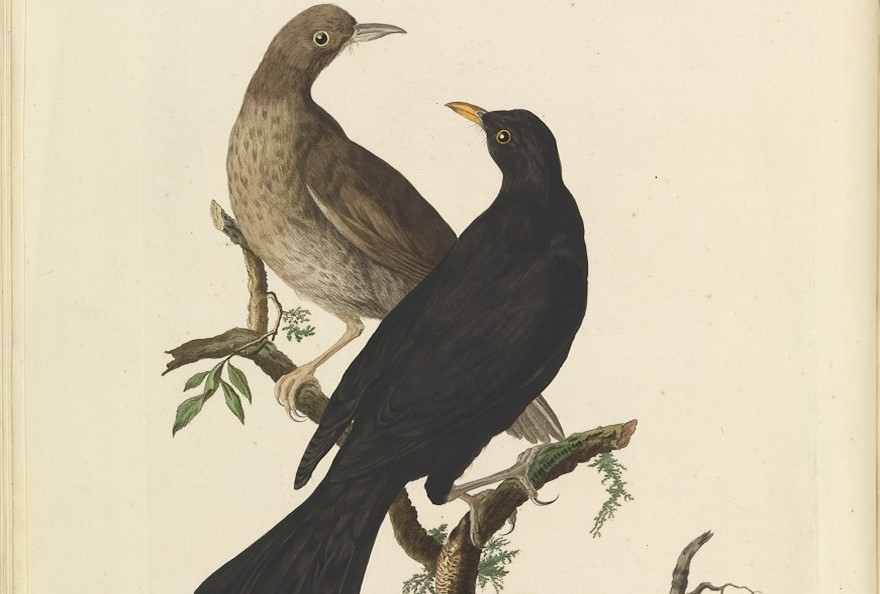
Thirteen Ways of Looking at a Blackbird by Wallace Stevens [w/ Audio]

I
 Among twenty snowy mountains,
   The only moving thing
  Was the eye of the blackbird.

II
 I was of three minds,
   Like a tree
  In which there are three blackbirds.

III
 The blackbird whirled in the autumn winds.
   It was a small part of the pantomime. 

IV
 A man and a woman
   Are one.
 A man and a woman and a blackbird
   Are one.

V
 I do not know which to prefer,
   The beauty of inflections
 Or the beauty of innuendoes,
   The blackbird whistling
     Or just after.

VI
 Icicles filled the long window
   With barbaric glass. 
 The shadow of the blackbird
   Crossed it, to and fro.
 The mood
   Traced in the shadow
     An indecipherable cause.

VII
 Old thin men of Haddam,
   Why do you imagine golden birds?
 Do you not see how the blackbird
   Walks around the feet
     Of the women about you?

VIII
 I know noble accents
   And lucid, inescapable rhythms;
 But I know, too,
   That the blackbird is involved
     In what I know.

IX
 When the blackbird flew out of sight,
   It marked the edge 
 Of one of many circles.

X
 At the sight of blackbirds
   Flying in a green light,
 Even the bawds of euphony
   Would cry out sharply.

XI
 He rode over Connecticut
   In a glass coach.
 Once, a fear pierced him,
   In that he mistook
 The shadow of his equipage 
   For blackbirds.

XII
 The river is moving.
   The blackbird must be flying. 

XIII
 It was evening all afternoon.
   It was snowing
 And it was going to snow.
   The blackbird sat
     In the cedar-limbs.

Fog by Carl Sandburg

The fog comes
 on little cat feet.

It sits looking
 over harbor and city
  on silent haunches
 and then moves on.

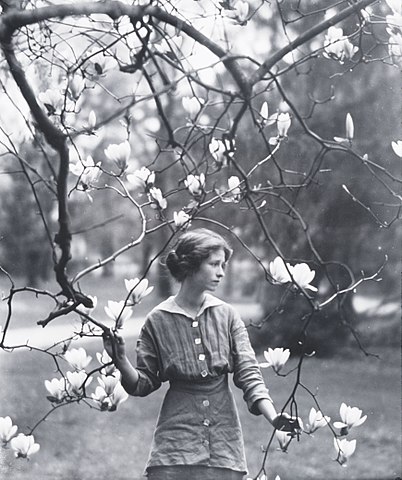
“What lips my lips have kissed, and where, and why” by Edna St. Vincent Millay

What lips my lips have kissed, and where, and why
   I have forgotten, and what arms have lain
 Under my head till morning; but the rain
   Is full of ghosts tonight, that tap and sigh
 Upon the glass and listen for reply,
   And in my heart there stirs a quiet pain
 For unremembered lads that not again
   Will turn to me at midnight with a cry.

Thus in the winter stands the lonely tree,
   Nor knows what birds have vanished one by one,
 Yet knows its boughs more silent than before:
   I cannot say what loves have come and gone,
 I only know that summer sang in me
   A little while, that in me sings no more.

I dwell in Possibility (466) by Emily Dickinson [w/ Audio]

I dwell in Possibility --
   A fairer House than Prose --
 More numerous of Windows --
   Superior -- for doors --

Of Chambers as the Cedars --
   Impregnable of eye --
 And for an everlasting Roof
   The Gambrels of the Sky --

Of Visitors -- the fairest --
   For Occupation -- This --
 The spreading wide of my narrow Hands
   To gather Paradise --

O Captain! My Captain by Walt Whitman [w/ Audio]

O Captain! my Captain! our fearful trip is done,
 The ship has weather'd every rack, the prize we sought is won,
 The port is near, the bells I hear, the people all exulting,
 While follow eyes the steady keel, the vessel grim and daring;
       But O heart! heart! heart!
          O the bleeding drops of red!
             Where on the deck my Captain lies,
                Fallen cold and dead.

O Captain! my Captain! rise up and hear the bells;
 Rise up -- for you the flag is flung -- for you the bugle trills,
 For you bouquets and ribbon'd wreaths -- for you the shores a-crowding,
 For you they call, the swaying mass, their eager faces turning;
       Here, Captain! dear father!
          This arm beneath your head!
              It is some dream that one the deck
                 You've fallen cold and dead.

My Captain does not answer, his lips are pale and still,
 My father does not feel my arm, he has no pulse nor will;
 The ship is anchor'd safe and sound, its voyage closed and done,
 From fearful trip the victor ship comes in with object won;
       Exult, O shores! and sing, O bells!
          But I, with mournful tread,
             Walk the deck my Captain lies, 
                 Fallen cold and dead. 

Stopping by Woods on a Snowy Evening by Robert Frost [w/ Audio]

Whose woods these are I think I know.
 His house is in the village though;
  He will not see me stopping here
 To watch his woods fill up with snow. 

My little horse must think it queer
 To stop without a farmhouse near
   Between the woods and frozen lake
 The darkest evening of the year. 

He gives his harness bells a shake
 To ask if there is some mistake.
  The only other sound's the sweep
 Of easy wind and downy flake.

The woods are lovely, dark and deep.
 But I have promises to keep,
  And miles to go before I sleep,
 And miles to go before I sleep. 

BOOKS: A Double-Barreled Detective Story by Mark Twain

A Double Barrelled Detective StoryA Double Barrelled Detective Story by Mark Twain
My rating: 5 of 5 stars

Amazon.in Page

This novella is Mark Twain’s satirical jab at the whole Sherlock Holmes concept. In particular, it pokes fun at a detective who eschews everything supernatural in favor of cold rationality, but who produces results so impossible that they are themselves supernatural.

The story has two temporally disjointed parts that almost seem like independent stories until the very end when all is tied up. (Holmes only appears in the second part.) This works nicely for parody of Holmesian detective fiction as it’s an approach that was used by Sir Arthur Conan Doyle on occasion — e.g. in A Study in Scarlet. The first part tells the tale of a woman who is treated foully by Jacob Fuller, the husband she eloped with but who harbored resentment towards her father, a man Fuller believed felt wasn’t good enough for his daughter. The woman makes her son, named Archy Stillman, promise that he will track down Fuller and make the man’s life a living hell.

The second part revolves around a murder that seems to be independent of the case described above, the killing of a man named Flint Buckner. Here Sherlock Holmes, who happens to be in town visiting his nephew – Fetlock Jones, “solves” the case only to be shown to be entirely and humiliatingly wrong by Archy Stillman using only a superior sense of smell and basic observation of the facts (with no elaborated inductions.)

While I never had anything against the Sherlock Holmes stories — in fact, I enjoyed them all — I did find Twain’s satire amusing and compelling as a story. [And it’s true that Arthur Conan Doyle did regularly strain credulity — that’s what made Holmes an intriguing character.]

Well worth reading.

View all my reviews

Rickety Gibberish [Free Verse]

A long time ago,
 I listened to the audiobook of
    Kerouac's "On the Road."

In that format, 
   I became aware of how often
     Kerouac used the word
       "rickety." 

Almost as aware as I became
   of how often Twain uses
      the N-word in Huck Finn
      when I unwisely listened to 
      that audiobook while driving
      through downtown Atlanta
      with my windows rolled down. 

I'm now reading Hunter Thompson's
   "Kingdom of Fear," and I've become
      aware that Thompson had a love
      of the word "gibberish" almost on par
      with Kerouac's love of "rickety."

And I think about how much beautiful
   rickety gibberish I've read from those
      authors, and what a fine 
      thing it is if one can write 
      rickety gibberish that stands up 
      under its own weight. 

Whitman’s Eye [Free Verse]

Walt Whitman saw the world 
   with its ubiquitous beauty
     laid bare.

He saw it in dock workers
    & painted ladies &
    swimmers & walkers &
    Presidents & paupers. 

He saw it in every hue &
    sinew, and danced it into hymns.

BOOK REVIEW: Braided Creek by Ted Kooser & Jim Harrison

Braided Creek: A Conversation in Poetry: Expanded Anniversary EditionBraided Creek: A Conversation in Poetry: Expanded Anniversary Edition by Jim Harrison
My rating: 5 of 5 stars

20th Anniversary Edition Release Date: August 15, 2023

This is a twentieth anniversary re-release of a collection of short poems — on the scale of haiku or tanka — exchanged between Ted Kooser and Jim Harrison over many years. The poems are unattributed and, famously, literary critics who boldly proclaimed they knew which poems were written by which poet have been proven wrong.

While the length of the poems is similar to that of haiku and tanka, if one were going to categorize them in terms of Japanese verse, most would be more like senryū or kyōka (the poetic genres that match haiku and tanka [respectively] in form, but allow for humor, humanism, abstract metaphors, and freedom to deviate from juxtaposition of natural imagery.) But even that categorization would be deceptive because these poems tend toward a uniquely American voice.

That said, there are a few that fit the Japanese style well, e.g.:

In the morning light, / the doorknob, cold with dew.
Or,
The cups of the tulips / tip forward, spilling their snow.

There are also a few that are more like ko-an than like poems. (A ko-an is a Zen “riddle” designed to help practitioners break the hold of logic and reason on the mind. Typically, the ko-an looks like a question, but it can’t be thought out to an intellectually satisfying answer as most questions can.)

Is this poem a pebble, / or a raindrop coated with dust?
Or,
My wife’s lovely dog, Mary, kills butterflies. They’re easier than birds. I wonder if Buddha had dog nature.

But one hears an American voice in such examples as:

On my desk two / indisputably great creations: duct tape and saltine crackers.
Or,
Rowing across the lake / all the dragonflies are screwing. Stop it. It’s Sunday.

There are philosophical pieces, such as:

Only today / I heard / the river / within the river.
Or,
How tall would I be without my enemies to measure me?

This anniversary edition has a beautiful introduction by Naomi Shihab Nye and a brief epilogue by Kooser, but is otherwise the same.

If you like light and whimsical poetry that can make you laugh, or – sometimes – make you think, you should check out this collection.


View all my reviews