
Taken in May of 2018 in Nepal

Taken in May of 2018 in Nepal

Taken in the summer of 2010 in Ulan Bator, Mongolia

The arrogance, shoving words into rows,
try to describe someplace only god knows.
A cube of rock, turned edge skywards,
loftily defying each, and all, of my words.
Jolie laide in its craggy perfection,
free from all vanity and dejection.
When it shrouds itself in cloudy veils,
it doesn’t do so because it quails.
It demands no awe and yet has mine.
It is the sacred, sans the shrine,
and, before it, I bow.
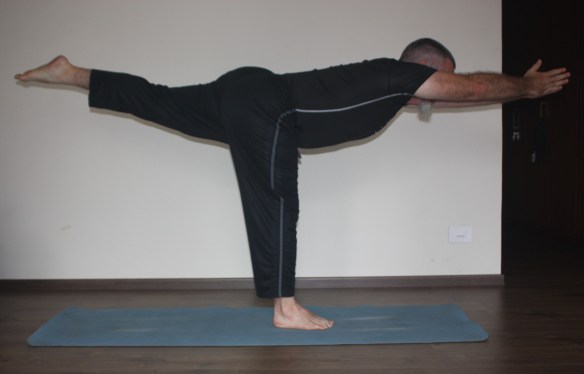
Vīrabhadrāsana III (Warrior III)
5.) Vīrabhadrāsana III (Warrior III):
What makes it challenging?
Substantial core strength is needed to obtain the capital “T” position. Straightening the lifted leg and getting it in line with the torso is the first challenge. Also, there is a tendency for the hip of the lifted leg to angle upward into an position in between Warrior III and Half Moon Pose (see below.) The front of the pelvis should be squared toward the floor. The drishti (focal point) at the extended hands also creates more of a challenge than looking straight down at the floor.
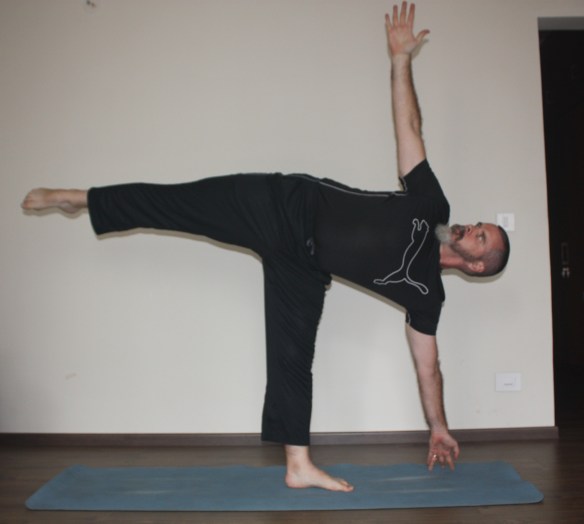
Ardha Chandrāsana (Half Moon Pose)
4.) Ardha Chandrāsana (Half Moon Pose):
What makes it challenging?
Largely, the same challenges that make Warrior III difficult. However, “stacking the hips,” i.e. getting the front of the pelvis squared to the wall (not the floor or at a downward angle) requires a high degree of hip flexibility. Hip openers may be necessary to be able to stack the hips without the torque of lifting the top hip up throwing one off balance.
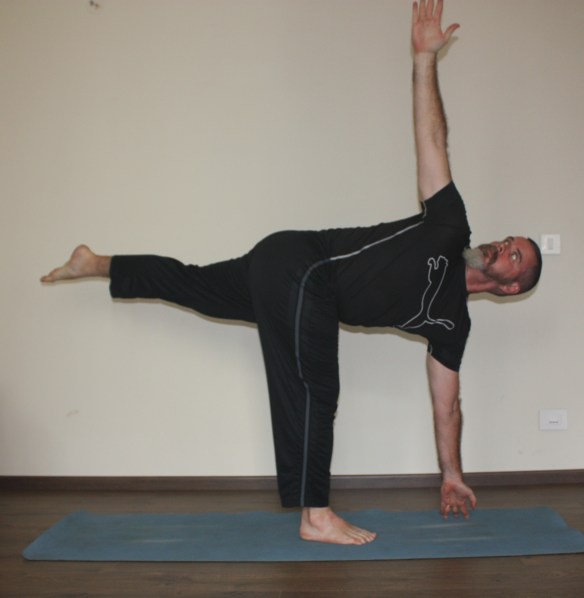
Parivrtta Ardha Chandrāsana (Twisted Half Moon Pose)
3.) Parivrtta Ardha Chandrāsana (Twisted Half Moon Pose):
What makes it challenging?
Again, this posture shares challenges with Warrior III and Half Moon. While it’s less difficult than Half Moon in that it doesn’t require hip stacking, it makes up for it in that twisting motions tend to make staying on balance difficult. This is because one has to remain stable on the standing foot as the torso rotates and if one can’t stack one’s shoulders the weight distribution may be hard to keep balanced. Also, achieving the drishti (looking at the upper hand) without breaking balance is no easy feat.
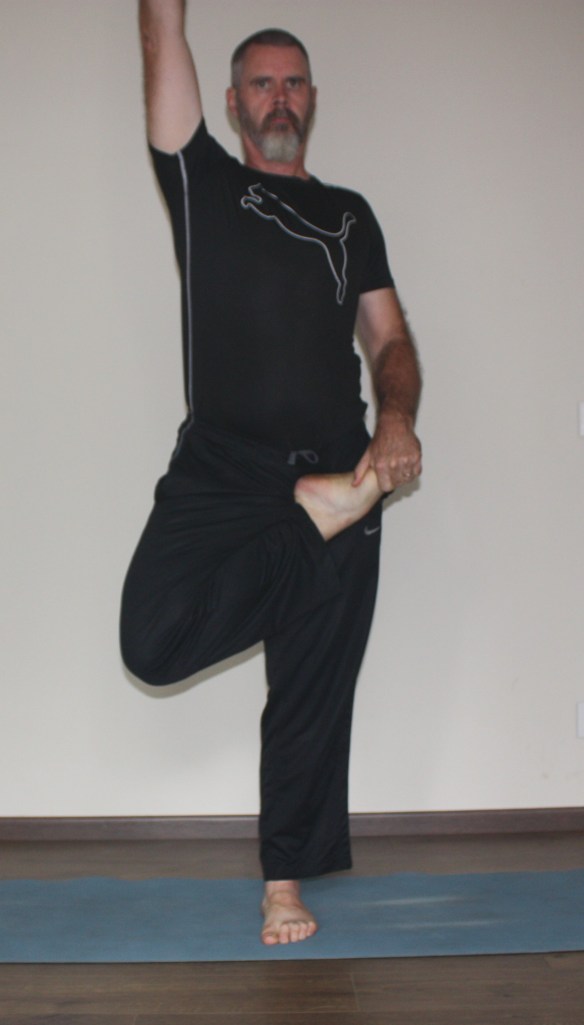
Ardha Baddha Padmōttānāsana (Bound Half Lotus Pose) [Standing]
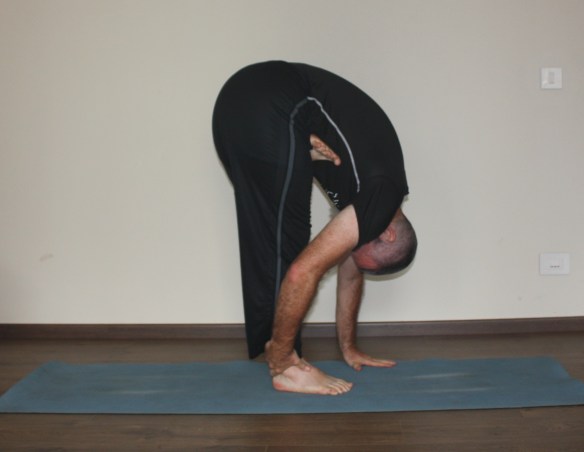
Ardha Baddha Padmōttānāsana (Bound Half Lotus Pose) [Folded]
What makes it challenging?
The knees should be next to each other, but the knee of the folded leg wants to be forward and to the outside. Also, one must get the heel aligned on one’s centerline (below the navel) so that when one folds the foot is in a position where it can compress into the soft, fleshy tissue rather than being wedged between bones.
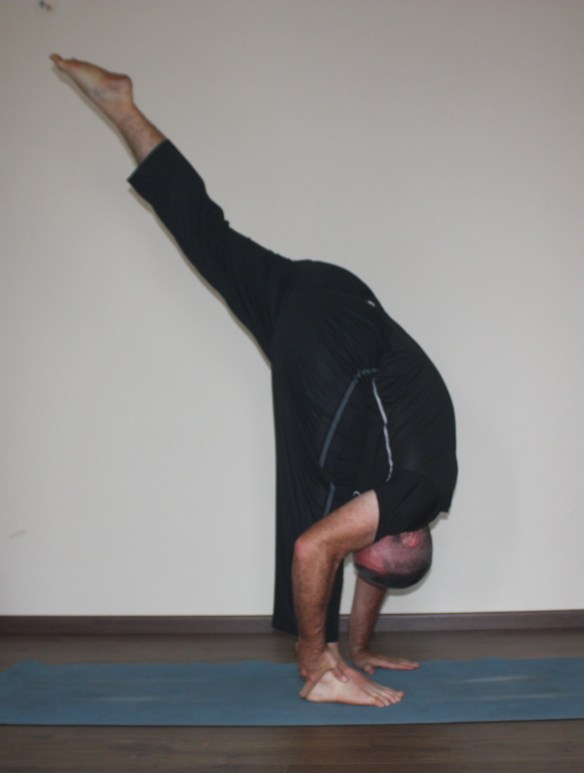
Ūrdhva Prasārita Ekapādasana (Standing Split)
1.) Ūrdhva Prasārita Ekapādasana (Standing Split):
What makes it challenging?
Straightening the lifted leg without throwing oneself off balance is the big challenge. It’s possible to put both hands around the support leg ankle, to make it even more challenging, but one must have an exit strategy in case one loses balance.
 People once saw in it great panache,
but Hitler killed the toothbrush mustache.
Now no one would dare to wear it.
Except that groundskeeper from Magnum P.I.
who turned out to be the mysterious millionaire.
Maybe, his wealth was Nazi gold?
But that isn’t my theory of the long shadow of Hitler’s mustache.
My theory is that when the short mustache comes back in fashion,
great evil will sit upon our doorstep.
For it is more than a choice of facial hair,
it’s a barometer of remembrance
that lacks an indicator of the half-life
of evil’s stain upon our collective consciousness.
Or, maybe, it just looks stupid on your face.
As if you made a dreadful razor error
and tried to play it off as a plan
through use of symmetry.
In which case, someone should be charting
the rate of application for name change by
Hitlers, Himmlers, Goebbels, and Görings.
 Aimless Love: New and Selected Poems by Billy Collins
My rating: 5 of 5 stars
I hope this isn’t taken the wrong way, but Collins is to poetry what J.K. Rowling is to the novel. By that, I only mean that his poems are as popular as poetry can be these days because they are readable, avoid needless complications, give challenge to pretentiousness, and are just plain entertaining. Collins combines dry humor, surreal elements, and profound observations to make poems that readers can either readily relate to or find hilarity in. While he does touch on traditional poetic topics like love and nature, he spends more time on language, quirkiness in everyday life, and poetry itself.
This book combines a collection of 51 new poems with “greatest hits” selections from Collins’s previous four collections: NINE HORSES (22 poems), THE TROUBLE WITH POETRY (16 poems), BALLISTICS (29 poems), and HOROSCOPES FOR THE DEAD (24 poems.)
The opening poem, from NINE HORSES and entitled “The Country,” displays typical Collins humor as it takes a parent’s warning to not leave strike-anywhere matches out and about because mice might start a fire, and brings it to its absurd conclusion by showing it. Odd little thoughts that flicker into and out of consciousness are a mainstay for Collins, and he wrings the full wit from them. “Litany” may be my favorite poem from the NINE HORSES selection. It takes the standard poetic tool of metaphor and shows the silliness that can result when it’s employed without context.
The selections from THE TROUBLE WITH POETRY include intriguing reflections on particular words. Examining the personal meanings of words as well as the meanings words migrate into is a common subject for Collins. This can be seen in poems like “Lanyard” and “Genius.” However, while those poems — as well as the titular poem — are enjoyable, the most hilarious is “The Revenant.” This poem turns the sanctity of the mutual bond of man and man’s best friend on its head as it imagines if a dog could tell its master its true feelings.
In BALLISTICS we see several examples of another recurring approach used by Collins and that is the use of a quote as the premise of a poem. “Tension” is among the funniest of these in which some advice to writers about the risks of using the word “suddenly” is put to the test. My favorite from this section may have been “Old Man Eating Alone in a Chinese Restaurant” in which Collins admits he’s glad that he avoided that old chestnut as a young poet because now he’s said old man.
In HOROSCOPES FOR THE DEAD we see a few poems (in addition to the titular one) that concern themselves with mortality, including a whimsical ride through a cemetery on a bike – “Cemetery Ride.” However, “Table Talk” is among my favorites for the joy it takes in mocking pretentiousness. In the poem, an individual brings up Zeno’s most famous paradox, suggesting no arrow should ever hit its target because it always has to halve the remaining distance – and, thus, should remain forever at bay.
Among the new poems, “To My Favorite 17-Year-Old High School Girl,” is among the funniest and is most certainly the one with the most general appeal to readers. In it, we see a father celebrate his daughter, but with no shortage of backhanded compliments as he compares her to other teenagers who were more productive, brilliant, or at least more helpful around the house.
I found this collection to be immensely enjoyable and I’d recommend it for anyone. Even if you aren’t a poetry reader, you may find this collection makes you one.


