BOOK REVIEW: Anarcha Speaks by Dominique Christina

Anarcha Speaks: A History in PoemsAnarcha Speaks: A History in Poems by Dominique Christina
My rating: 5 of 5 stars

Amazon page


This collection of poems, written by Dominique Christina and selected / arranged into a story by Tyehimba Jess, tells the story of a slave woman who was used for medical experimentation. Most of the poems are in the voice of this woman, Anarcha, and are conveyed in a slave dialect. However, a few are from the perspective of Dr. Marion Sims, the doctor who used Anarcha (and other slave women) for research and experimental procedures. Even without the cues in the poem titles, it’s easy to tell when these switches in voice occur because the doctor’s poems are in “proper” English, as opposed to Anarcha’s dialect. I should point out, while I can’t tell you how accurate the slave dialect is, I can say it presents no challenge to the reader’s understanding of the story or of the imagery or metaphor of the poetry.

The events described in these poems are based on a true story. Anarcha developed a fistula (a hole in bodily tissues that’s not supposed to be there) as a complication of carrying a child, and as a result suffered persistent bleeding. Anarcha’s owner handed her over to Dr. Sims to repair the fistula and stop the bleeding, which would require the development of a new procedure. Sims is often called the father of modern gynaecology, and was lauded with statues and honors. However, in recent years, his image has been tarnished by the fact that many of his advancements were only possible through the non-consensual examination of, and experimentation upon, slave women.

I should point out that, while reading this book has made me interested in learning more about the details of the story, I can’t really comment on the degree to which the poems accurately convey history. From the little I was able to garner from quick internet research, there are wide-ranging views on Dr. Sims and his research. Some think Sims belongs in Josef Mengele’s corner of hell. (Note for non-history buffs: Mengele is the Nazi doctor who experimented on Jews and other prisoners during the Second World War.) Others believe Sims was genuinely working to heal the slave women and wasn’t solely motivated to find a treatment for paying patients, and that — in the context of his times — he should be considered a fine, if fallible, doctor. I don’t know how much is know about what was in Sim’s mind or how it matched his behavior, but at a minimum he seems to have been much less delicate with his slave subjects than he would have been with his patients in terms of subjecting them to pain and humiliation.

I will say that the poems in Anarcha’s voice feel authentic, i.e. they feel like they convey truth about what would go through a person’s mind when put in her position. Her humanity is felt. In a few cases in the Dr. Sims poems, that authenticity feels like it breaks down, and one thinks, “no one sees themselves that way” – an instance of self-deification springs to mind. That said, perhaps it’s an accurate depiction. More than one doctor has been known to be colossally narcissistic on occasion.

That said, this is a poetical work and not a historical account, and so the beautiful language, clever metaphors, and emotional resonance of the work are what serve to make it a book that should be read. I would highly recommend this book for all readers. Even if you aren’t typically a poetry reader, you’ll find this free verse collection readable because of its story and the insightful view into the mind of Anarcha it presents.

View all my reviews

BOOK REVIEW: The Yellow Wallpaper by Charlotte Perkins Gilman

The Yellow WallpaperThe Yellow Wallpaper by Charlotte Perkins Gilman
My rating: 5 of 5 stars

Amazon page


This short story, written in the last decade of the 19th century, tells the story of a sad woman’s descent into madness. The lead is an upper-class lady, wife of a doctor, and is staying in a rented mansion with her husband and her husband’s sister (who acts as their housekeeper) through the summer. The protagonist has been diagnosed with a depressive disorder with hysterical tendencies, and the story serves as an indictment of the way in which mental illness was treated.

It’s not clear what the true nature of the protagonist’s mental or emotional infirmity was at the beginning of her move to the summer-house, but it’s clear that the treatment makes her state of mind much worse. That treatment was a so-called “rest-cure,” and it prohibited her from working, writing (which is now known to be quite therapeutic), or doing much else, save for staring at the walls – hence the title. As happens when the mind is shut-off from external stimuli, it starts to form its own stories that become projected into the individual’s world in the form of hallucinations. In the protagonist’s case, these hallucinations play out in (and behind) the irregular wallpaper pattern.

The fact that the woman’s husband is a doctor, ironically, contributes to her worsening condition because she accepts his “treatment” as being formulated by a great authority. As much as it is an indictment of the specific treatment offered (i.e. “rest-cures”), it may be even more of an indictment of the belief that there exists an infallible authority on the mind. A humbler doctor might have listened to his patient, and adjusted course when it became clear the patient was getting worse under the existing treatment.

This is a very quick read. It may be slow in places, as one might expect of a story that involves a substantial amount of staring at, and contemplation of, wallpaper, but as her condition becomes more serious the story becomes gripping and the nature of reality more in question. The edition that I read contained drawings.

I found this story both intriguing and thought-provoking, and would recommend it for all readers.

View all my reviews

The Only Bad Poem is a Dead Poem, or: Random Thoughts on Meaning in Poetry

What makes a bad poem?

  • too cloying and / or angsty?
  • too cryptic and indecipherable?
  • uses too many words like “cryptic” and “cloying”?
  • composed by Paula Nancy Millstone Jennings, or a Vogon?*
  • reads like pop music lyrics from the 80’s?
  • doesn’t rhyme?
  • does rhyme, but in a Dr. Seuss-y kind of way?
  • a trochee got jammed amidst the iambic pentameter?

In my opinion (typically, not humble), the answer revolves around meaning and feeling. Poetry is a product of words, and for every other product of words, clarity of meaning is at the forefront of desirable traits.

Allow me to illustrate: Say one produces a business memo, and one hands copies around the conference table. If, having read the memo, not all readers are in agreement about its meaning, one has failed as a memo-writer. (Unless one or more of the readers is an idiot.)

However, if one produces a poem, hands copies around a table, and everyone agrees about its meaning, you’ve failed as a poet.

Like any blanket statement about poetry, that one is a lie. My point is that meaning is overrated as trait of poetry. Poems can be like Zen koan. If you can grasp the meaning intellectually some old monk will be there to cuff you upside your noggin (probably figuratively, your own inner angry Zen monk.)

So if conveying meaning is purely optional, what to convey? Feeling. Sounds, images, and even metaphors can evoke a feeling in one reader that’s different from the next reader, but evoke a feeling in each never-the-less.

So, just ask, will this poem make a reader feel some kind of way?

___________________________________________________________________

* This is a joke that only makes sense to those who’ve read Douglas Adams’s “Hitchhikers Guide to the Galaxy” books. If you haven’t, go read at least the first (same-named) book and come back. I’ll wait.

DAILY PHOTO: Orchids of the Royal Botanical Gardens

Taken in May of 2015 in the Royal Botanical Gardens, Peradeniya

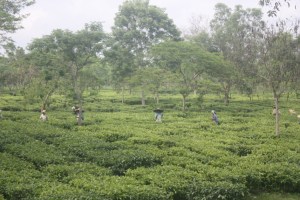
POEM: What Kind of Shrub?


What kind of shrub grows an Empire?

What kind of shrub shifts the well-laid tracks of global trade routes?

What kind of shrub doesn’t know whether to be of nature or man?

Its even green sings the song of nature, stretching in an unbroken landscape to the forest’s pristine chaos-

-except when in need of picking. Then its bright, almost glowing, fresh tips are the shade of a newly trimmed outfield, standing out against nature’s dark olive.

But, its flat-topped, close-cropped ‘do tells a tale that’s all man, as do the fine parts that section off the shrubs into labyrinthine patterns for the pickers to navigate.

And what kind of shrub, each day, draws hordes of humans with wicker baskets on their backs and conical hats that are to the Vietnamese Paddy Hat what a novelty sombrero is to a real sombrero.

What kind of shrub…

POEM: Witching Hour Wanderer

he lies beneath a winter’s night full moon
under the stretching silence of fresh snows
quiet, save for the Saw-whet’s beep-beep tune
as if the living were claimed by the shadows

somewhere boots will crunch on a crust of ice
out to find the lost and longing wanderer
who thought no cabin rafters could suffice
to fuel the fires of an ardent ponderer

two enter a race neither knows he’s in
with the crawling clouds that’ll douse the moonlight
and with river ice that’s getting thin
but mostly with the mean teeth of frostbite

would someone come for you in the witching hour?
then treasure him be he tender or dour

DAILY PHOTO: Finnish Orthodox Church

Taken in the summer of 2012 in Helsinki

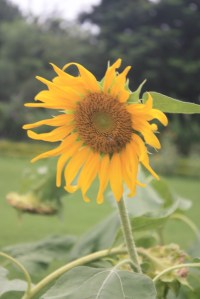
POEM: The Thaw Entwined, or: The Sunflower’s Wisdom

No. Snow and ice can’t rectify my mind.
Don’t pray I’ll flash fire it into a boil.
I’ll seize, sullen, frozen, as a gargoyle.
Frost will form on my eye, and I’ll be blind.
A thaw comes only in the state entwined.
If only I were gifted at that toil.
I watch Trussed Wonder’s melt begin to roil,
wondering how they knew which way to wind.
 
But nature graces those lacking talent.
A sunflower’s wisdom is all one needs.
Making turning to the sun look gallant,
is the lazy thaw path to being freed.
 
There is no flash fried wisdom you shouldn’t shun,
but, perhaps, just revolve to face the sun.

DAILY PHOTO: Orange Gates, Tokyo

Taken in the Summer of 2008 in Shinjuku

Taken in Ueno Park, Tokyo

POEM: Decay

People fear death,
but beyond death lies decay,
and one can rejoice in decay.

For to decay is
to be Santa handing out piles of gifts,
building blocks badly needed to make
stalks and sternums.

Becoming the dark, rich loam,
the color of coffee grounds,
from which shoots and leaves
sprout to chase the light.

Your gifts will keep giving
despite the people grieving
because you are a pile of
recyclables.