Taken in May of 2015 at Ramnagar, Karnataka


you’ve clocked me on atomic time
dragged me below the water line
but you don’t know from whence I’ve come
blank, teary-eyed, and feeling numb
weary from my endless travel
my throat parched, the sound of gravel
still you pull from me a charred word
but it feels distant and absurd
somehow he thinks that he will find
somewhere among the broken time
a time shard that tells the story
lost city, ditched and hoary
weary wanderer drowned down there
pulled from green waters by his hair
“but who was the evil culprit!”
i once heard screamed from a pulpit
the funeral for a future me
i heard the word i could not see
found by some old man of means
who could see behind the scenes
but to know the truth, he could not
secrets hide in bits time forgot
Banned Books Week runs from September 23 to 29 in 2018, offering a nice reminder about all of the books that are so awesome that some doofus doesn’t want you to read them.
Here are five of my favorites:

5.) One Flew Over the Cuckoo’s Nest by Ken Kesey: Randle McMurphy conducts a con to convince authorities that he’s insane and belongs in an asylum rather than doing hard time in a prison. It’s a commentary on how free-spirits are viewed by society and the pressures put upon them to conform. It’s been challenged many times on the usual grounds of sex and language, as well as for the “glorification of criminal activity.”
4.) A Clockwork Orange by Anthony Burgess: In a dystopian England, the head of a small band of thuggish teenagers is imprisoned and convinced to undergo operant conditioning that will make any future attempts to engage in violent behavior personally painful. The book is a critique on social engineering, though it should be pointed out that there are two different versions of the book in circulation, one with the final chapter written by the author and one without it, and the inclusion or deletion of that chapter has serious implications for the book’s message. Instances of sex and violence are the usual basis for challenges to this novel.
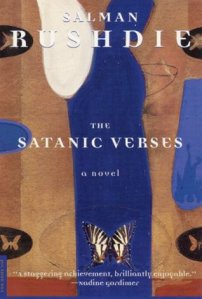
3.) The Satanic Verses by Salman Rushdie: Two men fall from a plane and survive, one archangel and one demon. The title of the book, and much of its controversy, is owed to a plot point about the Islamic prophet Muhammad (Mahound, in the book) receiving both angelic and demonic guidance and prophecy. This is the most explicitly banned book on the list with at least a dozen countries explicitly banning it — most of them were Islamic countries offended by the portrayal of events when Islam was first coming into existence, but a few banned it out of public safety fears over extremist activity. The author is under Fatwa, religious approval of Rushie’s execution, by Iranian authorities.
2.) Brave New World by Aldous Huxley: In this soft dystopia, people are kept in line by readily available drugs and promiscuous sex. Among the American Library Association (ALA) list of challenges to this book was one suggesting the book be banned because it: “makes [promiscuous] sex look like fun.” Which made me laugh a little.
1.) The Grapes of Wrath by John Steinbeck: A family, bankrupted by the one-two punch of the Dust Bowl and Great Depression, packs up and heads out to the promised land of California, only to discover that it wasn’t all that it promised. Objection to language is the most prevalent cause for challenges to this book.

Annapurna, Nepal; Taken in May of 2018
5.) The Death Zone may be a myth, or — probably more accurately — everyone may have their own personal death zone:
It’s widely stated as fact that above 8,000 meters (26,000 feet) every human being is dying, no human can acclimatize, and the race is on to get back below that altitude before the body is damaged beyond its ability to repair itself. This hard-limit is widely publicized in reputable, mainstream publications such as National Geographic. There’s a certain logic to such a limit. In response to the diminished pressure of oxygen, the body produces more hemoglobin (that’s acclimatization), but the bloodstream can only take up so much hemoglobin.
Mark Horrell, in his mountaineering blog, challenges the idea of a one-size-fits-all hard limit, and provides anecdotal examples that contradict the 8,000 meter cap.
4.) Sticking one’s face in water allows one to hold one’s breath longer:
Sensory cells in the face and nostrils sense wetness and this sensation triggers a slowed heartbeat (bradycardia) and constriction of blood vessels (vasoconstriction) so as to reduce blood flow to the extremities.
A more detailed explanation can be read here.
3.) Mouth-to-mouth resuscitation works because our lungs only capture about 20% of the oxygen in each inhalation:
If we had super-efficient lungs, our exhalations wouldn’t contain enough oxygen to sustain the patient receiving cardiopulmonary resuscitation (CPR.)
This and many other fascinating respiratory facts can be found on the Crash Course videos on the subject.
2.) In two weeks time the breath you’re exhaling right now will have spread out around the globe.
Sam Kean’s book, Caesar’s Last Breath, discusses this subject in great depth. In fact, the title is a reference to the fact that in each breath it’s likely that one inhales a molecule of Caesar’s dying breath.
1.) When you lose weight, most of it (84%) is lost in exhaled carbon-dioxide:
This may not be a question that ever occurred to you, but I bet you find it fascinating once it’s brought to your attention. It’s not like when you cut 5 kg, there’s a fat pile sitting somewhere. More about this subject can be learned here.
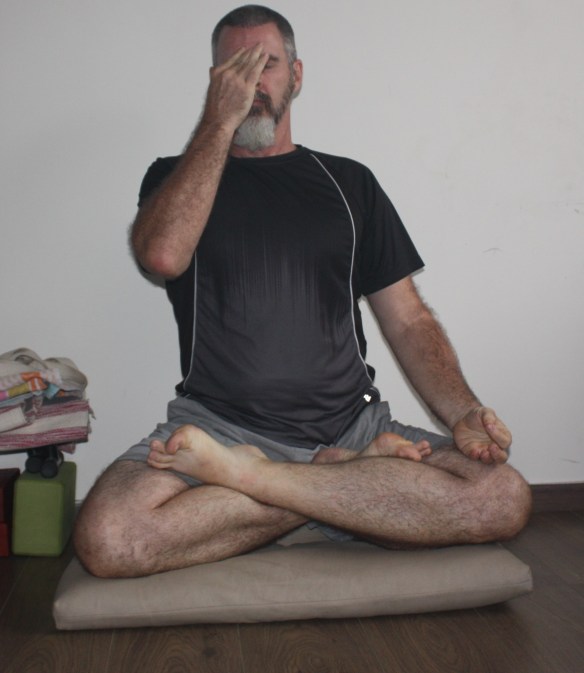
Nadi Shodhana; Alternate Nostril Breathing
It’s come to my attention that I’m doomed.
I heard that a cat was killed by curiosity.
I realize that I’m not a cat —
not even a hepcat,
which sounds like it would be a cat with hepatitis,
but it’s really the ringing endorsement of a 1940’s jazz artist.
(I learned the term from Looney Tunes reruns in the 70’s,
alas, too late for the hipster seal of approval.)
But, I digress.
My point is that I’m vastly more curious than a cat.
Cats are only curious about two things:
1.) where is my food?
&
2.) why does this human act like it’s the boss of me?
But I digress once more.
My real point is that if anyone has received a lethal dose of curiosity,
even given my large body mass and super-feline capacity to neutralize toxins,
surely it’s me.
Curiosity is my defining characteristic, the sine qua non of my life.
I’m curious about the arcane, the anachronistic,
and all the subjects typically maligned as:
“dreadfully boring,”
“painfully tiresome,”
“excruciatingly tedious,”
and “soul-crushingly ho hum.”
I have a Master of Economics degree, for heaven’s sake.
Even my “interesting” graduate degree, the one in International Affairs,
largely involved the study of the obsolete tactics of a collapsed empire.
I’ve spent hours asking, “Who am I?”
out of curiosity about whether Sri Ramana was right,
and eventually a meaningful answer would coalesce.
I’m curious about everything there is to be curious about.
Is there a god, and, if so,
-is she pretty?
-does it have tentacles?
-is it a lonely job?
What is consciousness? Where is consciousness? Is consciousness? Conscious much?
-And can one ever know a thing by using that thing as one’s primary tool of investigation? Or is it like trying to fully know a house while locked in one of its closets? Plato’s cave and all that jazz.
What technological advancement will blow us to smithereens?
-And will it be the same one that got all those alien races who should be billions of years ahead of us, but who are radio silent and whose suns aren’t even partially blotted out by Dyson swarms. Or is the road of civilization strewn with technological landmines — each unique, but deadly?
I’ve climbed to the top of a mountain just to know what was on the other side.
Only to be answered by the rows of ridge lines stretching out into the grey distance,
which said to me, “Even this little blip of the universe is too big for you to know.”


Leap Frog “sky-writing” in colored smoke

Leap Frog with American Flag

Golden Knight with POW – MIA flag

Golden Knights; Taken at the Chicago Air & Water Show on August 19, 2018
Military precision parachute teams from both the US Army (the Golden Knights) and the US Navy (the Leap Frogs) appeared at the 2018 Chicago Air & Water Show.