
Taken in January of 2019 near Vang Vieng, Laos
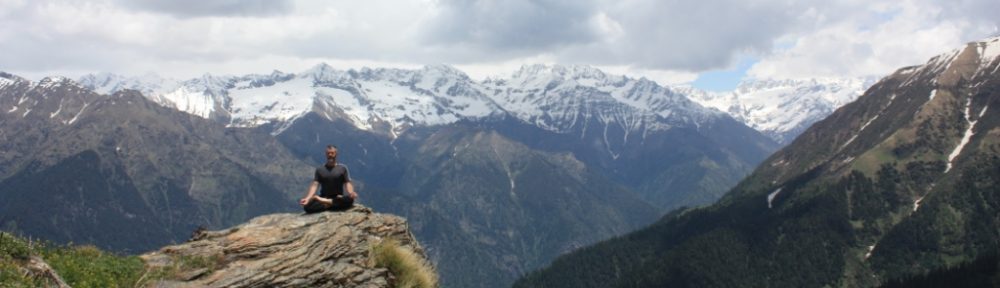
Taken in January of 2019 near Vang Vieng, Laos
 As I continue to look at variations in consciousness, it occurred to me that poetry writing (or at least pre-writing) often involves an altered state of consciousness. Often, I do an exercise akin to freewriting. Freewriting is an exercise that has been popular for a long time for beating writer’s block. You just write: fast, without judgement, and without concern that you’re taking a reader to any particular place. (It’s somewhat like “brainstorming” in process, but usually solitary and producing sentences or phrases and not bullet-point lists.) The point is to break the grip of self-consciousness and lay waste to the idea that every word has to be pure brilliance to be worthy of your time.
My process begins by quieting my conscious mind, typically with long exhalation breathwork (pranayama.) For those unfamiliar with yogic pranayama or other forms of breathwork, drawing out one’s exhalations (in conjunction with relaxing the body) slows the heart rate and otherwise activates the rest and digest functions of the body. (The curious or dubious can look up “cardiac sinus arrhythmia” or “respiratory sinus arrhythmia,” which is the same thing alternatively labeled by the cause [respiration adjusted] or the effect [heartbeat changes])
After my conscious mind is tranquil, I set pencil to paper and just start writing quickly — without looking back or forward, but just trying to be present with whatever my mind vomits forth. Usually, there is an understandable grammar, but no understandable meaning (at least not beyond the granularity of a phrase.) But building meaning isn’t the point, and I don’t care. Sometimes, I fall into a rhythmic sound quality, but other times I don’t. To give an idea of what the raw feed of this looks like, here’s an example from this morning:
Turn ten, run the nines. I found a fever down the line and could not bend the wall to weep, but heard the conveyor line… beep – beep – beep. Oh, so some fucking wisdom says let live the demons that I dread, but there’s a cold magnolia leaf on the ground and I can hear it skid at the break of dawn, but what sign is that to feel it out. I killed a monk and stole his doubt, but you’ll never blame away the triple frame…
So, it’s a collection of words and phrases that has no discernible meaning collectively. Once and a while, I go through some of these flows of verbiage and underline words, phrases, or ideas that have some spark or merit, and then — if I can — unshuffle and word-cobble until I have a poem.
However, my point in this post isn’t to describe how a poem gets its wings. Instead, it’s to discuss the process by which the consciousness “presents” us with something from out of nowhere. (The conscious mind would claim it “created” it, but I have my doubts. I’ve learned the conscious mind routinely takes credit for many things that are not its doing.)
It’s not like I have an idea (stolen or otherwise) and then I think it through, and then I order those thoughts into an outline. (The usual writing process.) On the contrary, I go to great lengths to make my conscious as quiet as possible as a precursor. I think about the term William James coined, “stream of consciousness” which became a prominent literary device. Is it streaming into consciousness, from consciousness, or through consciousness? Where does it come from?
You might say, “Why worry about where it comes from because it’s a garbage heap?”
But once in a while there are epiphanies and flashes of insight amidst the rubble and dung. Sure, maybe I grant detritus post-hoc gold status, but there’s something there I feel I have yet to understand.
In consciousness, we seem to have awareness of [something] and meta-awareness (i.e. we are aware of what we are aware of [something.]) Sometimes that meta-awareness is a grand and beneficial tool, but sometimes it’s just another word for self-consciousness. Sometimes having a one-track mind is a beautiful thing.
I said that my practice was “akin to freewriting,” and it might seem exactly freewriting, but the main difference is that it’s purposeless. Sure, once and a while I go back through and rag-pick, but mostly I do the practice just to revel in the experience of being completely with whatever words are streaming. The writing and being consciousness of what is surprising me on the page takes enough of my mental faculties that I have none left to be self-conscious.
Who knows where this journey will take me next month? There’s still a lot of territory left in the altered states of consciousness. Fasting, dance, shamanic drumming, tantric sex, psychonautics, etc. Who knows?

Taken in the summer of 2011 at Veresegyház, Hungary

Taken at Angkor Wat in October of 2012
 Candy by Terry Southern
My rating: 5 of 5 stars
The protagonist of this story, Candy Christian, is a caricature of a flighty, young beauty with daddy issues. Candy’s personality mixes cringe-worthy naivete with an endearing – if unjustified – optimism about the virtue of men. This, combine with her laudable but exploitable desire to render assistance, leads to a chain of events in which her trusting nature is repeatedly manipulated, usually without her ever becoming aware she’s been duped (or, at least, without it being admitted to the reader.)
This book claims to be a satire on Voltaire’s “Candide.” While readers may find varying degrees of commonality between the books, they do share some common ground. Both start with the protagonist being educated by a philosopher. In Candide’s case, it is Pangloss (i.e. “all talk”) who insists that Candide lives in the best of all possible worlds. In Candy’s case, it’s Dr. Mephesto (i.e. presumably derived from the Germanic demon “Mephestopheles” whose name means something like “scatterer of lies,”) and Candy’s philosophy teacher harps on the point that a person must find meaning in service, and to be willing to demonstrate that service as – of course – an attempt to bed Candy.
The books are also both episodic, jumping from location to location with adventures occurring at each locale. However, this episodic nature starts late in “Candy,” with the first two-thirds or so taking place in her hometown (Racine, WI) and – only then going on the move. Despite the availability of air travel, Candy doesn’t get around as much as Candide, though she does finish her journey at a Tibetan monastery. Both books have also been classified as being of the “education of a youth” (i.e. Bildungsroman) variety. However, they both have also been criticized on the basis that there wasn’t much of value learned by the lead. That said, Candide offers a clear moral to end the story, whereas Candy’s takeaway is in a more ambiguous twist ending.
“Candy” (the book) hinges on more than one absurd turn of events, but given that the genre is humor, I had no problem with that. [Even Shakespeare, in works like “The Comedy of Errors,” asks one to suspend disbelief in exchange for a laugh and some solid entertainment.]
I will point out one last similarity between “Candide” and “Candy,” they have both frequently been banned on the basis of moral arguments. Which brings me to to a couple warnings. If it’s not been made clear to this point, this book is sexually graphic, and individuals troubled by that may want to avoid it. The other class of reader who may be offended by the work are those disturbed by the book’s frequent victory of exploitative characters. In some ways, the book shares as much in common with Marquis de Sade’s “Justine” as it does with “Candide.” While the tone isn’t at all dark like Sade’s book, the story does suggest that world order is such that the weak and naïve will repeatedly be exploited by the strong and amoral.
I found the book to be humorous. The story is intriguing and well-developed, and – if one can suspend one’s disbelief regarding a few of the more absurd events – the reader will find it engaging. It’s not always a comforting read, but if you don’t mind (or enjoy) that condition, then you’ll likely to find it a pleasant read.
blinding fire of neurons
— excitation & secretion —
all from a 2-D arrangement of pixels
that my brain thinks is worth getting worked up over —
symmetry, smoothness, scaling, and that jazz–
but that program isn’t the final word
i’ve re-jacked the synaptic dance
when the wiser bit recognized something
flawless in the arrangement of a pile of flaws
or a gorgeous simplicity,
or, alternatively, poison in the perfection
in the short-run,
what was said of pornography may be true of beauty —
i.e. “I know it when I see it.”
but, in the long run,
we’re all dust,
&
vaguely-remembered best impressions
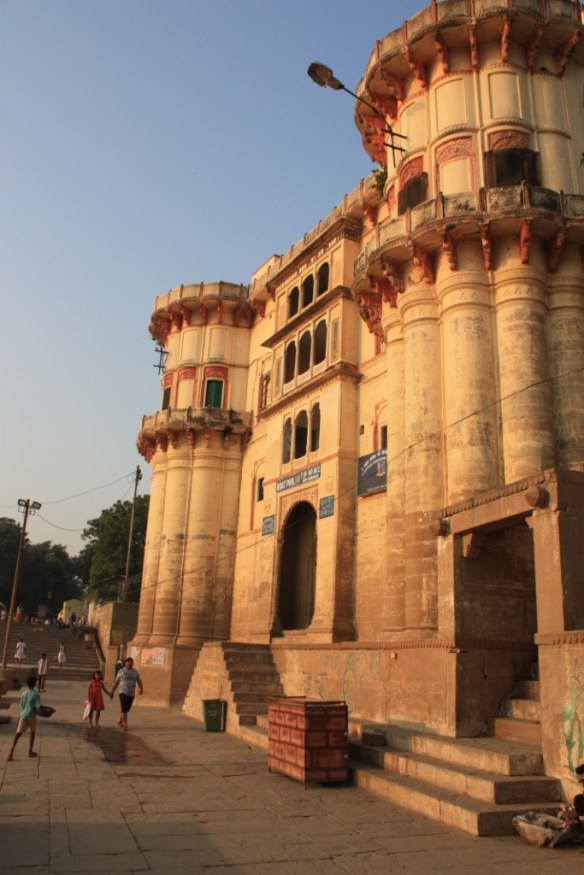
Taken in October of 2015 in Varanasi (Benares)

Taken in April of 2017 at Chobe National Park
At night, I die a shallow death.
The heaven is strange; its rules few.
I walk forest, field, and mansion,
weaving the doors of one hallway.
I’m told it’s me all the way down,
but something says, “Psst!” in the dark.
Subconscious is a drug dealer.
It tempts me with alluring prey.
I give chase in that spaceless space.
Unlike the dog with twitching legs,
This chase succeeds or fails at rest.
Then, I claw back to life each morn.
a rock slab juts angularly through the waves
in a tempest — torrential & tumultuous
the tip-top of that rock forms a jagged cliff,
and next to that jagged cliff stands a shack —
rickety but resolute —
it sways in whipping winds,
but neither collapses
nor flies into the gnashing maw & smashing fists
of the monstrous surge below
between the slats of that shack,
a rain-pelted eye peers out,
awaiting the lightning that will
show her a flash frame of infinite, angry seas


