
Taken in July of 2009 from atop Stone Mountain in Georgia

Taken in July of 2009 from atop Stone Mountain in Georgia
[A pantoum is a Malay form built in quatrains, and which uses repetition of lines. The second and fourth lines of one stanza become the first and third of the next. The final stanza can, but doesn’t necessarily, revisit lines from the first stanza.]
 She bends a moment writ in iron time,
while concentrating on a hov’ring bee.
Its undulation hushes a turbid mind.
Entranced, there’s nothing else to feel or see.
She concentrates on the hov’ring bee.
It becomes the sum of all things in her world.
There’s nothing else to feel or hear or see.
Only the bee alighting, body curled.
The bee is all that resides in this world.
Its undulation lulls her into trance.
She sees it flit and hover, its body curled.
The moment slows to show her its wee dance.
[Senryu is a Japanese style of poetry that’s identical to haiku in form, but different in content. While haiku rely on images (usually natural and often seasonal) and the juxtaposition of such images — devoid of analysis, commentary, or judgement — Senryu poetry explores human nature. In other words, while humans appear rarely in traditional haiku (and, when they do, it’s as a part of nature;) Senryu are always about humans and they do present commentary — often intended to be humorous.]

two dodge bird poop
the missed credits himself,
the struck curses birds
when floors must be swept,
some needn’t be told, some must,
and some told they can’t
extroverts
having virtual parties,
while I read
Blake said,
“The cut worm forgives the plow.”
What of the plowman?
boredom exempt:
creatures who use their teeth, feet,
or their brains
the hungry snake
doesn’t begrudge the winning
chameleon
[A rondeau is a closed poetic form of French origin. It uses tetrameter, a half-line refrain, and rhyme schemes of aab and aabba. The first poem I ever learned by rote, “In Flanders Fields,” is among the best known English-language examples of this type of poem.]
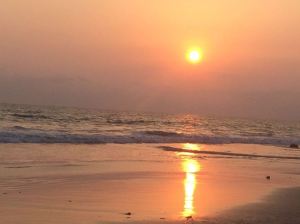 I’ve seen sunsets in colors bright.
I climbed Phnom Bakheng for the height
to peer above the canopy.
Fire orbs dip to Andaman Sea,
and I crossed isles to beat twilight.
Hues: royal purple to blazing fire light
I’ve watched Midwestern skies fade to night
from a tower above the trees.
I’ve seen sunsets.
Seven ridges of varied might,
were stacked from tree- to snowcapped-height,
and a different scene for each degree —
as painted clouds flared windward to lee,
and I watched from an idyll campsite
I’ve seen sunsets.
waking in a train car
at the rail yard
slouched in the darkness —
but not pure darkness
because the lights are always on at the railyard
and the pale light shines in at strange angles
slapping the window makes your palm hurt,
bruising the bone of your thumb,
but gets you no closer to being free
trying to wedge your fingers between
the rubber ends of the sliding door panels
proves useless
the door doesn’t give way — weakly —
as it does when a running rider
slips a hand in at the last second during rush hour
nothing to do but to try to go back to sleep
but your mind races with what you’ll say
how it’s “a funny story”
or
indignantly, “isn’t someone supposed to check each car?”
of course, they are, and they did,
but the driver, eager to get home,
just peeked through window into that last car
and didn’t see the person huddled
in the backward-facing first row of that last car
mind-racing, and butt feeling the hard seats
you can’t fall asleep,
and you wonder how you ever did
but, eventually, you do
you wake in the train car
still at the railyard
but without the darkness
because a bright light shines in your face
as someone says,
“What are you doing here?”

Taken in the summer of 2002 near Budapest.
[A tanka is a Japanese form closely related to the shorter form, haiku. In fact, a haiku can be thought of as the upper phrase of a potential tanka. Traditionally, the tanka (a.k.a. waka) is a 31-syllable poem. In modern notation, the additional 14 syllables are put into two seven-syllable lines below the three haiku lines, i.e. 5 – 7 – 5. (That said, there are many — myself included — who feel that the 5 – 7 – 5 – 7 – 7 approach applied to English language poetry loses the sparse, Zen feel of Japanese poetry because English syllables can be — and frequently are of — much longer duration. Personally, I’m more partial to the 2 – 3 – 2 stressed beats approach.) Historically, a haiku presents an image devoid of analysis or commentary. In Tanka, there is a pivot and the lower phrase often presents a response to the image.]
dry season
afternoon downpours
come daily
like one bird nesting
in another’s nest
soggy forest
oppressed smoke hangs low
unseen, but smelt
bone dry wood exists
but only within flame
drippy garden
a bright orange flower
hangs its head high
you warm my mind,
if not my bones


Taken near Bokonbayevo on the south shore of Issyk-Kul in the summer of 2019.


