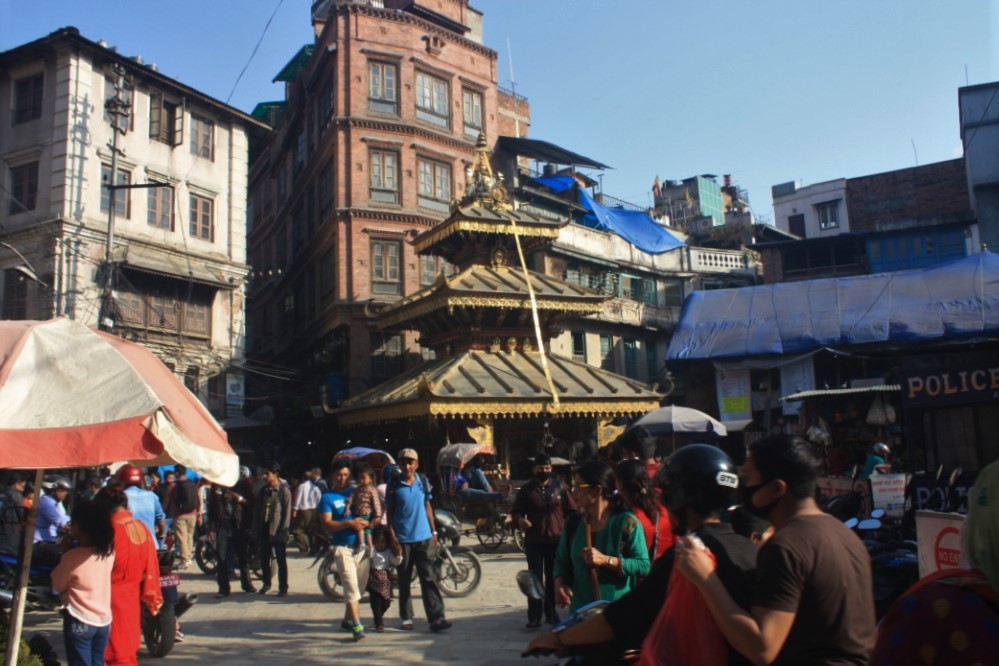
Alone in a Crowd [Couplets]

He sits alone. His barstool straight,
it faces forward - not askew.

The room is full, the music loud.
He stares through his half-empty brew.

He's oblivious to all else --
all alone in the human zoo.

DAILY PHOTO: Tomb of Ibrahim Rouza, Bijapur

Taken in Bijapur (Vijayapura) in December of 2020

BOOK REVIEW: His Last Bow by Arthur Conan Doyle

His Last Bow: A Reminiscence of Sherlock Holmes (Wisehouse Classics Edition - with original illustrations)His Last Bow: A Reminiscence of Sherlock Holmes by Arthur Conan Doyle
My rating: 5 of 5 stars

Amazon.in Page

This story collection is the penultimate book in the Sherlock Holmes canon. One sees a shift into the modernity of the twentieth century in the seven collected stories. In particular, “The Adventure of the Bruce-Partington Plans,” is about the theft of plans for a submarine, and the final story, the titular finale, “His Last Bow” takes Holmes out of the world of crime and law enforcement and into the realm of espionage. Of course, the Sherlock Holmes books have always taken advantage of both the science of the day as well as offering glimpses into the cultures and peculiarities of far away lands. This blending of the cutting edge with exoticism is part of what gave these books a mystique that set them apart from other detective fiction, and is also partly why they have aged so well.


Two recurring plot devices in the book are poisonous substances and – ever popular with Doyle – the criminal secret society. Poisons play a central role in “The Adventure of the Devil’s Foot” and “The Adventure of the Dying Detective.” The secret society angle plays into the only two stories of the collection that are two-parters: “The Adventure of Wisteria Lodge” and “The Adventure of the Red Circle.” “His Last Bow” isn’t the only departure from the standard Sherlock fare. Given an attempt to kill off Holmes as well as the unsuccessful finality of this book’s title, it seems like Doyle was acutely concerned by the capacity for these stories to become overplayed. Therefore, he seemed to experiment a little with story. Unfortunately for him, the author did too good of a job at creating one of the most intriguing characters ever, and so demand for the stories remained unabated – regardless of the fact that the stories tend to become a bit more predictable as one reads through them in their entirety.


I felt this collection provided a nice mix of atypical and classic Sherlock. It’s definitely worth a read.

View all my reviews

Himalayan Oasis [Haiku]

on the arid steppe
sits a green oasis -
patchwork fields

DAILY PHOTO: Palace & Sky, Leh

Taken in Leh in August of 2016

BOOK REVIEW: Mademoiselle Baudelaire by Yslaire

Mademoiselle BaudelaireMademoiselle Baudelaire by Yslaire
My rating: 4 of 5 stars

Amazon.in Page

This graphic novel mixes fact and fiction to tell the tale of the romance between French poet, Charles Baudelaire, and Jeanne Duval, the Haitian mulatto woman with whom he maintained a long-term relationship. The fictional portion of the story is necessitated by the fact that some of the couple’s story is unknown. Much more is known about Baudelaire than Duval, and in terms of what is on record, accounts differ. The relationship was passionate and complex, but it’s hard to say how loving it was. Baudelaire is depicted as fetishizing Duval’s dark skin, and Duval seems like a gold-digger at times.


The bulk of the story is told in an epistolary fashion as a letter from Duval to Baudelaire’s mother after the poet’s death. While the epistolary form seems apropos for creating a tone for historical fiction set during the 19th century when that form was all the rage, it was the source of my only problem with the book. That problem is that some of what’s communicated strains credulity. First, the work is erotic in nature, and it seems unlikely that even the most libertine of women would feel the need to share with a mother what they did with her son. It just feels awkward. Second, there is a fair amount of “as you know, Bob” exposition in the letter. [“As you know, Bob” being shorthand for telling a character something that they would know at least as well as the teller knows, and – in some cases – more so.] This is most clearly seen when the letter talks about a time when Baudelaire was living with his mother, such that it’s not clear how Duval knows this information, but it’s non-sensical for her to act as though the mother wouldn’t know.


Other than that, my view of the book was entirely positive. I found the art was effective and captured the spirit of the time well. There’s large amounts of nudity and graphic sexuality, so if that’s troubling for you, it’s not your kind of book. The prose is just purple enough to lend authenticity to the 19th century epistolary format, but quite readable.


I found the book fascinating and I read it straight through. If you’re interested in the Bohemian life of a womanizing poet / laudanum addict, you’ll definitely find this book compelling.


View all my reviews

Gompa [Haiku]

mountain Gompa,
fused to the mountainside
as if carved from rock

DAILY PHOTO: Big-Eared Baby Baboon

Taken at Amboseli National Park, Kenya in June of 2017

Those Who Bled for the City [Free Verse]

blood runs to the gutters,
flowing and whirling,
a sluicing pink juice
that circles and sloshes
down the drain

most did not feel
the missing blood,
but it came from 
each and every one 
of them -

the locals, the exiled,
the travelers, and
the ne'er-do-wells -

all bled into the city,
and something grew 
from that protein slurry

most contributed only
drips & drops,
but some hemorrhaged,
giving their liquid selves 
for something 
they couldn't 
anticipate 

Mekong Canoe [Haiku]

the tilting boat
slips the nipa labyrinth
with silent ease