
Taken on September 20, 2015 in Bangkok’s Chinatown
I wonder if scale of the diagram is indicative of the degree to which each is a problem, or what?

Taken on September 20, 2015 in Bangkok’s Chinatown
I wonder if scale of the diagram is indicative of the degree to which each is a problem, or what?

Taken on September 20, 2015 in Bangkok
 The Monstrous by Ellen Datlow
My rating: 4 of 5 stars
Release Date: October 27, 2015
This is a story anthology offering tales of monsters—just not your everyday monsters. In her Introduction, Editor Ellen Datlow said her solicitation for stories asked for “unusual monster stories.” She wanted neither “human monsters” (i.e. no pedophiles or serial killers) nor was she interested in your classic Transylvanian Count Dracula. With this book’s 20 stories, the authors succeed in meeting Datlow’s request—in several cases spectacularly. Some of the stories are chilling, others are creepy, and two are even humorous, but all feature monsters that are out of the ordinary, or—at least—the monsters are in extraordinary situations.
Without further ado, I’ll offer a brief synopsis of, and comments on, the stories in this anthology:
1.) A Natural History of Autumn by Jeffery Ford: Set in Japan, a salaryman takes a girl-next-door escort to a remote onsen (thermal springs bathhouse and inn.) Neither of the main characters is what they seem, and, therein, lies the story’s appeal.
2.) Ashputtle by Peter Straub: A beloved kindergarten teacher describes her life and experience of the disappearance of a bright student. This story comes closest to violating the “no human monsters” proviso, but it creates a character so intriguing that you don’t necessarily care.
3.) Giants of the Earth by Dale Bailey: Miners stumble onto something unexpected deep within the Earth. This wasn’t one of the more engaging or memorable works, though it does have an intriguing premise.
4.) The Beginning of the Year without Summer by Caitlín R. Kiernan: A professor and a young, female townie chat by lakeside, and also a discovered book is returned. This is one of two southern gothic pieces, and is more engaging for the conversation between the intelligent professor and a more “common” young woman than for monstrous or supernatural elements.
5.) A Wish from a Bone by Gemma Files: An archeological team in a war zone stumble into more than they signed up for. Like a terrestrial Aliens movie with Sumerian evil spirits in lieu of aliens.
6.) The Last Clean, Bright Summer by Livia Llewellyn: A teenaged girl in a dystopian future travels with her parents to the sea for a rite of passage of an unexpected and haunting variety. This is one of the most visceral entries, and the author captures the teenage voice to great effect. This is in my top five stories from the anthology.
7.) The Totals by Adam-Troy Castro: A get-together between monsters to discuss quarterly figures and give out performance awards. This is one of the humor-oriented pieces—though not to the extent of the Monsters animated movies. The two humor pieces (the other being How I Met the Ghoul) offer two different angles on monster humor. This piece is set in a monstrous world, but juxtaposed against that eeriness is the work-a-day feature of a staff meeting. (The other story is set in our world—or at least a very mundane world reminiscent of ours—and draws its humor from the introduction of the monster into the midst in a very banal environment.)
8.) The Chill Clutch of the Unseen by Kim Newman: The last monster killer waits for the last monster to steam into town. This is one of the entries with a wild west feel to it. A common approach in this collection is to create unusual monster stories by putting monsters that may or may not be usual (in this case they aren’t) into settings and across from characters that one wouldn’t expect to see them.
9.) Down Among the Dead Men by Jack Dann and Gardner Dozois: A man discovers that his best friend in a Nazi concentration camp is a vampire. Referring to the previous entry (i.e. the Kim Newman story), this is an example of a typical monster (a vampire) given new life by placing it in a context that one would least expect to find it—a concentration camp. This was also one of my top five from this collection.
10.) Catching Flies by Carole Johnstone: A girl and her baby brother are removed from a household (by a DFACS-like entity) after their mother dies from mysterious causes. I mentioned a story done in the voice of a teenager. This is one of a few entries written in the voice of a child—which is very apropos for an anthology about monsters.
11.) Our Turn Too Will One Day Come by Brian Hodge: A man is called in the middle of the night, and asked to come and bring a shovel—which is, needless to say, never a good situation. The monsters, while fascinatingly described and unique, are almost superfluous to this story. The monsters appear only at the end, and it would be a highly readable story without them—though it would be in the wrong collection sans the monsters.
12.) Grindstone by Stephen Graham Jones: A man who’s been shot up is fleeing from something across desolate territory. This is the other entry with a very Western feel to it. This is also one of the shortest entries of the batch.
13.) Doll Hands by Adam L. G. Nevill: Set in a dystopian future, a laborer in a luxury building takes matters into his own (doll-like) hands when he can no longer accept the atrocities the super-wealthy patrons of the building are perpetrating. One of the great features of this story is that it creates visual imagery that one isn’t sure whether to take literally or just descriptively. For example, the lead baddie is an old, rich woman who’s described in avian terms. It’s clear that something has gone terribly wrong in this world, though there is strategic ambiguity as to what. This is in my top five.
14.) How I Met the Ghoul by Sofia Samatar: A reporter conducts an interview with a ghoul in an airport lounge. This is the other story that is more comedy than horror. The comedy is born of putting the monstrous creature in a mundane setting during a workaday interview. It’s not even the kind of hard-hitting story that a well-known journalist would take on, but more like a cub reporter doing a human interest featurette.
15.) Jenny Come to Play by Terry Dowling: A former Siamese twin, separated from her twin as a teenager, admits herself into a psychiatric hospital where her psychiatrist tries to separate fact from fiction and the twisted imaginings of insanity from reality. These Siamese twins shared no common organs, just muscle, and were ideal candidates for separation as infants. However, their father kept them conjoined (and much worse) so that they could be the main attraction in his cabinet of curiosities. Not only is this story in my top five, I’d have to call it my favorite of the bunch. It reminds me a little of the work of the novelist team Preston and Child at their best. It has the same combination of creepiness and dark foreboding, while keeping one in the dark as to what imaginable events have actually transpired.
16.) Miss Ill-kept Runt by Glen Hirshberg: A family drives through the night to go to stay with family as if fleeing an ill-defined threat. This is another of the stories done in a child’s voice and perspective, and it captures that voice well.
17.) Chasing Sunset by A.C. Wise: A young man flees across country in an attempt to escape a demonic father who is after his body. This story offers the most impressive use of language. It’s one of the most enjoyable pieces to read, and, while it didn’t quite make my top five, it definitely gets honorable mention.
18.) The Monster Makers by Steve Rasnic Tem: A grandfather teaches his grandkids the family magic of being able to make others turn into monsters. In a way this seems like a thinly-veiled allegory for how grandparents turn children into “monsters,” but it’s entertaining nonetheless.
19.) Piano Man by Christopher Fowler: A travel writer doing a story on New Orleans gets caught up in a local voodoo turf war. This is another Southern Gothic piece with post-Katrina New Orleans as the setting—with all its tragic, macabre undertones.
20.) Corpsemouth by John Langan: An American visits his ancestral home and old world family in Scotland and discovers that the “gibberish” last message of his dying father actually had a rather spectacular meaning. This story rounds out my top five. I found it to be engaging, highly readable, and with an intriguing premise.
This anthology is thrilling and readable, and I’d recommend it to anyone who wants to read about unusual monsters.

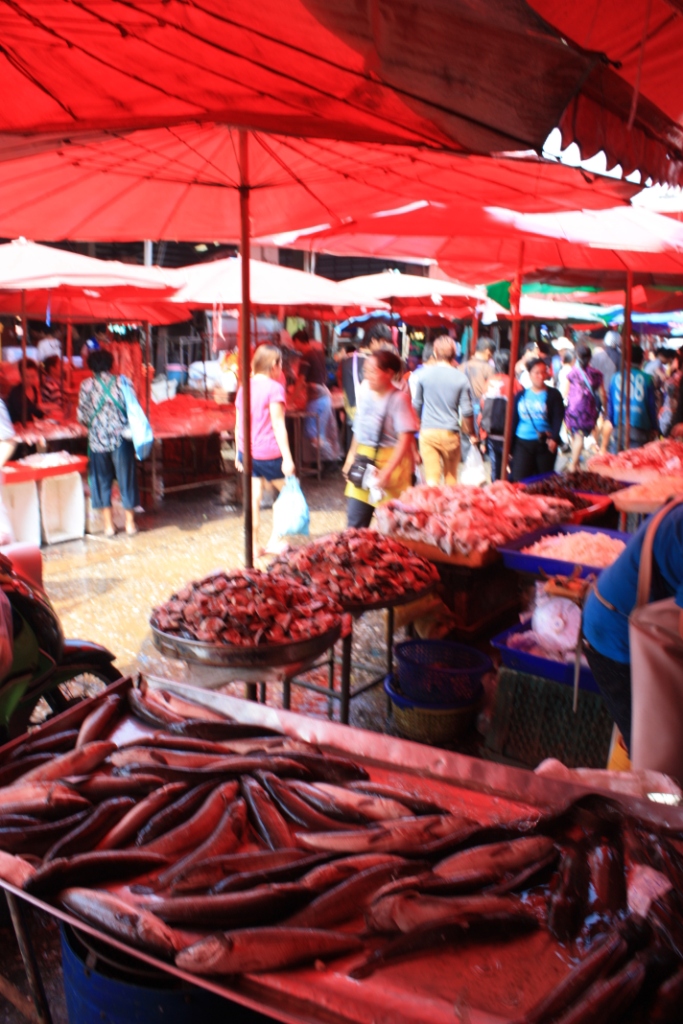
Taken on September 20, 2015 at Khlong Toei Market
In India there is a color coding system that one sees on all packaged goods and probably a majority of restaurant menus. A green dot in a square means the food is vegetarian (which means neither egg nor meat content in the product) and a red dot means non-veg.
Here in Thailand, at Khlong Toei Wet Market, it’s interesting to see how vendors used red and green awnings. In this case, it’s not so much to signify the product as to enhance its visual appeal. Vendors who specialized in green produce inevitably used green awnings to make their greens look greener. By the same token, meat vendors and fish vendors that specialized in “red fish” (e.g. tuna, as opposed to white fish, say halibut) used red awnings to make the reds redder. Incidentally, white fish and squid sellers often used a combination of white and blue tubs to create another kind of aesthetic appeal. Fruit vendors are out of luck because they have just too many colors to deal with. (Unless they specialized a single fruit like watermelon–or durian, because if you sell durian you’re out of luck on selling anything you don’t want tainted by the smell of durian.)

Taken in October of 2012 at Angkor
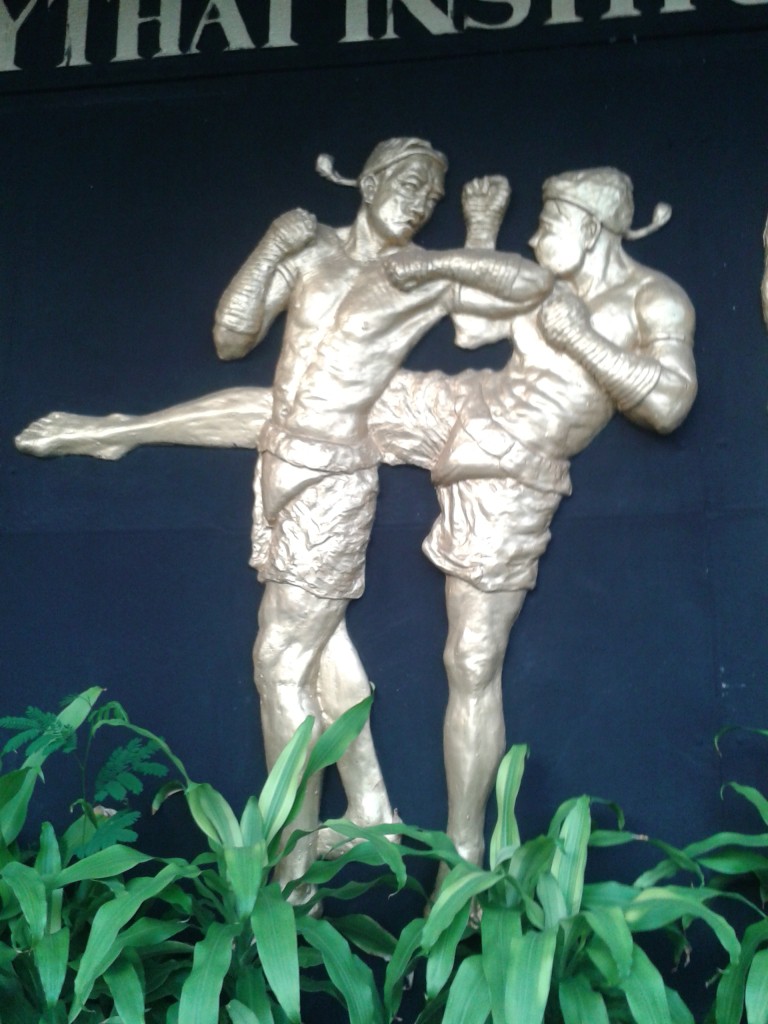
Taken at the Muay Thai Institute in Rangsit, Thailand.

Taken on September 13, 2014 at Jatujak Park
 Buddha’s Brain: The Practical Neuroscience of Happiness, Love, and Wisdom by Rick Hanson
My rating: 4 of 5 stars
This is one of those books whose title leaves one unclear as to the book’s nature. The title has religious connotations, but its subtitle, The Practical Neuroscience of Happiness, Love, and Wisdom suggests a secular and rationalist work. The subtitle might clear things up if it weren’t for the fact that there are so many New Agey, spiritualist types who like to glom onto scientific terminology—presumably in an attempt to lend credibility to ideas that are “out there.” Thus, one may reasonably wonder whether this is just another Biomechanics of Chakra Fluffing style book—actually, I made that one up, but if you can see why such a title would be oxymoronic you know where I’m coming from. Without further ado, let me state that this book is rooted in the science of the brain, and, while it uses its fair share of concepts from Eastern religion as pedagogic devices, it doesn’t presuppose need to believe in anything [or anybody] for which there is no evidence. [What remains less clear is whether this book is properly considered self-help or pop science?] This issue with the title may be why Hanson came out with the more secularly-titled Hardwiring Happiness book a few years later that seems to cover similar territory (though, I’ve not yet read the latter.)
The central premise of Buddha’s Brain is that the brain’s neuroplasticity allows one to change the way one experiences life by changing the way one perceives and responds to life’s little trials and tribulations. Over time, one can become happier, more loving, and wiser—i.e. one can have a brain more like the Buddha’s. “Spiritual” matters are always at the periphery of what Hanson is discussing because this type of practice has historically been in the bailiwick of religious traditions—specifically Eastern (and other mystic) traditions that focus on looking inward to be a more virtuous person. However, where said traditions have often relied on assumptions unsupported by current science—such as the existence of a unitary (i.e. universally interconnected) consciousness, Hanson considers the issue from the perspective of our current understanding of the brain. In particular, he focuses on the fact that we are capable of training our brain to respond more positively to events.
Evolution, beautiful and elegant as it may be, has made us pessimistic and prone to disproportionately focus on the negative. This is because survival depended on being ready for worst case scenarios. So we imagine what that worst case is, and endlessly replay scenarios to prepare ourselves for how to deal with said worst cases. While this approach may have enhanced our ancestor’s survival probability, it can easily get out of hand and for far too many people it has. In the book, Hanson proposes three evolutionary strategies (i.e. creating separations [us / them, I / you, etc.], maintaining stability, and threat avoidance / opportunity seizure) that often end up tainting our worldview, raising our stress levels, and causing declining health and well-being. The book does get into the mechanics of stress reduction as well as how to change the way one experiences the world so as to be exposed to less stress.
Rick Hanson is a psychologist who holds a Senior Fellowship at a center at the University of California at Berkeley. He also founded his own center called The Wellspring Institute for Neuroscience and Contemplative Wisdom.
The book is organized into 13 chapters arranged in four parts. The four parts are: I.) The Causes of Suffering, II.) Happiness, III.) Love, and IV.) Wisdom. These parts are preceded by front matter which includes the first chapter which lays out the basics of the brain in layman’s terms as well as discussing the evolutionary survival strategies that sometimes fail to serve us well in modern living. More detailed discussion of the brain is introduced throughout the book at is relevant to the discussion at hand, but the level of this discussion should be approachable to all readers. Each chapter is divided into many subsections to make the reading easily digestible. One of the nice features of this book is that each chapter has a bullet point summary at the end. Actually, the author uses bullet points prominently throughout the book. There is one appendix which explores questions of nutrition for brain health. There is an extensive reference section containing largely scholarly references, as one would expect of a science book.
I mentioned earlier that I wasn’t certain whether to classify this as a self-help or popular science book. In many ways it’s both. It does give a great deal of practical advice about what one can do to change one’s life. On the other hand, it offers more background into the science than your average self-help book—though always at a layman’s level.
I’d recommend this book if you are interested in self-improvement, the science of the mind, or both.


