Taken in November of 2015 at Jaipur
Said to date back to the 15th century, Kesar Kyari Bagh is a saffron garden surrounded by Maota Lake.

Taken in November of 2015 at Jaipur
Said to date back to the 15th century, Kesar Kyari Bagh is a saffron garden surrounded by Maota Lake.
 Astrobiology: A Very Short Introduction by David C. Catling
My rating: 4 of 5 stars
This book explains how life came about on Earth and what that might mean for life elsewhere in the universe. It may seem odd that life’s origins on Earth is relevant to this otherwise extraterrestrial sub-discipline, but that bit of biology offers insight into what is necessary for life—at least life as we know it. There is also the question of whether life originated entirely within Earth’s primordial soup, or whether there was an extraterrestrial ingredient necessary.” [Note: we aren’t talking about an advanced civilization placing creatures here so much as raw materials frozen in space dust or a meteorite. This is the idea of panspermia that once had a substantial following.]
If you’re interested in whether there might be life beyond our planet, this little introduction will give you the basic insights into where it might be found and what it might be like. Though the book deals with a highly technical subject, it’s written with the non-expert in mind.
The book consists of eight chapters. The first chapter defines the subject of “astrobiology,” which is important as it’s not exactly a household term—and is arguably an ill-chosen term to boot. However, chapter one also defines life and outlines what are the necessities for the development of life. The second chapter explores what type of celestial body life might reside upon–or in. We tend to think narrowly of other planets like ours, but what about moons or meteorites, or even space dust? More broadly, this chapter gives the reader a primer on cosmology and astronomy as is relevant to the development of life. Chapter three evaluates the conditions which proved conducive to spawning life on Earth. This is followed by a chapter that looks at how the Earth provided an environment in which life could flourish, even allowing for the evolution of intelligent lifeforms. Chapter five explains how genes and the chemistry of life contribute to the perpetuation of life.
Chapters six and seven both answer the question of where we might expect to find extraterrestrial life. The former discusses promising locales for life within our solar system and the latter is about the space beyond. Needless to say, chapter six is a great deal more specific; it actually proposes nine celestial bodies in the solar system that could theoretically harbor life, and expounds upon which are most and least promising and why. Chapter seven is more about what kinds of places we might expect to find life, and where we might direct our investigations. While scientists are finding new planets all the time, it is a relatively new capability and these distant bodies are only discovered through indirect evidence. The last chapter is a brief one that discusses “controversies and prospects.” With respect to controversies the primary contender is the Rare Earth hypothesis that suggests that life may not be so common as we expect by virtue of the massive number of solar systems out there. As for prospects, that is just a couple of pages on the most likely contenders at the time the book was written.
The book has about a dozen illustrations, mostly explanatory diagrams and all in black-and-white. It also has a two-page further reading section. However, that’s it as far as ancillary matter is concerned.
I found this book to be interesting and a good way to get up to speed on the basic concepts necessary to understand the search for extraterrestrial life. I’d recommend it for others who’d like to do the same.

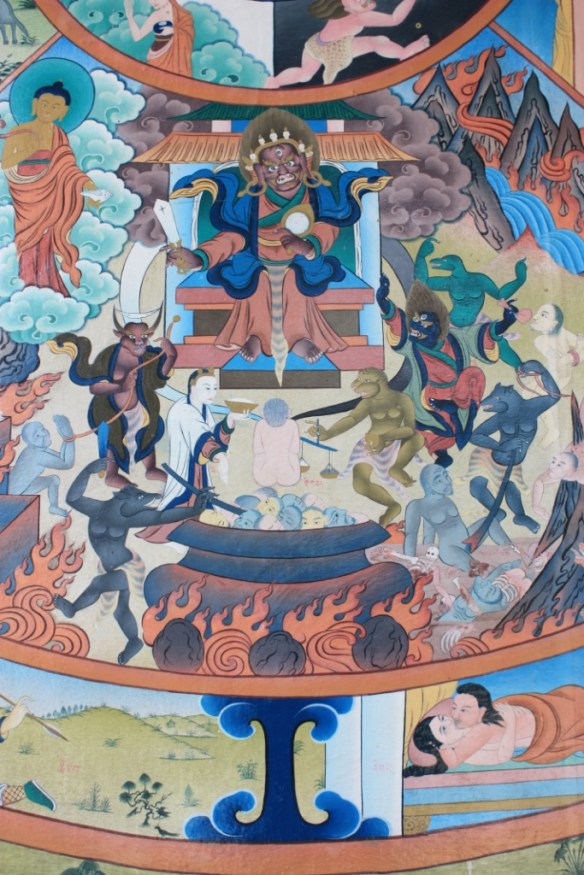
Taken in March of 2014 at the Namdroling Monastery in Bylakuppe (south Karnataka)

 The Grand Design by Stephen Hawking
My rating: 4 of 5 stars
Why is there a universe, and why is it as it is? This is the question addressed by “The Grand Design.” These questions have been taken up in many ways by many disciplines in addition to science (e.g. mythology, religion, and philosophy), and science, itself, is continuously attempting to hone in on an explanation that is consistent with observed reality. Hawking and Mlodinow suggest that, for now, the leading contender is M-theory.
The authors advocate for M-theory, but also for the [relevant] notion of model-dependent realism. M-theory predicts that quantum fluctuations are causing a continuous spawning of new universes—each with its own laws of nature (or lack thereof.) Most of the bubble universes in this frothy multiverse don’t have staying power, but a few—like ours—are governed by laws that not only allow them to blossom, but also to spawn life. Besides the existence of a multiverse of universes governed by differing sets of laws, there are some other predictions of the M-theory model that remain to be proven. These include the existence of eleven dimensions, most of which are curled up and must be curled up in a certain way according to a set of laws and conditions. The theory also predicts that there will exist “objects” of various dimensionality up to nine. [Whether we will ever be able to test any of these predictions remains unclear.]
What’s this model-dependent realism bit? This is the idea that what we know of reality exists through models that connect observations to a set of rules. Within the limited space for which we have observations, there is no requirement that there be a solitary model or mapping between rules and observations. Because of this, there may be multiple theories. Physics has been long looking for a grand unified theory (GUT) or a Theory of Everything (TOE) that explains all the laws of the universe in one fell swoop. Hawking suggests that such a solitary theory may not be found given our limitations, and that we may have to exploit different theories for different situations. This belief is important because M-theory isn’t a unified theory but a grouping of theories that each work well in certain domains. Needless to say, this isn’t a particularly satisfying notion for the many physicists who are hoping for a more satisfying level of elegance.
The book consists of eight chapters. The first, entitled “The Mystery of Being,” is a brief description of the central question and an outline of why M-theory is proposed as the answer. Chapter two gives an overview of our evolving understanding of the laws that govern the universe, and sets up the important idea that the configuration of the universe is contingent upon the form of the laws governing it. The third chapter is where the authors argue for model-dependent realism, while discussing the arguments of realists and anti-realists as well. Chapter four describes alternate histories and the idea that the probability of an observation is dependent upon all possible histories that could have led to said observations. This bit of quantum strangeness is crucial to reconciling the central question. The next chapter describes the forces seen in our universe and considers attempts to unify the four forces (i.e. gravity, electromagnetism, the weak nuclear force, and the strong nuclear force) in a single theory that explains it all—a ToE. Chapter six discusses our universe with particular respect to its steady expansion that has allowed galaxies and solar systems to form. Chapter seven goes further, exploring the nature of a universe that could support the development and evolution of life. There are a wide variety of precise conditions needed to produce intelligent life. We live in a narrow band with respect to our distance from our star in which our type of life could be created. If the orbit of the sun was more elliptical or our axis wasn’t stabilized by a moon, we couldn’t be—and those features require laws that support them. The authors also examine how the chemistry of our universe is conducive to the development of complex life. The final chapter uses a discussion of a primitive computer game called “the game of life” to show how a model shapes reality as we know it. This grid-based game has only a few rules, and yet if there are more than a few pixels at the beginning, it becomes impossible for us to predict an outcome. With the complexity we see in our universe, this situation is vastly greater.
The book contains many graphics, mostly color, to clarify ideas that are difficult to comprehend via verbal description, or sometimes just to add levity. The only ancillary matter is a brief glossary of terms that come up in the book. There are no notes and no bibliography.
I found this book to be thought-provoking. However, I don’t know why it had the feel of a sales pitch. It repeats the theme of “M-theory is the best game in town” ad nauseam. This repetition draws attention to itself because the book fails to directly challenge those who critique M-theory in any depth or detail. It also fails to take on the question of how it is that M-theory might be taken from a purely theoretical construct to one that can be tested. (It makes falsifiable claims, but does that matter if we may never have a capacity to test those claims?) Those aspects wouldn’t be necessary if the book wasn’t making a pitch. [It felt like the book may have wanted to convince its pop-sci readers that–while they would only have a foggy idea of the why M-theory might have merit at the end of the book–they should remember that it’s the best–so that no funding gets cut from M-theory research and delivered to other lines of inquiry. In other words, the take-away sometimes feels like: “Stephen Hawking is super-smart, and he says ‘vote M-theory.’”]
I would recommend this book for those interested in the big picture of our universe’s existence, but as a neophyte it has made me want to read Woit’s “Not Even Wrong” or Smolin’s “The Trouble with Physics” just so that I’ll know what the critics are saying.

Taken in December of 2015 in Ho Chi Minh City (Saigon) at the Independence Palace (a.k.a. Reunification Palace.)
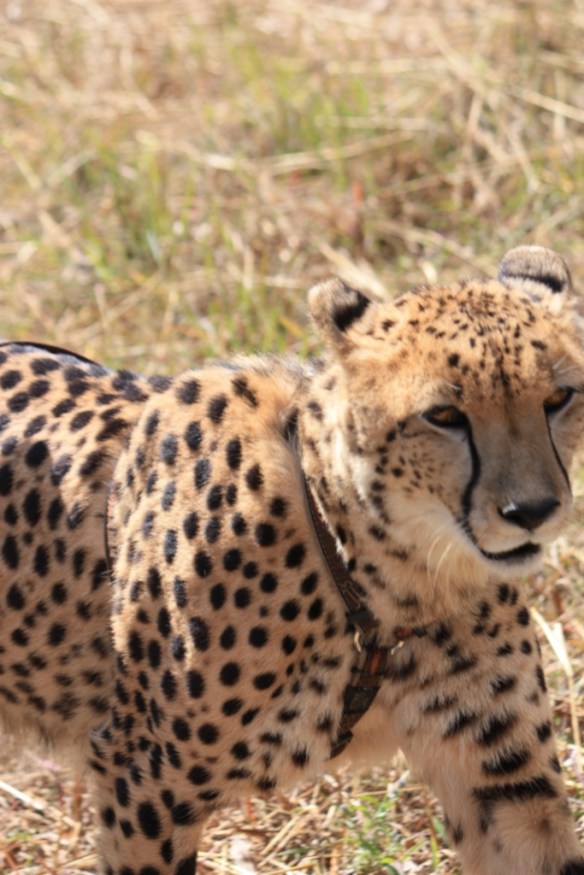
Taken in May of 2016 in Zambia

Taken in October of 2015 at Khajuraho

Taken near Cuzco, Peru in July of 2011
Sunflowers are supposed to turn to look at the sun, but this one was looking over it’s shoulder. I wonder if it was confused or distracted?