POEM: Dancer’s Defection

Source: Wikipedia

Source: Wikipedia

[after hours, the circus of the mind]
twisted puppets of an unworldly kind
marionettes have danced into a heap
but for one dancer who takes her leap


beyond the stage, off the ledge
freed of strings by midnight’s edge
bounding over a haunting chasm
the beating heart locked in a spasm


from backstage toy soldiers pour
but ballerina ‘s caught, slipped to floor
while her pursuers smash into shards
sliding wide as a fallen house of cards


and thus ends the dancer’s defection
exiting stage right without detection
viewed by empty seats, row-on-row
and who caught her, and where’d she go?
those are facts we’ll never know

POEM: Invisible They

img_2133

Is there a they?

Or is they us?

On the same old day,

riding a different bus?


Tilting heads at the same places.

Different route, same blank faces.

Electrified through the same lines.

Picking fruit amid the same mines.


Is there a them

amid your dreams

deep in the REM

the field of screams?


No. There you are each shadow monster.

The bright and the dark, indivisibly you.

You may wish to be not the mobster,

but you can’t ever cleave yourself in two.


Maybe “they” are an illusion.

A genetic glitch now passe.

A wanton act of collusion

to create an invisible they.


DAILY PHOTO: Our Lady of the Immaculate Conception, Goa

Taken on October 9, 2016 in Panjim, Goa

Taken on October 9, 2016 in Panjim, Goa

img_3053

DAILY PHOTO: Municipal Market Flower Stalls, Panjim

Taken on October 9, 2016 in Panjim (Panaji)

Taken on October 9, 2016 in Panjim (Panaji)

img_3089 img_3090

BOOK REVIEW: Fooling Houdini by Alex Stone

Fooling Houdini: Magicians, Mentalists, Math Geeks, and the Hidden Powers of the MindFooling Houdini: Magicians, Mentalists, Math Geeks, and the Hidden Powers of the Mind by Alex Stone
My rating: 4 of 5 stars

Amazon page


This book operates on two levels. The first is the autobiography of a magician, telling a tale from being gonged off stage at the “Magic Olympics” through a rising obsession with the craft before rolling into his redemption. On a second level, it’s a history of magic in the modern age (although there are occasional forays into more ancient history.) The author tells of the magicians that inspired him, some of whom he learned from personally and some were from the preceding generation, such as Dai Vernon—the magician who actually fooled Houdini. However, the book’s title doesn’t come from Vernon’s feat with the Ambitious Card Trick, but is instead a more general statement about the challenge of tricking magicians—an accomplishment a great deal more prestigious than fooling a pod of eight year olds at little Timmy’s birthday party.

Stone was a science writer turned Physics graduate student, and so the science of magic and mentalism comes out frequently. However, this book is distinct from one such as “Sleights of Mind” by Macknik & Martinez-Conde, which is focused entirely upon conveying the science of how magic tricks work (primarily neuroscience with a focus on how the sense organs and brain interact to a magician’s advantage.) In truth, I expected this book to more along the lines of “Sleights of Mind.” However, in a way, it’s a good thing that it wasn’t. Stone reviews the science that Macknik and Martinez-Conde drill down into enough so that it’s a good review if one has read that book (I had) or an introduction if one hasn’t. What Stone does a great deal more of is describing the perfection one’s craft. Along the way he shows us a blind card handler with a preternatural capacity for tactile control of the deck, he takes us to clown college to improve showmanship, and he meets up with some street hustlers of the 3-card monte variety.

Throughout the course of the book are ups and downs that maintain the tension. In fact, one chapter is actually entitled “It’s Annoying and I Asked You to Stop,” about the inevitable point at which a magician’s obsession with improving his/her skills stops being cute to loved ones. There is also a chapter about Stone’s [almost] being blackballed from the magic community for revealing secrets in a general readership magazine (I guess that’s a muggle-mag?) An important part of the story is Stone’s search for a Yoda, a wizened member of the magic community who can give him the deeper insight needed to fool a room of experts. He eventually finds said individual, but is not quickly adopted. (It has a hero’s journey feel through this part.)

I thought that the author did a good job of building an interesting story arc within a work of nonfiction. This increases the book’s readability, particular if one has no particular interest in magic. One need not be knowledgeable about the discipline to find the story interesting and to learn some fascinating tidbits. If nothing else, one will learn how con men cull marks, so one can avoid falling prey to their potent psychology (though I expect the subset of readers of books and those tricked into gambling 3-card monte is probably not huge.)

One area in which a reader might be dissatisfied is in the coverage given to mentalism and math-based tricks. The alliterative subtitle makes reference to “magicians, mentalists, and math geeks…” but the bulk of the book is about close-up magic; mentalism and mathematical methods don’t come in until the last few chapters. If you’re expecting that the coverage of those topics will be on par with that of close-up magic, this may not be the book for you. Still, while this was different from I expected, it didn’t hurt my impression of the book.

I enjoyed this book, and received some intriguing insights from it. I’d recommend it for those interested in magic and in particular the craft and science of it. Even if you aren’t that interested in magic, you might find the story of one man’s development of his discipline to be worth reading.

View all my reviews

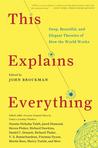
BOOK REVIEW: This Explains Everything ed. by John Brockman

This Explains Everything: Deep, Beautiful, and Elegant Theories of How the World WorksThis Explains Everything: Deep, Beautiful, and Elegant Theories of How the World Works by John Brockman
My rating: 4 of 5 stars

Amazon page


A theory that explains a lot with a clear and simple set of ideas is much beloved by scientists and social scientists alike. In this book, about 150 renowned thinkers were asked what theory they thought explained the most with the least. Every year, Edge.org (the online face of an Algonquin Round Table-like group called “The Reality Club”) produces a question to direct toward members, and this book resulted from the 2012 question. The editor, John Brockman, had his work cut out for him given limited space and the fact that a few theories (e.g. Darwinian Evolution) would be rehashed ad nauseam without coordination. (Many authors sited Darwin, even if they weren’t discussing evolution because they knew it’d already been addressed from many angles.)

The contributors are a veritable who’s who of science, and include: Matt Ridley, Richard Dawkins, Leonard Susskind, Frank Wilczek, Steven Pinker, Martin J. Rees, Max Tegmark, Freeman Dyson, V.S. Ramachandran, David Eagleman, Robert Sapolsky, Richard Thaler, Daniel Dennett, Howard Gardener, Lisa Randall, Eric R. Kandel, Alison Gopnik, Lee Smolin, Nassim Nicholas Taleb, Mihaly Csikszentmihalyi, Jared Diamond, and Michael Shermer. One may note that not all of the authors are, strictly-speaking, scientists. The book even ventures into the arts and humanities, including contributors such as Alan Alda and Brian Eno. Of course, this means that the book sometimes veers away from theories that have explanatory power on the scale of natural selection or the neat offerings of physics and chemistry, but these entries often provide some intriguing food-for-thought.

All of the entries are short; some are less than a page and most are less than three. Given the range of authors, the approaches and the degree of colorfulness employed in entries varies greatly. There are few graphics and no ancillary matter (notations or bibliography) except for an editor’s introduction. It’s good bathroom reading, or for any other time when one has a couple free minutes to take in an idea.

I enjoyed this book, and found it thought-provoking. Often it wasn’t the expected theories (i.e. the most parsimonious) that provided the greatest revelatory insights. There were even responses that challenged the nature of the question. One won’t necessarily find all the responses present elegant theories, or that all of them even are theories, but that’s not the point. They are all ideas that have merit in some regard. One will see old standards (e.g. the 2nd law of thermodynamics) from new angles and will be exposed to ideas that might be entirely new (e.g. the Faurie-Raymond hypothesis that suggests the advantage of lefties in fighting.) I found essays on swarm intelligence and frames of reference taking my thinking in new directions.

I’d recommend this book for those looking for some interesting thinking on elegant ideas.

View all my reviews

DAILY PHOTO: Black & White Butterfly… in Color

Taken in Panjim, Goa on October 9, 2016.

Taken in Panjim, Goa on October 9, 2016.

POEM: Fuel & Fools

Source: Wikipedia (Public Domain)

Source: Wikipedia (Public Domain)


It was a fire-breathing preacher,

a hard-core and ceaseless teacher,

of lessons they said they wanted none.

Yet, it belched them out by the ton.


Spitting fire and dreadful lies

from the freedom of the skies.

And all about, its fires burned.

And people wailed like lovers spurned.


And then one day there came sage.

He found some sad, some in a rage.

“What troubles you folk,” he inquires.


“From far above, it slings these fires!

Can you save us, you wise old man,

from life in this blasted frying pan?”


“Every fire requires a fuel,

And every lie, a willing fool.

Do you feed the beast, or in its fires bask?”


“Neither, of course, and how dare you ask!”


“I can douse the flames, but they’ll flare right back,

if you fuel them with your petty, piddling yak.”


“Just do it, old man, before we all burn!”


“OK, I’ll give you this one chance to learn.”

So, pulling a hose, off the sage marched.

“Mighty dragon, you must be terribly parched?”


“You know, breathing fire IS a thirsty job.”


At a nod, minions spun the spigot knob.

The water caught the grateful dragon in the throat.

Steam rose, ash spewed, and that’s all she wrote.

With no fire to breath, the dragon flew off,

sputtering out its last ashen cough.


The town was saved, or so it appeared.

But it was as the sage had feared.

Soon, some dabbled in volatile mixtures–

at weakest moments, becoming fixtures.

And the fools? Oh, they missed the glow

of the dragon’s garish and tawdry show.


And soon enough, conditions were right

for the dragon’s fire to again alight.

DAILY PHOTO: Azad Maidan, Panjim

Taken on October 9, 2016 in Panjim, Goa

Taken on October 9, 2016 in Panjim, Goa


This monument is dedicated to Dr. Tristao de Braganza Cunha, who was an Indian nationalist who opposed the colonial regime. While India gained it’s independence from Britain in 1947, Goa remained under Portuguese rule until 1961.

DAILY PHOTO: Goan Churches in Black & White

St. Andrew's Church in Vasco  da Gama

St. Andrew’s Church in Vasco da Gama

Basilica of Bom Jesus, Old Goa

Basilica of Bom Jesus, Old Goa

Arched buttresses of the Basilica of Bom Jesus

Arched buttresses of the Basilica of Bom Jesus

Se Cathedral, Old Goa

Se Cathedral, Old Goa

Se Cathedral, Old Goa; The asymmetry is due to an accident that destroyed the other tower

Se Cathedral, Old Goa; The asymmetry is due to an accident that destroyed the other tower

Church of St. Cajetan, Old Goa

Church of St. Cajetan, Old Goa

Chapel of St. Catherine, Old Goa

Chapel of St. Catherine, Old Goa

Church of St. Francis of Assisi, Old Goa

Church of St. Francis of Assisi, Old Goa

Royal Chapel of St. Anthony, Old Goa

Royal Chapel of St. Anthony, Old Goa

Ruins of St. Augustine's Church, partially demolished in the late 19th century by gov't order

Ruins of St. Augustine’s Church, partially demolished in the late 19th century by government order

Church of Our Lady of the Rosary, Old Goa

Church of Our Lady of the Rosary, Old Goa