BOOK REVIEW: The Way of the Iceman by Wim Hof and Koen De Jong

The Way of The Iceman: How The Wim Hof Method Creates Radiant Longterm Health--Using The Science and Secrets of Breath Control, Cold-Training and CommitmentThe Way of The Iceman: How The Wim Hof Method Creates Radiant Longterm Health–Using The Science and Secrets of Breath Control, Cold-Training and Commitment by Wim Hof
My rating: 5 of 5 stars

Amazon page


Wim Hof is often presented as a freak of nature. If you’re flipping through the science channels, you might see a segment that shows him subjecting himself to extremely cold temperatures with no ill effects. This book is an attempt by Hof, and co-author Koen De Jong, to counter the proposition that he’s some sort of mutant (or—worse–that his demonstrations are cons) by offering a method by which anyone can achieve the same feats. It should be noted that long before Hof and YouTube came on the scene, there were people [notably Taoist and Tibetan Buddhist monks] performing similar acts.

Hof’s method (called the “Wim Hof Method” or WHM herein and in this book) consists of three components: cold training, breath exercises, and commitment building. The book explores this three-legged stool from both the scientific and practical dimensions. There’s one chapter on each of these elements that describes what it does to the body and how it contributes to well-being, and later chapters both describe what scientific studies have found so far and outline the approach by which the reader can explore the WHM on their own.

There’s a lot of front matter in this book (two forwards, a prologue, and an introduction), but the book more-or-less consists of seven chapters. The first of these is a mini-bio of Hof. It describes a fascinating event in Hof’s youth in which he was exposed to cold, as well as his travels to India in an attempt to find a yoga teacher. [As is the case with most people who come to India seeking to find that quintessential guru—i.e. a half-naked, weather-beaten, and forehead paint-streaked classical guru—he found that he had to wade through a sea of charlatans and shysters while never finding the true masters who are likely hidden away in caves in the Himalayas. Note: this is not to say that one can’t find excellent yoga instruction in India but it’ll likely be by someone fully clothed and not someone smoking pot on a ghat in Varanasi.] This resulted in Hof taking an experimental approach in which he studied the effects of various activities on himself (and such experimentation is what he advocates for others as well.) It should be noted that Hof didn’t invent this method from scratch—e.g. the breath component is based on Tibetan Tummo meditation.

As mentioned, Chapters 2 through 4 explore the three components of the WHM, i.e. cold training, breath exercise, and commitment building, respectively. These chapters describe the science of how these three elements generally (as opposed to a later chapter that describes studies in more depth) act upon the body. The commitment section describes a number of arduous feats such as climbing Kilimanjaro in a T-shirt and shorts, but also describes the role of diet (with particular emphasis on the fast-5 diet which is similar to, but not precisely, what Hof came to practice organically.)

Chapter 5 dives more deeply into the science than does the preceding chapters, and focuses on the studies in which Hof has participated in his attempt to facilitate a better understanding of his method.

The penultimate chapter suggests what the WHM might do for people in various classes, including: healthy people, athletes, and people suffering from various physical and mental ailments. With respect to the latter, there is discussion of exemplary cases as well as the possible means by which the training might act.

The final chapter is a brief outline of how the WHM can be put into practice by readers. There is also a sample log by which practitioners can chart their experience.

There are a range of graphics including line diagrams and photographs. Most of the photographs are inspirational shots of Hof in action, but there are diagrams and other graphics used to convey scientific ideas. There’s a recommended reading page as well as a works cited page. Both lists are small and confined to a few key sources of information, with the latter being the more scholarly works. There is also a glossary that may prove handy for some readers.

This book is illuminating and many stand to benefit from it. I found the approach of the authors to be sound; it’s basically “see for yourself.” This book could easily have been a sales brochure, and in some ways it is, but the fact that it emphasizes the science and the suggestion that the reader try the practice lends credibility. I’d highly recommend this book for anyone who wants to expand and explore the limits of their capability.

View all my reviews

BOOK REVIEW: The Science of Breath by Swami Rama et. al.

Science of BreathScience of Breath by Swami Rama
My rating: 4 of 5 stars

Amazon page


This is an oldie, but a goody. The first edition came out in 1979, but as its intent is to provide an overview of the anatomy and physiology of breath for yoga practitioners, the fact that it doesn’t access the bleeding edge of respiratory science isn’t all that detrimental.

This short book consists of four chapters. Two chapters are by the famous yogi Swami Rama, and the other two are written by medical doctors. The first chapter is an introduction to breath from the yogic perspective. It both explains why it’s so important to understand and work with breath and introduces the mythic physiology (prana, nadi, chakra, etc.) that has historically been used to explain pranayama (breath exercises.)

The second chapter is written by Dr. Alan Hymes and it explains the mechanics of respiration. While Chapter 2 focuses on the anatomy of breathing, it begins with an explanation of cellular respiration to introduce the role of breath in powering muscles. There is a fine explanation of the operation of the diaphragm and the intercostal muscles in breathing.

Chapter 3 is written by Dr. Rudolph Ballentine, and it delves into the role of the nose and nasal cavities in respiration. Breathing through the nose is emphasized in both yoga and many other systems of breath training (e.g. the Buteyko and Wim Hof methods.) This is because the nasal cavities perform many useful functions such as moisturizing and warming air, capturing pollutants, and extract heating and moisture from exhaled breath. Besides exploring nasal anatomy and physiology, Dr. Ballentine describes jala neti shatkarma (nasal cleansing with salt water) and nadi shoudhana (alternate nostril breathing.)

The final chapter, written by Swami Rama, mostly describes various techniques of pranayama (breathing exercises) and related practices bandhas and mudras (locks and seals in which bodily parts are contracted or constricted.) However, the chapter begins with a mix of physiology and mythic physiology. That is, it explains some topics not addressed earlier–such as the interaction between the nervous and the cardiovascular systems as well as chakra.

My standing complaint about books that weave together science and pseudo-science is mitigated a bit herein. My problem with putting these ideas together is that it can be difficult for the reader to determine what concepts reflect reality and which offer models to help one visualize energy. However, except for the last chapter, this book does a good job of keeping these ideas separate. The chapters by the medical doctors present the science with minimal intrusion of unscientific concepts. Swami Rama does present science and mythology together, but not so much scrambled together in a confusing mish-mash.

Chapters 2 through 4 use a number of graphics to help present the material. In the middle chapters these largely consist of line drawings to convey the relevant anatomical features or physical actions. The last chapter adds photographs to demonstrate relevant postures. There is a page of recommended readings, but it’s more of an advertisement for other books put out by the Himalayan Institute than the recommendation of books on the science of breath.

I found this book to be educational. It packs a lot of useful information into a concise package and is readable to a layman. I’d recommend it for yoga practitioners and others who are engaged in breath work.

View all my reviews

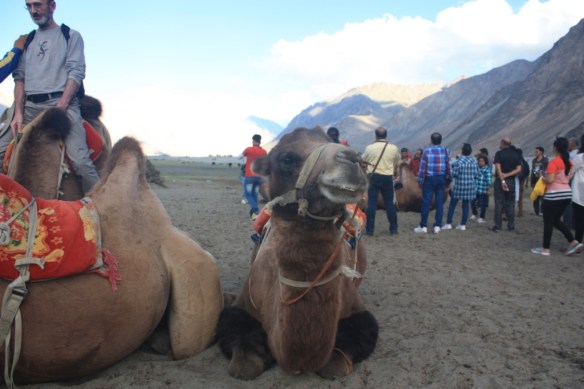
DAILY PHOTO: Two Camels in the Himalayas [Yoga Folks Will Get This]

Taken in the summer of 2015 in Kullu District, Himachal Pradesh

Taken in the summer of 2015 in Kullu District, Himachal Pradesh


Taken in the Summer of 2016 in Nubra Valley, Ladakh

Taken in the Summer of 2016 in Nubra Valley, Ladakh

5 Ways to Manage Your Email & Social Media Addiction

Addiction? That seems harsh. It feels like I’m equating a person who has his phone in hand several times every hour with a heroin junky or a nymphomaniac. But, the difference is in the word “Manage.” I wouldn’t write a post entitled “How to Manage your Heroin Addition.” I’d write one called, “Quit that Shit Before it Kills You.”  I’m not suggesting that one needs to do away with checking email and social media. These are great tools that allow us to be much more productive (potentially.)


Still, if we’re honest about it, most of us at some point get caught up in the compulsive checking of emails, social media, internet feeds, click-bait sites, sale pages for online retailers, and stats pages. There’s no denying it. A pile of evidence has accumulated about the extent to which people are dismayed by their own e-world activities. I just started reading Kotler and Wheal’s “Stealing Fire” (out February 21, 2017) and they site a study that found that about 2/3rds of those surveyed admitted checking their status page when they woke up in the middle of the night. It might seem off topic for book about altered states of consciousness to report on such matters, but its not because it’s all about the pursuit of a neurochemical bump. (Also, as I’ll discuss, a major problem of this addiction is in keeping one from slipping into the Flow with one’s work, family, or hobby activities.)


So, below are five methods I’ve found useful in my own on-going struggle with this addiction.


5.) Set a timer:  The problem with this addiction is that when one falls into habitually checking one’s status, one isn’t able to stay on task, and that means that one won’t achieve that elusive state of optimal performance called Flow. One needs time to immerse oneself in a task.


When I’m writing and editing, I set a timer, and until it beeps I do nothing off topic. I don’t make it some Herculean effort. I use 60 and 90 minute intervals. After the alarm rings, I can check email, do Tai Chi, get a cup of coffee, or work on my handstands. A longer time period may be more–or less–beneficial for you. (Isaac Asimov was said to only take a break after 5,000 words, but few writers have that in them.) The point is to make it long enough that one can get into a focused state of mind, but not so long that you become distracted and run down.


4.) Know your high energy period: This point relates to the last because it’s about blocking one’s productive time, and putting the more Flow-demanding activities when one is at one’s best. e.g. Are you a lark or an owl? (i.e. morning person or evening person.)


For example, I’m a morning person. This creates a potential problem. While I find it easy to get up with the sun, I’m at risk of saying, “Oh, I’ll just check emails, Facebook, my blog stats, a couple YouTube channels, and then I’ll get to work.” Then it’s noon, and the hours in which my mind was at its very best are gone. From 7pm until I go to sleep is when I should check these feeds because by that time my mind isn’t good for editing or writing tasks that require a high level of attention to detail.


3.) Go Cold Turkey [for a few days]: Sometimes it’s easier to make changes when one is forced by circumstance to quit. Then one can be more conscientious in resumption of the activity in question. (Moving to India helped me break a lot of bad habits.) If nothing else, this will help to give you confidence that the Earth won’t roll off it’s axis just because you aren’t checking on it twice an hour.


I can offer two examples from my own life. Every year my wife and I go on an extended trek in a place where there are no bars and saving batteries is essential. The past couple years, this has been in the Himalayas because we’ve been living in India, but anywhere remote will work. I also did the Vipassana Meditation Course last year. (If you’re interested in the latter, you can read my account of it here.)

img_1397


2.) Meditate: Why? Because when you start meditating regularly, you tend to do less and less out of mindless habit. You become conscious of what you’re doing, and that’s the first step to making changes. You also start to become attuned to those very subtle dopamine bumps, and in that way you  aren’t fighting it the impulse blindly. The high of the click is infinitesimally more subtle than taking mind altering substances, and so it’s easy for this all to take place below the waterline (analogizing the mind to an iceberg but instead of the majority of the mass of ice below the waterline, it’s the conscious mind above and the subconscious below.)

img_1556


1.) Substitute: In the immortal word of the rock band “The Who.” If your problem is so extensive that it does more than block your attempts to hit the Flow, you may need to find a healthier alternative to wean yourself away.


What does one look for in a substitute? If it’s going to fill the same space, it requires immediate feedback and a mix of “fails” mixed in with “successes.” These are the components that make the e-world so addictive. We know immediately whether we got something or not, and that keeps us clicking–not unlike the famous rats that would keep pressing a button for pleasure even to the point of forgetting to eat.


Some people may work on games that will help build their brain. (Warning: just don’t trade one unproductive addiction for another.) I’m an advocate of working on physical activities (e.g. trying to develop new capabilities in calisthenics or yoga), but these often involve a demoralizing amount of fails to reach the optimal level (the optimal being that one has enough fails to keep it from being boring but not so many that one is brutalized.)

5 Hyphenated Yogas That Miss the Point of Yoga

The laissez-faire and easy-going yoga community has spawned some phenomenally ridiculous mergers. I have “yoga” as a term on Google News, and almost every week I get fed a new example. I’m not saying every new approach to yoga is bad, but there’s one disturbing trend–i.e. the distraction yoga.


In the title, I refer to “hyphenated yogas,” but what I’m really ranting about is “distraction yogas.” A distraction yoga is one in which an element is brought into the practice so that one doesn’t have to keep one’s mind on one’s breath, alignment, and / or mental state. (Because who wants to think about that shit when one can be thinking “Wow, that kitten sure is cute.” or–believe it or not–“This beer has hoppy undertones.”)


Now before I get accused of hating puppies or beer, let me point out that nothing could be further from the truth. What I’m ranting against is the notion that you can marry any two good things and make a great thing. If you don’t believe me, please allow me to dip my nachos in your banana split. See, there are plenty of things that are awesome independently that make abominations when forced together.


I’ll include links as I go, lest you think I made this stuff up for hilarity’s sake.


5.) Beer Yoga: This is one of the most recent and intriguing distraction yogas. I’m not saying that one needs to follow a strict Vedic approach to life to practice yoga, but–come on–could you stop drinking for a couple hours to pretend your body is a temple (or at least that it’s not sitting in a trailer park with the windows busted out.) Unless “calf slaughter-yoga” catches on, it’s hard to imagine a less yoga-like practice than consuming intoxicants during the practice of yoga. By the way, there’s also a marijuana yoga, but I’ll lump these together as intoxicant yogas.

beermug


4.) Goat Yoga: This is one of many “animal yogas.” Like the others, the point is to have cute creatures around. How it’s supposed to help one’s yoga, I can’t fathom. Actually, I can fathom the suggested logic, probably something to do with calming and engendering feelings of compassion and well-being. But, ultimately it’s distraction by cuteness. Note: you can also do yoga with cats, dogs, horses, and probably river otters.

goatyoga-461x346


3.) Karaoke Yoga: Talk about distraction–nothing better than pounding music and reading a prompter to keep one’s mind off that ache in one’s hamstring.

karaoke_yoga


2.) Rave Yoga / Club Yoga: This might be a cheat because it’s similar to the previous one on the list, and I’m trying to lump these together so as to not be too repetitive. However, it’s not exactly the same, and is the perfect example of a distraction yoga. (There’s also Harmonica yoga and other musical yogas, but I won’t double-dip anymore.)

bombay_yoga-2e16d0ba-fill-735x490


1.) Tantrum Yoga: It wasn’t easy to determine whether I’d include this one or not. On the one hand, it’s not a distraction yoga in the sense that the others are. On the other hand, it takes the award for being least yoga like on the grounds that it’s not about dispassionately witnessing one’s emotional state but rather feeding one’s negative emotions. Note that I don’t group laughter yoga into the same class. I’m not sure whether laughter yoga is beneficial (or to what degree it’s a yoga), but I know that many people benefit from it because it bolsters positive emotional states.

tantrum


Now, one may have noticed that there are many seemingly strange (hyphenated) yogas that I haven’t mentioned. I haven’t said a thing about surf board-yoga, stripper pole-yoga, or acro-yoga–and I specifically excluded Laughter Yoga from the wrath of my rant. That’s because this isn’t a rant about people being innovative or non-traditional, it’s about people missing the point of what yoga is supposed to be (i.e. a means to quiet the mind.) I don’t know whether I can see myself doing yoga on a surf board or a stripper pole, but I’m certain that one has to give it one’s full attention–it’s not about finding a distraction to make yoga more palatable to hipsters.

BOOK REVIEW: Light on Pranayama by B.K.S. Iyengar

Light on Pranayama: The Definitive Guide to the Art of BreathingLight on Pranayama: The Definitive Guide to the Art of Breathing by B.K.S. Iyengar
My rating: 4 of 5 stars

Amazon page


This is B.K.S. Iyengar’s A-Z guide to breath and breathing exercises (pranayama.) It’s meant to do for pranayama practice what “Light on Yoga” did for asana (postural) practice. That is, it presents all the classic techniques, offers variants to meet individual needs, and provides the background necessary to put pranayama into the context of a balanced yoga practice.

Let me begin by discussing the book’s organization, and this book is organized to the n-th degree. There are parts, sections, chapters, and even the paragraphs are numbered (though–near as I can tell–the latter serves no purpose for a typical reader and may be more for the help of the writer and his assistants. It does create a somewhat biblical scheme, so maybe it was assumed there would be a need to quote this guide “chapter and verse,” as they say in Bible study.)

The bulk of the book consists of the first of two parts, and Part I is divided into three sections. The first of those sections is “The Theory of Pranayama,” and it puts pranayama in the context of yoga’s entirety. If you’ve read other B.K.S. Iyengar titles, much in these nine chapters will be familiar (e.g. discussion of the eight limbs.) However, chapter 4 offers a nice description of the anatomy and physiology of respiration. There are many anatomical drawings and diagrams in it to help convey the complex information. There’s also additional information about the traditional Indian notions of breath encapsulated in the concepts of prana, nadis, and chakras.

Section II is entitled “The Art of Pranayama” and it covers those topics necessary regardless of what technique of breath exercise one is practicing. It includes seated postures, mudras, bandhas, inhalation, exhalation, retention, etc. This section, too, has nine chapters. The final section of Part I describes the various techniques of pranayama. The chapters of this section are arrayed in lists, and they systematically build from the basic technique towards more advanced variations (e.g. by inserting retentions.)

Part II covers meditation (dhyana) and the corpse pose (savasana.) With respect to the former, it suggests how one’s body, mind, and sense organs should be conducted in the act of meditation. In the case of the chapter on corpse pose (after cross-legged seating position, this being the most common position for practice) there’s an extensive look at the details of that pose.

There are a number of helpful features incorporated into the book. In addition to the drawings mentioned in Chapter 4, there are black-and-white photos throughout to clarify the textual instructions. There is also a glossary of Sanskrit terms and an Appendix of courses of pranayama (i.e. recommendations as to how to sequence breathing techniques for optimal results with guidance as to how many sets or repetitions of each to use.)

My major criticism is one I’ve offered about previous books from this author and others. There’s a muddle of science and mythology that makes it hard to know how much weight to give particular instructions. It may be that a given piece of advice (e.g. a contraindication) is based on repeated observations of the physical or mental effects, or on a sound understanding of anatomy & physiology. In which case, it makes sense to heed such advice. However, advice can also be based on myths and the desire to preserve a way of thinking about the human body which is wholly unsupported by evidence. In which case, if one has no dog in the fight to preserve egos, it makes sense to disregard said advice. I suspect the vast majority of statements of what to do (or not to) fall into the first category, but some may fall in the latter, and it’s not easy to tell which is which.

I would recommend this book for students and teachers of yoga. It’s a good reference for one’s pranayama practice.

View all my reviews

5 Bits of Ancient Eastern Wisdom to Make Your Modern Western Life Happier

img_12811.) The Dispassionate Witness:  A person’s default setting is to repress emotions and pretend they don’t exist. On the one hand, this seems to work because others rarely notice one’s clenched jaw or downing of Prozac, and it’s true that fist-fights rarely break out in workplaces and classrooms. On the other hand, this approach leads to a lot of passive-aggressive behavior and stress-related illness. I just read in some material on Flow and business that 2/3rds of performance issues in businesses result from strained relationships.

The alternative is to take time to observe one’s emotional state, but to watch it without dumping fuel onto the fire. This process puts one’s feelings in perspective so that one can respond in a careful, but not repressed, manner. It doesn’t mean one won’t still be mad, sad, or scared, but one will be in a position to act in a manner that is neither petty and knee-jerk, nor one that consists of gobbling antacids. This brings us to #2.


2.) The Second Dart: [Siddhartha Gotama] Buddha talked about the mind’s response to an event as the second dart, suggesting that the second dart produces much more prolonged misery than the first. Imagine one is walking along and gets hit by a dart. Ow!  It hurts. But what makes it agonizing is when one’s mind becomes obsessed with the injury. It’s unfair that someone threw a dart at me. What if the wound doesn’t heal right? What if the wound heals up too well, and I don’t have a cool scar at story time?

This point is closely related to #1. One has to observe, but not let mind run wild. The first dart is real. The second dart is immaterial, a figment of the mind.


3.) Relaxation is Part of the Process: Anyone who’s attended a yoga class is familiar with closing in savasana (corpse pose.)  Occasionally, a student wants to get up and walk out at this point. They “aren’t paying __ $’s to lay around on their a##.” For Americans, rest is something begrudgingly accepted between actually doing stuff.

The problem with the “rest as laziness” approach isn’t just that one is likely to suffer a relaxation deficit, but also that the rest one gets isn’t effective. But how can rest be effective? I’m glad you asked. Because when you’re doing savasana or yoga nidra (yogic sleep) you’re not just letting your monkey mind run wild as it does when one is watching television or stuck in afternoon rush hour.


4.) Breath is Anything but Mundane: Since breathing is constantly going on and one can choose not to think about it, people dismiss it as unworthy of consideration. However, breath is the one point at which we can consciously influence our autonomic nervous system. [Well, there’s also blinking, but to my knowledge there’s no evidence that one can adjust one’s energy level or emotional state through blinking–but you can with breath.]  Breath is the key to improved physical performance, but it’s also a powerful tool to train the mind.


5.) Use the Belly: I haven’t studied a large number of martial arts, but I’ve trained in a diverse few that were extremely different in both approach and priorities. It could be said that these arts (budō, tai chi chuan, muaythai, and kalaripayattu) had nothing in common. Except they did. They all valued strength in a point below the navel. Sometimes it was called dan tien; other times tanden. However, regardless of the pronunciation, name, or the precise anatomical location, there was this commonality.

Strength in the belly is tied to both breath and mental concentration.

img_1786

5 Courage Building Yoga Practices

Learning to manage and moderate one’s fears and anxieties needn’t involve strapping on a parachute, cold quitting a job, or bare-knuckle boxing in a back alley. In fact, it may be best to begin by quietly watching those anxieties at the other end of the spectrum, the one’s so subtle that conscious awareness of them can be blotted out by the noise of living–but which nevertheless have a physiological impact.


The ability to quietly and non-judgmentally witness one’s emotional state–as is taught in yoga and related practices such as Buddhist meditation–is crucial (and, in my opinion, is one of the most valuable lessons that these systems have to teach.) Crushing or repressing emotions is a demonstrably losing strategy. At best these feelings are tamped into one’s subconscious mind, still adversely affecting one’s outlook and, therefore, indirectly casting a pall over one’s life.


You’ll note that I’ve mentioned courage and moderating fear, but have not mentioned defeating emotions or quelling fear. Wrongly, our archetypes of fearlessness are characters like John McClane (i.e. the “Die Hard” movies), Katniss Everdeen (i.e.”The Hunger Games” trilogy),  or Yoda (i.e. the “Star Wars” movies.)  But neurologists who study patients whose brains have been damaged such that they are literally fearless tell us that the defining characteristic of such individuals is “paralysis by analysis.” In other words, Sheldon Cooper (i.e. “Big-Bang Theory”) is a more apt model. Also, the fearless tend to live short lives because they eventually do something fatally inadvisable.


We need our fear. However, while fear can keep us from doing stupid things, it can also turn us into the worst version of ourselves. Therefore, our fear needs to be moderated with courage and reason (to these, some would add “faith.”)


You may note that I tend toward the intermediate / advanced with the practices I mention. This is, in part, because that’s probably more likely the point at which one is ready to take this on. In beginning a practice, one may have one’s hands full to grasp the basics of alignment and breath.


Without further ado, here are a few yoga practices that I’ve used to help me witness my anxieties and learn to moderate them:


1.) Nauli (and other external breath retention [i.e. bāhya kumbhaka] techniques.): Breath retention can produce a subtle anxiety, even when one has full control of the timing of release and the next breath. In fact, subtle anxiety may cause one to have a less robust retention than one might otherwise. Truth be told, this practice has probably been more fundamental than any of the āsana practices that will follow, for me personally.  

Note: external retentions are relatively advanced practice and should only be added to one’s sadhana after one has been taught by an experienced teacher and is somewhat experienced with pranayama.

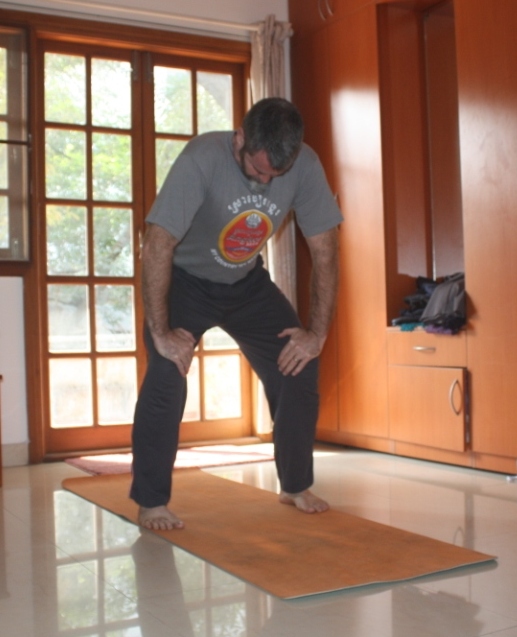
practicing nauli

practicing nauli


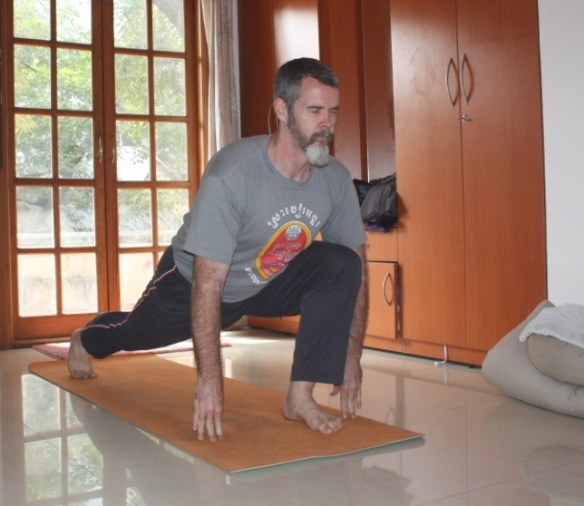
2.) Eyes closed: This is particularly effective with Surya Namaskara (Sun salutations), standing poses, and–at an advanced level–balancing poses. One should make sure that ones balance is solid throughout before attempting with one’s eyes closed. We have redundant systems to help achieve balance (i.e. inner ear, proprioceptive, and visual), but–for the sighted–going without vision can be nerve wracking.

ashwa sanchalanasana in Surya Namaskara

ashwa sanchalanasana in Surya Namaskara


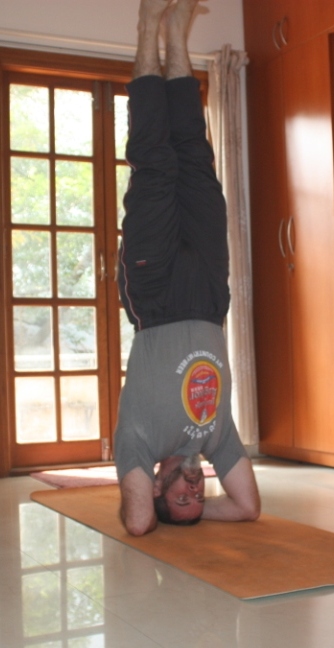
3.) Inversions: Inversions are meant to be calming because when the blood pressure to the head increases, it triggers reactions in the body to reduce it. However, it may take some time before that promised is reached. I’ve done a more extensive post on inversions that can be read here.

shirshasana (headstand)

shirshasana (headstand)


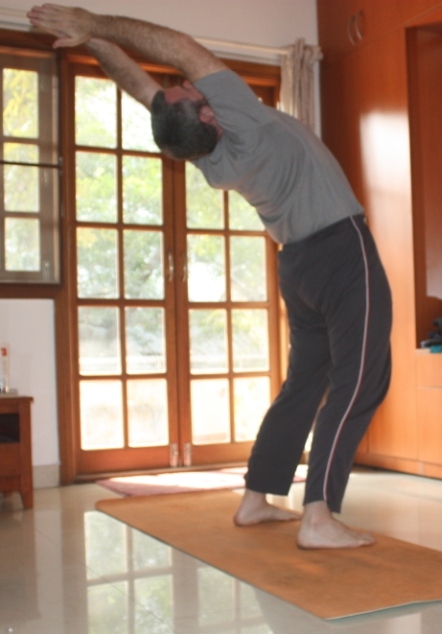
4.) Standing Back-bends: (Ardha Chakrasana / Urdhva Triangmuktasana / full Urdhva Dhanurasana) Simple back-bending can create the feeling that one is about to fall back onto one’s head. One may want to begin with a simple back-bend as one might do in Surya Namaskara before advancing to the complete Urdhva Dhanurasana in which one moves into a wheel pose (Chakrasana) from a standing position. (Urdhva Triangmuktasana is an intermediary in which one’s knees are more deeply bent, and one reaches back towards one’s Achilles tendon.)

ardha chakrasana

ardha chakrasana


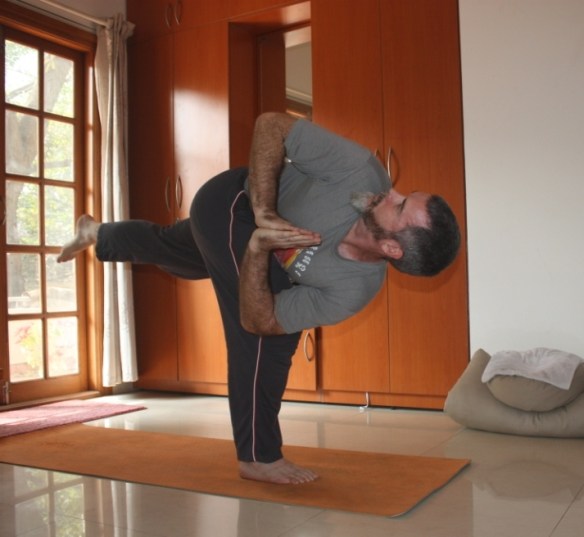
5.) Standing Balances: Depending on one’s level, anything from tree pose (vrksasana) to bound twisted half-moon pose (baddha parivrtta ardha chandrasana) may be applicable. I’ve shown the unbound version of the latter (parivrtta ardha chandrasana.) Twisting and balancing at the same time provides a great challenge, if one is already confident with balances generally.

parivrtta ardha chandrasana

parivrtta ardha chandrasana


Happy practice.

5 Books to Improve Mind-Body Performance

It’s the time of year when people think about how to be better, fitter, and smarter; so I thought I’d drop a list of books that I found helpful and thought-provoking.


If you’re interested in learning more about any of these books, the hyperlinks take you to my review in GoodReads, and from GoodReads you can get to Amazon page.


1.) THE RISE OF SUPERMAN by Steven Kotler: How do extreme athletes achieve Flow when one false move will kill them?

RiseOfSuperman


2.) FASTER, HIGHER, STRONGER by Mark McClusky: How do elite athletes squeeze the most out of the potential of the human body?

FasterHigherStronger


3.) BECOMING BATMAN by E. Paul Zehr: What would it take, physically and mentally, to become the Caped Crusader?

Becomingbatman


4.) FLOW by Mihaly Csikszentmihalyi: How does one achieve that state of relaxed and confident concentration in which we perform our best called Flow?

flow


5.) Extreme Fear by Jeff Wise: How does one overcome anxiety and fear to perform one’s best?

ExtremeFear

BOOK REVIEW: Siddhartha’s Brain by James Kingsland

Siddhartha's Brain: Unlocking the Ancient Science of EnlightenmentSiddhartha’s Brain: Unlocking the Ancient Science of Enlightenment by James Kingsland
My rating: 5 of 5 stars

Amazon page


Kingsland builds his niche by connecting the dots between the teachings of the Buddha and scientific discoveries about meditation and mindfulness. There are many books that tell the life story of Siddhartha Gautama from various perspectives (e.g. famously the books by Hermann Hesse and Karen Armstrong.) There are also a number of books reporting the science of meditation (e.g. Herbert Benson and Sat Bir Singh Khalsa.) However, it’s not so common for the subjects to be overlapped.

There’s a reason that this middle path hasn’t been more widely studied. While Buddhism is arguably the most science-friendly of the major world religions, there’s always a gulf between spiritual and scientific thinking. The writer has to figure out how to chart a course through rocky waters. Books appealing to spiritual seekers are likely to come across as insubstantial fluff to the scientifically minded reader, and books appealing to skeptics are likely to feel materialistic and cold (and, perhaps, naive) to the spiritualist. The Buddha’s teachings about the need for the practice to be experiential, rather than faith-based, offers a unique opportunity to tread this tightrope. Furthermore, the Dalai Lama’s willingness to facilitate a dialogue between science and Buddhism has been crucial as well. One can easily set aside controversial issues like reincarnation and karmic law as they aren’t essential to the value of mindfulness.

The book consists of twelve chapters. The chapters generally begin with a story or teaching from the life of Buddha, and then go on to investigate the relevant lesson in more detail with particular emphasis on any relevant scientific discoveries that support said teachings.

The story of Buddha begins in a wealthy, high-caste household with young Siddhartha Gautama being kept from seeing the effects of aging, illness, and death. When the young Siddartha, nonetheless, sees these things, it is a powerful introduction to the concepts of impermanence and suffering that will play a central role in his future teachings. Chapter 1 starts this introduction and also offers an overview of the book. Chapter two continues it. In Chapter three, Kingsland describes a little of the known history of meditation, though its origins are lost to time.

Chapter 4 is entitled “The Second Dart” and it discusses the Buddha’s teaching of the same name—the second dart being one’s mental reaction to an event (i.e. the initial dart.) Chapter 5 investigates the question of whether there is a self—and, if so, of what manner. A core idea within Buddhism is that the self is illusory.

Chapter 6 gets to the heart of the matter by explaining the mechanism of mindfulness meditation and what has come to be known as MBCT (Mindfulness Based Cognitive Therapy)—a secular approach to the use of mindfulness to improve well-being. The next chapter tells the story of how a group of fire worshippers came to follow the Buddha after he made clear that everything (their senses, thoughts, and emotions) were aflame with craving, hatred, and delusion, and that springboards into a discussion of how mindfulness is used to reduce craving and addiction.

Chapter 8 tells the story of an attempt to kill the Buddha via an angry, drunk elephant, and the Buddha’s thwarting of the plot by way of calm and compassion. As one might have guessed, the chapter is about moderating emotions, just as the Buddha controlled his fear before the elephant.

Chapter 9 takes a jaunt into evolutionary biology to question how the mismatch between what humans evolved to do and what we do in the modern world causes mental illnesses and how mindfulness can help mitigate the problem. Chapter 10 is about metacognition, or the ability to observe and reflect upon our own mental experience—i.e. thinking about thoughts. Chapter 11 is about cognition and decision-making, and the role that meditation can play in improving our performance in this domain. The last chapter discusses the Buddhist conception of death and enlightenment. It isn’t until this point that there’s a major divergence between the Buddhist and scientific viewpoints. There is a discussion of the Buddha’s teachings emphasizing that belief in ideas from on high is not so important as experience.

Six of the chapters (2, 4, 6, 8, 10, & 11) are concluded with guided meditations to offer the reader an introduction into the basics of mindfulness. These are simple practices that many readers will already be familiar with in some variant or another. (e.g. breath awareness, bodily awareness, and mindful eating.)

There are only a few graphics (e.g. maps and diagrams—mostly of the brain) but there is no need for additional graphics. The book has references annotated.

I found this book interesting and thought-provoking. It uses the stories of Buddha as well as some stories from the present day to make the reading more engaging and approachable. The discussion of scientific research is easy for a neuroscience neophyte to follow.

I’d recommend this book for anyone interested in learning more about the science behind Buddhist practices.

View all my reviews