DAILY PHOTO: Climbing Lizard

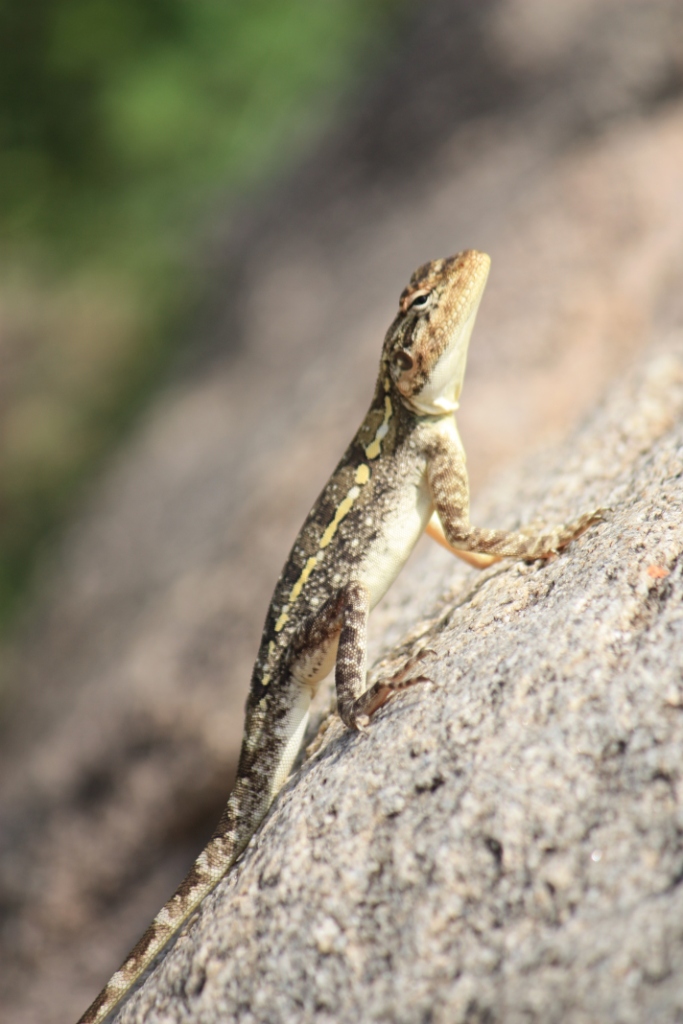
Taken November 2, 2013 at Hampi.

Taken November 2, 2013 at Hampi.

These little lizards were one of the most common animal lifeforms at Hampi.  They blend into the rock quite well despite the broken white or yellow line of dots on their backs, which itself blends into the splotched pattern of the creature.

I believe they are called Psammaphilus Dorsalis, Peninsular Rock Agamas, or South Indian Rock Agamas. [However, I know nothing about lizards and am open to correction by a herpetologist.]

DAILY PHOTO: Precarious Rock

Taken November 3, 2012

Taken November 3, 2012

Part of what makes Hampi so surreal is all of the precariously balanced boulders. This shot is oriented straight up and down, i.e. the camera is not tilted, and so one wonder’s “How is that rock not falling?”

DAILY PHOTO: Stone Chariot

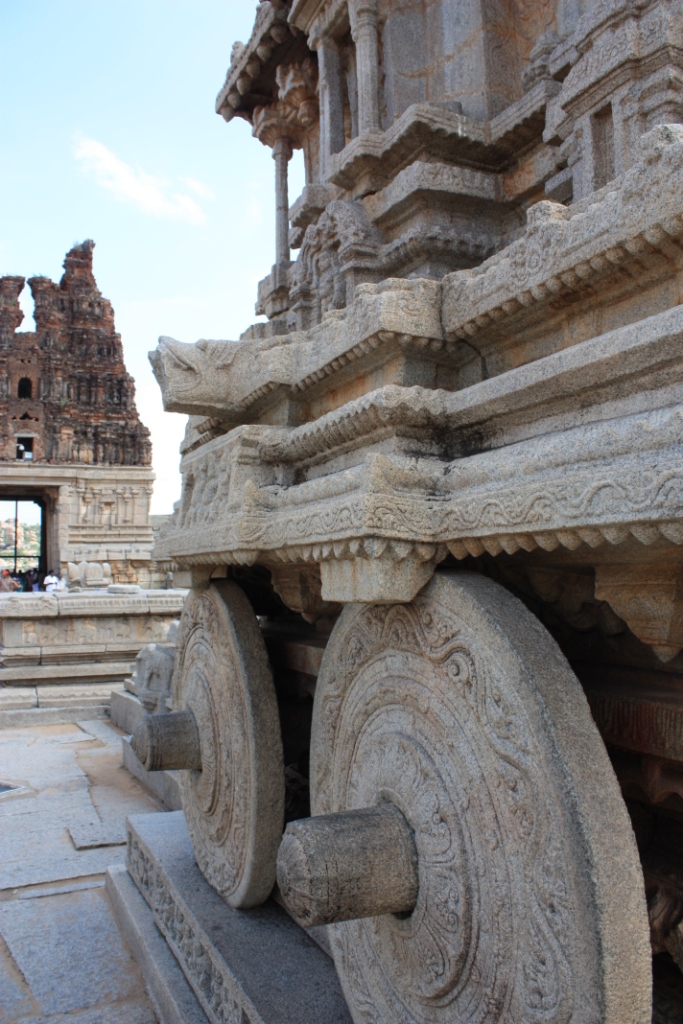
Taken November 2, 2013 at Hampi

Taken November 2, 2013 at Hampi

This stone chariot is one of the most iconic scenes of Hampi. The wheels on the chariot were once capable of moving, but no more. It remains an amazing sculpture. It’s in the Vittala temple complex, and is one of the first things that draws the eye when one enters through the gate that one can see in the background.

DAILY PHOTO: Towering 4-Handed Guardian

Taken November 2, 2013 at Hampi

Taken November 2, 2013 at Hampi.

These guardians of the inner sanctum can be seen here and there throughout Hampi.

I assume they were meant to be guardians and not just four-handed mutant freaks doing yoga stretches to loosen up their leg abductor muscles.

BOOK CHAT: Walking by H.D. Thoreau

WalkingWalking by Henry David Thoreau

My rating: 5 of 5 stars

Amazon page

Thoreau paints a portrait of walking in such grandiose terms that one will cease to think of putting one foot in front of the other as one of life’s mundane tasks. He’s not talking about just any walking, however. He’s not talking about the mall walkers who briskly exercise in temples of consumerism. He’s not talking about those who walk through the park with top 40 hits blaring from their iPod ear buds.

Thoreau is talking about those individuals he calls saunterers. To saunter, as to stroll, is to walk in a leisurely and aimless fashion. Thoreau’s walking is that which:
-takes place in nature.
-leaves worldly worries behind.
-is not a trivial time commitment.
-is more an exercise of the mind and spirit than of the body.

To the mall walker, Thoreau would point out the error of a missed opportunity to get away from mankind’s chaos and enjoy nature. As he puts it, “The most alive is the wildest.” and “…all good things are wild and free.” He’s also clear in that walking for exercise misses the point by injecting hurriedness into a time that should be about slowing down.

On those with iPods, cellphones, or other contrivances that distract one from the environs, Thoreau is equally clear, “What business have I in the woods if I am thinking of something outside the woods?”

Thoreau’s essay broadens as it progresses. From a commentary on the virtues of sauntering, the essay turns to the glories of nature, the character of America, and the state of thought in his contemporary society. These may seem like unrelated concepts, but there is a string of logic that connects them.

The connection to nature and the virtue of wildness should be clear. It’s nature that is the optimal backdrop of sauntering. It’s in nature that one can be set free from the troubles of the world of man and obtain a glimpse of god. It’s in nature where creativity breeds with chaos turned down and native brilliance turned up.

Thoreau’s discussion of America is tied to the theme of walking in a couple of ways. The first is as a land made for walkers. For example, he points out that a man could pitch a tent almost anywhere in North America without great risk of becoming a meal. The same couldn’t be said of India or Africa or Siberia, where man isn’t the sole predatory creature. The second is America as a place with room to venture out into uncharted territory. Thoreau points out that we may look to the East for the lessons of our predecessors, but a person should look West for opportunities to grow in one’s own right. Of course, Thoreau’s America was different from today’s America.

The end of the essay broadens out even further. Thoreau comments upon mankind and the state of ideas and thought. He echoes Socrates when he talks about that age-old question of whether it’s better to be ignorant (to know one knows little) or deluded (to think one knows a lot, but be drowning in false knowledge.) A reader may suggest that this is a false dichotomy. Why can’t one know most everything and not have a one’s body of knowledge rife with false knowledge? I can’t say, but all of the evidence suggests that if such a state exists, it’s the domain of God or gods (if such entities exist.)

Thoreau also bemoans what he sees as the decline of thinking man. What does this have to do with walking? I think Thoreau answers in the following quote:
“So it would seem few and fewer thoughts visit each growing man from year to year, for the grove in our minds is laid waste—sold to feed unnecessary fires of ambition, or sent to mill—and there is scarcely a twig left for them to perch on.”

I think that everyone should read this thin book–really an essay and not a full-scale book. The problems Thoreau notes have only gotten worse in our modern age. Far too few take the time to walk, and to acquire the benefits of sauntering.

View all my reviews

DAILY PHOTO: Yellow Blossoms

Taken November 2, 2013 at Hampi.

Taken November 2, 2013 at Hampi.

The Hampi area is painted from a different palette than most of Karnataka. Instead of uniform green, the brownish-red of the boulders dominates, and, while green lines the spaces between the rock, the vivid yellow of these flowers decorate the base of many hills.  Of course, there remain islands of green, in the form of corn fields, banana plantations, and palm groves.

DAILY PHOTO: Sunset Over Hampi

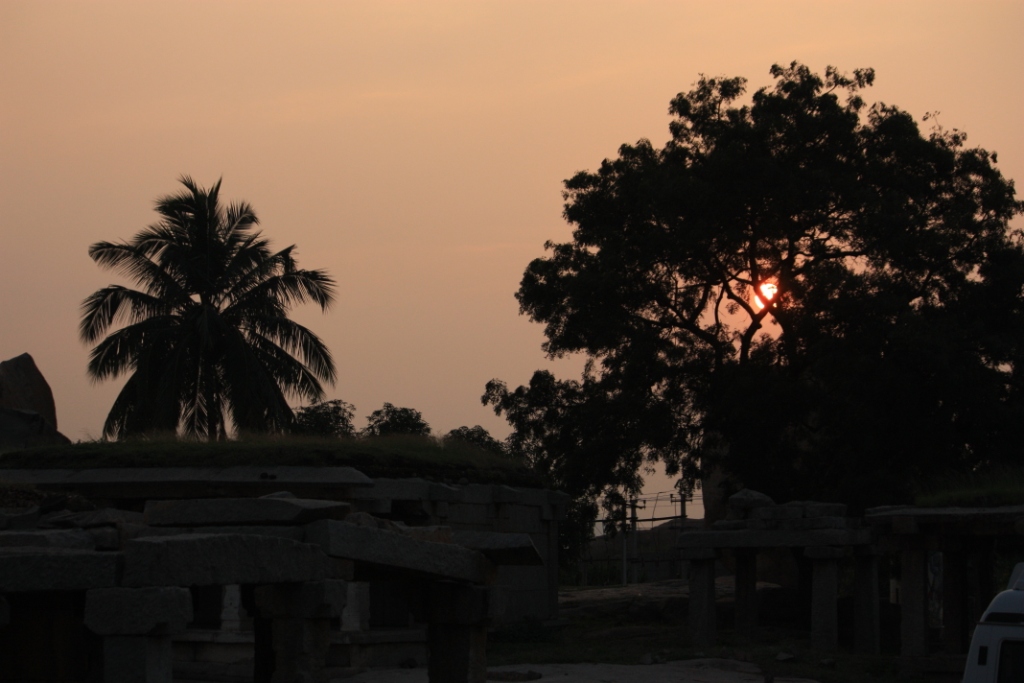
Taken on November 1, 2013

Taken on November 1, 2013

In the tropics the summer days seem so short and the winter days seem so long–at least if you grew up at 42°N (northern Indiana) and now you’re living at 13°N (Bangalore, India.) There’s no discernible adjustment in the length of days here. Maybe, if you’re a local. But it always gets dark around 6 at night and becomes light around 6am the next morning.

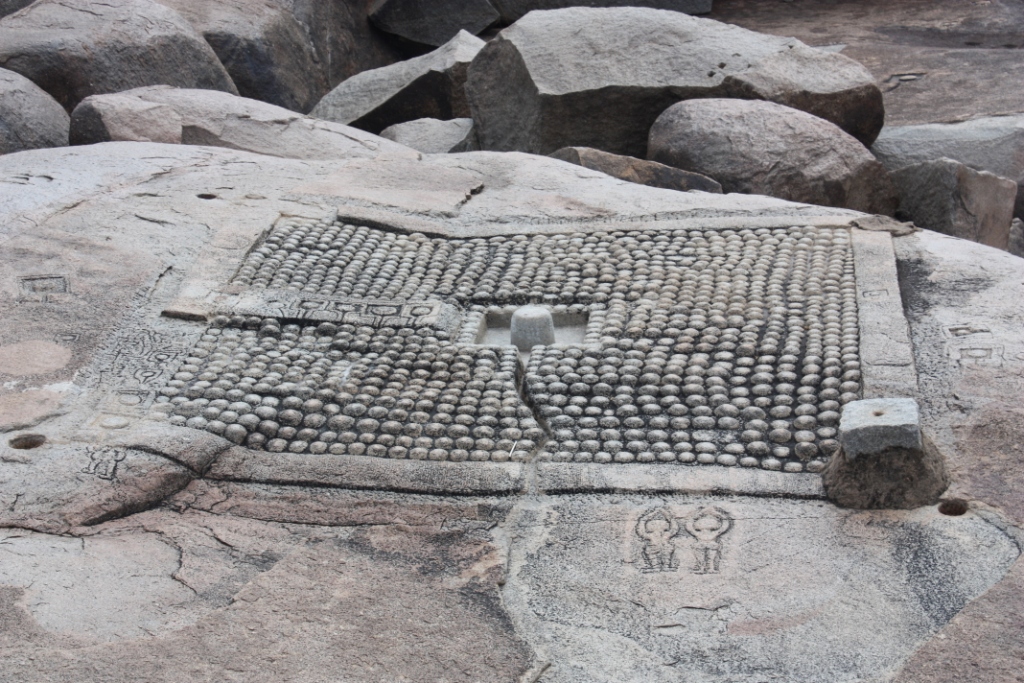
DAILY PHOTO: 1008 Linga on the Tungabhadra Bank

Taken November 1, 2013 near the Tungabhadra river at Hampi.

Taken November 1, 2013 near the Tungabhadra river at Hampi.

I read the Wikipedia article on Shiva linga, which said that it was a grave error to think of a lingam as a phallus. However, the article went on to say that the union of the lingam and the yoni represents the inseparability of male and female and the act of creation. Therefore, I’m sticking with the neophyte view that this symbolically represents the male organ of amour.  [Note: the terms linga and yoni are used in the Kama Sutra to describe the male and female organs, respectively. The terms may have been euphemisms that distorted the true initial meaning, or this might be taken as evidence of the correctness of the neophyte view. I’m not qualified to comment.]

Shiva is one of the top-tier aspects of God in Hinduism. He’s one aspect of the Hindu trilogy. Brahma is the creator. Vishnu is the operator. And, Shiva is the destroyer. This may seem a little ominous, but it’s obvious that something must be destroyed to make way for new things to come into existence. In a more modern interpretation, matter cannot be created or destroyed but can only change forms. These two ideas may seem very different, but when one considers that there is a finite amount of matter, if you want to make something new, then something else has to give up its matter to build it.

So while Shiva’s hallmark quote is, “I am become death, destroyer of worlds,” [reiterated by Robert Oppenheimer in referring to his role in the Manhattan Project] he’s really not so bad a deity.

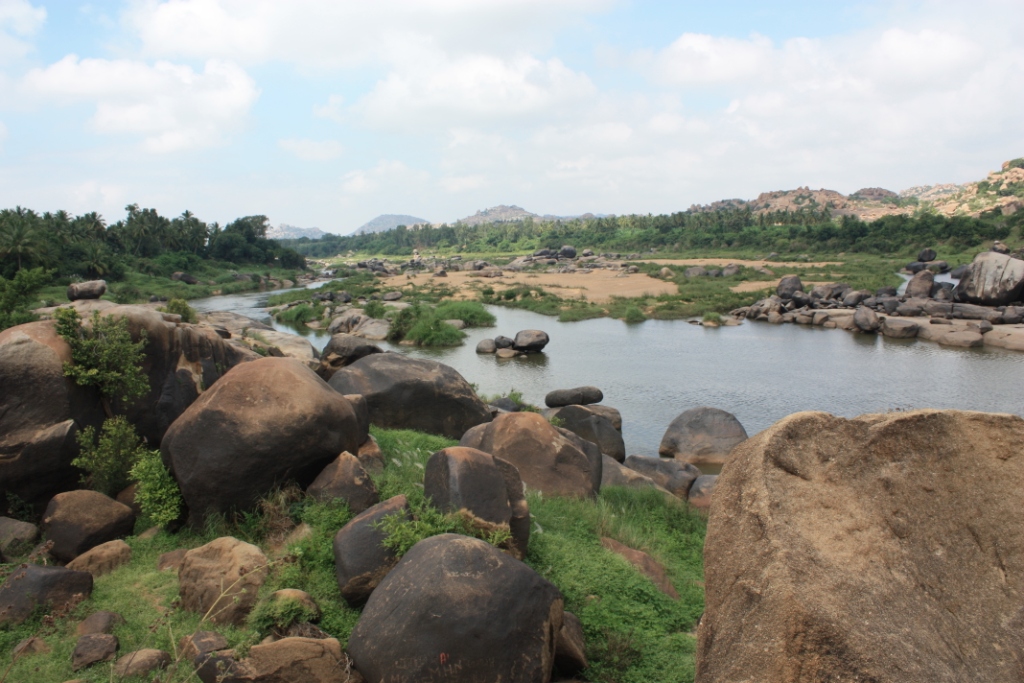
DAILY PHOTO: Hampi Boulders

Taken on November 1, 2013 on the Tungabhadra  River

Taken on November 1, 2013 on the Tungabhadra River.

I just got back from a trip to Hampi, India. My wife and I agreed that it’s the most spectacular Indian historic site we’ve seen to date. The reason why it edges out the–awe-inspiring–Taj Mahal for us is that even if man had never touched this land it would be a spectacle to behold due to the unique geological processes that have taken place there. (The Taj Mahal is impressive, but once you leave its gates, the glory shrivels. In Hampi, leave the ruins and the awe has just begun.)

The rocks in that region are some of the planet’s oldest, and while much of the softer rock has been entirely washed away, the harder marble remains, but has been eroded over time. It creates an otherworldly appearance that is suitable for the set of a sci-fi film. Some formations seem to defy gravity, with boulders stacked on boulders in impossible ways.

I highly recommend a trip to Hampi. It’s about 7 hours by car from Bangalore (if your driver knows where he’s going–ours was a bit longer.)

A couple of points to keep in mind.

-There’s no alcohol allowed in Hampi village.

-There’s little non-vegetarian food in Hampi (Even if you’re vegetarian, you may be a little underwhelmed. It’s bland by Indian standards, and almost every guesthouse / restaurant tries to sell every ethnic food imaginable resulting in a “jack-of-all-trades-master-of-none” warmed-over mediocrity. The one exception that we found was the Mango Tree restaurant, which is generally packed. Eat at off hours if you can.)

-If you stay across the river, the ferry only runs until 6pm. We stayed in one of the many basic guesthouses in Hampi proper. Staying in a nicer hotel incurs a trade-off that one will have to travel quite a while to get to the site. (As my wife said, “30 kilometers is too far in India.”) If you miss the ferry, the trip by car is a long way around.


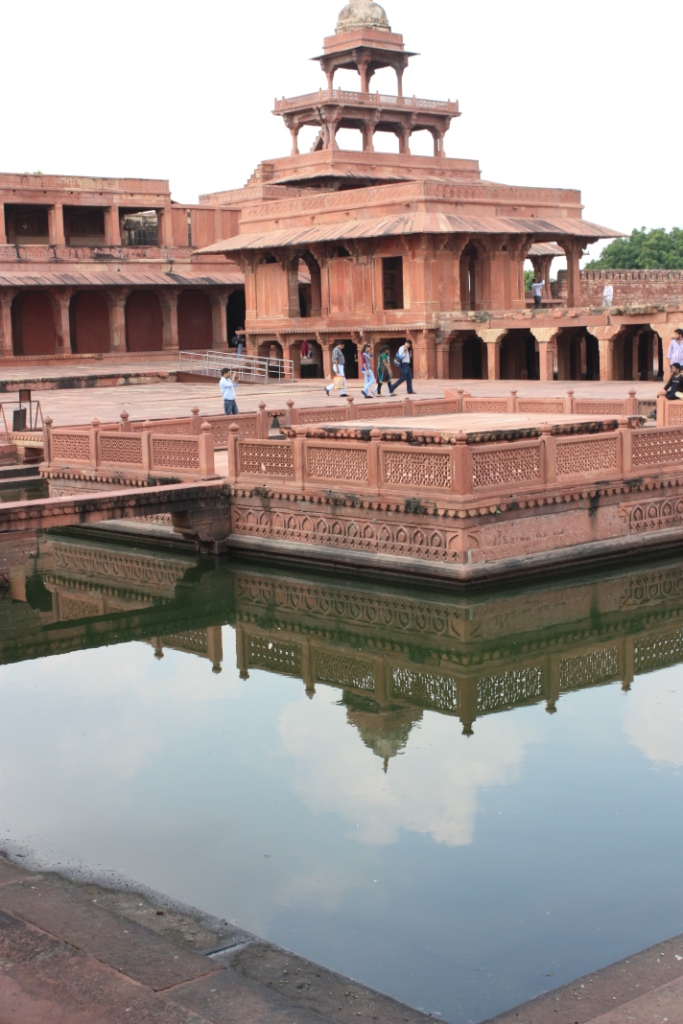
DAILY PHOTO: Fatehpur Sikri

Taken October 13, 2013

Taken October 13, 2013

Fatehpur Sikri is a historic site not far from Agra (home of the Taj Mahal.) It’s almost entirely red sandstone, and is impressive site and well-maintained– including ornate carvings inside many of the structures.

This will be my last post for a few days as I will be traveling to Hampi, another set of famous Indian ruins of once great states.  I’ll be back after Diwali with photos and experience from that visit.