BOOK REVIEW: Narrow Road to the Interior: And Other Writings by Matsuo Bashō

Narrow Road to the Interior: And Other WritingsNarrow Road to the Interior: And Other Writings by Bashō Matsuo
My rating: 5 of 5 stars

Amazon page


Bashō was a traveler, and much of his poetry came from what he witnessed and experienced on the road. This volume contains four travelogues (each containing interspersed haiku); the most famous of these being the title piece, but also including: “Travelogue of Weather-Beaten Bones,” “The Knapsack Notebook,” and “Sarashima Travelogue.” In addition to the travel writings, there is a section of select Bashō poems. The word “travelogue” may create a misapprehension. These weren’t diaries of the minutiae of his travels. They offer a poet’s eye view of highlights and insights, and—of course—interspersed poems. [There is a term for this genre of prose mixed with poetry, haibun.]

Matsuo Bashō was born in Iga-Ueno (famously a center of ninja warriors during the Warring States Period), and traveled extensively within Japan. He lived from 1644 to 1694, during the time between the end of the Warring States Period and the Meiji Restoration that brought Japan into modernity. It was a period of relative peace ruled by a military dictatorship, lying in the long shadow of war. Zen touches are prevalent throughout Bashō’s writings, but so are references to Chinese philosophy and history, Shinto, not to mention the Japanese poets who preceded him.

In addition to the aforementioned content, the book includes some nice ancillary features. First, there is a Translator’s Introduction that helps provide necessary context about Bashō’s life and times, as well as offering insight into what was valued in Japanese poetry of this time–including influences of systems like Zen, Taoism, and Confucianism. There is an Afterword describing the last years of Bashō’s life, as well as end-notes and a bibliography. Notes are useful for this type of book because most readers face both cultural and historical barriers to understanding (myself included.) As for graphics, there is a map to help readers grasp the extent of the poet’s travels. There is also a chronology to help keep the events of Bashō’s life—most notably the timeline of his travels—straight.

I’m not sure how the translator’s (Sam Hamill) version compares to an ideal, but I enjoyed it. For example, Bashō refers to an innkeeper called Hotoke Gozaemon, which Hamill translates as “Joe Buddha.” I suspect that is an example of veering away from literal translation to communicate an essence in a way that is readily grasped by the English-language reader. Some of the haiku translations seem clunky, but it’s extremely hard to put haiku into English, so I can’t say it could be avoided. English syllables and words can be chunky and our grammar doesn’t lend itself to being sparse. I will say that a nice feature of the “Selected Haiku” section is that it includes the Romanized Japanese poem under the translation. This isn’t done throughout the haibun “travelogues,” but it’s done in that last section. The main benefit of this is allowing the reader to hear the sound of the poem, but it can also allow one to compare different translations of the same poem.

There are several translations of these same writings available (often gathered together into a single volume like this because it makes for an acceptable length book–rather than the pamphlets that the individual haibun would be.) This is the only version that I’ve read to date, and so I can’t compare it to others. However, I was quite pleased with this version and found it to be both readable and evocative.

I’d recommend this book for haiku lovers, travelers, and those who want to see what awesome travel writing can look like.

View all my reviews

Traveling Kashmir Under Curfew

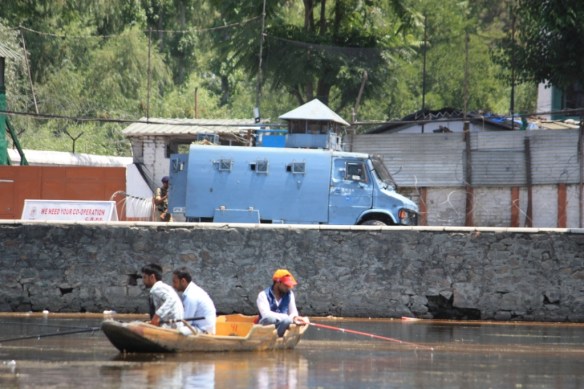
Taken in July of 2016 in Srinagar

Taken in July of 2016 in Srinagar; Armored Personnel Carrier (APC) in back, fishermen in front, a typical Srinagar scene


We’d made our arrangements. We’d fly into Srinagar and spend a week there to acclimatize and sight-see before a trek that would take us from Sonamarg to Naranag (fyi: this direction was reversed the night before the trek because of bandhs (strikes) that blocked the road from Srinagar to Sonamarg.)  After Kashmir we’d head to Ladakh. Standing on the Tibetan Plateau, Ladakh’s greatest risk would be mountain sickness–a risk we’d curtail by acclimatizing in the lower altitudes of Kashmir. On the other hand, Kashmir had the potential to be dicey, but there’d only been infrequent violence in recent years–and never directed against foreigners or tourists. One didn’t even have to get special permits to visit anymore.


That was about a week before a militant commander of Hizbul Mujahideen, Burhan Wani, was killed. Wani’s death triggered a wave of outrage leading to violence. The death toll crept into tens of people. The violence mostly consisted of rock-throwing by young men directed at military, paramilitary, and police forces, and the response of those units involving lethal and less-than-lethal weapons (the latter occasionally were not so “less than,” as was seen with the  pellet guns which caused a fatality, reinvigorated the conflict–unbeknownst to us–as we were on the trail.)


We were on the horns of a dilemma. Should we dump our plans and either go to Ladakh for the entire time or someplace else like Kyrgyzstan–which had been on our short list when planning the trip. Either way, we’d loose a little bit of money, but safety wouldn’t be a concern. If we went straight to Leh (11,000 ft+ / 3500m) we’d be less eased into the altitude. Or, should we hope that the troubles would blow over and Kashmir would return to a safe status quo.


It was impossible to tell whether events would settle down or take a turn for the worse. Furthermore, the Indian government took an approach that was–for a democracy–baffling.  They shut down the local news outlets, making it even more difficult to find out what was going on on the ground. They also shut down phone and internet communications such that we couldn’t get in touch with our trekking company for several days. We could get in touch with our hotel because many of the locals have lived through past episodes and know how to set up communications so as to avoid being put out of business by government shutoffs. However, asking individuals who have an incentive to keep one coming regardless of the situation, one never knows how much one can trust their suggestions. We dealt with reputable operators, and they were ultimately a primary source of information, but one can never tell in the beginning.


I can only assume the Indian government’s thought process went something like this: 1.) We can’t suggest that people don’t travel to Kashmir because we’ll be seen as pounding the final nail in the coffin of Kashmiri tourism for a season that will already be dismal. This will only exacerbate the current problems because the Indian government is largely blamed for how backwards and under-performing Kashmir is. (Note: while there is wide variation as to what Kashmiris seek–some want to remain part of India but with more autonomy and access to resources, others want to be an independent country, and still others want to be part of Pakistan, none seem to be pleased with the current state of governance.) 2.) On the other hand, we can’t recommend that people travel to Kashmir either because we’ll look like huge putzes if we encourage tourism and travelers gets hurt–we may even face a crisis of confidence in tourism nationally. Therefore, lets just be as opaque as possible. We’ll try to prevent anyone from knowing anything about what’s going on so that whatever decision they make we can say we had no part in it.


Given the dearth of information, our decision ultimately came down to whether we wanted to be optimistic or pessimistic. We chose to be optimistic. I guess that was the right course, because ultimately the trip worked out. However, we did have to be flexible and make a lot of adjustments–often at the last minute. However, we didn’t loose much–or any–money because of the cancellation policies of the businesses we engaged.


First of all, there were some places that we’d planned to visit that were strictly no go. We’d planned to do a day trip to Gulmarg and an overnight trip to Pahalgam. Needless to say, we would have seen a lot more of Srinagar, itself, had it not been closed off. Basically, we could go anywhere we wanted to in the Dal Lake area, including the numerous gardens, but trips into Srinagar Old Town were not happening. We ended up taking an overnight trip to Sonamarg. We didn’t plan to do this because we were to see that town as part of our trek. However, there’s not seven days worth of Dal Lake to see (unless you really want to just relax), so we ended up making two visits to Sonamarg (which also doesn’t warrant that much time, but we couldn’t get anywhere else, and Sonamarg was safe and accessible.)


Second, we could only travel in the dead of night. You probably read the word “curfew” and thought, “Oh, that means that no one can be out after dark.” In Kashmir that logic was reversed, and everybody does everything after dark. As mentioned, drivers wouldn’t drive many stretches of road. However, the places they would go (e.g. safe and secure Sonamarg and locations along the Srinagar-Leh Highway, NH1D) they would only drive overnight. I had trouble grasping this logic, all though it seemed to work. It seemed to me that it would be easier to conduct an ambush in the dark and get away with it. I was told that it wasn’t ambushes that anyone was worried about. Drivers were worried about rock throwers breaking their windshields. Fair enough. It still didn’t make sense. It seemed that if one were going to make mischief, one would set an alarm for 1 am or 5 am and place your basket of rocks next to the bed. The roadblocks created what one might call a target rich environment because all the vehicles were bunched up together. Ultimately, I concluded that the reason it worked was that the rock-throwers lived with their mommies and daddies, and they were tucked in in their jammies during the hours in question.


During our first full day in Srinagar, there was an Indian Minister visiting to help ease tensions. We, therefore, didn’t realize that the vast numbers of police and paramilitary forces were unusual–even relative to the current heightened state of security.  The next day, it was a lot less intimidating as there were not AK-47-toting guards every fifty feet along Dal Lake Boulevard.


Ultimately, we never felt unsafe or saw any violence firsthand. Our most unnerving moment came traveling along the Srinagar-Leh highway in the middle of the night when we came upon a huge gathering of people blocking the road. The were just pashmina merchants and restaurateurs who were getting no business, and who were trying to stir up some business in the middle of the night. Needless to say, I suspect few were in the mood for 2 am shopping or eating. However, generally, while the locals were desperate because their tourism season had been strangled, the Kashmiri’s are relatively laid-back compared to much of India, so even the touts weren’t unusually annoying.


We were told not to tell locals that we were American, and we complied with that suggestion. (This obviously doesn’t apply to anyone who can ask to see your passport–e.g. security forces, nor to the sparsely arrayed other tourists–including India tourists–who are more likely to be able to differentiate accents and for whom there is nothing to be gained by deceit.) It’s not that there was any animosity against America, but rather there is a thought that mighty America can fix any problem that it puts its mind to. My wife is of Hungarian origin, so this didn’t even require a lie, per se, as long as she did the talking.


I guess the question of interest to readers is whether they should travel to Kashmir or not? If you can tolerate your plans being changed (or are the type that don’t make plans at all) you’ll be alright. I don’t regret the trip, and I think we had an educational and enjoyable experience.


That said, you may want to adjust downward any times your guidebooks recommends for your visit because you’ll end up bored if your travel is restricted. You may also want to allow more time for travel because only traveling at night means you  may lose a day trying to get out of town. I should point out that the hotels were very accommodating with regard to the early check-in necessitated by this travel situation. However, it is a bit more exhausting having to travel through the night.


If you’re not familiar with the nature of the Kashmir conflict, here is a handy timeline from the BBC to help clarify it.


BOOK REVIEW: The Elephanta Suite by Paul Theroux

The Elephanta SuiteThe Elephanta Suite by Paul Theroux
My rating: 4 of 5 stars

Amazon page

The Elephanta Suite is a collection of three novellas that feature Westerners out of their league in India. As an American living in India, I suspect anyone who’s had this experience will recognize instances in which—for good, bad, or a mix of each—one is swallowed whole by some feature of India that one couldn’t possibly have anticipated. The novellas aren’t interconnected, except by way of the themes that run through them and Theroux’s trademark use of what I’ll call—for lack of a better term—cameo references. These aren’t his own cameo appearances in the book—as he’s also been known to do—but rather minor instances in which the lives of the characters in one story brush up against those in another.

The first of the novellas is called “Monkey Hill,” and it features a tourist couple who are staying at an upscale resort that’s near a town with a large Hanuman temple. (Hanuman is the “monkey-god” of Hinduism, a popular deity with a monkey-like face and a man-like body who features prominently in the epic entitled Ramayana.) The resort grounds also have monkeys, and so there are two potential meanings to the title. Like many wealthy travelers to India, the couple isn’t really experiencing India—though, like the characters in the other stories, they end up doing so in a major way by the story’s end. Experiencing India in unexpected ways is a central theme across the three works. The couple’s only real experience of India comes through each of their respective dalliances with locals that are carried out unbeknownst to the other. (I would point out that characters who aren’t particularly high in moral fiber are another prevailing theme across these stories, but really such characters are a hallmark of Theroux’s writing in general.)

“The Gateway of India,” as Bombay visitors might suspect, is set in that city and the waterfront attraction features prominently in the novel. The lead in this story is a business traveler who’s staying in the famous Taj Hotel in Mumbai. (The hotel overlooks the Gateway and was allegedly built by a pissed off J.N. Tata who was irate because, as a Parsi, he wasn’t allowed to stay in any of the upscale hotels because they exclusively catered to Westerners. As a “screw-you,” he built the most elegant hotel in the country at the time.) At the story’s beginning, our business traveler is a caricature of business travelers to India. He’s too scared to eat or drink anything that isn’t from a five-star hotel—and even then he’s wary. He’s filled with disgust whenever he rides through town or interacts with locals in the street. By turns, he’s transformed over the course of the story. Like the couple in “Monkey Hill” his introduction to the real India comes from a sexual liaison with a native. That said, this story features the most positive character transformation of the three stories. This is the one “feel-good” transformation of the three.

The final novella, entitled “The Elephant God,” begins in Mumbai, but is largely set in Bangalore. This story features yet another class of traveler to India–the backpacker. This lead is a young woman who is traveling on a tight budget while staying at an ashram. Beginning the story in Mumbai allows the reader to see how the backpacker loses her traveling companion, an issue that will prove crucial to the story’s resolution. As one might expect of a backpacker, our protagonist has had a truer experience of India than the wealthy protagonists of the other stories. She knows a little of the indigenous culture and how real people behave faced with real world events. In fact, there’s an intriguing piece of the story line that involves a job she gets teaching English to employees of a call center for a multinational corporation. [It should strain credulity that she’d be able to get a job on the visa she would have, but this is India.] At any rate, she begins to realize that—by teaching the call-takers to speak to American customers in a way that will make Americans comfortable—she’s essentially turning them rude—all their endearing deferential mannerisms fade in the face of her teachings. She feels bad about this. The titular reference involves an elephant and its handler (mahout) that she befriends. (In two years living in Bangalore, I’ve not seen an elephant living inside the city, but I can’t say that I found this aspect of the story unbelievable. I have seen, for example, the equally improbable camel or two.) The elephant isn’t a major feature of the story until the climax, though visits do recur.

I enjoyed these stories and would recommend The Elephanta Suite–particularly for any Westerners who have spent, or plan to spend, substantial time in India. The book may not surprise or inform such readers, but it’ll probably resonate with them.

View all my reviews

Uncle’s Shop, And Other Mysteries of The Indian Auto-Rickshaw

20140219_152150Where is Uncle’s shop? It’s where you are going if you got into an auto-rickshaw with a driver who has volunteered to drive you around for less than the metered rate. It may not be where you want to go, where you think you’re going, or where you’d like to go. But in the driver’s eyes, by taking him up on a reduced fare, you’ve entered into an implicit contract to be taken to a random store and nagged into buying something expensive enough that the shop can happily recoup the driver’s finders fee.

FYI- Bangalore auto-rickshaw fare is currently 25 rupee (Rs) for the first 1.9km, and 13Rs  for every kilometer thereafter. If the driver offers to take you around for 10 or 20Rs, you know they have plans. (Although there is a small chance that they are counting on you to be ignorant of the fact that the place they are offering to take you is 50 feet away.) Usually, a driver will offer to take you to a place for 4 to 8 times the metered rate (sometimes more if he has no idea where said place is–a not uncommon condition in Bangalore.) In other words, the driver will normally try to rip you off in the old-fashioned way (which eats at your pocket-book, but not at your time.)

If you find the new-fangled rip-off scheme to be a deplorable con, just remember to save some of your wrath for FaceBook, Google, and the other websites you commonly use. They almost all work on the same model. You get charged little or nothing to use said sites in exchange for agreeing to be shamelessly pitched stuff you don’t want or need.

What does Uncle’s shop sell? I hope you like a good mystery, because there’s no telling whether Uncle’s shop sells anything in which you have the slightest interest. If you are a single male, Uncle’s shop probably sells saris and pashminas. If you have a tiny apartment, Uncle’s shop probably specializes in 14 foot tall bronze statues of Ganesha. It could sell woven goods, knick-knacks, bric-a-brac, widgets, tsotchkes, or relics of a religion you know nothing about so you can engage in some low-grade impiety. (FYI- You may not realize this but for the devoted, it can be a bit offensive for a bunch of non-believers to be wearing “OM” symbols or having Buddha statues who aren’t Hindu/Yogic or Buddhist, respectively. Sort of the way many hardcore Christians feel about how Christmas was shanghai’d by a jolly old elf or Easter was overtaken by a giant bunny.) In some cases, Uncle’s shop will sell all of the aforementioned items and more.

Surely I will get an outstanding deal at Uncle’s shop, right? I mean, Uncle is not going to rip off his nephew’s customer, right? Wrong. First of all, there is an infinitesimally small chance that the driver is biologically related to the store owner in any way, shape, or form. It’s probably more likely that they’ve never formally met.

Second, let’s do some Uncle’s shop mathematics. We will call the wholesale cost of the product “C” and the bloated profit that the store owner would like “W” (for “wishful thinking profit”)  and the lowest profit “Uncle” is willing to accept “R” (for “reservation price profit.”) If you just walked into the shop off the street and bought said item you’d pay some amount ≤(C+W) and ≥(C+R).

However, now the driver expects a reward. [Granted, it may be nominal in the scheme of things.] We’ll call the fixed-rate payment to the driver “S” (for “sucker wrangling charge.”)  [You may wonder why I’m assuming this is a fixed-rate payment. Fair enough, if the driver is savvy, it will be percentage. However, my finding has been that between 60% and 80% of autorickshaw drivers in Bangalore don’t understand the concept of a map. I’m not saying they don’t know how to use a map. I’m saying that they don’t get that it’s a representation of the streets surrounding them. My point being, auto-rickshaw drivers are–as a group–not savvy. Granted, certain among them are really savvy. However, my point holds as long as we can except that S>0, for all S–whether fixed or a percentage.)

Long story short, now you will pay between (C+W+S) and (C+R+S), where S>0.  Long story shorter, going to Uncle’s shop with an auto driver will not save you money (unless you’re looking for something specific, and it will save you the value of time to have a guide to show you where to get what you’re after. Good luck with said guide being an auto driver, the driver doesn’t care what you want, he wants you to buy whatever Uncle’s shop is selling. You can buy what you want on your own time.) It’s true that you may find it worth it to pay the nominal extra amount for many reasons, i.e. convenience, a likable driver, etc. Just be informed.

How come it’s called Uncle’s shop, when nobody involved is the Uncle of anybody else involved? Indians use “auntie” and “uncle” as honorifics for older individuals who are in positions / stature commanding respect–it needn’t be a relative by blood. For auto drivers, this includes random shop owners who’ll pay them 50 rupee for dragging hapless tourists into the store.


Lies My Tuk-Tuk Driver Told Me

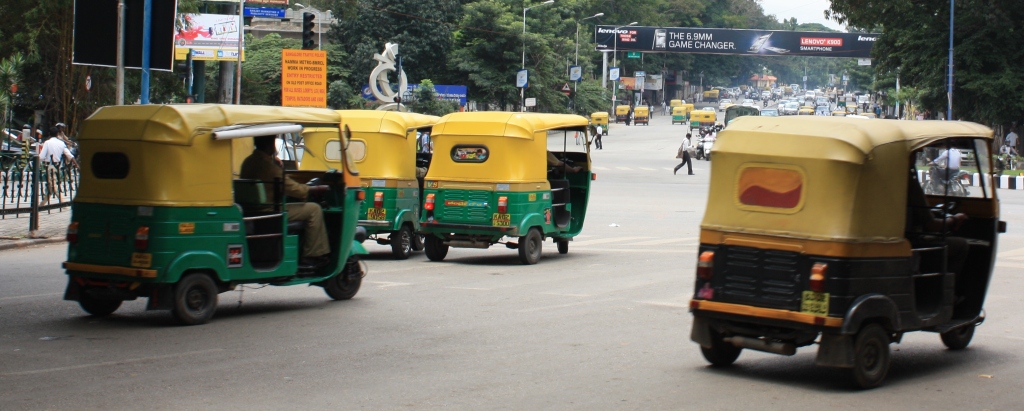
Taken Sept 5, 2013 in Bangalore, India

Taken Sept 5, 2013 in Bangalore, India

Tuk-tuks or Autorickshaws  are the ubiquitous three-wheeled vehicles-for-hire seen throughout South and Southeast Asia. (Note: Owing to their evolution from walking or pedal rickshaws, they’re sometimes just called “rickshaw” for short, or even “pedicab” or “petty cab”–the latter likely a corruption of the former.) They’re an essential way to get around in the big cities of Mega-Asia, but almost everyone has a bad experience with one at some point.

Let me point out that I’m not suggesting that most tuk-tuk drivers are amoral liars, but as a tourist (or someone who looks like one) the drivers that approach you probably will be. The vast majority of drivers are honest, hard-working men (and the elusive woman) just trying to put food on the table. That’s why my key advice to people on the subject is, “Pick your driver, and don’t ride with the ones who pick you. Then always negotiate your fare–or make sure they will use the meter– before you get in.” The drivers who pick you often have rationalized that it’s alright to treat foreigners like crap. And I’m not so much talking about charging you a little more money (which I personally don’t mind), but more that it’s alright to waste your time or take you places you didn’t ask to go [and potentially much worse.]

Well, without further ado, I’ll share some of my interactions with drivers. This is inspired by a whooper I was told yesterday.

1.) Driver: “The Temple is closed.”
Me: “But there’s a line of Caucasians and Japanese people with cameras going into the place right this moment. I can see them as we speak.”
Driver: “Uhh, monks and nuns.”

2.) Driver: “That road closed. Big protests. Throwing stones. Very dangerous!”
Me: “But I can see all the way to the corner where we need to turn, there’s nobody there.”
Driver: “They hide. [Pantomiming popping up over a wall] Throw rocks.”

3.) Driver: “Meter[ed fare is] 200 Rupee, but I’ll take– only 150 Rupee.”
Me: “I just took a trip yesterday that was 50% farther and took twice as long, and the metered fare was 50 Rupee.”

4.) Driver: “But traffic very bad, VERY BAD. Premium rate time.”
Me: “But it’s Sunday morning at 8:00am. I haven’t heard a horn for half an hour, and I happen to know that there’s no such thing as ‘premium rate time.'”
Driver: “It’s new.”

5.) Driver: “You can’t get from here to there, except go past travel office.”
Me: “Sure you can. It’s one block over and then a straight shot of five kilometers. The travel office is four kilometers out-of-the-way.”
Driver: See lie #2

10-LIST: Bangkok Tips

10 helpful tips for visiting Bangkok.

1.) When seeking a massage and not a “massage” [insert wink], the older and uglier the masseuse, the better the massage. Alternatively, if your masseuse is gorgeous and/or wearing a miniskirt, you are in a brothel… and your masseuse may be a dude.

2.) Just because the religion’s core message is one of peace and tolerance doesn’t mean a Buddhist nun won’t put you in a hammerlock if you fail to make a donation at each and every Buddha you see. BTW, there are about 70 bizzillion of them.

3.) Tuk-tuk fares have no connection whatsoever to distance traveled. One day you may have a driver take you all over town for $1.70, and the next you can’t get one to take you three miles to Hualamphong station for less than $5. To be fair, it takes three days to travel three miles to Hualamphong–unless you’re on foot, then it takes about 20 minutes.

4.) You can’t get out of town without being taken to a silk suit “wholesaler” and a “state-sanctioned” tourist travel office; just get it over with. When you meet a local who is friendly, helpful, and seems to have no ulterior motive whatsoever, that’s when the hook is set. The entire country is in on it. The Thai Pledge of Allegiance even has a line to the effect of, “…and will faithfully divert tourists to silk shops and tourist offices whenever possible, so help me Buddha.”

5.) Trains always leave on time, but a train has never arrived less than three hours late in the history of Thailand. This begs the question of whether the time-space continuum is the same as in the rest of the world.

6.) The Grand Palace is open every day–even though you will be told twenty times a day that the palace is “closed today only”–often within earshot of a blaring loudspeaker announcement on a loop  that says, “The Palace is open everyday from 8:30am to 3:30pm, do not believe anyone who attempts to divert you!” Don’t bother pointing out the announcement, they’ll just tell you that some dimwit forgot to turn it off and that the Queen is having a Parcheesi festival with heads of state today. [They are very creative in their detail.]

IMG_1976

7.) The penalty for peeing on a wall is… nothing. The penalty for peeing on a wall under a photo of either the king or the queen is death administered summarily. This means you have a fifty-fifty shot of getting away with it alive.

8.) If you are prudish, avoid Chinatown as porn is sold from kiosks in the street. Alternatively, if you are looking for cheap porn, tasty dim sum, or cheap plastic items emblazoned with “Hello Kitty” clipart make sure to allow a day in Chinatown. You might be wondering who would flip through vast troves of skanky and, in some cases, freakish porn in the middle of a thronged pedestrian thoroughfare presumably traveled by friends and family, the answer is, “more than you’d think.”

IMG_3837

9.) Be friendly, but–remember– if you tousle a child’s hair you will be asked to leave the country immediately.

10.)  Contrary to what you have heard, Bangkok is not one big red-light district. Its 429 separate, reasonably-sized  red-light districts are spread evenly throughout the city for your convenience.

Despite my sarcasm, Bangkok is a fun and fascinating city that should be visited by all. You’ll learn a lot from those discussions with locals, even if they do wind up with you buying a necktie just to get out of a silk shop.

WRITING DEVICES: The Author Cameo in A Dead Hand

I’ll soon finish reading a novel by Paul Theroux called A Dead Hand. I won’t get into the details of the book in this post because I’ll do a review later, but there’s a writing device in it that really intrigued me. Theroux inserts himself into the novel in a cameo role as a competitor to the protagonist. That is to say, the main character is a traveling writer who writes mostly magazine articles, while Theroux a prolific writer famous for travelogues such as The Great Railway Bazaar and Ghost Train to the Eastern Star,  as well as for many novels which are written with a travel writer’s sensibility for location. (A Dead Hand takes place in and around Calcutta, India.)

I enjoyed the author cameo. It would only work well for a writer like Theroux, one who is both well-known and, because of his nonfiction work, who readers have a feel for as a person. Still, I couldn’t think of another novel I’ve read in which this has been done. I’ve only read Theroux’s nonfiction so far, so maybe this is a running gag with him.

Inserting himself offers some opportunity for adding humor. For example, there’s a part in which the main character’s friend, who is also a go-between who introduces the two writers, says, “He [Theroux] said he wanted to take the train from Battambang to Phnom Penh.”

To which the main character replies, “He would. The bus is quicker!”

This technique also gives one the impression that we are getting some inside insight into the writer. When the main character mistrusts the author, how are we to process that?

Granted it’s a little like an actor looking into the camera and talking straight to the audience.

I’m interested to hear if this is a more widespread technique than I’m aware of? Who else does this?