Five Wise Lines (August 2024)

Empires arise from chaos, and empires collapse back into chaos. This we have known since time began.

The romance of the three kingdoms by luo guanzhong

Being poor is a mere trifle. It is being known to be poor that is the sting.

Jerome k. jerome; “On being hard up”

The art of war teaches us to rely not on the likelihood of the enemy’s not coming, but on our own readiness to receive him…

Sun tzu; The art of war

It is impossible to enjoy idling thoroughly unless one has plenty of work to do.

Jerome k. Jerome; “On being idle”

The wise man, like a child, can be filled with wonder at anything.

Tibetan proverb

BOOKS: “Thirty-Six Stratagems” by Sun Bin [or Anonymous]

Thirty-Six Stratagems: Bilingual Edition, English and Chinese 三十六計: The Art of War Companion, Chinese Strategy Classic, Includes PinyinThirty-Six Stratagems: Bilingual Edition, English and Chinese 三十六計: The Art of War Companion, Chinese Strategy Classic, Includes Pinyin by Sun Bin
My rating: 3 of 5 stars

This is a collection of idioms on strategy with brief explanatory commentaries on each. The idioms, themselves, are thought-provoking and worth studying, but the book is problematic in a couple of regards. First, some of the work seems to either be plagiarized or has been plagiarized. Let me explain that accusation, because the actual thirty-six stratagems are clearly in the public domain, dating to the Sixth Century AD. However, while checking out the Wikipedia site to learn more about the author (incidentally, attribution of this work to Sun Bin is not accepted by consensus,) I discovered that the whole English translation of commentaries is verbatim the same as in Wikipedia. (Wikipedia has a tag on the article that it may contain original research and solicits further information.) I further noticed that the commentaries aren’t straight translations of the original Chinese text, but rather are reformulations written to be understandable to a present-day reader of English with no particular insight to Classical Chinese culture and history (which they are.) I can’t say whose work it is or whether it isn’t a misunderstanding that would be cleared up with additional information, but my point is that I wouldn’t recommend forking over any money to the publisher without knowing that the actual work (not the copy / pasting, but the intellectual work) either belongs to them or is in the public domain. Especially, given that it’s freely available on the internet.

That brings me to a second problem, a problem that is clearly on the publisher. There is a very limited sense in which this is a bilingual edition. Yes, the idioms themselves are presented in Chinese characters with pinyin as promised, but the commentary is wholly in English. The idioms, themselves, are largely Chengyu and other forms of Chinese idiom (so 4 characters, give or take, are all that is in Chinese for each.) So, if you’re purchasing this book to work on learning to read Chinese, it’s of limited benefit, and you’ll have to go elsewhere to get the Chinese commentary.

There is an appendix that explains a little about Classical Chinese. I can’t say whether this is original work or exists elsewhere on the internet. I can say that it also isn’t presented in a bilingual fashion either, excepting a few characters for some of the vocabulary. The appendix does have some interesting information.

My recommendation to readers would be not to buy this text when you can read both the Chinese and the exact English translation on Wikipedia for free. My recommendation to the publisher would be, if the commentaries are their original work, to put in a complaint to Wikipedia to pull it as copyright infringement. (And if they were the ones who lifted the text, to stop it already.)

View all my reviews

BOOKS: “Nuclear War” by Annie Jacobsen

Nuclear War: A ScenarioNuclear War: A Scenario by Annie Jacobsen
My rating: 5 of 5 stars

Amazon.in Page

Release Date: March 28, 2024

Annie Jacobsen’s new book is fascinating and — quite frankly — horrifying from cover to cover. The book presents a hypothetical minute by minute unfolding of events that culminate in full-scale nuclear war and the end of the world as we know it. A four-hundred-page book that breaks down the events of an hour may sound like a recipe for tedium, like Joyce’s seven-hundred-plus page elaboration of the events of a single day in “Ulysses.” But, it is anything but. There is so much to explore amid the concepts like “the nuclear football” and MAD (Mutually Assured Destruction,) and EMP’s (Electromagnetic Pulse weapons.) There is also so much to go wrong, and much that is virtually certainly go wrong.

That last sentence might suggest that the book takes an excessively pessimistic view to create drama. Sadly, it does not need to. The ultra-fast timeline of nuclear calculus does the work of ensuring that many things will go terrifyingly and irreparably wrong. Decision makers have a short window to make decisions, and “use-’em-or-lose-’em” thinking plays a major role in decision making. (i.e. One can’t count on delaying a decision about a counter response because one’s delivery infrastructure — notably, the human bit of it — will likely be destroyed if one absorbs the first strike.) There is also the fact that — counter to all the abort buttons seen in the movies — once missiles are launched, there is no way to stop them. [A bit of “Dr. Strangelove” writ into the system.] At many of the points at which it may seem that Jacobsen is being pessimistic for effect, she explains the basis for her pessimism: from historical events like the failure of the nuclear hotline to commentary by experts.

Lest one think that nuclear warfare is a threat of the past, and that it’s a solved problem, Jacobsen’s scenario reminds us that it’s not just a matter of NATO v the Warsaw Pact (i.e. America v the USSR in the common conception) anymore. She does this by using North Korea as the instigator. We don’t ever learn the Kims’ theoretical motivation, but all one really needs to know to make one nervous is that the DPRK has been quite happy playing the role of pariah, engaging in a number of activities in violation of international law and norms, as well as that Kim Jong Un might just believe some of the ridiculous things his yes-men tell him. (Not to mention the famines and other destabilizing conditions that could lead some other inside actor or group of actors to take unanticipated actions.) The truly disturbing part is to see how easily a strike by the DPRK could draw Russia or possibly China into the nuclear exchange. [Russia because it’s in the path between the US and the DPRK, and China because it could suffer massive casualties from strikes on North Korean facilities near the border that send radiation to sizable Chinese population centers.]

This book is a must-read for anyone who thinks nuclear weapons are the problem of a bygone era.

View all my reviews

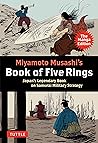
BOOKS: “Miyamoto Musashi’s Book of Five Rings: The Manga Edition” art by Koji Kondo; trans. by Makiko Itoh

Miyamoto Musashi's Book of Five Rings: The Manga Edition: Japan's Legendary Book on Samurai Military StrategyMiyamoto Musashi’s Book of Five Rings: The Manga Edition: Japan’s Legendary Book on Samurai Military Strategy by Miyamoto Musashi
My rating: 5 of 5 stars

Amazon.in Page

Release Date: April 30, 2024

As readers may suspect, this isn’t simply a graphically illustrated edition of The Book of Five Rings. That book, being written as an instructional manual, doesn’t lend itself to a literal manga adaptation. Rather, this work is a graphic novelization that puts Musashi’s strategic masterwork into a narrative context. While it does share many strategic and philosophical ideas from The Book of Five Rings, it’s more a telling of the story of how the manual came to be and how it was transmitted out into the world. It tells this story primarily by exploring how Musashi came to have three apprentices, and how he went about teaching them the lessons encapsulated in the manual. It also delves into Musashi’s most famous duel, the Ganryū-jima battle against Sasaki Kojirō, an event that formed a turning point in Musashi’s life.

I found this manga to be engrossing and highly readable. It is well worth reading, even if one has read one or more translations of The Book of Five Rings. The translation of ideas seemed clear and consistent with my understanding of Musashi’s worldview. I’d highly recommend this manga for readers interested in the history of martial arts, biographies of intriguing individuals, as well as strategic and philosophical ideas.

View all my reviews

Berry Game Theory [Haiku]

summer berries:
 to pick or let ripen?
  what will birds do?

Of Samurai & Cats: Issai Chozan’s Neko no Myōjutsu

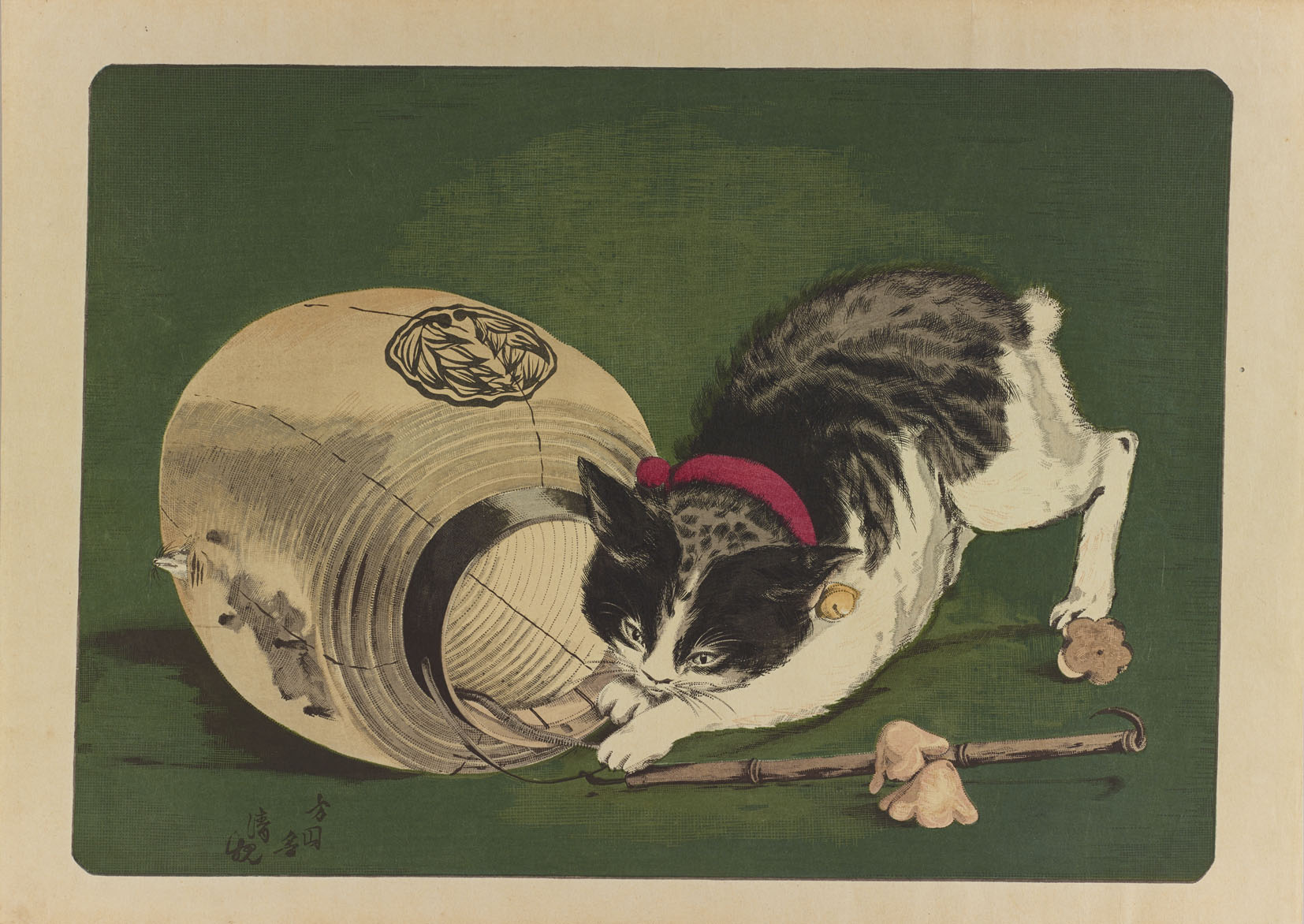
Cat & Lantern (1877) by Kiyochika Kobayashi

BACKGROUND: Issai Chozan’s Neko no Myōjutsu (“Eerie skills of the Cat”) was published in the book Inaka Sōji in 1727. It’s an example of dangibon, a light-hearted form of instructional short story, a form for which Issai Chozan is said to have been one of the originators. On the surface a story of rat-catching cats, in reality it’s a lesson in strategy and philosophy of combat.

SYNOPSIS: I’ll include citations and links below, so you can read the story in its entirety, should you choose to do so. But for now, a brief synopsis: A samurai, Shoken, has a rat in his house, and it’s driving him crazy. Shoken’s housecat is terrorized by the rat. The samurai brings in the best rat-catching cats from the neighborhood, and each is soundly defeated by the rat. Shoken decides to take matters into his own hands, chasing after the rat with a wooden sword (bokken,) but the rat evades each attempted strike and, ultimately, bites the samurai on the face. Finally, Shoken brings in a legendary elder cat from across the city, a cat who doesn’t look like much, but who effortlessly evicts the rat from Shoken’s house. The balance of the story is a conversation between the successful old cat and three of the skillful younger cats who’d failed to catch the rat (as well as with Shoken.) Each of the three explains its approach to achieving victory, and in turn the master cat explains the limitations of each one’s approach. The old master goes on to explain how when he was younger, he’d met a tomcat who slept all day, and yet no rat would come within miles of it. He asked how the tomcat achieved this, but the tomcat was unable to explain it.

THE LESSON: The first cat, a young black cat, explained that it was a master of technique. The black cat was agile and strong in movement of all kinds and practiced diligently to streamline and perfect all of its techniques. The old cat pointed out that focus on technique still left the black cat with too active a mind, thinking too much about how it would defeat its opponent. The master went on to say that there is value in technique, but it can’t be allowed to be the extent of one’s abilities. He emphasized that one’s clever actions must be in accord with the Way.

The second cat, a tabby, proudly proclaimed that all of its effort went into building its energy or spirit (ki, also called chi,) and that it could defeat most rats with a gaze (though not the one in question.) The old master explained that spirit is a fine thing but being too conscious of it hurt the second cat’s ability. The master went on to say that one can never be sure that the opponent won’t have more spirit than one, and so complete reliance on ki can lead one to a defeat.

The third cat, a gray one, said that its philosophy relied on yielding and never forcing a fight. The old master explained that this was a misunderstanding of the principle of harmony, and that this kind of yielding was a man-made contrivance that was not in accord with nature and often led to muddiness of the mind. While the old cat goes on to say that none of these elements (technique, ki energy, or yielding) is without value, it’s clear as he continues that the answer isn’t as simple as being a combination of them, but rather requires a completely new way of being, of experiencing and perceiving the world.

To Shoken, the old cat explained the importance of not thinking of swordsmanship as a means to defeat an enemy but, rather, a means of understanding life and death. The old cat went on to discuss mushin (i.e. “no mind,”) a serene state of mind that allows one to be flexible to whatever comes along. The old cat emphasized the importance of eliminating distinctions of object and subject through a process of self-realization and explained that the process of seeing into one’s being one can trigger satori (sudden enlightenment.)

CITATIONS:

Matheson Trust for Comparative Religion translation, available online at: https://terebess.hu/zen/neko.pdf

Ozawa, Hiroshi. 2005. The Cat’s Eerie Skill. Essence of Training in Japanese Culture: Technique Acquirement and Secret of Kendo. Online at: https://tenproxy.typepad.jp/recent_engagement/files/essence_of_training_in_japanese_culturee.pdf

Suzuki, D.T. 1959. The Swordsman and the Cat. Zen and Japanese Culture. New York: Pantheon Books. pp. 428-435

Wilson, William Scott. 2006. The Mysterious Technique of the Cat. The Demon’s Sermon on the Martial Arts. Tokyo: Kodansha International

Jo-Ha-Kyū [Free Verse]

Eye-to-Eye.

circling
&
jockeying for position,

playing with the distance
through subtle shifts,

then testing the distance,
engaging in exchanges

Thrust - Parry - Retreat - Repeat

moving faster,
the interval of exchanges 
ever shortening

then --
in one instant --

it's done.

BOOK REVIEW: Introducing Game Theory: A Graphic Guide by Ivan & Tuvana Pastine

Introducing Game Theory: A Graphic Guide (Introducing...)Introducing Game Theory: A Graphic Guide by Ivan Pastine
My rating: 5 of 5 stars

Amazon.in Page

This book is meant to provide a non-mathematical introduction to the basics of game theory, using examples that make the subject readily intuitively grasped. With this objective in mind, the book does a great job. Game Theory is an interdisciplinary subject that seeks to explain behavior in strategic games, a strategic game is one in which all players make decisions that can influence the outcome of the game. Let’s clarify, using a literal “game.” In chess, it’s meaningless to ask what the best move is without considering what the opponent has done and is likely to do – i.e. one’s best move must always take into account what the other player has done. This is in contrast to games of skill or chance (like a running race or roulette, respectively,) in which one doesn’t really need to respond / adapt to what the opponent has done (or will do) in order to win.

The reason I mention using an example that is literally a game is that Game Theory is used in a wide variety of domains, from military to business strategy, most of which don’t involve “games” in the common use of that word. The book draws from many disciplines, usually the ones where the concept at hand was initially developed – e.g. nuclear weapons strategy or marketing. While the book is a bit more heavily loaded with examples from the business world, it doesn’t ignore contributions from other sectors. Many of the games discussed will be familiar to the general reader at some level from the outset (e.g. the Prisoner’s Dilemma, Chicken, Battle of the Sexes, etc.) but one should finish reading with a better understanding of ideas like payoffs, equilibria, efficiency, sequential play (v simultaneous,) and coordination – all of which are crucial to applied strategic decision-making.

If you are interested in a starter book about strategic decision-making, this one is worth reading.

View all my reviews

BOOK REVIEW: Military Strategy: A Very Short Introduction by Antulio J. Echevarria II

Military Strategy: A Very Short Introduction (Very Short Introductions, #523)Military Strategy: A Very Short Introduction by Antulio J. Echevarria II
My rating: 5 of 5 stars

Amazon.in Page

This concise guide to military strategy is well-organized and can be readily understood by an amateur reader. The book provides an overview of the domain of military strategy by comparing and contrasting related pairs of strategic paradigms.

After an overview chapter (ch. 1) that broadly defines the subject and lays out the organization for the rest of the book, chapter two explores strategies of annihilation and how they are similar to and different from strategies of dislocation. Chapter three investigates attrition and exhaustion, strategies that deal in destroying warfighting resources and will to fight, respectively. Chapter four elucidates how the threat of force can be used to keep the enemy from making a move (deterrence,) or force them to make a desired move (coercion.) Chapter five looks at strategies that rely on instilling fear to change an opponent’s behavior, including aerial bombardment and terrorist tactics. Chapter six considers different approaches to using selective targeting to achieve strategic goals: i.e. decapitation and targeted killing. The penultimate chapter (ch. 7) contrasts the various approaches to cyber warfare with cyber-power, more generally.

The final chapter (ch. 8) briefly examines the determinants of success and failure of military strategy.

The book is straightforward and uses historical cases to provide clear examples of each type of strategy. It doesn’t go much beyond definition and some classic examples, but it is an excellent starting point for organizing one’s thoughts on the topic in preparation to learn more.

If you’re in need of a concise overview of (or refresher on) military strategy, this is a fine guide to consider.


View all my reviews

The Jujutsu Murders, Plus Some Brain Science

Jujutsu

Imagine you’re a detective in Edo Period Japan (1603-1868), and you’re told to investigate a case in which three highly-trained practitioners of one of the most well-respected jujutsu schools have been stabbed to death. Each of the three bodies has only one mark on it–the lethal stab wound. The wound is on the right side of the abdomen in all three cases. There are no signs of a prolonged struggle, despite the fact that each of the three had many years of training and none of the men was an easy victim. The stabbings happened independently, and there were no witnesses to any of the killings. So, who or what killed these three experts in jujutsu?


Nobody knows who killed them, but a rigid approach to training contributed to what killed them. As you may have guessed, the killer took advantage of knowledge of the school’s techniques, i.e. their “go-to” defense / counter-attack for a given attack. It’s believed that the attacker held his scabbard overhead in his right hand, and his weapon point forward in a subdued manner in his left. All three of the defenders must have instinctively responded to the feigned downward attack as the killer stabbed upward from below with the unseen blade.


It’s a true story. I read this account first in Jeffrey Mann’s When Buddhists Attack. That book offers insight into the question of what drew some of the world’s deadliest warriors (specifically, Japan’s samurai) to one of the world’s most pacifistic religions (i.e. Buddhism–specifically Zen Buddhism.)  Mann cites Trevor Leggett’s Zen and the Ways as the source of the story, and Leggett’s account is slightly more detailed.


This story intrigues because it turns the usual cautionary tale on its head. Normally, the moral of the story would be: “drill, drill, drill…”


Allow me to drop some brain science. First, there’s no time for the conscious mind to react to a surprise attack. The conscious mind may later believe it was instrumental, but that’s because it put together what happened after the fact and was ignorant of the subconscious actors involved. (If you’re interested in the science of the conscious mind’s stealing credit ex post facto [like a thieving co-worker], I refer you to David Eagleman’s Incognito.)  Second, our evolutionary hardwired response to surprise is extremely swift, but lacks the sophistication to deal with something as challenging as a premeditated attack by a scheming human. Our “fight or flight” mechanism (more properly, the “freeze, flight, fight, or fright” mechanism) can be outsmarted because it was designed to help us survive encounters with predatory animals who were themselves operating at an instinctual level. (If you’re interested in the science of how our fearful reactions sometimes lead us astray when we have to deal with more complex modern-day threats, I refer you to Jeff Wise’s Extreme Fear. Incidentally, if you’re like, “Dude, I don’t have time to read all these books about science and the martial arts, I just need one book on science as it pertains to martial arts,” I just so happen to be writing said book… but you’ll have to wait for it.)


So where do the two points of the preceding paragraph leave one?  They leave one with the traditional advice to train responses to a range of attacks into one’s body through intense repetition. Drill defenses and attacks over and over again until the action is habitual. This is what most martial artists spend most of their training effort doing. A martial art gives one a set of pre-established attacks or defenses, and it facilitates drilling them into one’s nervous system.


Of course, the astute reader will point out that the three jujutsu practitioners who were killed had done just what was suggested in the preceding paragraph, and not only didn’t it help them but–arguably–it got them killed. I should first point out that the story of the three murder victims shouldn’t be taken as a warning against drilling the fundamentals. As far as their training went, it served them well.  However, there’s a benefit to going beyond the kata approach to martial arts. One would like to be able to achieve a state of mind that once would have been called Zen mind, but–in keeping with our theme of modern science–we’ll call transient hypo-frontality, or just “the flow.” This state of mind is associated with heightened creativity at the speed of instinct. (If you’re interested in the science of how extreme athletes have used the flow to make great breakthroughs in their sports, I’d highly recommend Steven Kotler’s The Rise of Superman.) Practicing kata won’t help you in this domain, but I believe randori (free-form or sparring practice) can–if the approach is right.