BOOK REVIEW: The Science of Breath by Swami Rama et. al.

Science of BreathScience of Breath by Swami Rama
My rating: 4 of 5 stars

Amazon page


This is an oldie, but a goody. The first edition came out in 1979, but as its intent is to provide an overview of the anatomy and physiology of breath for yoga practitioners, the fact that it doesn’t access the bleeding edge of respiratory science isn’t all that detrimental.

This short book consists of four chapters. Two chapters are by the famous yogi Swami Rama, and the other two are written by medical doctors. The first chapter is an introduction to breath from the yogic perspective. It both explains why it’s so important to understand and work with breath and introduces the mythic physiology (prana, nadi, chakra, etc.) that has historically been used to explain pranayama (breath exercises.)

The second chapter is written by Dr. Alan Hymes and it explains the mechanics of respiration. While Chapter 2 focuses on the anatomy of breathing, it begins with an explanation of cellular respiration to introduce the role of breath in powering muscles. There is a fine explanation of the operation of the diaphragm and the intercostal muscles in breathing.

Chapter 3 is written by Dr. Rudolph Ballentine, and it delves into the role of the nose and nasal cavities in respiration. Breathing through the nose is emphasized in both yoga and many other systems of breath training (e.g. the Buteyko and Wim Hof methods.) This is because the nasal cavities perform many useful functions such as moisturizing and warming air, capturing pollutants, and extract heating and moisture from exhaled breath. Besides exploring nasal anatomy and physiology, Dr. Ballentine describes jala neti shatkarma (nasal cleansing with salt water) and nadi shoudhana (alternate nostril breathing.)

The final chapter, written by Swami Rama, mostly describes various techniques of pranayama (breathing exercises) and related practices bandhas and mudras (locks and seals in which bodily parts are contracted or constricted.) However, the chapter begins with a mix of physiology and mythic physiology. That is, it explains some topics not addressed earlier–such as the interaction between the nervous and the cardiovascular systems as well as chakra.

My standing complaint about books that weave together science and pseudo-science is mitigated a bit herein. My problem with putting these ideas together is that it can be difficult for the reader to determine what concepts reflect reality and which offer models to help one visualize energy. However, except for the last chapter, this book does a good job of keeping these ideas separate. The chapters by the medical doctors present the science with minimal intrusion of unscientific concepts. Swami Rama does present science and mythology together, but not so much scrambled together in a confusing mish-mash.

Chapters 2 through 4 use a number of graphics to help present the material. In the middle chapters these largely consist of line drawings to convey the relevant anatomical features or physical actions. The last chapter adds photographs to demonstrate relevant postures. There is a page of recommended readings, but it’s more of an advertisement for other books put out by the Himalayan Institute than the recommendation of books on the science of breath.

I found this book to be educational. It packs a lot of useful information into a concise package and is readable to a layman. I’d recommend it for yoga practitioners and others who are engaged in breath work.

View all my reviews

BOOK REVIEW: Head in the Game by Brandon Sneed

Head in the Game: The Mental Engineering of the World's Greatest AthletesHead in the Game: The Mental Engineering of the World’s Greatest Athletes by Brandon Sneed
My rating: 5 of 5 stars

Amazon page


There are many factors that influence whether an athlete can reach an elite level. Physical factors such as VO2 max (maximum oxygen consumption) and musculature have long been at the fore in the minds of coaches and trainers, but they’ve never told the full story. There are athletes who have the muscles, lungs, and general physiology to dominate their sports who fall apart under pressure. One also sees the occasional athlete who is consistently good even though he seems puny by comparison to his peers. It used to be that mental performance was considered an endowed X-factor–you either had it or you didn’t. Coaches didn’t know how to coach for issues of the mind and often exacerbated problems with old school attitudes and approaches.

We’ve now entered a new era in which a bevy of techniques and technologies are being exploited to strengthen the mind and improve psychological deficiencies, just as gyms have always been used to build the body and combat physical deficiencies. These range from techniques of meditation and visualization that have been known to yogis and Buddhists for centuries to advanced technologies that have only become available in recent decades and which are constantly improving and being made obsolete. Sneed examines the gamut of these approaches as they are applied to improving performance in sports: from the meditative or therapeutic to the electronic or pharmacological. One no longer need give up on athletes who are great at their best, but who get the yips at the worst possible times. The performance of mediocre athletes can be improved and that of the best can be made more consistent.

Sneed has a unique qualification to write this book. He counts himself among the athletes who couldn’t reach his potential because of inconsistency rooted in psychological challenges. His willingness to be forthright about his own problems makes the book more engaging. His own stories are thrown into the mix with those of athletes from football, basketball, soccer, baseball, adventure sports, and mixed martial arts (MMA.)

The book’s 19 chapters are divided among four parts. The first part lays the groundwork, helping the reader understand the rudiments of how the brain works, doesn’t work, or works too hard for a competitor’s own good. A central theme is that the ability to analyze and train through the lens of neuroscience has removed some of the stigma that has always been attached to psychological issues in sports (not to mention the days when they were written off as weakness.) Much of the six chapters of Part I deal with assessment of the athlete’s baseline mental performance. The last chapter (Ch. 6) covers a range of topics that have been around a long time as they’ve been reevaluated through modern scientific research. These include religion, faith, superstition, meditation, visualization, and the immortal question of whether sex is good or bad for athletic performance.

The second part consists of five chapters taking on one fundamental truth: mind and body are not two disparate and independent entities. This section starts at the most logical point: breath. Practitioners of yoga (i.e. pranayama) and chi gong have known for centuries that breath can be used to influence one’s emotional state and level of mental clarity. Sneed evaluates the technology that is being used to help athletes master the same age-old lessons. Having laid the groundwork through breath, the section advances into biofeedback technology. There are two chapters in the book that deal with pharmacological approaches. One is in this section and it deals with legal (at least in some locales) substances such as caffeine, alcohol, nicotine, nootropics (alleged mind enhancing drugs), and marijuana. (The other is in the final part and it deals with hallucinogens.) There are also a couple of chapters on technologies used to produce or enhance desired mental states.

For most readers, the third part will be seen as the heart of the book. Having considered how to evaluate an athlete’s mental performance (Part I) and how to influence mind states by way of the body (Part II), this part explores the range of technologies that are used to exercise the mind in a manner analogous to working out the body. These technologies focus on a range of areas including improving the nervous system’s ability to take in information, process that information, and respond appropriately. Much of this part focuses on video games; albeit video games using state of the art virtual reality and which are customized to improvement of athletic performance. Some of the games are used to train general cognitive performance (e.g. Ch. 13) but others are specifically tailored to the game in question (i.e. Ch. 14.) Just as simulators are used in aviation, part of the advantage of these games is the ability to put players in progressively more challenging conditions.

The last part of the book was the most interesting to me, personally. [It’s also the part of the book that will be the most relevant and readable a few years down the road because it’s not as modern technology-centric as most of the book—especially Part III–is.] It’s entitled “The Spirit” and it explores X-factors to performance, but sans the assumption that these are endowments, but rather under the assumption they are trainable. The part has an important introduction that presents the research about how “soft” factors like gratitude play into outlook and performance. Then there are the Part’s three chapters. The first describes an experiment involving taking elite athletes into physically arduous conditions of the kind normally experienced by military special operations forces in survival training. The second tells the story of MMA fighter Kyle Kingsbury’s use of hallucinogenic substances (most intriguingly, ayahuasca, a powerful drug long used by Peruvian shamans.) Finally, the last chapter deals with sensory deprivation—a technology some will associate with the movie “Altered States” but which many athletes swear by.

The book has an extensive section on notations and sources organized by chapter. There are no graphics.

I enjoyed this book and found it to be informative. There are a number of books that explore the techniques and technologies of optimal mental performance, but this one develops a niche by focusing on the realm of sports and some of the technologies that are only available with the kind of deep-pockets seen in professional sports. The book is heavily weighted toward the technology part of the equation, which is both good and bad. If you’re reading it now (2017), it’s great because you’re getting an up-to-date discussion of the subject from the perspective of entities that are awash in money for tech. The downside is that this book won’t age well, at least not as well as it would if there was more emphasis on approaches that aren’t based on cutting-edge technology.

I’d recommend this book if you are interested in optimal human performance, and if you have an interest in sports, all the better.

View all my reviews

POEM: Neurochemical Grace

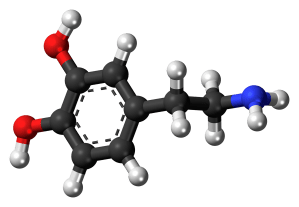
Dopamine Model; Source: Wikipedia


I’m grateful for the ability to be grateful.

For gratefulness causes dopamine and serotonin levels to rise.


I’m grateful for the fine people in my life.

For delightful company causes oxytocin and vasopressin spikes.


I’m grateful for my health.

[Or am I healthy because I’m grateful?]

For gratitude correlates to superior health across several indicators.*


I’m grateful for my food,

which is well-balanced to provide the brain glucose,

while offering all the

vitamins, minerals, and amino acids

my neurochemistry needs.**


*Sansone, R.A. and Sansone, L.A.2010. Gratitude and Well Being. Psychiatry. 7(11): 18-22.

**Gibson, G.E. and Blass, J.P.1999. “Nutritional and Functional Neurochemistry.” Basic Neurochemistry: Molecular, Cellular, and Medical Aspects, 6th ed. NCBI: Bathesda, MD.

BOOK REVIEW: Mastermind by Maria Konnikova

Mastermind: How to Think Like Sherlock HolmesMastermind: How to Think Like Sherlock Holmes by Maria Konnikova
My rating: 4 of 5 stars

Amazon page


This is a book about how to be more observant while avoiding the pitfalls of drawing faulty conclusions based on unsound reasoning, tainted memory, or faulty assumptions. Examples from the canon of Sherlock Holmes (i.e. the 4 novels and 56 short stories written by Sir Arthur Conan Doyle) are prevalent throughout the book, but Konnikova also discusses Doyle’s limited real life investigations as well as those of the men who influenced the writer. Doyle lived at time when science and reason were making great strides in overcoming superstitious and spurious ways of thinking, and so the Sherlock Holmes works were cutting edge for their time.

The book is neatly organized into four parts with two chapters each. The first part is entitled “Understanding Yourself” and it unpacks what we have to work with in the human brain. One learns how one’s brain works and how it sometimes leads one astray. It also introduces how the scientific method can provide a framework to harness the brain’s strengths and avoid the hazards of its weaknesses.

Part II investigates how one can become more skilled at investigation, as well as the role played by creativity and imagination. We learn how our attention is much more limited than we feel it to be.

The third part reflects upon the building one’s powers of reasoning as well as the importance of knowledge-building in the process. Konnikova describes “deductive reasoning” using Holmes’s favorite term. [She doesn’t really get into the whole muddle of—as many have pointed out—the fact that Holmes more often uses induction than deduction, i.e. going from very specific observations to draw broader conclusions.] The second chapter considers the importance of being knowledgeable and broadly educated. Holmes’s conclusions often hinge on fairly arcane knowledge about a range of issues: animal, vegetable, and mineral. However, a large part of the discussion is about the idea of degree of confidence. It’s also pointed out that knowledge can be double-edged sword—an impediment as well as a tool. Extraneous knowledge may lead one down the wrong path.

The final part suitably closes the book with one chapter on practical advice for how to put all of the knowledge discussed in the book to work and another on the recognition that even the best minds can go astray. The first chapter summarizes as it offers pragmatic advice. The second of these chapters discusses a fascinating investigation of a supernatural phenomenon (i.e. the existence of fairies from photographic evidence) upon which even Sir Arthur Conan Doyle’s mind led him astray.

The use of the Sherlock Holmes character is beneficial as many readers have consumed the entire Holmsian canon, or will do so, because it’s short and readable even today. Even those who haven’t read it will at least be familiar with the lead character and his proclivities as well as the other essential characters, such as Dr. Watson, Professor Moriarty, and Irene Adler. There are too many television shows, movies, and pop culture references to not be aware of these characters. One needn’t have read all Doyle’s Holmes to benefit, as Konnikova offers the essential background. However, one might find it a bit more intriguing if one has read the canon. At the end of each chapter, Konnikova offers a set of references that point to the sections in the Sherlock Holmes canon relating to that chapter’s discussion. Konnikova uses quotes and stories that aren’t attributable to Doyle to good effect throughout this book as well.

Graphics are used sparsely and only as absolutely necessary. There is a “Further Reading” section at the end of the book in addition to the end of chapter pointers. Besides a list of the Sherlock Holmes books, there are chapter-by-chapter prose suggestions of relevant key readings.

I found this book interesting and informative. While it may be most useful for someone who wants to become more attentive, less prone to biases, and more effective in drawing conclusions, it could also be enjoyed by Sherlock Holmes fans as a way to drill down into stories a bit further.

View all my reviews

BOOK REVIEW: Stealing Fire by Steven Kotler and Jamie Wheal

Stealing Fire: How Silicon Valley, the Navy SEALs, and Maverick Scientists Are Revolutionizing the Way We Live and WorkStealing Fire: How Silicon Valley, the Navy SEALs, and Maverick Scientists Are Revolutionizing the Way We Live and Work by Steven Kotler
My rating: 5 of 5 stars

Amazon page


“Altered states of consciousness” conjures visions of rogue scientists hitting hallucinogens and then sealing themselves up in sensory deprivation tanks until they either have a breakthrough or a breakdown. This book may touch on such activities, but it’s about something else. It’s about the states of consciousness in which the part of the mind that is critical, overly cautious, and always creating worst case scenarios fades into the background, allowing one to be more effective, happier, and to drop one’s neurotic tendencies. Kotler and Wheal refer to this as ecstasis, borrowing from the Greek word meaning “to get outside oneself.” They differentiate it from the Flow of Mihaly Csikszentmihalyi with which it clearly has overlap. (One of the authors, Kotler, wrote a great book on the exploitation of Flow by extreme athletes entitled “The Rise of Superman.”) [I’d love to see a Venn diagram of how they see these states overlapping, but—alas—one isn’t provided, though there is some discussion of it.]


The book is organized into three parts. The first part consists of three chapters and it both explores what ecstasis is and why it’s so hard to find. The story of how the Navy SEALs designs training to build group Flow states on command is illuminating as is the second chapter’s discussion of how Jason Silva found ecstasis through freewheeling philosophizing. The third of the chapters describes three prominent barriers to achieving these states of mind. These barriers are among the reasons for the rarity of these altered states even though they’re available to everyone.


The heart of the book is the second part which describes four avenues by which people pursue these altered states of consciousness: psychology, neurobiology, pharmacology, and technology. The chapter on psychology uses a dialogue series between Oprah and Eckhart Tolle as a stepping off point, probably more because of what it tells us about the scale of yearning for ways to get outside of one’s head than because of the dialogues’ value in facilitating that condition. Positive psychology as recipient of a mantle once held by religion and spiritualism is an important theme in this chapter.


The neurobiology chapter isn’t just about the biology of the brain and nervous system; it’s about the integration of brain and body. In it, we learn about how expressions, postures, and gestures can influence our state of mind.


Many apparently believe that the story of pharmacology is a much bigger part of this book than it actually is, but it’s a part that’s hard to ignore. As one who seeks non-pharmacological approaches to Flow (I’m more about yoga, meditation, and movement) I still found this chapter fascinating, and perhaps most so in its discussion of other species’ pursuit of chemically induced highs [particularly that of dolphins.]


The technology discussed covers a range of approaches from biofeedback devices designed to help one navigate one’s way into the zone, to gear to help one engage in trigger activities at lower risk. For example, the mix of defiance of gravity and high-speed gliding experienced wing-suiting seems to be a potent trigger for ecstasis. It also seems to kill anyone who keeps doing it long enough. So the question is whether one can create the sensation and still achieve the trigger without inevitably experiencing an untimely demise.


The grimness of that last paragraph is an apropos lead-in to discussion of the book’s final part, which considers how one can organize one’s pursuit of ecstasis without running into the many pitfalls that coexist with it—from becoming a pleasure junky to dropping out of life to killing oneself. The first of three chapters in the final part discusses the Burning Man festival phenomena in great detail as well as other avenues by which people find themselves drawn into the pursuit of altered consciousness. The next chapter describes how both government and commercial firms have sought to exploit the bliss of these altered states. The last chapter is about how to merge daily life and pursuit of ecstasis in a balanced way so one avoids becoming a pleasure junky who runs his life aground on rocky shoals in pursuit of the next ecstasis fix.


The book is endnoted, and has some nice ancillary features—a number of which are available online with the link being given at the back of the book. An appendix that I found interesting was one entitled “Notes on Inside Baseball.” This section discussed a number of controversies that were outside the scope of the book, but which readers might wish to research in greater detail.


I found this book to be highly engaging. The authors use the narrative approach throughout to keep it interesting, while at the same time conveying complex ideas in an approachable fashion. They scour many disparate realms in search of this altered consciousness, and so there’s never a dull moment.


I’d recommend this book for anyone interested in learning more about how to shut down that perpetually critical and gloomy part of the brain so that one can achieve one’s optimal potential.

View all my reviews

BOOK REVIEW: The Man Who Wasn’t There by Anil Ananthaswamy

The Man Who Wasn't There: Investigations into the Strange New Science of the SelfThe Man Who Wasn’t There: Investigations into the Strange New Science of the Self by Anil Ananthaswamy
My rating: 5 of 5 stars

Amazon page


What is the self, and is the self a distinct entity as we feel it to be? Those are questions that philosophers and theologians have been debating for centuries, and they’re the questions at the heart of this book. Ananthaswamy takes a crack at answering by looking at several of the ailments and mental phenomena that seem to steal or morph what we think of as the self.


While there are many distinct views on the self, the predominant view has always been the one guided by the way it feels. And it feels like there is some non-material entity—call it a soul, a spirit, a consciousness—that resides in the body though is–in certain extraordinary circumstances–detachable from the body (e.g. death.) This gave rise to a widespread belief that while our physical bodies may have a shelf-life, this non-material bit is eternal—or at least not governed by physical laws.


However, as science has illuminated the workings of the brain, it looks more and more as though this “non-material entity” is, in fact, an emergent property or illusion that derives from the activity of our material brain / nervous system. One of the phenomena that a materialist explanation would have once had great difficulty in explaining is the out-of-body experience [OBE.] Historically some may have written these off as fraud, but the cases are common enough and described similarly enough that that strains credulity. However, we now have strong reason to believe that the OBE is a specific kind of hallucination, and that reason is that OBEs can now be consistently induced by neuroscientists applying an electrode to a specific point on the brain. As for the old schools of thought, it seems that the Buddhists were by far the closest when they suggested that there is no self—that it’s illusory.


Ananthaswamy’s book consists of eight chapters. Each of the chapters addresses a particular ailment or phenomena of the mind that has something to tell us about what the self is and what it isn’t. If a specific injury, ailment, or consumption of a chemical cocktail makes one feel as though one has lost part of what it feels like to be a person—then we may get some idea where the self resides or where the series of neural activities that feels like a self resides. (Spoiler: There is no single spot in the brain where the self or sense of self resides.)


The first chapter gets straight to the heart of the matter by describing Cotard’s syndrome, a disease in which a person swears that he or she doesn’t exist or is dead. This affliction seems to attack the most fundamental sense of self—the gut feeling that one is a distinct living being. Another way that we think of ourselves as that distinct living being is through our life story. Chapter two looks at how diseases like Alzheimer’s shatter this sense of self-hood.


Another basic level at which we feel the self is in its correspondence to the confines of our body. However, not even this physically rooted approach to self is unassailable. One may be familiar with cases of phantom limb syndrome in which amputees feel a lost limb. Incidentally, this is another reason people have felt there was a soul—one that didn’t know the body was amputated and kept its original non-material shape, an idea that V.S. Ramachandran’s work showed was likely not the case. Ananthaswamy, however, focuses on an ailment that is the exact opposite of phantom limb syndrome, those who feel that one or more of their limbs are foreign entities. This is where the book’s reporting is at its most intriguing as the author manages to speak with a doctor who does amputations for such people at no small risk to his medical credentials.


In chapter two, the author investigated the self as a collection of memories—in other words, the things one has done. Chapter 4 explores people who don’t feel a connection between the actions they are performing and the self even as they are performing said actions. The cases discussed involve patients with schizophrenia.


Chapter five examines depersonalization syndrome. With this syndrome, there’s an emotional disconnect which people feel as being in a dream, but during the patients waking life. The chapter focuses on two cases which give different means by which this can occur. One was an individual who was abused as a child, and the ailment seems to have been a defense mechanism to disconnect from the trauma. The other was chemically induced—though, disconcertingly, the effects went on long after all of the drugs should have been out of the woman’s system. Chapter six explores another set of afflictions involving stunted emotional response, and those are the autistic syndromes. The principle case involves a high functioning Asperger who was intelligent enough to learn how to respond even though he had no emotional cues. A quote from that individual that sums up his experience of the world nicely is, “I love my sister, but it’s done purely at a cognitive level. I think love for her; I don’t feel love for her.”


The penultimate chapter is where the author describes case of OBE and other hallucinations in which the self seems to migrate, split, or wander. The final chapter continues examining the self free of the body by considering cases of epilepsy. Epilepsy can have many powerful mental effects. One may be familiar with the many cases of “spiritual awakening” that have been attributed to temporal lobe epilepsy. And some have speculated that Joan of Arc, St. Paul of Tarsus, and Mohammed all suffered from epilepsy. Ananthaswamy also presents cases of people on psychedelics—most famously Aldous Huxley.


There’s an epilogue that both tells us what the Buddha had to say about self during his first sermon at Sarnath, and sums up what’s been learned about what the self isn’t and what it seems to be. The book is annotated, but there are no graphics or other ancillary matter. It’s really not needed as the focus throughout is narrative, the telling of fascinating cases that illuminate the experience of the self. I appreciate that the author went out and sought some unique cases. I read a fair number of pop neuroscience books, and there are a few cases that get rehashed ad infinitum (Phineas Gage, H.M. etc.) It’s not that Ananthaswamy doesn’t go retell a few of the classics, but he also does some original investigation. The chapters on depersonalization disorder and amputation show this distinct touch.


I’d highly recommend this book for those who want insight into the nature of the self from a scientific perspective. I’ve read many books that touch upon the subject as part of a broader theme, but this is the first I’ve read that focuses entirely on this subject from a scientific rather than philosophical or spiritual perspective.

View all my reviews

BOOK REVIEW: Incognito by David Eagleman

IncognitoIncognito by David Eagleman
My rating: 4 of 5 stars

Amazon page


This is the book that started me on a fascination with the science of the subconscious mind. In it, Eagleman explains that our subconscious mind has a much bigger role than our consciousness lets us believe. We feel that the conscious mind is in charge of the whole enchilada of our mental being, but in reality the conscious is often late to the party while still managing to weave a narrative about how it saved the day. The conscious has an important role, but one much more limited than it seems, but because consciousness Is the frame through which we are aware the world, it’s easy to miss how much the subconscious handles.


The book is organized into seven chapters. The first chapter sets up the notion that the mind is like an iceberg, the subconscious is the more massive portion that lies below the waterline, and the conscious is the peak that lies above.


The second chapter explores the interface of the senses and the mind. We think that our sensory experience of the world is like looking through a spyglass, but it’s much more a secondary rendering—subject to editing and corruption. Eagleman discusses many illusions that serve to show us that our sensory experience is not as true as we feel it to be.


Chapter three investigates why it is that in some cases the more we think about a task the worse we do with it, and how biases show up even among those who swear they don’t have a racist notion in their body. A number of interesting cases, such as chicken sexing, are used to convey where our conscious mind is of no use to us. Anyone who’s practiced a martial art is aware that sometimes thinking is death.


The fourth chapter explains concepts like instinct and our perception of beauty and attractiveness. It’s entitled, “The Kind of Thoughts That Are Thinkable,” and that gives some insight into the theme.


The next chapter covers one of the most important ideas of the book, that our brains are not all on one page on any given idea. This is one thing that our conscious mind dupes us into believing, that we have a certain belief and that we are uniformly of that view. In fact, our reasoning and emotional systems often have quite different perspectives on a matter. As I mentioned earlier the people who think they don’t have a racist notion in their body. In one sense, they are correct in that they can reason that it’s illogical to think of people differently based on skin color, but such a person still often shows a marked bias when asked to make associations that are made more quickly when they are not at odds for the subconscious.


Chapter 6 gets into the policy ramifications of what has been discussed to this point. If decisions aren’t a product of the conscious mind, then are we right to send people to prison for crimes that they didn’t consciously decide to commit and couldn’t have consciously overruled? The case of Charles Whitman who took up a sniper position in the University of Texas clock tower in 1966 takes center stage in this discussion. Whitman suffered a great change of behavior that was posthumously (by autopsy) linked to the development of a tumor. Eagleman proposes that the traditional question of blameworthiness is the wrong one.


The last chapter reflects upon what it means to be a human person in light of a mind arising from material activity. A central idea is the self as an emergent property rather than the “thing” we feel it to be.


The book presents many monochrome graphics of various types to support the text. It’s also annotated and has a substantial bibliographic section.


I’d recommend this book for anyone interested the nature of the subconscious mind. Eagleman uses interesting cases to demonstrate his points. This makes it quite readable while conveying some challenging ideas.

View all my reviews

5 Ways to Manage Your Email & Social Media Addiction

Addiction? That seems harsh. It feels like I’m equating a person who has his phone in hand several times every hour with a heroin junky or a nymphomaniac. But, the difference is in the word “Manage.” I wouldn’t write a post entitled “How to Manage your Heroin Addition.” I’d write one called, “Quit that Shit Before it Kills You.”  I’m not suggesting that one needs to do away with checking email and social media. These are great tools that allow us to be much more productive (potentially.)


Still, if we’re honest about it, most of us at some point get caught up in the compulsive checking of emails, social media, internet feeds, click-bait sites, sale pages for online retailers, and stats pages. There’s no denying it. A pile of evidence has accumulated about the extent to which people are dismayed by their own e-world activities. I just started reading Kotler and Wheal’s “Stealing Fire” (out February 21, 2017) and they site a study that found that about 2/3rds of those surveyed admitted checking their status page when they woke up in the middle of the night. It might seem off topic for book about altered states of consciousness to report on such matters, but its not because it’s all about the pursuit of a neurochemical bump. (Also, as I’ll discuss, a major problem of this addiction is in keeping one from slipping into the Flow with one’s work, family, or hobby activities.)


So, below are five methods I’ve found useful in my own on-going struggle with this addiction.


5.) Set a timer:  The problem with this addiction is that when one falls into habitually checking one’s status, one isn’t able to stay on task, and that means that one won’t achieve that elusive state of optimal performance called Flow. One needs time to immerse oneself in a task.


When I’m writing and editing, I set a timer, and until it beeps I do nothing off topic. I don’t make it some Herculean effort. I use 60 and 90 minute intervals. After the alarm rings, I can check email, do Tai Chi, get a cup of coffee, or work on my handstands. A longer time period may be more–or less–beneficial for you. (Isaac Asimov was said to only take a break after 5,000 words, but few writers have that in them.) The point is to make it long enough that one can get into a focused state of mind, but not so long that you become distracted and run down.


4.) Know your high energy period: This point relates to the last because it’s about blocking one’s productive time, and putting the more Flow-demanding activities when one is at one’s best. e.g. Are you a lark or an owl? (i.e. morning person or evening person.)


For example, I’m a morning person. This creates a potential problem. While I find it easy to get up with the sun, I’m at risk of saying, “Oh, I’ll just check emails, Facebook, my blog stats, a couple YouTube channels, and then I’ll get to work.” Then it’s noon, and the hours in which my mind was at its very best are gone. From 7pm until I go to sleep is when I should check these feeds because by that time my mind isn’t good for editing or writing tasks that require a high level of attention to detail.


3.) Go Cold Turkey [for a few days]: Sometimes it’s easier to make changes when one is forced by circumstance to quit. Then one can be more conscientious in resumption of the activity in question. (Moving to India helped me break a lot of bad habits.) If nothing else, this will help to give you confidence that the Earth won’t roll off it’s axis just because you aren’t checking on it twice an hour.


I can offer two examples from my own life. Every year my wife and I go on an extended trek in a place where there are no bars and saving batteries is essential. The past couple years, this has been in the Himalayas because we’ve been living in India, but anywhere remote will work. I also did the Vipassana Meditation Course last year. (If you’re interested in the latter, you can read my account of it here.)

img_1397


2.) Meditate: Why? Because when you start meditating regularly, you tend to do less and less out of mindless habit. You become conscious of what you’re doing, and that’s the first step to making changes. You also start to become attuned to those very subtle dopamine bumps, and in that way you  aren’t fighting it the impulse blindly. The high of the click is infinitesimally more subtle than taking mind altering substances, and so it’s easy for this all to take place below the waterline (analogizing the mind to an iceberg but instead of the majority of the mass of ice below the waterline, it’s the conscious mind above and the subconscious below.)

img_1556


1.) Substitute: In the immortal word of the rock band “The Who.” If your problem is so extensive that it does more than block your attempts to hit the Flow, you may need to find a healthier alternative to wean yourself away.


What does one look for in a substitute? If it’s going to fill the same space, it requires immediate feedback and a mix of “fails” mixed in with “successes.” These are the components that make the e-world so addictive. We know immediately whether we got something or not, and that keeps us clicking–not unlike the famous rats that would keep pressing a button for pleasure even to the point of forgetting to eat.


Some people may work on games that will help build their brain. (Warning: just don’t trade one unproductive addiction for another.) I’m an advocate of working on physical activities (e.g. trying to develop new capabilities in calisthenics or yoga), but these often involve a demoralizing amount of fails to reach the optimal level (the optimal being that one has enough fails to keep it from being boring but not so many that one is brutalized.)

5 Books to Introduce You to Your Subconscious

In a world free of frontiers, the subconscious mind is the final frontier.


Below are a few books that I found useful. The hyperlinks forward to my review on GoodReads or the book’s GoodReads page.


Also, I’ve included three honorable mention books that I haven’t yet reviewed, but which seem both relevant and intriguing.


5.) Brainwashing by Kathleen Taylor: What makes some minds more malleable than others and how are minds bent to a given purpose? In learning the answers, one discovers that the bases of our beliefs are often more deep-seated than one might believe.

brainwashing_taylor


4.) Sleights of Mind by Macknik & Martinez-Conde: Magicians and mentalists are notoriously skilled at exploiting the chinks in the armor of  our minds.

sleights_of_mind


3.) Subliminal by Leonard Mlodinow: Physicist and pop science writer, Leonard Mlodinow, explores the many ways in which our behavior is more influenced from the back of the house than we feel to be the case.

subliminal


2.) The Tibetan Yogas of Dream and Sleep by Tenzin Wangyal Rinpoche: This is my nod to the fact that the Western scientific community isn’t the only entity that has something useful to say on this subject. Tibetan Buddhists have a long tradition (arguably predating Buddhism and into the Bon-era) of dream yoga (lucid dreaming) and our dreams offer the greatest portal to the subconscious.

tibetanyogas


1.) Incognito by David Eagleman: Eagleman tells us that our conscious mind represents the tip of the mental iceberg, and he explores the many ways in which we are subject to the vagaries of what exists below the surface.

incognito_eagleman


Here are a few others.


The Man Who Wasn’t There by Anil Ananthaswamy: I just finished this book. In it, the author investigates whether there really is  such a thing as the self by studying a number of diseases and phenomena of the mind that look like negations of self. (e.g. Cotard’s Syndrome in which people insist they are dead, depersonalization disorder in which life seems a dream in a literal rather than poetic sense, out-of-body-experiences in which there is a hallucination that one is outside one’s body, etc.)


The Attention Merchants  by Tim Wu: I haven’t read this one yet, but it’s said to be good and is about how our programming is exploited to keep us clicking. If you’ve ever wondered why you can’t seem to just drop social media even when it seems like a phenomenal waste of time–why it exerts such a strong pull–this book delves into what proclivities of the mind have been seized upon.


Reality is Broken by Jane McGonigal: I’m about 1/3rd of the way through this one. It has some overlap with the Wu book. In it, McGonigal asks why games have so much appeal–even to the extent of becoming addictive. As with why we keep clicking, the answer has a lot more to do with the primitive parts of our mind than the high tech subject matter might suggest.

BOOK REVIEW: The Hidden Life of Trees by Peter Wohlleben

The Hidden Life of Trees: What They Feel, How They Communicate—Discoveries from A Secret WorldThe Hidden Life of Trees: What They Feel, How They Communicate—Discoveries from A Secret World by Peter Wohlleben
My rating: 5 of 5 stars

Amazon page


I picked up this book because it was on one of those “Best Science Books of 2016” lists, and it turned out to be the most important book I read last year. Like most of humanity, I’ve been guilty of thinking about trees largely as objects. Don’t get me wrong. Like others, I never forgot the basics of biology and always remembered that trees are alive because they grow, reproduce, and whatnot. I’ve also never failed to realize that without trees to suck up carbon dioxide and exude oxygen, we couldn’t exist—though I’ve probably not been sufficiently grateful. Still, because of the molasses-like time flow of trees, their immobility, and the fact that many can live for decades after someone chainsaws off a limb, it’s possible to feel they have more akin with rocks than with we members of the animal kingdom. (Note: trees don’t always respond as well as people think to random “trimmings.” As will be a recurring theme, our misunderstanding of this has a lot to do with time perception. If your dog’s head was in the way of the TV screen, and you cut it off with a chainsaw. You’d immediately realize that you’re a homicidal maniac and an idiot because the dog would be dead right then and there. When there’s a branch in front of your window and you hack it down, the tree may stay green for a couple of years [a blink on its time scale] and by the time it dies you’ll have completely forgotten that it was your action that lead to its demise.)

The author, Peter Wohlleben is a German forester, and this book was originally released in German before being translated to English (as well as other foreign languages.)

Wohlleben systematically dismantles the barriers between trees and us by showing the many ways in which they’re more like us than we could possibly fathom at a mere glance. The subtitle’s dual question of “What They Feel, How the Communicate” reflects just a couple of aspects of how trees are more like us than we realize. There are also chapters that investigate how trees share from strongest to weakest, and how the tough love parenting strategy of trees produces robust offspring. (Experience of time may be the way in which humans have the most trouble relating to trees. We believe there is benefit in virtually everything coming to us faster, whereas trees benefit greatly from growing slowly. Slow growth makes for sturdier trees.)

Moving back to that question of communication, one may be dubious that trees communicate because we can neither hear them nor see their gestures. But not only do trees communicate with other trees, some species communicate with members of the animal kingdom as when a tree under attack from insects releases a scent that attracts birds that feed on the attacking insects.

Wohlleben does a great thing by showing us how trees should be more relatable to us than we imagined. However, the lesson needn’t stop there. One might also take away a broader lesson that we shouldn’t assume that our frame of reference maps to the sum of reality. That maybe we should have sufficient humility to recognize the impressive intelligences of species we view too simplistically. There have been a number of books that have come out in recent years that have noted the ways in which monkeys, ravens, owls, and even octopi are much more astute than we give them credit for. Seeing this extended to the plant kingdom takes the discovery to a new level of mind-blowingness.

This book consists of 36 short chapters, each of which deals with a specific topic of interest (e.g. forest etiquette, social interdependence, climate effects, hibernation, illness, and how trees survive under challenging conditions—droughts, introduction of competitors, etc.) There are a few graphics throughout the book, mostly line drawings of trees with the species identified. The book does have notes. However, it’s really set up more like a book of short essays by a naturalist than it is your usual work of popular science.

I’d highly recommend this book for anyone who breathes oxygen.

View all my reviews